

What is the most dependable way to approach powering tools on a remote worksite? Start with the tools, not the generator. When a grid connection is unavailable or impractical, your crew needs a supply that suits the equipment and work schedule. A mismatch can leave essential tools waiting or create a setup that is harder to deploy than the job requires.
Choosing a power source takes more than estimating the worksite’s size. Tools have different electrical requirements, tasks may overlap, and access, layout and weather can affect where equipment can be placed. A short task may need a different arrangement from a longer project, while a moving work area changes where power needs to be available. Assessing these factors gives you a practical basis for comparing options and planning around disruption.
This guide explains how to assess equipment loads, map operating patterns and compare grid connection, portable off-grid solar and standalone systems. It also covers deployment and safety planning for Australian worksites, including regional Victorian projects. Use the steps to create a power plan based on your crew’s actual tasks and keep essential equipment ready where the work takes place.
Key Takeaways
- Plan powering tools on a remote worksite around the equipment your crew uses and when it runs, rather than choosing a system by capacity alone.
- List each tool’s rating, map operating patterns and identify which equipment may run at the same time to estimate demand.
- Compare grid access, a Portable off-grid solar generator and other suitable options against the worksite’s duration, mobility needs and expected load.
- Plan equipment placement, cable routes, weather protection and access before work begins to support safe, orderly operation.
- A tailored solar system design service can align an off-grid power concept with site conditions, tool loads and operating needs.
Why powering tools on a remote worksite needs a plan
When a grid connection is unavailable or impractical, tools still need a dependable source of power at the point of work. An interruption can stop a task midway, delay the next trade or leave equipment unavailable when the crew needs it. If workers have to move tools or equipment across a large site to reach power, that can also disrupt access and work sequencing.
Plan around the job rather than a generic estimate of site demand. Identify which tools the crew will use, how many hours they’ll operate, where work will take place and how equipment can reach the site. This helps distinguish a temporary setup for a short task from an off-grid system for ongoing operation. Off-the-grid systems operate independently of the main electricity network, but the right arrangement for a worksite depends on its loads and conditions.
Temporary work may call for a mobile power source that can move as the work area changes. A permanent or long-term site has different needs, including a planned supply for regular use and changing demand. Treating both as the same problem can result in a system that is awkward to deploy or poorly matched to the work. A site-specific assessment makes the options easier to compare.
Which worksite conditions change your power requirements?
Start with site access and layout. A remote location may be difficult to reach with bulky equipment, while a spread-out work area can mean longer cable routes or a need to position power close to separate tasks. Check how much suitable space is available for power equipment and whether the work location or site layout will change during the job.
Project duration matters too. A short task, a multi-day project and an ongoing operation have different operating patterns and deployment needs. Regional Victorian sites can also have varied access and weather conditions, so consider how these may affect equipment placement and day-to-day use. Record the conditions rather than assuming the same setup will suit every location.
Which tools need power first?
Build an inventory before estimating demand. Include essential tools, battery chargers and supporting equipment, then note when each item is needed and for how long. Separate equipment that must remain available from tools that can be used at different times. This shows which loads are critical and where an interruption would affect work most.
Next, identify which items may run at the same time. Adding every tool’s rating together can overstate demand if the crew won’t use them simultaneously. Looking only at one tool can understate demand if several operate together. Map likely combinations across the workday to create a more realistic starting point for powering tools on a remote worksite and planning around the crew’s tasks.
How to assess tool loads before choosing a remote power system
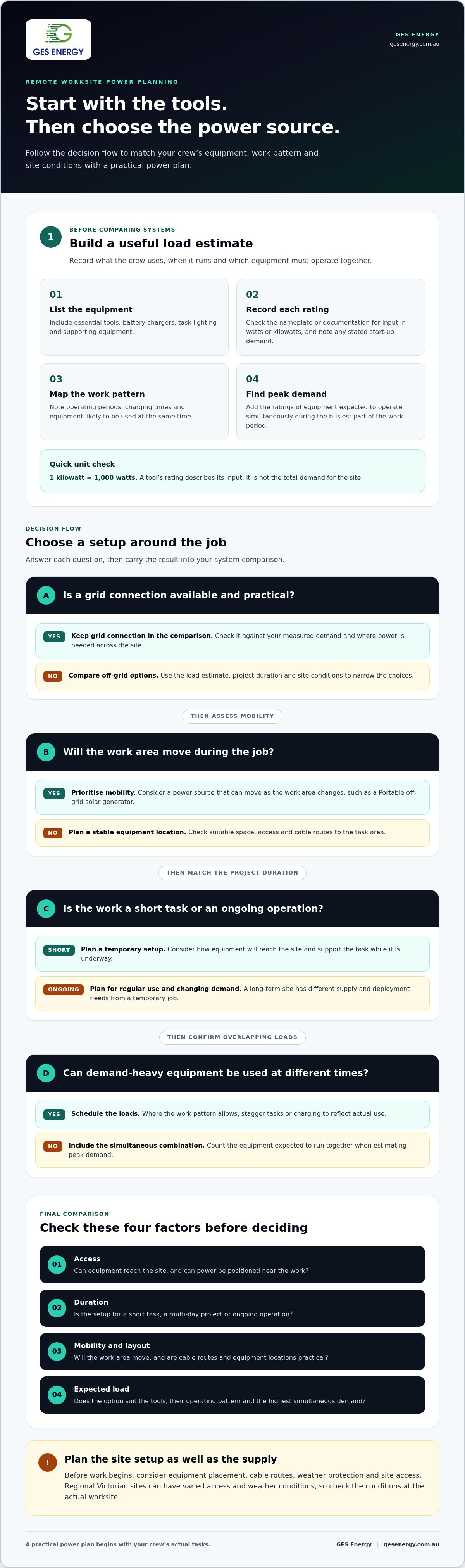
A useful load estimate reflects what the crew will actually use, not simply how many tools are on site. Gather equipment details and map the workday before comparing power systems. This gives you a clearer view of the supply needed at any one time and the energy required across operating periods.
- List the equipment. Include essential tools, battery chargers, task lighting and supporting equipment needed to complete the work.
- Record the ratings. Note the electrical input shown on each item’s nameplate or in its documentation. Check whether the information gives power in watts or kilowatts, and note any separate start-up demand specified by the manufacturer.
- Map usage. Record expected operating periods, charging times and when each item is likely to be used. Mark equipment that must run together and items the crew can schedule at different times.
- Identify peak demand. Add the ratings of equipment expected to operate simultaneously, then check whether that combination reflects the busiest part of a typical work period.
Watts measure the rate at which equipment uses power. A kilowatt is 1,000 watts, so expressing a larger load in kilowatts can make it easier to compare with a system’s capacity. An individual tool’s rating describes its input, not the site’s total demand.
Build a realistic tool and equipment inventory
Capture the nameplate details for each item, along with how often and how long it’s expected to operate. Include less obvious loads, such as chargers that replenish batteries between shifts or lighting needed to keep a task area usable. These supporting items draw power too and can affect the plan, particularly if several chargers run while tools are in use.
Separate essential equipment from items that can wait. Note which loads overlap during key tasks and which can be scheduled one after another. For example, if the work pattern allows, a charger may be used during a break rather than at the same time as another demand-heavy task. A realistic schedule helps avoid planning around an unlikely all-at-once scenario.
Turn the inventory into a usable load estimate
Peak demand is the highest simultaneous electrical load expected from equipment operating at the same time. This figure helps define the power the system must supply at once. It differs from total energy use over a day, which also depends on how long each load runs.
For stored-energy planning, consider operating periods as well as recharge windows. A system may need to support work for an extended period before it can recharge, so record when power is available for replenishment and how the crew’s schedule affects that opportunity. Check your calculations against equipment documentation and the requirements of the worksite. The Portable Generator Manufacturers' Association also provides portable generator safety and performance information. Use it as a reference, not a substitute for applicable Australian requirements.
For a tailored assessment of site loads and operating needs, explore GES Energy’s solar system design service.
Compare remote worksite power options by access, duration and demand
Power options suit different site conditions. Compare access to a connection, how long the supply is needed, whether equipment must move and the loads your crew expects to run. No single approach fits every job. Weigh each option’s practical limits against the work schedule, task locations and the level of supply continuity the project needs.
Use the table below as a starting point alongside your load estimate. Consider what happens if work moves, charging time is limited or site access changes. These factors can matter as much as the power source itself.
| Power option | Access and mobility | Duration and demand | Operational considerations |
|---|---|---|---|
| Grid connection | Requires a usable connection at or near the work area. Less suited to frequently shifting work locations. | Can support ongoing use where the connection and supply meet site demand. | Connection access, distance to work areas and cable routing affect practicality. |
| Portable off-grid solar | A Portable off-grid solar generator can be deployed where grid access is limited and power needs to move with temporary work. | Suitability depends on the loads, operating hours and available charging windows. | Plan its position, exposure to site conditions and how the crew will access power during the task. |
| Standalone solar and battery system | Designed for a site that needs an independent supply, rather than a unit moved between work areas. | Can be planned for longer-term use and a broader pattern of site loads. | Solar generation, battery storage and demand need to be matched as a connected system. |
| Fuel-powered generator | Can supply power at locations without a grid connection, subject to equipment access and safe placement. | May suit short-term use or demand that aligns with the generator’s capacity. | Plan for fuel supply, refuelling, operating conditions and manufacturer guidance. |
When can portable off-grid solar suit a worksite?
Portable solar may suit a temporary remote task where grid access is absent and the crew needs a mobile source of electricity. Consider whether the unit can be moved to the work area, how long tools need to run and when charging can take place. Concentrated daytime use may have different requirements from work that relies on tools across extended shifts.
Compare expected loads with the system’s documented capabilities and available charging windows. If the work plan leaves little time for recharging, or several high-priority tasks need power at once, include those constraints in the system plan. For more context on independent power arrangements, see the off-grid solar systems guide.
When might a larger standalone system be more appropriate?
A longer-term site or one with several ongoing loads may need a planned standalone system rather than a mobile unit. Solar panels generate electricity, battery storage holds energy for later use, and the system is designed around site demand and operating patterns. This approach requires planning for the site’s energy needs, not just the tools used for a single task. A solar and battery systems guide explains how these elements work together.
Match the option to the project’s duration, access, mobility needs and demand profile. Revisit the comparison if the site layout or work schedule changes, so the approach continues to suit the job rather than relying on a fixed assumption.
How to plan deployment, safety and day-to-day operation
A dependable setup needs more than a suitable power source. Plan where the equipment will sit, how workers will reach it and how the crew will manage changing loads throughout the job. Safe deployment depends on suitable equipment, site planning and compliant installation.
Before work starts, verify the electrical safety and installation requirements that apply to the site in Victoria or elsewhere in Australia. Requirements can depend on the type of work and power system, so use current guidance from the relevant authorities and ensure installation decisions are made by appropriately qualified people. Don’t assume a setup used on one site is suitable for another.
Prepare the site and work sequence
Map the work area and identify where tools will operate during each stage of the job. Choose a position for power equipment that gives workers access for operation and monitoring, while keeping it clear of active work and vehicle movements. Consider how the layout may change as the crew moves between tasks.
Plan cable routes before connecting loads. Keep routes clear of walkways, work areas and access paths, and account for places where vehicles or materials may pass. Review local weather and site exposure when deciding where to place equipment and how it should be protected. Follow equipment instructions and applicable site requirements rather than assuming equipment is weather-resistant or adequately protected.
Agree on a connection sequence so workers know which loads to connect and who is responsible for checking the setup. Confirm that the planned connections suit the equipment and site requirements before operation begins. A clear sequence reduces confusion when crews, tools or work areas change.
Keep power dependable during the job
Set a routine for checking system status during work. Record interruptions, changes in demand and recurring issues, along with the task underway at the time. These notes can help the site lead spot patterns and adjust work sequencing or power use before a small disruption affects the day’s plan.
Schedule charging around work priorities and the supply available. Where practical, use quieter periods to recharge tools or batteries, and avoid adding non-essential loads to tasks that need uninterrupted power. If demand changes as the project progresses, update the work plan and reassess whether the system still suits the crew’s needs.
For projects that run over time, include maintenance and support in the plan. Set out who will monitor the equipment, how faults will be reported and what steps the crew should take if power becomes unavailable. Keep equipment documentation and operating instructions accessible to the people using the system. These arrangements support continuity without treating the power supply as a set-and-forget item.
Careful deployment helps keep powering tools on a remote worksite organised, safe and aligned with the job. Plan an off-grid worksite power system with GES Energy’s solar design and off-grid expertise.
How GES ENERGY can support a remote worksite power plan
A practical power plan turns worksite requirements into a system concept that suits the job. GES Energy designs and installs solar power systems, including off-grid systems and portable off-grid solutions for remote applications across Australia, with a strong focus on Victoria. A Portable off-grid solar generator may suit temporary work where grid access is limited and power needs to be available at the work location.
For projects across Victoria, GES Energy serves Melbourne, Geelong, Ballarat, Bendigo, Shepperton, Melton, Mildura, Wodonga, Traralgon, Wangaratta, Horsham, Sale, Colac, Echuca, Ararat, Portland, Swan Hill, Benalla and Maryborough. Start with a clear project brief that lists tools and supporting equipment, expected operating patterns, project duration, site access and conditions. These details help shape a system concept around the work rather than a generic estimate.
From worksite requirements to a system concept
GES Energy’s solar system design service can align an off-grid concept with site loads and operating needs. Your tool inventory, usage patterns and site layout all inform the brief. So do practical constraints, such as where equipment can be placed and whether the work area may shift. This helps clarify system requirements before the project moves into detailed planning.
For temporary deployments, a portable solution can be considered alongside the expected load and available charging windows. Longer-running or more involved sites may call for a broader off-grid design. The system concept should account for how generation, storage and site demand relate, without assuming a particular capacity or runtime before the project requirements are assessed.
Clear project information also helps identify what needs further engineering and how the site’s energy plan may need to develop as work changes. Keep the design brief focused on real operating conditions, including the tasks that rely on power and the consequences of an interruption. This keeps decisions grounded in the site’s needs.
Plan support for project scale and ongoing operation
For larger solar, battery and energy projects, EPC services cover engineering, procurement and construction. GES Energy delivers utility-scale projects up to 5 MW, including micro-grid projects. GES Energy also provides maintenance, which can be part of planning for ongoing system operation.
Worksite power needs can change as a project moves from initial setup to regular operation. Review the system concept against the intended duration, evolving loads and site conditions, then plan how operation and maintenance fit into the project. For larger or more complex requirements, GES Energy’s off-grid and EPC services can support planning from system design through project delivery.
Before taking the next step, bring together your tool loads, project duration and site conditions. A well-defined brief helps focus the discussion on a suitable remote power approach. Discuss a remote worksite power solution.
Set your worksite power plan in motion
Make the power plan part of the project’s working documents, not a decision that disappears after setup. Assign responsibility for reviewing it when the work area, schedule or equipment changes. This helps keep the supply plan aligned with the job as it develops, rather than relying on assumptions made during mobilisation.
For powering tools on a remote worksite, turn the crew’s requirements into a clear project brief. Include the intended work stages and note changes that could affect how power is used. This gives the project team a practical reference as work progresses and keeps decisions connected to operational needs.
GES Energy offers portable off-grid solutions and off-grid solar systems, supported by solar system design, EPC and maintenance services. Discuss a remote worksite power solution to explore an approach for your project. With a clear brief and a plan that can be reviewed as conditions change, you can make more informed decisions about keeping essential work supplied.
Frequently Asked Questions
How do you calculate the power needed for tools on a remote worksite?
For powering tools on a remote worksite, estimate each item’s energy use by multiplying its input in watts by its operating hours, then convert watt-hours to kilowatt-hours by dividing by 1,000. Add energy use across the work period to estimate daily demand. Separately, total the ratings of equipment that may run at once to understand the system’s required output. Check nameplate details and manufacturer documentation, especially for tools with specified start-up requirements.
Can portable off-grid solar power run worksite tools?
Yes, portable off-grid solar can run tools if the system’s output and stored energy suit the equipment and work pattern. Check tool requirements against the system documentation, including whether tools can operate together and how long they need to run. A site using cordless tools may also need power for chargers between tasks. Consider where the unit can be positioned and when it can recharge during the project.
What is the best way to power tools where there is no grid connection?
There’s no single best option for every grid-free site. For a temporary job, compare a Portable off-grid solar generator with a fuel-powered generator, considering mobility, expected demand and how each supply will be maintained. Longer-term work may call for a standalone solar and battery system designed around ongoing loads. Include site access, charging opportunities and project duration in your decision.
How do you keep tools powered during cloudy weather?
Plan for periods when solar generation may be reduced by accounting for expected demand and available stored energy. A battery can supply energy when panels aren’t generating enough, but its ability to support the crew depends on system design and load. Schedule charging around work priorities, minimise avoidable use and plan an alternative supply if uninterrupted operation is essential. Don’t assume the same solar output in all weather conditions.
Is a portable off-grid solar generator suitable for a construction site?
It can suit a construction site when the required loads, job duration and deployment needs match the unit’s documented capabilities. Consider whether it can be positioned near the work area, protected in line with its instructions and accessed without obstructing site activity. Check that its connections suit the equipment and that workers can follow the operating guidance. For a changing or larger site, reassess suitability as work areas and power needs shift.
What safety requirements apply to temporary power on a Victorian worksite?
In Victoria, check WorkSafe Victoria’s Electrical installations at construction sites: Industry standard and AS/NZS 3012:2019 for applicable requirements. Guidance includes three-monthly inspection and testing of portable electrical equipment and flexible cords, and six-monthly retesting of construction wiring and switchboards by a licensed electrician. This is relevant to projects in Melbourne, Geelong, Ballarat, Bendigo, Shepparton, Melton, Mildura, Wodonga, Traralgon, Wangaratta, Horsham, Sale, Colac, Echuca, Ararat, Portland, Swan Hill, Benalla and Maryborough.
Should I use a solar battery to power tools on a remote worksite?
A solar battery may suit a site where stored energy is needed outside solar generation periods, but it must be planned around the tools’ demand and intended operating schedule. Check both the battery’s usable energy and the system’s ability to supply the loads running at the same time. Consider when the battery can recharge and how demand changes across the job. A site assessment can help establish whether storage fits your operating needs.


