

Could the greatest benefit of solar be having more control over when your business buys electricity, rather than simply producing power on your roof? For Australian businesses, the benefits of solar energy depend on how closely generation matches site operations. When solar output coincides with daytime demand, it can reduce grid electricity use and support more informed energy planning.
If you’re weighing up energy costs but aren’t sure solar suits your site, start with the details that shape a project’s value: electricity use, tariffs, operating hours, available roof or ground space, and future needs such as EV charging. Battery storage may help a business use more solar generation, depending on demand and system design.
This article explains the financial, operational and environmental benefits in practical terms, without treating broad sustainability claims as guaranteed outcomes. You’ll learn what affects solar performance, when storage or a microgrid may fit your energy goals, and what to assess before planning a commercial project. It also explains how site-specific design and engineering can bring generation, demand and future requirements together for businesses across Victoria and Australia.
Key Takeaways
- The benefits of solar energy can include lower grid reliance, more informed energy cost planning and progress towards sustainability goals, depending on how the system fits your operations.
- Solar panels supply on-site demand first. Grid electricity covers any shortfall, while daylight, weather, shading and system design affect generation.
- Review your site’s consumption patterns, available space and future energy needs to determine whether solar is a practical fit.
- For Victorian businesses, a site assessment can turn energy objectives into design requirements. GES ENERGY designs and delivers projects across Australia.
- A tailored solar system design service can align generation, storage or microgrid options with your site and operating priorities.
What benefits of solar energy matter most to Australian businesses?
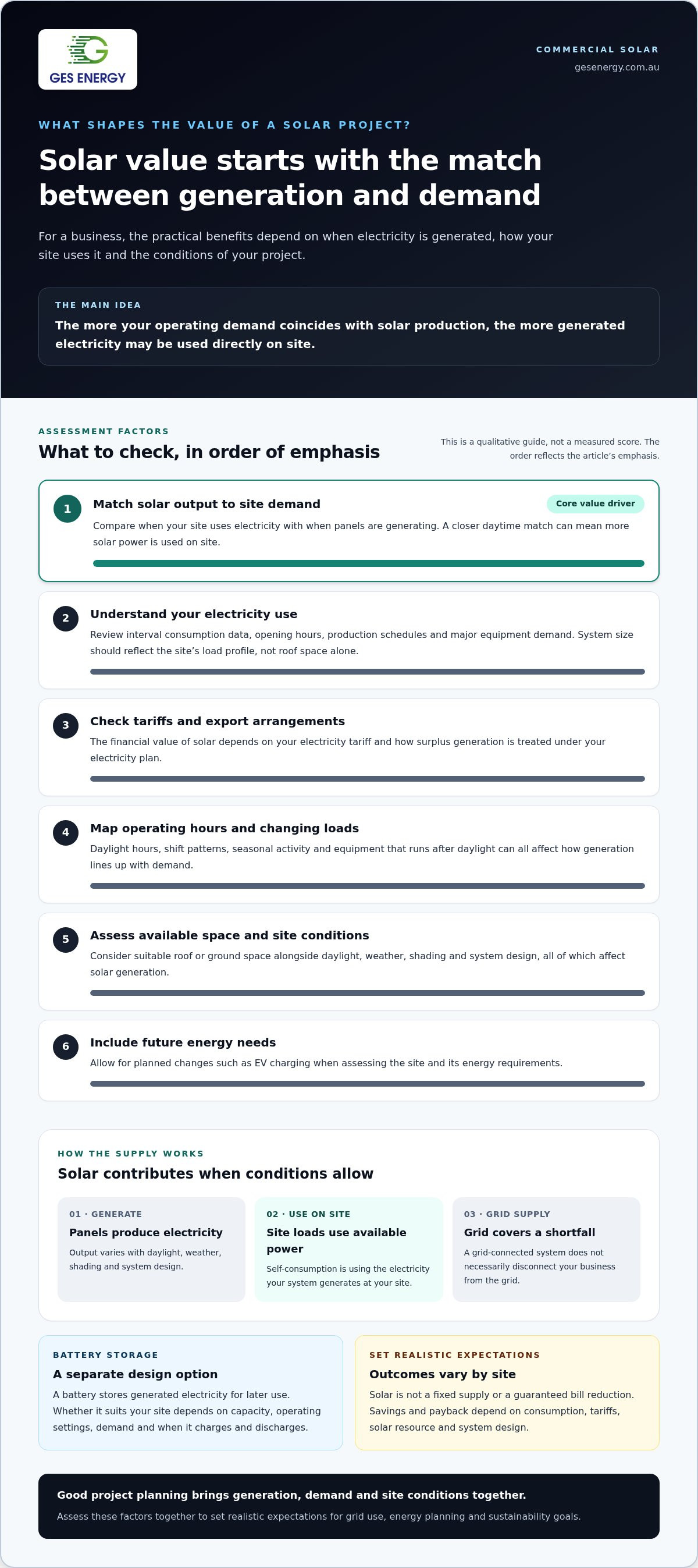
What could solar change about your business’s energy use and planning? Practical benefits can include using less grid electricity while panels are generating, gaining more control over part of your energy supply and supporting sustainability goals. The value depends on how much power the site uses during solar production, as well as site conditions and system design.
Commercial solar turns suitable roof or site space into an on-site source of electricity that can help manage grid use and support business energy goals. It won’t remove the need for grid supply in every case, and outcomes vary by site. A useful assessment weighs financial, operational and environmental objectives together.
Financial and operational benefits beyond the power bill
Solar panels generate electricity on site, where it can supply business equipment and reduce the amount drawn from the grid during production. The financial value depends on how generation matches consumption and the electricity tariff. A business with substantial daytime demand may use more of its solar generation directly than a site whose main activity takes place after daylight hours.
For example, a warehouse may use electricity for lighting, refrigeration or equipment during the day. When those loads operate as solar power is generated, on-site electricity can contribute to their demand. Any remaining demand still needs to be supplied, which may include grid electricity. That is why system size should reflect the site’s actual load profile, not roof space alone.
Matching generation with daytime demand can improve the value of the electricity produced. It also gives your business another input for energy planning: expected solar output can be considered alongside operating schedules and grid use. Because generation varies, solar should not be treated as a fixed supply or a guaranteed bill reduction. Savings and payback depend on a current analysis of consumption, tariffs, solar resource and system design.
Environmental benefits and business sustainability goals
Solar panels generate electricity without direct emissions during operation. A business can use this renewable electricity to support organisational emissions goals. Its contribution depends on how much solar power the site generates and consumes, connecting sustainability planning to the site’s energy supply rather than relying on a broad environmental claim.
Be precise about what an emissions claim covers. Direct emissions during operation differ from the full lifecycle impacts of a solar system, which require separate evidence and assessment. Operational generation alone does not establish a quantified emissions reduction.
Australia’s solar uptake provides national context for businesses considering on-site generation. The overview of Solar power in Australia outlines the country’s solar development and electricity contribution. For your project, the relevant outcome depends on site conditions, consumption patterns and system design.
How solar energy supports cost control, energy independence and resilience
A commercial solar system works in stages. Panels generate electricity when conditions allow, site loads use available power, and the grid supplies demand that solar generation doesn’t meet. If generation exceeds immediate site use, the treatment of surplus power depends on the system and electricity plan.
Solar output changes with daylight hours, weather, shading and system design. This variation matters for businesses with changing shifts, seasonal activity or equipment that runs outside daylight hours. Comparing generation with demand helps set realistic expectations for grid imports and energy planning.
Energy independence means relying less on grid electricity for some of your site’s needs, not necessarily disconnecting from the grid. A grid-connected system can reduce reliance during suitable operating periods, while the grid remains part of the supply arrangement.
How self-consumption can support energy cost management
Self-consumption means using the electricity your solar system generates at your site. The more your operating loads coincide with solar production, the more generated power may be used directly instead of drawn from the grid. Review interval consumption data alongside opening hours, production schedules and major equipment demand to assess this fit.
For example, a facility running electrically powered equipment during daylight may use more solar generation on site than one whose main loads operate in the evening. The effect on bills depends on tariffs, export arrangements and actual consumption. System design should account for these factors rather than assume every kilowatt-hour generated has the same value.
When batteries or microgrids add a different benefit
A battery is a separate design option, not an automatic part of a solar installation. It stores generated electricity for later use, subject to its capacity, operating settings and the wider system design. Storage may suit a site seeking to use some solar power beyond generation hours. The outcome depends on when the battery charges and discharges in relation to demand.
Microgrids may suit projects with broader energy requirements, where generation, storage and site loads need to be considered together. Their role depends on project objectives and site conditions. The solar and battery systems guide explains key design considerations for adding storage to a solar setup.
To assess these options, map when your site uses electricity, identify loads that could align with solar hours, and define what you want storage or a microgrid to achieve. A site-specific solar project design can translate those priorities into a plan for your operations.
Are the benefits of solar energy right for every Australian site?
No single solar design suits every business. The benefits of solar energy depend on whether a site can host a suitable system and use the electricity it generates. A business with clear installation space and substantial daytime demand may have different opportunities from a site with limited usable area or most electricity use outside solar hours.
Those differences do not automatically rule a site in or out. They mean the project needs to account for physical conditions, energy demand and the site’s electrical context before estimating likely results. The largest system that fits on a roof or parcel of land is not necessarily the best match for the business.
Site and energy-use factors that shape the outcome
Usable roof or ground area, shading, orientation and structural context all inform system design. An assessment should also consider how electricity use changes through the day and across operating periods. Review consumption data, operating hours and major loads to see when demand may align with solar generation and whether that pattern is likely to change.
Grid connection and other site requirements also need project-specific assessment. The existing electrical arrangement can affect how a proposed system is planned and integrated. These inputs help define a suitable project scope before system size or expected benefits are estimated.
Separating realistic benefits from common assumptions
Solar can contribute to on-site electricity supply, but it does not guarantee uninterrupted power. A business that needs electricity during an outage requires a system designed for that purpose. Do not assume a standard solar installation will keep selected equipment running when grid supply is unavailable.
Surplus generation does not automatically produce a particular export income either. The value of exported electricity depends on the applicable arrangements, while the amount used on site depends on the relationship between solar output and consumption. Treat both as project inputs, not universal outcomes.
A balanced assessment weighs likely fit against site constraints. It should help you understand:
- Which roof or ground areas are suitable for panels, considering shade and structural context.
- How much demand occurs during expected solar generation hours.
- Whether grid connection and site electrical requirements affect the proposed design.
- Whether your priority is on-site use, export, backup capability or another defined outcome.
For another view of the trade-offs, the solar power disadvantages guide covers considerations alongside potential benefits. Once you’ve identified your site constraints and priorities, a commercial solar project design can translate those inputs into a proposal for your operations.
How to assess solar energy benefits for a Victorian business
A sound solar assessment starts with your business’s energy use, not a panel count. For a Victorian site, assess demand, site conditions, project objectives and available incentives in that order. This helps you compare a proposed system with how the business operates and judge the benefits of solar energy against practical requirements.
A site-level checklist before weighing the benefits
Gather information that shows when and how your site uses electricity. Electricity bills provide a starting point; interval data, where available, can reveal demand at finer time intervals. Operating schedules add context, including shifts, seasonal activity and planned production changes.
Record major electrical loads, critical equipment, planned electrification and any energy-storage objectives. Note potential panel locations and constraints such as shading, roof or ground space, structural context and access. These details support a qualified design assessment and help define a realistic project scope.
Use the information to set clear objectives. You might prioritise using more generated electricity on site, planning for future loads or assessing storage as part of a wider energy strategy. A financial model should use site consumption, tariffs and proposed system design rather than a generic savings estimate. The commercial solar return on investment guide covers financial modelling in more detail.
Incentives, project economics and local context
Incentives can affect project economics, but eligibility depends on current scheme rules and project details. As at October 2026, eligible solar PV systems up to 1 MW may qualify for Small-scale Technology Certificates under the Small-scale Renewable Energy Scheme. Eligibility and certificate value depend on scheme requirements, system size, location, equipment and installation timing. Treat any potential certificate value as an estimate until eligibility and the applicable value are assessed for the project.
Victoria has a separate consideration: the Victorian Energy Upgrades program offers discounts for eligible business solar PV installations between 30 kW and 200 kW. The scheme has specific conditions, including requirements for the accredited provider, approved products and inverter capacity. Confirm current criteria and application timing before including a discount in financial modelling. Household solar rebates and loans are not a general basis for estimating support for a commercial project.
Keep incentives separate from the core project case. First assess expected generation, site use and project costs. Then account for any incentive the project is eligible to receive. This keeps assumptions clear and helps you compare scenarios if eligibility, certificate value or timing changes.
GES ENERGY is based in Melbourne and serves businesses across Australia, with commercial solar design and delivery tailored to site requirements. Plan a commercial solar project assessment around your demand data, site constraints and objectives.
How GES ENERGY can turn solar benefits into a tailored project
The practical value of solar depends on how well a project fits your site, energy use and objectives. GES ENERGY’s solar system design service translates those inputs into a project plan, helping your business assess requirements before delivery. The service covers commercial and industrial projects from 10 kW to 5 MW, whether the priority is on-site generation or a broader energy plan.
GES ENERGY has more than 10 years of experience in renewable energy and over 2,500 successful installations. Its project experience supports a methodical process: understand the site, define energy goals, then develop a design and delivery approach that reflects the project’s scale and operational needs.
From site design to delivery and ongoing support
Commercial and industrial solar design starts with site requirements and project objectives. Engineering considers the proposed system alongside the business’s electricity use and physical site, so the design reflects the project rather than a standard size. GES ENERGY also designs and installs solar systems for commercial and industrial customers.
For projects that need coordinated delivery, EPC services cover Engineering, Procurement and Construction for solar projects. This brings design and project delivery into one managed scope. Where the business’s objectives call for more than solar generation alone, battery storage or a microgrid may also form part of project planning.
Project support continues beyond installation. Ongoing maintenance and solar inverter repair services help businesses manage system care over time. This gives organisations a practical way to address maintenance and warranty claims as their energy requirements evolve.
Why project experience and workmanship matter
Project delivery depends on clear processes as well as technical design. GES ENERGY’s in-house teams hold ISO 9001, ISO 14001 and ISO 45001 certifications. Experienced engineering and delivery teams can help keep project decisions aligned with site requirements from planning through installation.
GES ENERGY provides a 10-year workmanship warranty on solar power projects. It covers workmanship, giving commercial and industrial customers a defined period of installation-related assurance without implying a guarantee of energy savings or system output.
A tailored project can connect the potential benefits of solar energy with the realities of your operations, site and future plans. For further planning context, explore the commercial solar project guidance. To discuss your site’s solar objectives, talk with GES ENERGY about a tailored commercial solar project.
Make your next energy decision with confidence
Your next step does not need to be a commitment to install. Start by identifying energy decisions your business expects to make, such as changes to operating hours, new equipment or plans to electrify part of your operations. These priorities can shape a solar assessment that stays relevant as your site evolves.
The benefits of solar energy become clearer when you assess them against your operating requirements, rather than relying on broad claims or generic estimates. A site-specific plan can help you compare options, identify information still needed and set practical criteria for evaluating a project.
For commercial and industrial businesses, GES ENERGY designs and delivers projects around site requirements, with SAA-accredited installation and a 10-year workmanship warranty on solar power projects. Start planning a solar system for your business with GES ENERGY to take a considered step towards greater control of your energy use.
Frequently Asked Questions
Can solar panels generate electricity during a blackout?
Solar panels alone do not guarantee power during a blackout. Many standard grid-connected systems shut down during an outage as a safety measure, so they do not send electricity into the grid while it is being repaired. Backup operation requires a system designed for that purpose, with compatible equipment such as suitable battery storage and isolation capability. If keeping selected equipment running matters to your business, specify those loads and include backup requirements in system design.
Do solar panels work on cloudy days?
Yes. Panels can generate electricity in diffuse daylight, although output is generally lower than under strong direct sunlight. The effect varies with weather, shading, orientation and system design. For your business, consider how changing output aligns with demand, such as refrigeration that runs throughout the day or equipment used only during certain shifts. System modelling can account for your site’s location and operating context, although actual conditions will vary.
What happens to excess solar electricity a business does not use?
Depending on the system, surplus electricity may be exported to the grid or stored in a suitable battery. These are distinct design choices: on-site use, export and storage each have different implications for system operation and financial planning. Available export options and their financial treatment depend on system configuration and electricity arrangements. Do not assume a particular tariff or export income without checking the terms that apply to your business.
Can a business add battery storage to an existing solar system?
It may be possible, but integration depends on the existing inverter, solar system design, site electrical configuration and intended battery use. An assessment can identify a suitable connection approach and whether other system components need changes. For example, a business that wants to use stored solar electricity outside generation hours needs a design that accounts for its existing equipment and operating pattern. Assess compatibility before selecting a battery.
Are solar incentives available for Australian businesses in 2026?
Possibly, subject to scheme rules. Eligibility can depend on system size, technology, applicant and location. Check current Australian and Victorian Government guidance and application timing before including support in a project model. Businesses in Melbourne, Geelong, Ballarat, Bendigo, Shepparton, Melton, Mildura, Wodonga, Traralgon, Wangaratta, Horsham, Sale, Colac, Echuca, Ararat, Portland, Swan Hill, Benalla and Maryborough should confirm how the programme applies to their project, as household offers do not automatically cover businesses.
Does solar energy reduce a business's carbon footprint?
Generating solar electricity can reduce a business’s reliance on grid electricity and may lower associated operational emissions. The scale of any reduction depends on how much solar power the site generates and uses, how much grid electricity it displaces and the emissions calculation method. Avoid applying a general percentage to your business without supporting data. Operational emissions are distinct from the full lifecycle impacts of manufacturing, transporting and installing solar equipment.


