

Choosing how to choose a portable solar solution starts with the site’s actual power needs, not the size or convenience of the equipment. For a temporary worksite, remote monitoring system or other off-grid operation, you need to know whether the system can support essential equipment through its operating schedule and local conditions.
The right option depends on what needs power, how often equipment runs and how the system will be deployed. A portable off-grid solar generator may suit a defined set of smaller loads, while a Portable off-grid solar package can be planned around a particular site. Estimating energy use and peak demand helps you avoid selecting a compact system that cannot support essential equipment.
This guide explains how to shortlist solution types, match capacity to loads and operating patterns, and account for site conditions across Australia, including Victoria. It also outlines how GES Energy’s solar system design service can turn site requirements into a practical plan for a portable off-grid system.
Key Takeaways
- See how to choose a portable solar solution by weighing deployment frequency, portability and the equipment each site needs to run.
- Estimate energy use by recording each device’s wattage and operating hours, then separating essential loads from flexible ones.
- Compare configurations for occasional backup, temporary sites and regular remote operations, including potential future expansion.
- Account for access, panel placement, security and seasonal conditions when planning a portable system in Victoria or elsewhere in Australia.
- Use a clear planning sequence, from application and load profile to configuration and delivery, to shape a project-specific Portable off-grid solar package.
How to choose a portable solar solution for your site and application
A portable solar solution is a movable power option for sites where grid electricity is unavailable, unreliable or only needed for a limited period. It can support occasional backup, temporary operations or ongoing remote work, but each use places different demands on power and deployment. A unit suited to a short task may not meet the needs of equipment running across repeated shifts.
Start by defining how long the site needs power, which loads are essential and how often the system will move. Consider portability, runtime and power demand together. A lighter option that is easy to relocate may have different capacity from a planned system serving several loads over an extended period. For basic context on panel technology, see Understanding Solar Panels.
A Portable off-grid solar package is a project-specific off-grid system planned for deployment at a remote site, rather than a generic retail kit. Its intended application, site conditions and load requirements all inform the selection.
Which sites benefit from portable off-grid solar?
Portable power can support regional Australian projects, temporary work areas and locations without dependable grid access. In Victoria, that might include a short-term infrastructure project, a seasonal regional operation or remote monitoring equipment far from existing supply. The best fit depends on how long and how regularly the system will be used, not simply whether the site is remote.
For occasional backup or a brief deployment, ease of relocation may be a priority. A site operating across successive shifts or returning seasonally has different requirements: power needs to be planned around recurring use, essential loads and the time between deployments. Treating these applications as the same job can result in a mismatch between system capacity and demand.
Portable solar generator or integrated off-grid package?
A Portable off-grid solar generator is a mobile unit that provides electricity in a remote location without grid access. It may suit a defined set of loads when moving and setting up a self-contained option is a priority. An integrated off-grid package is planned around the site’s application and can be a better fit when several loads or ongoing operations need to be considered together.
- Convenience: A mobile unit can suit short deployments where easy relocation is central.
- Multiple loads: A planned package takes the site’s range of equipment and operating pattern into account.
- Changing requirements: If demand may grow, consider expansion during initial system planning rather than assuming a compact option can be extended.
Neither format is right for every remote job. Match the choice to the deployment schedule, the equipment that must keep running and the time between uses. This gives you a practical basis for comparing options before assessing capacity and site conditions.
How to size a portable solar solution around real power needs
Size a system using measured or documented demand, not a rough guess based on the number of devices. To choose a portable solar solution, calculate the energy your site uses, identify when it uses it and decide which loads must stay powered. This gives you a sound basis for comparing system capacity with operating needs.
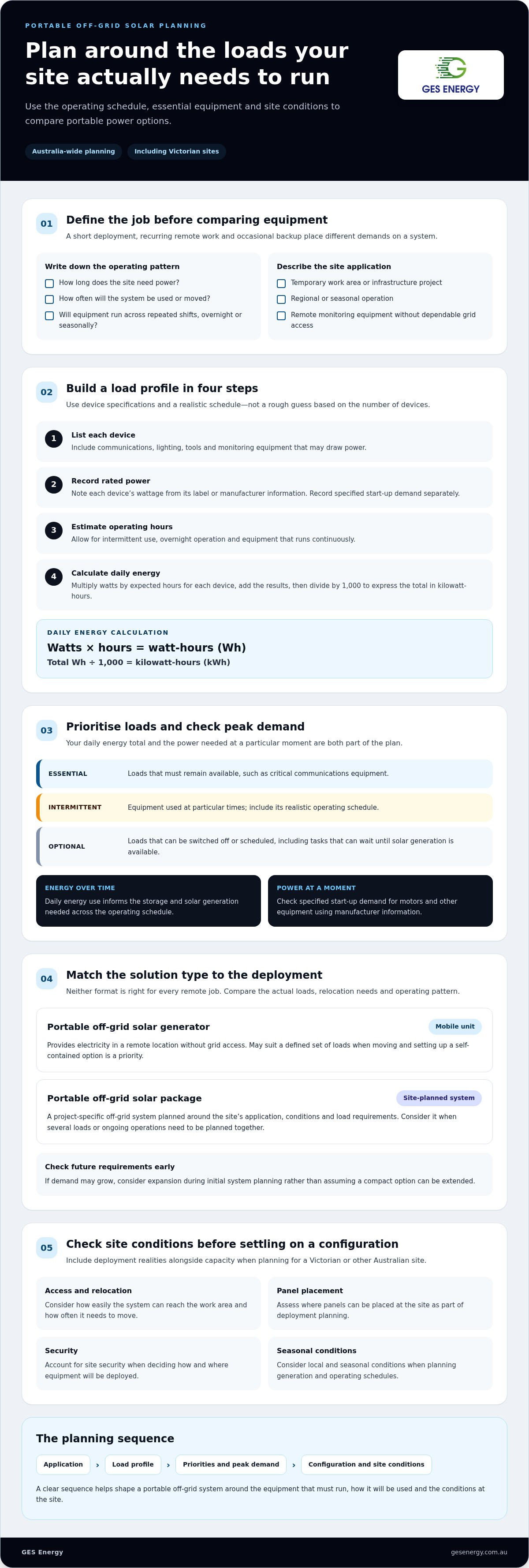
Daily energy use helps determine the storage and solar generation needed to support your equipment across its operating schedule. Build a load profile before comparing configurations:
- List each device. Include all equipment that may draw power, from communications and lighting to tools and monitoring equipment.
- Record rated power. Note each device’s wattage from its label or manufacturer information. Record specified start-up demand separately rather than estimating it.
- Estimate operating hours. Use a realistic daily schedule for each device. Account for intermittent use, overnight operation and equipment that runs continuously.
- Calculate daily energy. Multiply each device’s watts by its expected hours of use to estimate watt-hours (Wh) per day. Add the results, then divide by 1,000 to express the total in kilowatt-hours (kWh).
Build a practical load list before comparing systems
Group devices by priority once you have a total. Mark essential loads that must remain available, intermittent loads used at particular times, and optional loads that can be switched off or scheduled. For example, communications equipment might be critical, while a non-essential task could wait until solar generation is available. This helps you prioritise essential operations if supply is limited.
Check equipment specifications for motors or other loads with a start-up demand. Include the documented figure in your planning: the system must account for both energy used over time and power needed at a particular moment. Use manufacturer information where available rather than substituting a guess.
Match storage and solar generation to operating patterns
Battery storage and solar generation have different roles. Storage supplies energy when generation isn’t available, including overnight. Solar generation produces energy during suitable daylight conditions and can replenish storage. Your load schedule matters: equipment used after dark places a different demand on stored energy from equipment that can run during the day.
Plan for realistic operating conditions, including cloudy periods and consecutive days with lower solar generation. These are planning scenarios, not promises of a specific runtime. The balance depends on daily energy use, when loads operate and how much stored energy the site needs between periods of generation. A solar system design service can translate that load profile into project-specific system planning.
For a tailored assessment based on your site loads and operating schedule, explore GES Energy’s off-grid solar design.
Compare portable solar solution configurations for different jobs
The same equipment can suit one deployment and fall short in another. Compare options by considering how often the system moves, how long it needs to supply power, which loads it serves and whether requirements may change. This makes how to choose a portable solar solution a practical decision based on more than portability alone.
The table outlines typical trade-offs. Runtime depends on the actual loads, system design and operating conditions, so use these descriptions as planning guidance rather than performance estimates.
| Application | Portability | Runtime needs | Load mix | Deployment and expansion |
|---|---|---|---|---|
| Occasional backup | High priority if the unit must be moved or stored between uses | Intermittent; focus on the equipment needed during an outage | Usually centred on selected essential loads | Used as needed; future expansion may be less important than a clear backup priority |
| Temporary site | Important when the system shifts between work areas | Matches the project schedule, from brief tasks to repeated operating periods | Can combine essential equipment with loads used at set times | Deployment may recur or change; allow for changing site demands in the plan |
| Regular remote operations | May be less important than reliable placement and ongoing operation | Planned around routine use, including overnight demand where relevant | May include several critical and scheduled loads | Frequent or continuous use favours coordinated system planning and consideration of future needs |
Choose a system for occasional or temporary power
For occasional backup or a short deployment, prioritise transport, straightforward placement and the devices that must remain powered. Decide whether use will be brief, intermittent or likely to change between visits. A temporary Victorian worksite, for example, may have different demands at each project stage. Keep the backup load list separate from equipment needed to run a remote operation day after day.
Choose a system for ongoing remote operations
For a site that operates regularly, map daily hours, critical loads and the effect an interruption could have on work. Plan storage, solar generation and any other intended energy sources as one system, rather than selecting components in isolation. GES Energy’s off-grid solar system design service can help shape a project-specific package around those requirements. For broader standalone-system context, see the off-grid solar system design guide.
A professionally designed package is useful when several loads, recurring deployments or potential changes need to work together. Piecing together components can leave gaps between site needs and the system plan. Coordinated design brings the application, load profile and operating pattern into the same decision, without assuming one configuration suits every job.
Plan portable solar deployment for Australian and Victorian site conditions
A system that suits your load profile also needs to fit the site. Access, placement, exposure and the distance between solar generation, storage and equipment all affect deployment. A practical site assessment can identify constraints before the system is specified, helping prevent setup or day-to-day operation issues.
Regional conditions vary across Victoria, and seasonal changes affect available sunlight. Avoid basing a plan on a single ideal day. Consider the site’s exposure throughout the operating season, including shading and periods of lower solar generation, and factor these conditions into the system design. The solar and battery systems guide provides context on how storage supports energy use when generation and demand don’t align.
What should a remote-site assessment consider?
Map the work area, the location of each load and the route equipment must take to reach the site. Note access restrictions that could affect delivery, setup or relocation. A regional worksite with changing activity may need a different layout from a fixed remote monitoring location.
- Layout and distance: Mark where generation, storage and powered equipment will sit. The distance between them can affect cable routing and installation practicality.
- Exposure and protection: Identify shading through the day, weather exposure and places where equipment can be positioned and protected appropriately.
- Security: Record how equipment can be placed securely, especially at sites with limited supervision or changing access.
- Changing conditions: Note how the work area, loads or access arrangements may change during a project or between seasonal deployments.
These observations give the design process a realistic picture of the site instead of relying on assumptions made away from the work area.
What safety and service planning belong in the decision?
Electrical design, installation and commissioning require qualified, compliant project delivery. Plan safe equipment placement and suitable connections as part of the system design, not as tasks to resolve after equipment arrives. GES Energy uses SAA-accredited installers for off-grid solar projects.
Plan the handover as well. Keep clear system documentation so site operators can understand the setup and support routine checks. Planned maintenance can help identify wear, damage or changes in site requirements before they disrupt operations. For a Portable off-grid solar package, decide who will oversee the equipment between deployments and how changes to loads or layout will be recorded.
Use your site map, load profile and operating schedule to guide a tailored design. See how GES Energy plans portable off-grid solar systems around site conditions and technical requirements.
Plan your portable off-grid solar package with GES ENERGY
A sound plan follows a clear sequence: define the application, document the load profile, select a suitable configuration, assess the site and plan delivery. This turns how to choose a portable solar solution into a project brief based on how the system will be used, rather than a choice made from equipment specifications alone.
GES Energy provides portable off-grid solutions as project-based systems, not generic retail component bundles. Its solar system design service connects site requirements and operating needs with a tailored plan for an off-grid project. This approach is useful when power demand, deployment conditions and equipment locations need to be considered together.
What information helps shape a project-specific design?
A clear brief gives the design process a practical starting point. You don’t need to select equipment first. Focus on what the site needs to do, how long the system will be used and the conditions that may affect deployment.
- Site and timing: Provide the site location, expected deployment period and operating schedule. Note whether the system will remain in one place or move between work areas.
- Loads and priorities: Share your device list, rated power where available, expected hours of use and any documented start-up demand. Identify critical equipment and loads that can be scheduled or switched off.
- Site constraints: Describe access for delivery and setup, likely equipment placement, exposure, shading and security considerations.
- Future changes: Explain whether project stages, seasonal activity or planned expansion could change the site layout or power demand.
These details help distinguish fixed requirements from assumptions. If a worksite will move as a project progresses, for example, that should inform the deployment plan from the outset. If demand may increase later, include that possibility in the brief so future requirements can be considered alongside the initial application.
What to expect from GES ENERGY’s project approach
GES Energy supports off-grid solar design and installation projects across Australia, with a strong focus on Victoria. Based in Melbourne, the business serves Victorian regional sites as well as projects nationwide. Its project approach links the application, site information and power needs to system planning, helping you move from an initial brief towards a considered delivery plan. Victorian locations include Melbourne, Geelong, Ballarat, Bendigo, Shepparton, Melton, Mildura, Wodonga, Traralgon, Wangaratta, Horsham, Sale, Colac, Echuca, Ararat, Portland, Swan Hill, Benalla and Maryborough.
A project discussion can clarify what information is needed, how site conditions affect the design and what planning steps follow. It also gives you an opportunity to outline operating priorities before committing to a system. Bring your site details, load list and deployment schedule to help shape a Portable off-grid solar package around the job.
Discuss a portable off-grid solar solution with GES Energy to plan the next steps for your site and application.
Turn your site requirements into a clear next step
A well-planned portable system starts with a project brief that reflects how the site operates. Once you’ve outlined the application, expected loads and deployment conditions, you can move from broad options to a design discussion based on your priorities. That makes how to choose a portable solar solution less about guesswork and more about planning for power at your site.
GES Energy brings more than 10 years in renewable energy and over 2,500 successful installations to off-grid solar projects. Turn your site requirements into a practical project plan, with technical considerations addressed before delivery and installation.
Start planning your portable off-grid solar system with GES Energy. A clear brief is the first step towards a solution designed around your operation.
Frequently Asked Questions
Can a portable solar solution power equipment overnight?
Yes, if the system has enough stored energy for the equipment’s overnight use. Identify which devices must run after dark and whether they operate continuously or intermittently. A site might need communications equipment running all night but work lighting only for part of the evening. Include each overnight load in the operating schedule before settling on a system design.
Will a portable solar solution work on cloudy days?
Yes, solar panels can generate electricity in cloudy conditions, but output varies with available sunlight. Don’t plan around ideal weather alone. Consider how the site will manage during extended cloudy periods, such as by prioritising essential equipment or using another planned energy source. For a remote Victorian site, factor in the season and local exposure when assessing expected generation. A design should account for these conditions without treating a particular level of output as guaranteed.
How do I calculate the power my portable solar solution needs?
Record each device’s rated watts and expected operating hours, then multiply watts by hours to estimate daily energy use. Add the device totals and divide watt-hours by 1,000 to convert the result to kilowatt-hours. Check equipment documentation for start-up demand, especially for devices with motors. To choose a portable solar solution, start by separating essential loads from equipment that can be switched off or rescheduled.
Can I expand a portable off-grid solar package later?
Possibly, but don’t assume extra capacity can simply be added to an existing package. Expansion depends on the system design and whether the equipment can work together safely and effectively. If you expect new loads, a larger work area or longer operating hours, include those plans in the original project brief. A temporary site may add equipment as construction progresses, changing its power requirements over time.
Is a portable solar generator the same as a portable off-grid solar package?
No. A portable solar generator is a mobile electricity unit, while a Portable off-grid solar package is planned around an application and site requirements. A mobile unit may suit a defined task where easy relocation matters. A project-based package may be more appropriate for an operation with several loads, a recurring schedule or changing requirements. This distinction helps you compare an individual power unit with a planned site solution.
Does portable solar need professional installation?
It depends on the system and how you’ll use it. A mobile unit intended for standalone use may need less site work than a system connected to several loads or integrated into an off-grid setup. Electrical design, installation and commissioning for site-based systems should be handled by qualified professionals, with attention to safe placement and compliant work. Follow equipment instructions and don’t modify electrical connections yourself.
Can a portable solar solution support a worksite in regional Victoria?
Yes, it can be planned for a regional worksite if the design reflects the location, equipment and work schedule. A project near Mildura may have different access and seasonal conditions from one near Ballarat, Geelong or Wangaratta. Map where equipment will operate, note shading and exposure, and record how the site may change during the project. These details help shape a system around actual conditions and loads.


