

Could a cool, clear winter day produce more solar power than a scorching summer afternoon? It can. The impact of weather on solar panel output isn’t simply a matter of sunshine or temperature. Panels convert light into electricity, and heat can reduce their efficiency. Shorter winter days and a lower sun angle can also limit how long they generate.
If your system’s daily production rises and falls with the forecast, that doesn’t automatically mean something is wrong. Cloud cover, rain, heat and seasonal daylight all influence generation, so one low-output day is rarely enough to judge performance. It’s understandable to wonder whether a change is normal or a sign your system needs attention.
This guide explains how Australian weather affects solar generation and what typical daily and seasonal variation can look like, with useful context for Victorian households and businesses. You’ll learn why cooler conditions aren’t necessarily a problem, how to read generation patterns over time, and when persistent changes may warrant a system review. You’ll also see how site-specific design, including local sunlight and shading, helps set realistic expectations for your solar system.
Key Takeaways
- Understand the impact of weather on solar panel output by separating the effects of cloud, heat, rain and wind.
- Use Victoria’s seasonal patterns as context, while accounting for local cloud and rainfall when interpreting generation.
- Compare monitoring data across similar dates and conditions before deciding that a dip signals a system issue.
- Look for persistent output changes over time, then consider whether a system check may help identify the cause.
- See how site-specific design and ongoing maintenance can account for local shading and environmental exposure.
How weather affects solar panel output across Australia
Weather-related output variation is a change in solar generation caused by conditions around the solar array.
For households and businesses across Australia, the impact of weather on solar panel output starts with the amount and type of light reaching the panels. Solar cells convert light into electricity; they don’t need hot air or high temperatures to generate power. A clear day can provide strong direct sunlight, while cloud, haze or changing weather can reduce or soften the light reaching the array. Generation can therefore change even when the system is operating normally.
This video offers further context on panel efficiency and the factors that influence solar performance:
Why sunlight matters more than sunshine alone
Solar panels receive both direct sunlight and diffuse light. Direct light travels from the sun to the array, while diffuse light has been scattered by clouds and particles in the atmosphere. Cloud cover reduces the light available, but it doesn’t necessarily stop generation. Some diffuse light can still reach the panels, so output may continue at a lower level.
The amount of light can also change throughout the day as clouds move across the sky. A bright period followed by a cloudier spell may create noticeable rises and falls in monitoring data. For a plain-language overview of solar cell efficiency and weather conditions, see the factors that affect how solar cells convert light into electricity.
Weather variation is not automatically a system fault
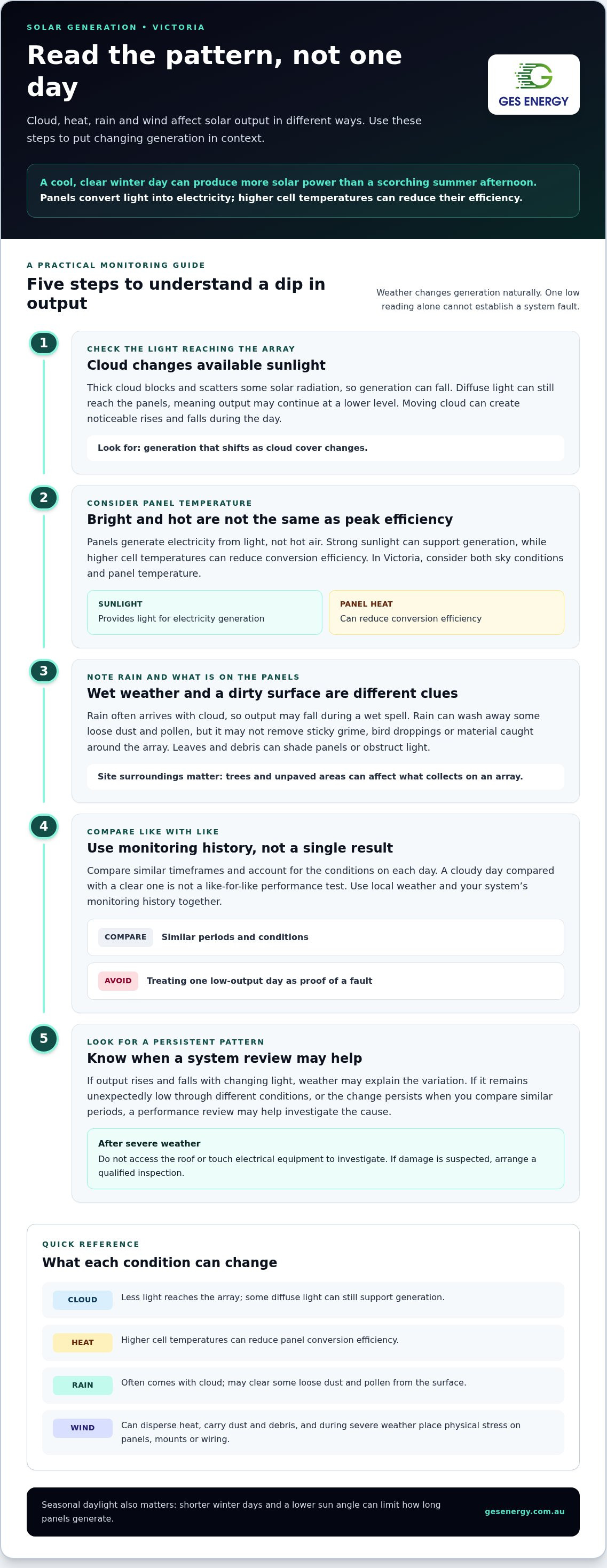
Generation naturally changes between clear, cloudy and rainy periods because the light reaching the array changes. Rain often arrives with cloud, so output can fall during a wet spell. Rain itself doesn’t show that a system has failed, and one low reading can’t establish the cause.
Monitoring helps you assess output across days and longer periods, rather than relying on a single result. Compare similar timeframes and account for the conditions on each day. A cloudy day compared with a clear one isn’t a like-for-like performance test.
Look for a pattern. If production rises and falls in step with changing light, weather may explain the variation. If output remains unexpectedly low through different conditions, or the change persists when you compare similar periods, a performance review may help investigate it. This approach works for household and business systems: it keeps normal weather effects in perspective while making ongoing concerns easier to identify.
Conditions vary across Australia, and even nearby sites can experience different cloud, rain or shading. Use your system’s monitoring history alongside local conditions to understand what is normal for your array. A single low-generation day is a reason to check the context, not to assume a fault.
Cloud, heat, rain and wind: what each condition changes
Each weather condition affects a different part of solar generation. Cloud changes the light available to the array; heat influences panel operating efficiency; rain and airborne material affect the panel surface; and wind can cool panels while placing physical loads on the system. In Victoria, these influences can overlap. A hot, cloudy afternoon, for example, combines reduced sunlight with warm panel temperatures, so the output pattern won’t reflect temperature alone.
Understanding how each condition works helps you interpret monitoring data more accurately. The impact of weather on solar panel output isn’t a simple choice between “good” and “bad” weather. The effect depends on what reaches the panels and how the system is exposed at its site.
Cloud and heat: less light versus warmer panels
Thick cloud blocks and scatters some incoming solar radiation, leaving less light available for conversion into electricity. Generation can fall during heavy overcast conditions, while thinner or broken cloud may allow more light through. Changes in cloud cover can also make output fluctuate during the day.
Heat works differently. Solar panels generate electricity from light, not hot air, and higher cell temperatures can reduce their conversion efficiency. A bright, hot day doesn’t automatically deliver the panel’s best operating efficiency: strong sunlight can support generation while heat works in the opposite direction. In Victoria, consider both sky conditions and panel temperature rather than assuming a warm forecast guarantees peak output.
Rain, dust, wind and severe weather
Rain can wash away some loose dust and pollen, helping keep the panel surface clearer. It won’t necessarily remove sticky grime, bird droppings or material caught around the array, and rainfall isn’t a substitute for a proper condition check. Dust, leaves and other debris can shade parts of a panel or obstruct light reaching its surface. Local surroundings matter: a site near unpaved areas or trees may collect different material from a more exposed location.
Wind can carry dust and debris onto panels, but airflow can also help disperse heat from their surfaces. Its effect depends on conditions at the array. Strong gusts and severe weather introduce a separate concern: physical stress or possible damage to panels, mounting equipment or wiring. A change in generation alone doesn’t prove damage, but take visible damage or a persistent concern seriously.
After severe weather, avoid accessing the roof or touching electrical equipment to investigate. If damage is suspected, arrange a qualified inspection. GES Energy provides ongoing solar maintenance to assess system condition and investigate persistent output concerns. Site-specific solar system design and maintenance also considers local sunlight, shading and environmental exposure, helping households and businesses make decisions based on their actual site rather than a general weather rule.
Seasonal solar output in Victoria: read the pattern, not one day
Solar generation in Victoria usually follows a broad seasonal rhythm, but the pattern at your property depends on more than the calendar. Winter brings shorter daylight hours and a lower sun angle, while summer offers a longer potential generation window. Cloud and rain can shift output in either season, so use the seasonal pattern as context rather than a fixed forecast for your system.
| Season | Daylight and weather influences | Likely generation pattern |
|---|---|---|
| Summer | Longer daylight provides more potential generation time. Cloud, rain and hot panel conditions can still influence performance. | Generation may be higher overall, but hot or cloudy days can interrupt the pattern. |
| Autumn | Daylight hours gradually shorten. Local cloud and rain can vary across the season. | Generation may ease from summer levels, with day-to-day variation shaped by local conditions. |
| Winter | Shorter days and a lower sun angle reduce the available generation window. Cloud and rain can further affect incoming sunlight. | Generation is often lower than in summer, though clear days can still contribute useful energy. |
| Spring | Daylight hours lengthen as the season progresses. Conditions can shift between clear and cloudy periods. | Generation may build towards summer levels, but local weather influences the day’s result. |
Why winter and summer generation can differ
Winter’s shorter days leave less time for panels to generate, and the sun’s lower position changes the angle at which sunlight reaches an array. In summer, longer days can extend the generation period, although hotter panels may be less efficient. These are broad influences, not a guaranteed output profile. Your location, array orientation, shading and local weather all affect the result.
Regional weather can modify these seasonal expectations. A cloudy or rainy stretch may lower generation during a period that would otherwise be more productive, while a run of clearer days can lift output within a lower-generation season. Melbourne and regional Victoria don’t share identical conditions every day, and sites in the same area may also experience different shading or exposure.
Victoria’s local conditions and site differences
For a useful comparison, look at the same system across similar timeframes and note the conditions. Comparing a clear spring week with a cloudy winter week won’t show the seasonal effect on its own. Instead, compare like-for-like periods where possible, then consider daylight, cloud, rain and any changes to shade around the array. This helps distinguish a broad seasonal shift from a change that persists beyond expected conditions.
Roof orientation and nearby trees or buildings affect how much sunlight reaches panels, while local exposure shapes the conditions around the system. Those details matter for homes and larger sites alike. Businesses assessing site-specific generation can also refer to this commercial solar guide for Australian businesses, which covers considerations relevant to commercial-scale solar design.
Reading the seasonal pattern gives you a more useful view of the impact of weather on solar panel output than focusing on a single daily total. Use monitoring history to understand how your system behaves over time, while keeping local daylight and site conditions in view.
How to check whether weather explains lower solar output
A lower generation reading can reflect cloudy weather, shorter daylight or another change at your site. A single number rarely tells you which. Use your solar monitoring history to build a clearer picture before deciding whether the change needs attention. These checks help homeowners and businesses separate a weather-linked dip from a pattern that may warrant a professional assessment.
Compare generation with the conditions at the time
Work through these checks in order. They create a more useful comparison than relying on memory or one isolated reading.
- Review your monitoring. Check the system’s generation data and identify when the output changed. Look at the timing as well as the total, since a shorter generation window may affect the daily result.
- Compare relevant dates. Choose similar days or periods, such as the same time of day or comparable weeks. Avoid treating a clear day and a heavily overcast day as equivalent benchmarks.
- Consider the weather. Note cloud, rain and available daylight for the dates you’re comparing. Weather records or a simple written log can help you spot whether lower readings coincide with less favourable conditions.
- Assess whether the change persists. Track generation across more than one period. If output improves when conditions change, weather may help explain the dip. If it stays low in clearer conditions, continue to the next step.
- Look for other changes. Consider whether new shading, visible debris or a system alert coincides with the output change. These observations can help direct a review, but they don’t establish a fault or its cause.
For systems with a battery, keep generation separate from energy use. Stored solar energy can affect when you draw power from the grid, but it doesn’t mean the panels generated more or less. A solar and battery systems guide can help explain how storage fits into household energy use.
When to arrange a system assessment
Persistent low output that remains unexplained after you compare similar periods, including periods with more favourable weather, merits professional assessment. Visible damage after severe weather or repeated unexpected changes are also reasons to arrange a review. Don’t climb onto the roof or handle electrical equipment to investigate; a qualified technician can assess the system safely and check possible causes without relying on a remote diagnosis.
Record the dates, monitoring readings, weather conditions and any alerts you’ve noticed before arranging an assessment. This gives the technician a clearer timeline and helps distinguish an isolated weather-related dip from an ongoing concern. The impact of weather on solar panel output is easier to assess when you compare consistent time periods and relevant site observations.
If lower generation continues without a clear weather explanation, a solar system assessment can investigate the performance concern.
Design and maintenance that account for local weather
Weather influences solar generation, but good planning starts with the conditions at your property. A system designed around its site can account for available sunlight, shading and exposure, giving you a more realistic basis for understanding expected performance. It won’t remove weather-related variation or guarantee a fixed output. It helps ensure the design reflects the conditions the system will actually face.
How site-specific solar design supports reliable performance
A site assessment helps determine where panels can be placed and what may affect the light reaching them. Nearby trees or buildings, roof layout and the property’s local exposure all inform the system design. These factors matter in Victoria, where conditions can differ between Melbourne and regional locations, and from one property to the next.
GES Energy designs solar systems for residential, commercial and industrial customers. Its solar system design service is tailored to the project, rather than based on a standard output promise. For a household, that means considering the available roof area and shading. For a business, the assessment also needs to reflect the site and the project’s energy requirements. A design can account for known site conditions, but actual generation will still vary with daylight and weather.
Before discussing a new system or changes to an existing one, note the conditions around the array. Consider whether trees have grown, nearby structures cast new shade, or the surrounding environment exposes panels to dust and debris. These observations help connect the site’s physical conditions with the generation pattern you see in monitoring data.
Maintenance when output remains below expectations
A temporary dip during cloudy or rainy weather doesn’t automatically mean your system needs maintenance. If output remains lower than expected across more favourable conditions, or you notice repeated unexplained changes, a professional review can help assess system health. Monitoring records, dates and notes about local conditions give a technician useful context for investigating the concern.
A system assessment may look for issues that weather data alone can’t explain, including changes in shading or possible equipment concerns. GES Energy provides solar health checks, inverter repairs and warranty assistance. These services support investigation when a performance concern persists; they aren’t a reason to arrange a check after every ordinary weather-related fluctuation.
Never climb onto the roof or handle electrical equipment to inspect a system. If you see visible damage after severe weather, arrange a qualified assessment rather than attempting to investigate it yourself.
Further details about GES Energy’s solar design and maintenance support explain how a project-specific design or maintenance review can help relate site conditions to system performance, without treating normal weather changes as a fault.
Turn your solar data into a confident next step
Your system’s generation history can help you plan with greater confidence. Keep a record of output across changing seasons and use it to build a clearer picture of how your property performs over time. That context can support future decisions about your energy use or system needs.
Understanding the impact of weather on solar panel output is part of that process, but persistent unexplained changes deserve attention beyond the forecast. A considered assessment can help distinguish expected variation from an issue that may affect system performance.
GES Energy has over 10 years in renewable energy and more than 2,500 successful installations. Its solar design, installation and maintenance services support Australian households and businesses at different stages of their solar journey.
To make sense of changing generation and discuss the right next step for your site, explore GES Energy’s solar design and maintenance services.
Frequently Asked Questions
Does rain stop solar panels from generating electricity?
No, rain doesn’t automatically stop solar panels from generating. They can still produce electricity if daylight reaches them, although cloud and rain may reduce the light available. Rain can wash away some loose dirt, but it won’t necessarily remove grime or debris. If output stays low after a rainy spell has passed, compare monitoring records with conditions over several days rather than assuming rain is the only cause.
Do solar panels work on cloudy days in Australia?
Yes, panels can generate electricity on cloudy days because diffuse daylight can still reach them. The amount depends on cloud cover and conditions at your site, so there’s no single output reduction that applies to every system. If a cloudy day brings a lower reading, check the monitoring data alongside that day’s weather. A dip that matches overcast conditions isn’t, by itself, evidence of a system fault.
Do solar panels produce more electricity in hot weather?
Not necessarily. Solar panels generate electricity from light, so hot air alone doesn’t increase production. High panel temperatures can affect efficiency, meaning a very warm, bright day may not deliver the highest possible output. Cloud cover, daylight hours, panel temperature and site conditions all contribute. Compare your system’s readings with similar periods rather than judging performance from the temperature forecast alone.
How does winter affect solar panel output in Victoria?
Winter’s shorter days can reduce the time available for generation, and seasonal sunlight conditions also shape how much light reaches the panels. Cloud and rain may further affect individual days. The pattern can differ between Victorian sites, so don’t apply figures from Brisbane or assume a fixed winter reduction. Compare broader periods with similar conditions to understand your system’s seasonal behaviour more reliably.
Can hail or strong winds damage solar panels?
Severe weather can pose a physical risk to solar panels and associated equipment, but a hailstorm or strong wind doesn’t prove damage has occurred. If you notice visible damage or repeated output changes after an event, arrange an assessment by a qualified professional. Don’t climb onto the roof or touch electrical equipment to investigate. A safe inspection can help assess the system without relying on assumptions about the weather.
How can I tell if low solar output is caused by weather or a fault?
Compare monitoring data with the weather on the same dates, then check similar periods rather than relying on one low reading. A dip that coincides with cloud or reduced daylight may reflect conditions; persistent unexplained underperformance warrants professional assessment. Shading or equipment issues may also need investigation. GES Energy supports customers in Melbourne, Geelong, Ballarat, Bendigo, Shepparton, Melton, Mildura, Wodonga, Traralgon, Wangaratta, Horsham, Sale, Colac, Echuca, Ararat, Portland, Swan Hill, Benalla and Maryborough. Contact GES Energy to discuss a solar system assessment.


