

The highest-efficiency panel isn’t automatically the best choice for your business. Commercial solar panel efficiency 2026 matters when it helps your site generate useful power within its roof space, operating conditions and energy needs.
When comparing panel ratings, a higher percentage may sound like a better business outcome. But a panel’s efficiency rating measures its output per square metre under standard test conditions, not the total electricity your system will produce. Heat, shading, roof orientation and system design all affect real-world generation.
This guide explains how to read efficiency ratings and weigh them against the factors that shape usable solar output. You’ll learn what to consider when roof space is limited, how Australian conditions can affect performance, and why matching system capacity to your business’s energy demand matters. GES Energy’s solar system design service assesses site conditions and project requirements, with commercial and industrial systems designed for projects from 10 kW to 5 MW. GES Energy works with businesses across Victoria, including Melbourne, Geelong, Ballarat, Bendigo, Shepparton, Melton, Mildura, Wodonga, Traralgon, Wangaratta, Horsham, Sale, Colac, Echuca, Ararat, Portland, Swan Hill, Benalla and Maryborough. The aim is to assess a system on its fit for your site, not just its headline panel rating.
Key Takeaways
- Understand how cell efficiency, module efficiency and whole-system performance describe different stages of solar generation.
- Use commercial solar panel efficiency 2026 alongside module wattage and available roof area to compare design options for your site.
- Assess your energy use, usable roof space, site constraints and seasonal operating conditions before settling on system capacity.
- See how a site-specific design connects panel selection with your business requirements, across projects from 10 kW to 5 MW.
- Learn how SAA accreditation and in-house ISO-certified teams support the delivery of commercial solar projects.
What commercial solar panel efficiency means for an Australian business
Solar panel efficiency is the share of sunlight a solar device converts into electrical energy. For a business, the practical question is how that rating relates to usable roof space, electricity demand and the design of the complete system.
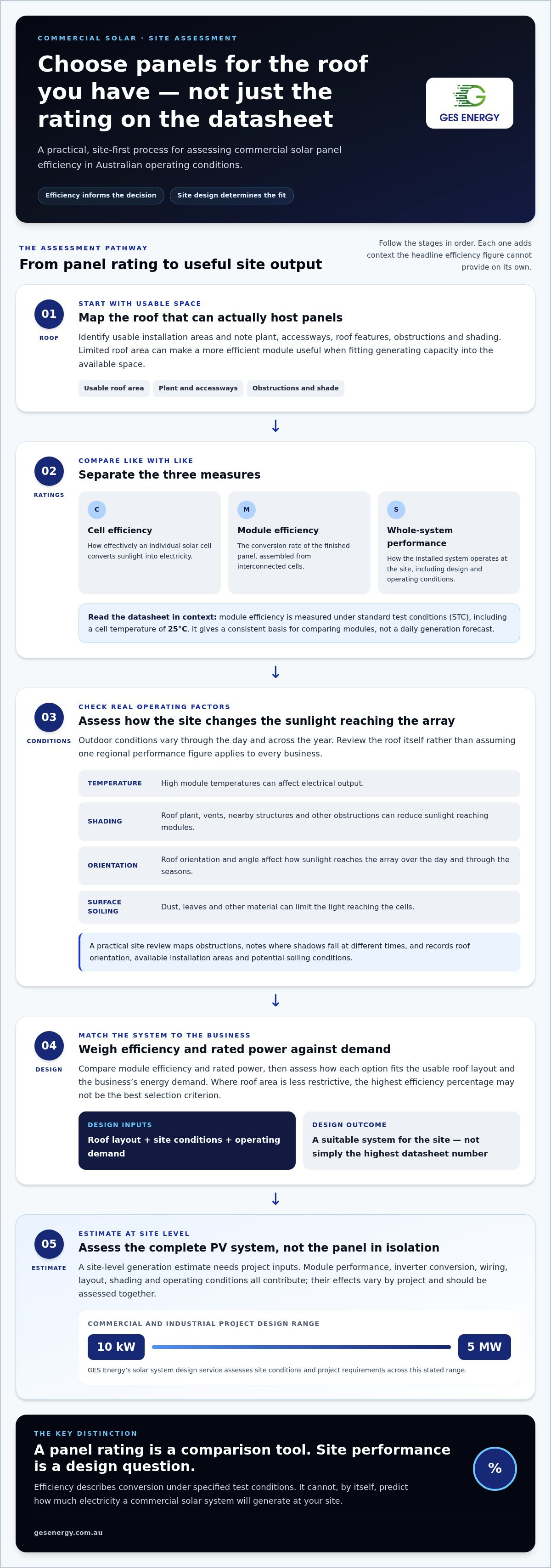
When comparing commercial solar panel efficiency in 2026, separate three measures. Cell efficiency describes how effectively an individual solar cell converts sunlight into electricity. Module efficiency describes the conversion rate of the finished panel, which contains interconnected cells. Whole-system performance describes how the installed system operates at a particular site, including the effect of its design and operating conditions.
For an explanation of how solar cell efficiency is measured and reported, consult Understanding Solar Panel Efficiency.
For a visual introduction to Australian panel comparisons, watch this video:
How is solar panel efficiency measured?
A solar cell is the electricity-generating component; a solar module is the complete panel assembled from cells and other materials. The module efficiency figure on a datasheet is measured under standard test conditions (STC), a controlled set of conditions that includes a cell temperature of 25°C. This provides a consistent basis for comparing ratings, but it is not a prediction of how much energy a panel will generate each day.
Actual generation depends on the location, installation and conditions during operation. A datasheet rating is useful for comparing modules on a like-for-like basis, but it cannot tell you on its own how much electricity a particular commercial site will produce.
Why does efficiency matter on a commercial roof?
Efficiency becomes especially relevant when usable roof area is limited. If plant, accessways, roof features or shading restrict the area available for panels, a more efficient module may help fit more generating capacity into that space. The design still needs to account for the usable roof layout and the business’s operating demand.
Where roof area is less restrictive, the highest module-efficiency percentage may not be the best selection criterion. A design can compare modules by efficiency and rated power, then assess how each option fits the site and demand profile. The goal is a suitable system, not simply the highest number on a datasheet.
A commercial solar assessment should connect panel ratings with the site and the business’s energy requirements. Efficiency informs the decision, but it does not replace system design.
What affects commercial solar panel efficiency in real operating conditions?
A module’s datasheet rating is measured in controlled conditions. On a commercial roof, sunlight, temperature and the surrounding site change throughout the day and across the year. These factors affect the electricity generated by the array, while design choices and system components influence how effectively that energy is converted and delivered.
For commercial solar panel efficiency in 2026, keep the distinction clear: panel efficiency describes a module’s conversion of sunlight under specified test conditions; site performance reflects how the complete PV system operates in practice. The rating alone cannot predict a business’s solar output.
How do temperature and shading affect solar output?
Outdoor modules experience changing temperatures and sunlight, rather than the steady conditions used for datasheet testing. High module temperatures can affect electrical output. Shading from rooftop plant, vents, nearby structures or other obstructions can also reduce the sunlight reaching some modules. The effect across an array depends on the shade pattern and system design, so it won’t be identical for every installation.
Orientation and roof angle affect how sunlight reaches the array over the day and through the seasons. Dust, leaves and other material on module surfaces can also limit the light reaching the cells. For a Victorian site, the design needs to account for the actual roof, its exposure and seasonal operating conditions, rather than assume one regional performance figure applies to every business.
A practical site review should map roof obstructions and note where shadows fall at different times. It should also record roof orientation, available installation areas and potential soiling conditions. These details help the designer assess panel placement and the likely effect of site constraints before estimating generation.
What is the difference between panel efficiency and system efficiency?
Panel conversion efficiency is the proportion of sunlight converted to electricity by a module under stated test conditions. Energy produced by a complete PV system is a site-level result, shaped by module performance as well as inverter conversion, wiring, layout, shading and operating conditions. These influences vary by project and should be assessed together, not represented as a single universal loss figure.
A panel’s efficiency percentage alone cannot predict how much electricity a commercial solar system will generate at your site. A useful performance estimate needs project inputs, including the roof layout, orientation, shading, selected system components and the business’s electricity use. Without those details, an efficiency percentage is a comparison point, not a site forecast.
The estimate should also reflect when the business uses electricity. A system designed around the roof alone may not align well with operating demand. Reviewing consumption patterns alongside site conditions allows design options to be assessed against the business’s actual requirements.
A site-specific solar system design service brings roof conditions, system components and business demand into one assessment, so your project decisions rest on more than a panel rating.
Panel efficiency versus wattage: which matters more for commercial solar?
Efficiency and wattage describe related but different things. A module’s efficiency percentage indicates how much sunlight it converts into electricity per unit of surface area under stated test conditions. Its wattage, measured in watts, describes its rated power output under those conditions. Neither figure alone tells you how much electricity an installed system will generate over a year.
For commercial solar panel efficiency 2026 decisions, compare the figures in the context of your roof and electricity use. This helps you judge whether higher output density is useful, or whether the design should focus on fitting an appropriate array to available space and demand.
| Factor | What it tells you | Why it matters to your site |
|---|---|---|
| Efficiency percentage | The share of sunlight converted into electricity per unit of module area under test conditions. | Relevant when usable roof area is constrained and you want to compare output density. |
| Module wattage | The module’s rated power under stated test conditions. | Helps compare rated capacity, but does not predict annual site generation by itself. |
| Available area | The roof space that can actually accommodate the array. | Obstructions, shading and layout affect how much capacity can be installed. |
| Site-level design fit | How the proposed array and system components suit the site and business demand. | Connects module choice with operating requirements and usable roof area. |
When can a higher efficiency rating be useful?
A higher efficiency rating can be useful when roof space is a key constraint. For example, a facility with limited usable roof area may need to compare modules by how much rated capacity they can fit into the available footprint. That comparison should also consider the business’s load profile, the roof layout and the wider system design.
Efficiency is one input, not a promise of lower bills or a particular generation outcome. A module that looks favourable on a datasheet still needs to suit the site and the times your business uses electricity. A design assessment can show whether the extra output density has practical value for your project.
When should wattage and system fit carry more weight?
Where roof area is less restrictive, wattage and the overall array configuration may be more useful in comparing options. But a higher-wattage module does not automatically mean more annual energy for your business. The number of modules that fit, their layout, site conditions and inverter-system design all shape the installed system’s performance.
Compare options using consistent assumptions. Review each proposed array’s rated capacity, usable area, layout and relationship to your demand, rather than selecting on one specification alone. This makes the trade-offs clearer: a module with a different balance of efficiency and wattage may suit the site better if it enables a more appropriate layout.
For decisions beyond panel specifications, the commercial solar installation guide covers broader considerations for planning a business project.
How to assess commercial solar panel efficiency for your site
Turn panel specifications into a useful project assessment by working through your business’s energy needs and the site’s practical limits. This gives a designer the information to compare options consistently, rather than treating a module rating as a forecast of system output.
Use this four-step process to prepare a clear design brief:
- Review energy use. Gather electricity bills and consumption records, including interval data if available. Note your main operating periods and when demand is highest. A business that uses most of its electricity during daylight hours may assess solar differently from one whose demand peaks outside those periods.
- Assess usable roof area. Record the approximate roof area available for panels, along with its orientation and any areas that may not suit the array. The total roof footprint isn’t necessarily the same as the space that can be used in a workable design.
- Identify site constraints. List visible obstructions, shading, roof access needs and other known limits. In Victoria, consider how the site’s exposure and seasonal operating conditions may affect the assessment. Conditions vary by location and property, so avoid relying on a single assumed regional output figure.
- Compare design options. Review proposed panel selections and array layouts against the available area and your energy demand. Consider the system as a whole, including its components and how the design fits the site, rather than choosing by one panel rating.
What information should a business gather before design?
Useful inputs include consumption records, operating hours, roof dimensions and orientation, visible obstructions, and known site constraints. Also note planned changes, such as extended operating hours or new equipment, that could affect future demand. These details help the design reflect the business you expect to operate, not only its current electricity use.
How should a business compare performance estimates?
Compare options using the same project inputs and assumptions. Check that each proposal distinguishes the system’s rated capacity from estimated energy generation, and explains the site details behind that estimate. If assumptions differ, the figures may not be directly comparable. Treat projected output as an estimate, not a guaranteed result.
A site-specific assessment uses engineering inputs and project requirements to connect panel choice, array layout and expected generation with your demand. For financial evaluation alongside the technical design, the commercial solar return on investment guide covers the broader decision.
GES Energy’s commercial solar system design work considers your site conditions and business requirements. Discuss a site-specific commercial solar design to assess your roof and project needs.
How GES ENERGY approaches commercial solar panel efficiency
Panel selection is one part of a commercial solar project. GES Energy’s solar system design service connects equipment choices with your site conditions and business requirements, so decisions account for more than a module’s headline efficiency rating.
From site assessment to a commercial solar design
The design process considers the usable installation area, roof layout, site conditions and your business’s energy requirements. Information about consumption and operating patterns helps shape a system around how your business uses electricity, while the site assessment informs how the array can be arranged.
Engineering translates those inputs into a project-specific design. This brings panel selection, system components and layout together for a proposed commercial system. It also gives your business a clearer basis for comparing options and understanding the assumptions behind generation estimates. The design is tailored to project requirements, rather than relying on a generic output figure or promising a fixed efficiency uplift, energy yield or saving.
GES Energy’s installation work is SAA-accredited, and its in-house teams hold ISO 9001, ISO 14001 and ISO 45001 certifications. These credentials provide context for the project team and delivery process, while the site-specific design addresses the technical requirements of your installation.
Project delivery and ongoing system support
For relevant solar projects, EPC services coordinate engineering, procurement and construction. Bringing these project stages together helps align the design with equipment selection and installation planning. The scope is set by the project requirements. A solar EPC services guide explains how these stages fit into project delivery.
Support also matters after installation. GES Energy offers a maintenance program and assistance with warranty claims, including inverter warranty claims. For commercial and industrial solar projects, the workmanship warranty is 10 years and covers workmanship, not a guaranteed level of energy generation. Keeping those scopes distinct helps set clear expectations for system support and performance.
For your commercial solar panel efficiency 2026 decisions, a design-led assessment provides a practical route from ratings to project requirements. It brings site conditions, engineering and business demand into the same discussion, without treating any single panel specification as a complete measure of project suitability.
Discuss your commercial solar project with GES Energy to start planning a system around your site and business requirements.
Put your solar plans into action
Use your next planning conversation to agree what a successful solar project needs to deliver for your business. Consider how solar fits your broader energy plans, who needs to be involved in the decision and what information will help your team assess the proposal. A clear brief keeps the project focused on practical business priorities, not just a panel specification.
Commercial solar panel efficiency 2026 is best considered as part of a site-specific design decision. Your next step is to turn information about your operations and site into a project brief that supports informed choices. GES Energy can translate those requirements into a commercial solar design tailored to your project.
Discuss a commercial solar design for your site and take a considered step towards a solar project that suits your business. With a clear understanding of your priorities, you can move forward with confidence.
Frequently Asked Questions
Is a higher-efficiency solar panel always better for a commercial roof?
No. A higher-efficiency module can suit a site with limited usable roof area, but it may not be the best fit for every business. The right choice depends on available space, the timing and size of your electricity demand, system design and project requirements. For example, a large facility with ample suitable roof area may have different priorities from a site where obstructions restrict panel placement.
What is the difference between solar panel efficiency and wattage?
Efficiency describes the share of sunlight a panel converts into electricity, while wattage is its rated power under defined test conditions. A module can have a higher wattage because it has a larger surface area, without having a higher efficiency percentage. Neither figure alone predicts site generation: the number of modules that fit, their layout and local operating conditions also shape the system’s energy output.
Can commercial solar panels produce their rated output throughout the day?
No. A panel’s rated output is established under defined test conditions, while sunlight and module operating conditions change outdoors. Cloud cover, the sun’s position, shading and the electrical configuration can all affect power at a given time. Rated output is a comparison reference, not a promise of constant production. For a commercial site, assess estimated generation over relevant periods alongside the business’s energy use.
Does hot weather reduce solar panel efficiency?
High operating temperatures can affect a module’s electrical performance, so hot weather may change its output compared with test conditions. The degree of impact depends on the panel’s specifications and the site’s conditions, including installation and exposure. For a business in Melbourne, Geelong, Ballarat or Bendigo, compare product datasheets and use site-specific design inputs rather than assuming one temperature effect applies to every roof.
Do solar panels lose efficiency over time?
Module performance can change over its service life, but this gradual change is different from a system fault. A sudden or unexpected drop in generation may have another cause, such as an equipment issue or a change in site conditions. Review the panel manufacturer’s performance and product documentation for applicable terms, and compare system monitoring data over time to help identify changes that may need investigation.
Are solar cell efficiency and solar module efficiency the same?
No. A solar cell is an individual electricity-generating component, while a module is a finished panel made from interconnected cells and other materials. The module has its own rated performance, so its datasheet is the relevant reference when comparing panels for a commercial project. Cell-level figures can describe component performance, but they don’t by themselves show how a complete panel or installed system will perform.


