

What if a week of heavy cloud cover or a sudden summer storm didn't mean a total blackout for your remote property? For many Australians, the desire for a high-performance off grid solar system is driven by a need for total energy independence and a refusal to pay rising grid connection costs. It's a goal that requires more than just buying panels; it demands an engineering-led approach to ensure your critical infrastructure remains powered regardless of the weather.
You're likely aware that the technical landscape for standalone power has shifted significantly recently, particularly with the transition to Solar Accreditation Australia (SAA) standards. This 2026 guide provides the expertise you need to design a system that won't fail when you need it most. We'll examine how to manage the latest AS/NZS 5033:2021 requirements, calculate precise battery sizing for your specific load, and leverage expanded federal rebates to reduce your long-term operational costs while securing reliable power.
Key Takeaways
- Understand why an off grid solar system is defined by total decentralisation and how it differs from a standard grid-connected setup.
- Learn how to prioritise energy flow between load, charge, and storage to maintain a 24/7 power supply in remote locations.
- Discover the importance of an engineering-led design that accounts for heavy surge loads like air conditioning and water pumps.
- Identify the essential maintenance and remote monitoring protocols required to ensure the long-term health and reliability of your infrastructure.
- Explore why custom project-based design and SAA-accredited commissioning provide superior stability compared to generic off-the-shelf kits.
What is an Off Grid Solar System? Understanding Standalone Power
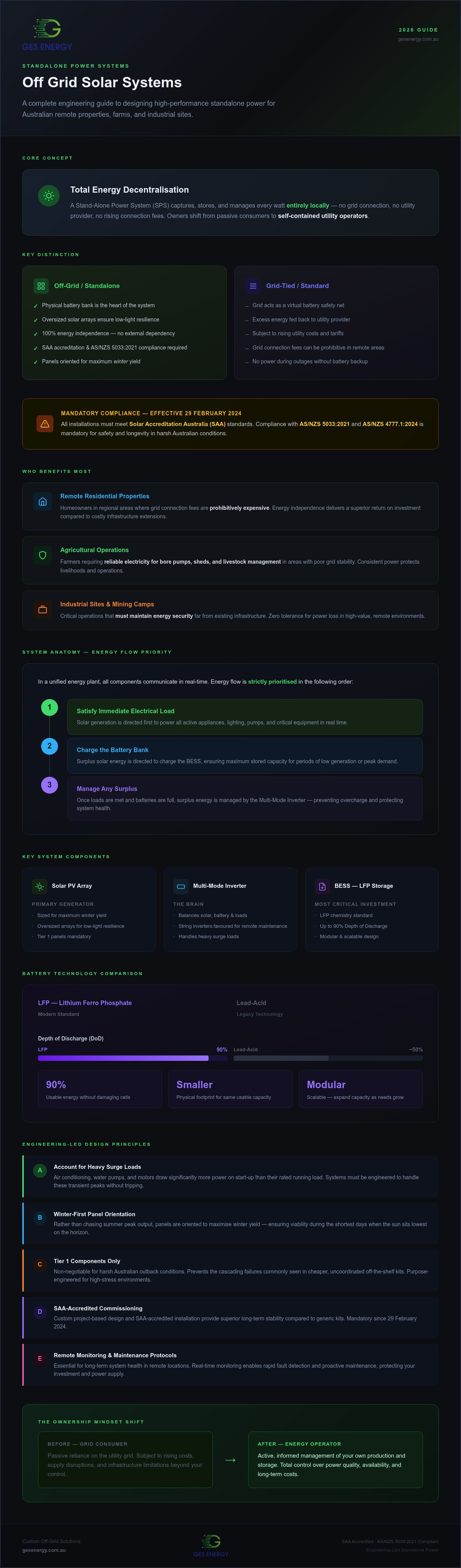
An What is an Off Grid Solar System? is far more than a simple collection of photovoltaic panels on a roof. It is a sophisticated, standalone energy ecosystem designed to function entirely independently of the national electricity grid. While a standard residential setup typically feeds excess energy back to the utility provider, a Stand-Alone Power System (SPS) captures, stores, and manages every watt locally. This architecture represents a fundamental shift from being a passive consumer to becoming a self-contained utility provider.
Off-Grid vs. Grid-Tied: The Key Differences
The most significant technical distinction is the absence of a utility safety net. In a grid-tied system, the grid acts as a virtual battery. In a standalone setup, the physical battery bank is the heart of the operation. Systems must be engineered with oversized solar arrays to ensure enough energy is harvested during low-light periods to keep batteries charged. Additionally, as of 29 February 2024, all installations must meet rigorous Solar Accreditation Australia (SAA) standards. Compliance with AS/NZS 5033:2021 and the updated AS/NZS 4777.1:2024 is mandatory to ensure safety and system longevity in harsh Australian conditions.
Who Benefits Most from Standalone Power?
- Remote residential properties: Homeowners in regional areas where grid connection fees are prohibitively expensive find that energy independence offers a better return on investment.
The Anatomy of a Standalone Energy Ecosystem
A high-performance off grid solar system functions as a unified energy plant. Unlike grid-tied setups that rely on external stability, a standalone ecosystem requires every component to communicate in real-time. This synchronisation ensures that energy flow is prioritised correctly: first to satisfy the immediate electrical load, then to charge the battery bank, and finally to manage any surplus. For industrial or remote residential applications, using "Tier 1" components is a non-negotiable requirement. These parts are engineered for the high-stress environments typical of the Australian outback, ensuring long-term reliability and preventing the cascading failures often seen in cheaper, uncoordinated kits.
Solar PV Arrays and Inverter Technology
The solar array is your primary generator, but the inverter is the brain. In off-grid configurations, a Multi-Mode Inverter manages the complex task of balancing solar input with battery storage and house loads. While micro-inverters offer shade tolerance, many large-scale standalone systems favour high-efficiency string inverters for their robustness and ease of maintenance in remote areas. Designing the array requires a shift in perspective. Instead of chasing summer peaks, we orient panels to maximise winter yield. This ensures the system remains viable during the shortest days of the year when the sun is lowest on the horizon.
Battery Energy Storage Systems (BESS)
Storage is the most critical investment in your ecosystem. Modern systems have transitioned almost entirely to Lithium Ferro Phosphate (LFP) chemistry, which offers significant advantages over traditional lead-acid batteries. LFP provides a much higher Depth of Discharge (DoD), typically allowing you to use up to 90% of the stored energy without damaging the cells. This efficiency means you can install a smaller physical footprint for the same usable capacity. When planning your BESS, scalability is vital. A well-designed system allows for modular expansion, letting you add more storage as your operational needs grow or as you integrate more intensive machinery.
Backup Generation and System Redundancy
Even the most advanced solar arrays face "black events", which are extended periods of heavy rain or thick cloud cover. A backup diesel or petrol generator acts as an essential safety net. We integrate these units with auto-start functionality, allowing the system to trigger the generator automatically when battery levels drop below a pre-set threshold. This redundancy is what separates a hobbyist setup from a professional-grade power solution. For those managing temporary sites or expanding rapidly, a portable off grid solution can provide the necessary bridge while permanent infrastructure is being commissioned.
Sizing and Designing Your System for Australian Conditions
Designing a reliable off grid solar system requires moving beyond generic online calculators. These tools often fail to account for the specific environmental stressors found across the Australian continent. A professional design starts with a rigorous engineering-led assessment of your actual energy needs. We look at temperature derating, where extreme heat reduces the efficiency of both inverters and battery storage. This is a critical factor for standalone power in Australia, as system performance can drop significantly when ambient temperatures exceed 40 degrees Celsius. We also apply the "Three-Day Rule" to every project, ensuring your off grid solar system has enough autonomy to maintain critical functions during extended periods of heavy cloud cover without relying solely on a generator.
Conducting a Detailed Load Analysis
The Winter Solstice Benchmark
The ultimate test for any off-grid setup is the winter solstice. This is the shortest day of the year, providing the least amount of solar harvest. We use this date as our sizing benchmark because if the system performs on June 21st, it will thrive the rest of the year. Our goal is to balance the array size so that your batteries reach 100% charge by midday, even in winter. This requires adjusting panel tilt angles to capture the low-angle winter sun more effectively. A steeper pitch might sacrifice some summer peak production, but it ensures the reliability and health of your battery bank during the months when energy production is most challenged.
Ensuring Long-Term Reliability and System Health
Smart Monitoring and Predictive Maintenance
Modern energy management relies heavily on digital analytics. Remote monitoring platforms allow you to track energy production and consumption in real-time through cloud-based interfaces. This data is invaluable for predictive maintenance. By analysing discharge patterns, we can identify declining battery health or inverter irregularities before they lead to a total blackout. For remote site managers, these tools provide peace of mind by allowing technical oversight from hundreds of kilometres away. If you are managing older infrastructure, GES Energy offers specialised technical support and solar inverter repairs and warranties to bring legacy systems up to modern standards.
Physical System Stewardship
Digital tools are powerful, but they cannot replace physical stewardship. In dusty regional environments, a layer of grime on your panels can reduce energy harvest by significant margins over time. You should organise a regular schedule to clear debris and check for "hot spots" caused by uneven shading or panel damage. High-UV exposure in Australia can also degrade cable integrity and housing seals if they are not inspected regularly. Additionally, your backup generator must be tested under load at least once a month. This ensures the mechanical components remain lubricated and the fuel system is clear, guaranteeing it will start during a critical "black event".
Consistent oversight prevents small issues from escalating into expensive repairs. By combining smart analytics with a disciplined inspection schedule, you protect the stability of your energy ecosystem. This diligent approach ensures your standalone power remains a reliable asset for decades, providing the security and independence you initially invested in.
Partnering with GES Energy for Custom Off-Grid Solutions
GES Energy operates as a national specialist in high-performance energy infrastructure. We understand that a reliable off grid solar system is not a commodity you buy off a shelf; it is a bespoke engineering project. While generic retailers focus on shipping boxes, our approach prioritises the long-term stability of your power supply. We provide end-to-end management, from the initial engineering-led design to the final commissioning by SAA-accredited technicians. This ensures every system we deploy, whether a remote residential setup or a 5 MW industrial micro-grid, meets the rigorous Australian standards required for 2026.
The GES Energy Design and Installation Process
Our process begins with a detailed consultation to establish your specific energy modelling requirements. We don't rely on guesswork. We analyse your seasonal load profiles to ensure the hardware we procure is perfectly matched to your operational needs. Once the design is finalised, we manage the procurement of Tier 1 components that are built to withstand local environmental stressors. The final stage involves professional commissioning and comprehensive user training. We want you to have total control over your energy ecosystem, backed by the knowledge that your installation was handled by licensed professionals with a national footprint.
Future-Proofing Your Energy Infrastructure
The energy landscape is changing quickly, and your infrastructure must be ready to adapt. We design scalable systems that can grow alongside your business or family needs. This often includes the integration of high-capacity EV charging stations into your existing off grid solar system. By planning for these future loads today, you avoid the cost and complexity of major retrofits later. For those managing larger operations, our guide on Commercial Solar: 2026 Guide for Australian Businesses provides deeper insights into how industrial-scale solar can secure your operational independence.
Choosing a partner for your energy transition is about more than just hardware. It is about securing a diligent steward who remains committed to the ongoing health and performance of your system. With GES Energy, you gain a professional partner who understands the intricacies of complex energy transitions and provides the peace of mind that comes with expert oversight. Our commitment to SAA-accredited labour and rigorous commissioning ensures your path to total energy independence is stable, predictable, and built for the long term.
Securing Your Energy Independence in 2026
Transitioning to a standalone power solution is a significant step toward total self-sufficiency and long-term cost stability. As we've explored, a high-performance off grid solar system is a complex ecosystem that requires more than just high-quality hardware. It demands a rigorous, engineering-led approach to ensure your power supply remains predictable during the shortest winter days and the most intense summer heatwaves. By focusing on site-specific load profiling and professional commissioning, you move beyond the limitations of generic kits and invest in infrastructure that is truly built for Australian conditions.
Success in the off-grid space is defined by meticulous planning and ongoing stewardship. Our team at GES Energy provides the expertise needed to navigate these transitions with confidence. We combine an engineering-led design process with a national support network to ensure your system performs at its peak from day one. When you're ready to take control of your energy future, our SAA-accredited installers are here to provide the technical oversight and professional commissioning your project deserves.
Request a Custom Off-Grid Design from GES Energy today. We look forward to helping you build a resilient, future-ready energy ecosystem that delivers genuine independence and peace of mind for years to come.
Frequently Asked Questions
How much does a typical off-grid solar system cost in Australia?
The cost of an off grid solar system varies based on the scale of your energy requirements. A basic system typically ranges from $25,000 to $35,000; while mid-range setups designed for standard family homes cost between $35,000 and $60,000. These prices are offset by Small-scale Technology Certificates (STCs) and the federal battery rebate; which can provide significant upfront discounts for eligible installations in 2026.
Can I run my entire house or business off-grid with solar?
What happens to my off-grid system on cloudy or rainy days?
Your system relies on stored energy from your battery bank during periods of low sunlight. Most professional designs incorporate two to three days of autonomy to ensure you have enough power for daily use during standard weather events. If heavy cloud cover persists beyond this period; an integrated backup generator will automatically trigger to support your loads and recharge the batteries.
Do off-grid solar systems require a lot of maintenance?
Standalone systems require consistent stewardship rather than intensive labour. You should clean your panels regularly to remove dust and debris; as this maintains optimal energy harvest in regional Australian environments. We also recommend annual professional health checks to inspect electrical connections and test the backup generator; which ensures your system remains compliant with SAA standards and manufacturer warranties.
How long do the batteries in an off-grid system last?
Modern Lithium Ferro Phosphate (LFP) batteries typically provide a service life of 10 to 15 years. Their longevity depends on their cycle life and how deeply they are discharged on a daily basis. By choosing high-quality Tier 1 components and ensuring the battery bank is stored in a temperature-controlled environment; you can maximise the return on your energy storage investment.
Is it possible to add more panels or batteries to my system later?
Scalability is a primary feature of a well-engineered off grid solar system. We use modular inverters and battery banks that allow for straightforward expansion as your energy needs grow. It's important to discuss your future plans during the initial design phase so we can ensure the balance of the system; including cabling and housing; is ready for additional hardware.
Do I need a backup generator for my off-grid solar setup?
A backup generator is a critical safety net for any standalone energy ecosystem. While your solar array is your primary generator; a diesel or petrol unit provides essential redundancy during rare "black events" or extended rainy periods. This ensures your critical infrastructure stays powered 24/7; providing peace of mind that your energy independence won't be compromised by extreme weather patterns.
What are the main advantages of an off-grid system over a grid-connected one?
The main advantages are total energy independence and the elimination of rising electricity bills. You are completely protected from grid instability and the high cost of connecting remote properties to the national network. Additionally; you gain full control over your energy production and quality while significantly reducing your environmental impact through the use of clean; locally harvested renewable energy.


