

A higher-kilowatt inverter isn’t automatically the right choice for a commercial site. Commercial solar inverter specifications are useful when you match them to the PV array, site conditions and grid connection requirements.
It’s understandable to start with output rating because it seems like a straightforward way to compare options. But AC capacity, DC input limits, MPPT configuration, voltage range and operating conditions all affect whether an inverter suits your array and site’s electrical setup. In Victoria, grid-connection requirements are another key design consideration, particularly for larger systems.
This guide explains the main AC, DC and MPPT ratings in practical terms, so you can compare inverter options against your project rather than headline figures alone. It also covers grid connection, operating conditions and servicing, plus the site information that helps shape a commercial system design. GES Energy designs commercial solar systems from 10 kW to 5 MW, connecting equipment choices with site and project requirements through its solar system design service.
Key Takeaways
- Read commercial solar inverter specifications as a set of related ratings, not a single output figure.
- Assess inverter capacity alongside the PV array, roof orientations, shading and MPPT configuration.
- Compare AC output, DC input limits, operating conditions and monitoring to assess whether an option fits your project.
- Prepare details about site loads, PV layout and grid connection needs for a more informed design assessment.
- See how GES Energy’s solar system design service turns site requirements into coordinated system specifications.
Commercial solar inverter specifications: what the numbers tell you
A commercial solar inverter converts the direct current (DC) electricity produced by a photovoltaic (PV) array into alternating current (AC) electricity for the connected system. Its rated output is a useful starting point, but it cannot tell you on its own whether the inverter suits a site. DC input limits, the number and arrangement of maximum power point trackers (MPPTs), operating conditions and monitoring functions also shape how the system can be designed and managed.
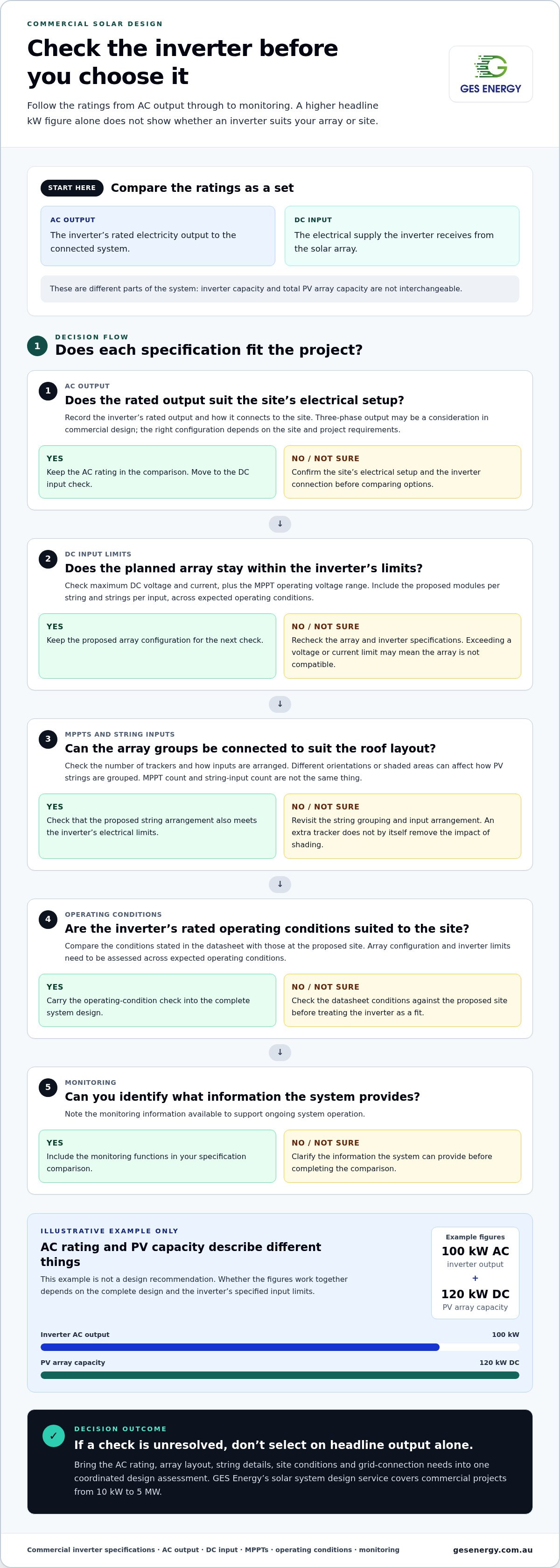
Read a datasheet in a consistent order to build a clear comparison:
- AC output: Record the inverter’s rated output and how it connects to the site’s electrical system.
- DC inputs: Check the input requirements and limits against the planned PV array.
- MPPTs: Note the number of trackers and how the inputs are arranged.
- Operating conditions: Check the conditions the inverter is rated to operate in at the proposed site.
- Monitoring: Identify the information the system can provide to support ongoing operation.
This sequence helps you assess commercial solar inverter specifications as part of a complete design, rather than treating the highest output figure as the automatic choice.
What do AC output and DC input ratings mean?
AC output is the inverter’s rated electricity output to the connected system. DC input describes the electrical supply it receives from the solar array. These ratings refer to different parts of the system, so inverter capacity and total PV array capacity aren’t interchangeable.
Illustrative example, not a design recommendation: Inverter AC output: 100 kW. PV array capacity: 120 kW DC. These figures describe the inverter’s rated output and the array’s capacity separately. Whether they work together depends on the complete design and the inverter’s specified input limits.
What do MPPT and three-phase mean on a datasheet?
MPPT means maximum power point tracking. It describes how the inverter tracks the PV array’s operating point to convert available DC electricity. MPPT count and input arrangements affect how the array can be grouped and connected, which matters when panel areas have different orientations or shading. A higher tracker count alone doesn’t establish that an inverter is the right fit. For broader background, see Solar inverter technology and types.
Three-phase output supplies AC electricity across three electrical phases rather than one. It’s a common consideration in commercial system design, but the right inverter configuration depends on the site’s electrical setup and project requirements. Review these details together to give the design team a practical basis for assessing inverter options and array compatibility.
Specifications only make sense in context. Roof layout, site conditions and the wider electrical design all influence which ratings matter most. GES Energy’s solar system design service connects these factors with coordinated specifications for commercial solar projects from 10 kW to 5 MW.
Match inverter output, DC input and MPPTs to the solar array
Assess inverter capacity and PV array capacity together. A larger array may be considered alongside an inverter with a lower AC output, but the design must stay within the inverter’s DC input limits and suit the site’s energy needs. There isn’t one DC-to-AC sizing ratio that applies to every commercial project.
Start with the roof or ground-mount layout. Available areas, panel orientations and shading influence how modules can be divided into strings and connected to the inverter. The final arrangement also needs to meet the inverter’s electrical limits in its datasheet. The number of panels that fit on site is only one part of the assessment.
How do MPPTs and string inputs affect array layout?
MPPT count helps determine how PV strings can be grouped. An MPPT tracker follows an array group’s operating point, while a string input is a physical connection for a PV string. A datasheet may show multiple string inputs assigned to one tracker, so the terms aren’t interchangeable.
For example, a roof with one section facing east and another facing west may need the arrays grouped to account for their different sunlight conditions. Separate MPPTs can allow distinct groups to be tracked independently, provided the inverter’s input arrangement and electrical limits suit the proposed strings. Shading also affects array output, so account for shaded areas in the layout rather than assuming an extra tracker will remove the impact.
How should you assess DC-to-AC sizing?
DC-to-AC sizing describes the relationship between the PV array’s DC capacity and the inverter’s AC rating. It’s a design decision, not a stand-alone measure of performance. Designers assess the site’s energy needs, array conditions and inverter limits together before deciding how the capacities should relate.
Check the datasheet’s maximum DC voltage and current, as well as the MPPT operating voltage range. The array configuration must stay within these limits across expected operating conditions. Include the proposed number of modules in each string and the strings connected to each input in this check. An array that exceeds a voltage or current limit may not be compatible with the inverter.
Some inverter models permit DC capacity above their AC rating, but any oversizing allowance is model-specific. Don’t apply a percentage from one product range as a universal rule. Check the relevant datasheet and assess the complete array configuration as part of the project design. For Australian project context, the Clean Energy Council provides Australian clean energy industry standards and related industry information.
To align array layout, inverter inputs and site requirements, GES Energy’s commercial solar system design service brings these details into one project assessment.
Compare commercial inverter specifications beyond the headline kW rating
A higher rated output or efficiency figure doesn’t automatically make an inverter the better choice. Compare each option with the proposed array, site conditions and operating needs. A structured review of commercial solar inverter specifications helps you distinguish relevant technical information from broad marketing claims.
Use the current manufacturer datasheet for each exact model. Record the model and datasheet version or date alongside the figures, so you can see what each comparison refers to. Compare efficiency figures only when the stated measurement conditions and metric are equivalent. A peak figure for one inverter may not be directly comparable with a different efficiency measure for another.
Which specifications matter most when comparing datasheets?
Check rated AC output, maximum DC input, voltage range and current limits against the planned system design. Then compare MPPT count and string inputs, monitoring provisions, stated protection features and the manufacturer’s operating conditions. Record warranty terms from manufacturer information, and note what each term covers rather than treating warranty periods as equivalent.
| Specification | What to compare | Source and context to record |
|---|---|---|
| AC output | Rated output and stated conditions | Exact model and manufacturer datasheet |
| DC input | Maximum voltage, current and operating range | Exact model, input configuration and datasheet |
| MPPTs and strings | Tracker count and string input arrangement | Exact model and relevant connection details |
| Operating conditions | Manufacturer-stated conditions and limits | Exact model and datasheet section |
| Monitoring and protection | Documented functions and stated protection features | Manufacturer documentation for the model |
Use this as a comparison worksheet, not as a substitute for design checks. If a brochure lists a feature without its conditions or model context, find the corresponding technical documentation before relying on it.
How do different inverter designs affect a commercial site?
Centralised and string-based layouts arrange conversion equipment differently. The choice can affect system layout, equipment locations and how the project is divided for inspection or servicing. Neither approach is right for every site: the array configuration and project design determine which arrangement is suitable.
Assess access as well as electrical fit. Equipment placement can affect how technicians reach units for inspection and maintenance. The number and location of units can also shape servicing logistics. Compare the proposed layout with practical site access and the manufacturer’s stated operating conditions.
Keep verified datasheet figures separate from marketing language in your comparison. A clear record helps you identify which options meet the project’s requirements and which need further technical assessment before selection.
Check Australian and Victorian site conditions before choosing an inverter
A datasheet can show whether an inverter’s electrical ratings appear suitable, but the site determines what the system needs to do and how it can connect. Work through four areas before finalising the equipment: site loads, PV layout, grid connection requirements and ongoing operations. This gives the design a practical basis and can surface constraints early.
- Site loads: Gather the site location, operating schedule and electricity-use information. Identify when the business uses power and what the system is expected to support.
- PV layout: Record proposed array areas, orientations, shading and physical constraints. These details inform how the array can be arranged and matched to inverter inputs.
- Grid connection: Identify the relevant electricity network and connection process. Requirements can vary with the site and proposed system, so an inverter rating alone can’t establish connection suitability.
- Operations: Consider equipment placement, access for inspection and servicing, weather exposure and practical maintenance needs.
What site details influence inverter selection?
Location and site conditions help determine whether the inverter’s stated operating limits suit the installation. The proposed equipment position should account for exposure and service access, while the array layout must reflect the available roof or ground area. A site assessment brings these factors together with the business’s energy use, connecting equipment specifications to real project requirements.
For Victorian businesses, network requirements are relevant from the early design stage. The applicable distributor and connection process depend on the site location and proposed project. GES Energy is based in Melbourne and serves businesses across Australia, with a strong focus on Victoria.
How do grid connection and safety shape the specification?
Grid connection is a project design and approval consideration, not something an inverter can guarantee. For Australian grid-connected installations, AS/NZS 4777.2:2020 Amendment 2:2024 became mandatory for new inverters on 23 August 2025. Victoria also requires CSIP-AUS communications for new solar systems. Apply the current standard and network requirements to the specific project before making design decisions.
These requirements sit alongside equipment selection. Consider the inverter model, proposed system and site connection together. An SAA-accredited installation supports professional project delivery, but it doesn’t guarantee network approval. GES Energy’s design process connects site details, applicable requirements and equipment choices, rather than treating any single datasheet figure as the whole answer.
Prepare your site location, operating schedule, electricity-use information and proposed PV layout for a clear assessment. Plan your commercial solar system design around the site’s operating and connection requirements.
How GES ENERGY turns inverter specifications into a project design
Datasheet figures become useful when they’re assessed alongside the site, PV array and project objectives. GES Energy’s solar system design service brings these requirements together to shape coordinated system specifications, including inverter selection and array configuration. The design scope is tailored to each project, linking equipment choices with practical site needs.
What information helps scope a commercial solar design?
Useful starting information gives the design team a clearer view of how the business operates and what the site can support. Prepare available site plans, electricity-use information, operating schedules and project objectives. Note planned changes that could affect energy demand or how the system will be used.
These details help inform the proposed PV array and inverter design. Site plans show potential array locations and constraints, while electricity-use patterns and operating schedules help define the system’s intended role. The design process can then assess how inverter capacity, DC input limits and MPPT arrangements relate to the proposed array and site conditions.
Keep project expectations tied to verified design information. Output estimates depend on the project’s actual inputs and design assumptions, while savings depend on factors such as site use and energy arrangements. A generic equipment figure cannot promise a specific result.
When do EPC and ongoing inverter support matter?
For larger or more involved energy projects, EPC services coordinate engineering, procurement and construction. This connects technical design decisions with equipment selection and project delivery. GES Energy provides EPC services tailored to each project’s scope and requirements.
GES Energy’s in-house teams hold ISO 9001, ISO 14001 and ISO 45001 certifications. These systems support structured quality, environmental and safety practices across project work. Alongside design coordination, they help keep technical decisions connected to practical delivery requirements.
With site information and project objectives in hand, you can move from comparing ratings to assessing a coordinated design. Discuss your commercial solar system design with GES Energy.
Put your inverter decision into a project plan
Turn your technical review into a clear project brief. Consider how the proposed system will support your business as its energy use, site operations or future plans change. This helps keep the inverter decision connected to the project’s purpose, rather than narrowing it to a comparison of catalogue figures.
Use your preferred options and site information as the starting point for a design discussion. GES Energy can assess commercial solar inverter specifications in the context of your project and develop a system design suited to its requirements. Its commercial solar work includes SAA-accredited installation, maintenance support and a 10-year workmanship warranty for solar projects. This covers workmanship, not the inverter manufacturer’s warranty.
Take the next step towards a design grounded in your site and business needs. Plan your commercial solar project with GES Energy, and move forward with a clearer basis for your investment.
Frequently Asked Questions
What does the rated AC output on a commercial solar inverter specification mean?
Rated AC output indicates the inverter’s stated output capacity under the conditions set out by its manufacturer. It’s useful for comparing equipment, but it doesn’t predict how much electricity a site will generate or use. For commercial solar inverter specifications, read the rating alongside the proposed array, site demand and applicable operating limits. Actual output varies with system design and operating conditions.
How many MPPTs does a commercial solar inverter need?
There’s no single MPPT count that suits every commercial array. The number depends on how the PV modules are arranged and whether different sections have different orientations or shading. For example, separate roof areas may need distinct groups tracked independently. The inverter’s input configuration and electrical limits also matter, so assess the full layout rather than choosing by tracker count alone.
Can a commercial solar inverter have a lower AC rating than the solar array’s DC capacity?
Yes, a PV array’s DC capacity can be higher than the inverter’s rated AC output in some designs. That relationship must stay within the inverter manufacturer’s specified DC input limits and suit the project’s operating needs. Don’t assume an oversizing allowance from one model applies to another. A designer should assess the exact inverter datasheet, array configuration and expected site conditions before settling on the system design.
Is a higher-efficiency commercial inverter always the better choice?
No. A higher published efficiency figure alone doesn’t establish that an inverter suits your site. Compare figures measured under equivalent conditions, then assess array compatibility, operating limits, monitoring provisions and service access. A model with a headline advantage may still be unsuitable if its inputs or installation requirements don’t match the project. Base the decision on verified technical data and the system’s wider needs.
What happens if a commercial solar inverter stops operating?
If an inverter stops converting power, the solar system may stop supplying AC electricity from the array until the issue is resolved. Check the system’s monitoring or display for a fault message and record when the problem began. Don’t open the inverter or handle electrical connections. GES Energy provides solar inverter repairs and warranty assistance. Diagnosis and next steps depend on the fault and equipment.
How often should a commercial solar inverter be inspected or maintained?
Follow the manufacturer’s maintenance instructions and set an inspection schedule that reflects the system, installation conditions and site operations. Keep monitoring fault records and note changes in system performance, as these can help identify an issue for assessment. Avoid assuming one fixed interval applies to every installation. GES Energy’s maintenance support can help businesses manage system checks and inverter warranty assistance as part of ongoing solar care.
Do commercial solar inverter specifications need to meet Australian grid-connection requirements?
Yes. A grid-connected commercial system must be designed around the applicable Australian standards and the network connection process for its site. Requirements can depend on the proposed system and local distributor, so model suitability alone doesn’t confirm connection approval. This matters for businesses across Victoria, including Melbourne, Geelong, Ballarat, Bendigo, Shepperton, Melton, Mildura, Wodonga, Traralgon, Wangaratta, Horsham, Sale, Colac, Ararat, Portland, Swanhill, Benalla and Maryborough.


