

Could a 150 kW solar project qualify for more than one incentive in 2026? It may, depending on your location, system design and the rules that apply. From 1 October 2026, the federal Small-scale Renewable Energy Scheme provides support for eligible solar PV systems up to 1 MW. In Victoria, eligible commercial systems between 30 kW and 200 kW may also qualify for a Victorian Energy Upgrades discount. That’s why commercial solar rebates australia aren’t a single, one-size-fits-all offer.
It’s easy to confuse business incentives with residential rebates or overlook requirements such as system size, approved equipment, accredited providers and network pre-approval. Eligibility isn’t automatic, and each scheme has its own criteria, process and timing.
This guide explains the federal pathways, how Victoria’s programme differs, and what business, site and energy-use details to prepare before planning a project. GES Energy designs commercial solar systems from 10 kW to 5 MW and provides EPC services for solar, battery and EV charging projects. For businesses across Melbourne, Geelong, Ballarat, Bendigo, Shepparton, Melton, Mildura, Wodonga, Traralgon, Wangaratta, Horsham, Sale, Colac, Echuca, Ararat, Portland, Swan Hill, Benalla and Maryborough, system design and project planning can account for site requirements and relevant incentive criteria without assuming a rebate will apply.
Key Takeaways
- Commercial solar rebates australia depend on more than business type: location, system capacity and project details all affect which pathways may apply.
- Compare federal solar and battery incentives by technology, scale and how support is delivered before including them in your project plan.
- Prepare recent energy bills, interval data, operating hours and site information to make an eligibility assessment more practical.
- Size a system around your energy use and site constraints. Treat incentives as one input in the engineering and financial assessment.
Commercial solar rebates in Australia: what support can businesses actually access?
Commercial solar rebates australia can refer to several types of support, not just money returned after installation. Depending on the scheme, a business may receive an upfront discount, participate in a certificate-based incentive, apply for a grant or receive tax treatment under current rules. Each pathway has its own eligibility criteria, process and timing. Treat an advertised incentive as a possibility to assess, not a guaranteed project saving.
A rebate is a direct reduction in eligible project costs; a certificate-based incentive creates or assigns certificates whose value may be applied as a discount or realised through a market transaction. The distinction matters when comparing project proposals. Support might appear on an invoice, depend on certificate value or follow a separate application process.
The broader Solar power in Australia overview provides context on solar across residential, commercial and industrial settings. For your project, the applicable scheme rules and site details determine which support may apply.
Why commercial solar incentives differ from household support
A business installation is assessed under the rules for its scheme, not automatically under household solar or home battery programmes. A non-residential site may have different system-size thresholds, equipment conditions and application steps. The business’s activities, electricity use and installation location can also affect eligibility.
For example, a solar system on a warehouse or office is assessed as a business project, while a household programme may be limited to a home and eligible equipment. A mixed-use site may need closer assessment of how the programme defines the premises and applicant. Check current programme documents before basing a design or budget on an incentive, as rules and availability can change.
Rebate, certificate or tax deduction: what is the difference?
A rebate or discount reduces eligible costs under a particular scheme. It may be applied upfront or follow an approval process; the amount and delivery method depend on the programme’s conditions. A grant is generally application-based funding, with its own purpose, assessment criteria and available funding.
Certificates work differently. An eligible activity may create certificates under a scheme, and their value can vary with scheme rules and market factors. Depending on the programme, certificates may be assigned or sold, with the resulting value contributing to an upfront discount or other financial benefit. Don’t treat an estimated certificate value as fixed cash until the scheme’s calculation and delivery process are clear.
A tax deduction is not a cash rebate. It may affect taxable income under applicable tax rules rather than directly reducing the installer’s invoice. Tax outcomes depend on your business circumstances, so check current Australian Taxation Office (ATO) guidance or seek advice from a registered tax professional before including a tax benefit in your project assessment.
Federal commercial solar incentives: compare SRES, certificates and battery support
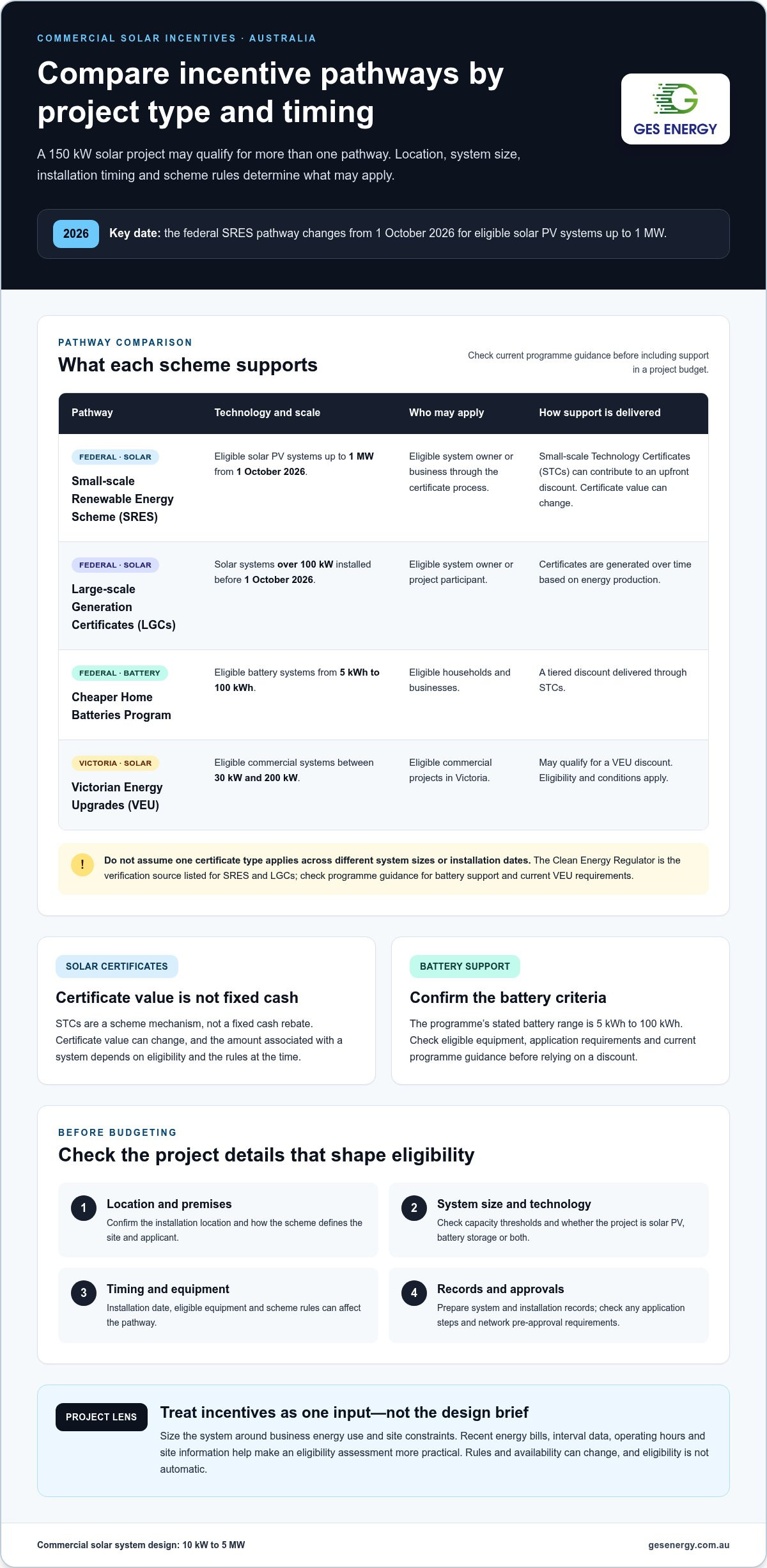
Federal support depends on whether your project installs solar PV, battery storage or both. The scheme name alone doesn’t establish eligibility: system capacity, installation timing, equipment and documentation can all matter. The comparison below reflects the rules available in 2026. Confirm current requirements with the relevant programme source before finalising project assumptions.
| Scheme | Technology and scale | Applicant | How support is delivered | Verification source |
|---|---|---|---|---|
| Small-scale Renewable Energy Scheme (SRES) | Eligible solar PV systems up to 1 MW from 1 October 2026 | Eligible system owner or business through the certificate process | Small-scale Technology Certificates (STCs) can contribute to an upfront discount | Clean Energy Regulator |
| Large-scale Generation Certificates (LGCs) | Solar systems over 100 kW installed before 1 October 2026 | Eligible system owner or project participant | Certificates are generated over time based on energy production | Clean Energy Regulator |
| Cheaper Home Batteries Program | Eligible battery systems from 5 kWh to 100 kWh | Eligible households and businesses | A tiered discount delivered through STCs | Program guidance and Clean Energy Regulator |
How SRES and small-scale technology certificates may apply
STCs are a scheme mechanism, not a fixed cash rebate. Their value can change, and the amount associated with a system depends on eligibility and the rules applying at the time. From 1 October 2026, the SRES covers eligible solar PV systems up to 1 MW. Systems above 100 kW installed before that date sit within the earlier LGC pathway described above. Don’t assume one certificate type applies across different installation dates or system sizes.
Check system capacity, installation criteria and application steps against current Clean Energy Regulator guidance. Certificate creation or assignment depends on the required system and installation records. Equipment requirements also matter: the Clean Energy Council Industry Programs outlines industry programmes relevant to approved products and accredited installers. Keep project documentation aligned with the applicable scheme.
Battery support and tax treatment need separate checks
The Cheaper Home Batteries Program’s name can suggest household-only support, but the 2026 guidance includes eligible businesses. It applies to battery systems from 5 kWh to 100 kWh, with a tiered STC discount. As at 1 May 2026, the rate for the first 14 kWh was 6.8 STCs per usable kWh; the next rate reduction is scheduled for 1 January 2027. Confirm current terms and assess battery eligibility separately from solar PV incentives.
Tax treatment is another distinct consideration, not an upfront rebate. The result depends on current law and your business circumstances, so consult current Australian Taxation Office guidance or a registered tax professional. GES Energy’s commercial solar system design service can align system scale, site requirements and relevant incentive criteria without assuming an incentive will apply.
Victoria commercial solar rebates: understand the VEU discount and its limits
Victoria’s commercial solar pathway is separate from household rebates. Under the Victorian Energy Upgrades (VEU) programme, eligible solar PV installations at non-residential premises may receive an upfront discount through Victorian Energy Efficiency Certificates (VEECs). A VEU-accredited provider manages the certificate process and applies the discount to the invoice, subject to programme requirements.
Victorian commercial solar discount eligibility depends on the premises, system specifications, provider and other current VEU programme criteria; a project’s location in Victoria alone doesn’t guarantee support. The programme can sit alongside federal incentives where each scheme’s criteria are met. For businesses assessing commercial solar rebates australia, check both pathways against the project design rather than treating a state discount as automatic.
Which Victorian businesses and solar systems may qualify?
The VEU criteria cover solar PV systems at non-residential premises with PV module capacity from 30 kW to 200 kW and inverter capacity of at least 30 kVA. These thresholds are a starting point, not a substitute for current programme documents. Confirm how the VEU defines capacity and premises before finalising system design or estimating a discount.
Projects outside the stated band, including larger installations, may need a different certificate or programme pathway. Federal support may also apply to some system sizes, but it has separate rules. Assess each scheme independently, including installation timing and the criteria in force when the project proceeds.
How VEU requirements affect project design
VEU participation requires a VEU-accredited provider. The provider handles VEEC creation and applies the discount, while the business should allow for the required local Distribution Network Service Provider (DNSP) pre-approval before installation begins. Network approval is a project-planning step, not paperwork to leave until construction is ready to start.
Product selection also needs attention. The programme guidance identifies approved product lists for panels and inverters. Review the current activity requirements for any warranty and monitoring conditions, and retain relevant equipment and system records. Don’t assume a product or system design qualifies simply because it meets the stated capacity band.
GES Energy designs commercial and industrial solar projects for businesses across Victoria, including Melbourne, Geelong, Ballarat, Bendigo, Shepparton, Melton, Mildura, Wodonga, Traralgon, Wangaratta, Horsham, Sale, Colac, Echuca, Ararat, Portland, Swan Hill, Benalla and Maryborough. Site assessment brings together roof or land constraints, proposed capacity and network-connection planning before equipment is specified. EPC coordination connects engineering, procurement and construction planning, keeping programme criteria visible as the project develops. The final design should serve the site’s energy needs as well as any incentive pathway being assessed.
Before relying on a VEU discount, confirm the current eligibility rules, provider requirements and pre-approval process in official programme guidance. This keeps the incentive estimate tied to the actual project conditions, rather than an advertised threshold alone.
How to check commercial solar rebate eligibility and prepare an application
A clear eligibility check starts with the project, not an advertised discount. Use this sequence to screen possible pathways before treating an incentive as part of your budget: identify the site, define the system, compare current scheme rules, assemble evidence, then validate the application process. This makes commercial solar rebates australia easier to assess without confusing an initial indication with formal approval.
Documents and project details to gather first
Bring together information that describes both the premises and its energy needs. You’ll need authority to carry out work at the site, confirmation that it is non-residential, and enough detail to distinguish the proposed project from a household installation.
- Energy use: recent electricity bills, interval data where available, and operating hours across typical days or seasons.
- Site details: address, site use, roof or land constraints, existing electrical infrastructure, and ownership or permission to install.
- Project scope: proposed solar PV capacity, whether battery storage is included, and the intended system configuration.
- Delivery information: proposed panels and inverters, installer or provider details, network-connection requirements, and any scheme-specific records as they become available.
Keep estimated and confirmed details separate. A preliminary system size can help screen scheme thresholds, but final equipment and connection information may change during engineering.
A step-by-step incentive screening process
Work through each candidate programme separately. Rules can differ by location, technology, capacity, installation timing and applicant, so eligibility for one pathway doesn’t establish eligibility for another.
- Identify the site and applicant. Record the state or territory, premises use, site authority and business applying for support.
- Define project scale. Note proposed PV module and inverter capacities, battery capacity if relevant, and whether the installation is new or an alteration.
- Check official scheme guidance. Review current federal, Victorian and relevant council programme pages. Use the Clean Energy Regulator for federal certificate requirements and Victorian Energy Upgrades material for the state pathway.
- Match the project to the rules. Compare the technology, size, location and applicant against published criteria. Note exclusions, approved-product conditions and any provider accreditation requirements.
- Validate timing and evidence. Confirm whether pre-approval is needed, when applications or network approvals must occur, who creates certificates, and which records must be retained.
This is scheme screening, not formal approval. Don’t order equipment or rely on an estimated incentive as a confirmed saving until the responsible programme or accredited provider has completed the required checks. GES Energy’s commercial solar system design service brings site requirements, energy data and potential incentive criteria into the same project assessment. Discuss commercial solar system design for a project planned around your business’s needs.
Plan a commercial solar project with incentives in view, not as the only driver
Incentives can improve a project’s financial case, but they shouldn’t set system size on their own. Start with how your business uses electricity, then assess the site, engineering requirements and relevant programme rules. A system designed around actual demand can support practical energy goals whether or not a particular incentive applies.
Match system design to business demand and project scale
Review electricity consumption across operating hours, including when demand rises and how much power the site uses during daylight. A business with steady daytime loads may use more of its solar generation on site. If activity peaks outside solar production hours, battery storage may form part of the assessment. These are design considerations, not promises of bill savings; the outcome depends on the site and its energy profile.
Roof condition and available area, shading, electrical infrastructure, network capacity and planned site changes can all affect system design. Proposed capacity should reflect these constraints as well as consumption data. GES Energy designs commercial and industrial systems from 10 kW to 5 MW, with project scope tailored to site requirements.
Keep two questions distinct: Will the system suit the site’s energy needs? And does the project meet an incentive’s eligibility criteria? A system may be technically suitable without qualifying for a particular programme. Conversely, a potential incentive doesn’t make an unsuitable system the right investment.
For larger or more involved projects, battery storage and EPC services can bring engineering, procurement and construction planning together. This coordination helps account for equipment, site work and network considerations as a project develops, while incentive rules remain one part of the wider assessment.
Turn an incentive check into a project plan
Once you’ve identified relevant schemes, build their current criteria and application timing into the project plan. Assess energy data, site constraints, connection requirements and system design alongside the financial case. A clear comparison should show which assumptions are confirmed, which depend on formal approval, and how the project performs if an incentive changes or doesn’t apply. This makes it easier to evaluate commercial solar rebates australia without treating estimated support as guaranteed savings.
GES Energy is a Solar Accreditation Australia (SAA)-accredited installer, designing and installing commercial and industrial solar projects with EPC coordination and ongoing maintenance. Commercial and industrial projects include a ten-year workmanship warranty. These capabilities connect incentive screening with the technical and delivery decisions needed for a project, while eligibility remains subject to programme rules.
Use the commercial solar guide and ROI guide as further reading when assessing system design and project returns. To discuss the next steps for your site, plan a commercial solar project with GES Energy.
Make your next solar decision with confidence
Turn incentive research into a clear project brief. Set out your site’s energy priorities, the system options worth assessing and the assumptions that still need formal confirmation. Compare the project’s case with and without potential support, so a change in programme rules doesn’t leave your decision resting on an unverified discount.
That preparation keeps the focus on long-term fit: how solar could support your operating needs, what site or network requirements need attention, and which incentive pathways warrant further assessment. The right design should make sense for your business first, with eligible support considered as part of the planning process.
For a considered next step, plan a commercial solar project with GES Energy. A well-prepared project brief can make the path from initial assessment to informed planning clearer, so you can move forward with confidence.
Frequently Asked Questions
Can Australian businesses claim STCs for a commercial solar system?
Yes, a business may be able to claim or assign STCs if its system meets the current Small-scale Renewable Energy Scheme (SRES) rules. Eligibility depends on system characteristics, installation requirements and the scheme settings that apply to the project. STCs are certificates, not a fixed government rebate, and their value can change. Check current Clean Energy Regulator guidance before including an estimate in a commercial solar rebates australia forecast.
Does the Cheaper Home Batteries Program cover commercial batteries?
The programme name and some guidance are home-focused, so don’t assume a business battery qualifies. Federal guidance available for 2026 also describes support for eligible business battery systems, but eligibility depends on current programme rules and installation details. Verify the latest official guidance before relying on support. Assess battery incentives separately from solar PV certificate schemes, as they concern different technologies and may have distinct conditions.
What commercial solar systems qualify for the Victorian Energy Upgrades discount?
Victorian Energy Upgrades guidance describes a pathway for eligible solar PV systems at non-residential premises, subject to technical conditions and use of an accredited provider. The 30-200 kW capacity range needs verification against current 2026 programme documents before you plan around it. System size, equipment and other programme requirements determine eligibility; being a Victorian business alone doesn’t qualify an installation. Melbourne sites follow the same scheme criteria.
Can a business combine Victorian solar discounts with federal incentives?
Possibly, but don’t assume that two incentives can be combined for every project. Each programme has its own eligibility rules, certificate requirements and application timing, and the system’s capacity and installation details can affect the outcome. Before including combined assistance in a project forecast, check current official guidance for both schemes and confirm the requirements for the specific system. Treat any preliminary estimate as unconfirmed until the relevant process is complete.
Are commercial solar tax deductions the same as rebates?
No. A tax deduction affects how an eligible expense is treated when calculating taxable income; a rebate or discount reduces eligible project costs under a programme’s rules. The tax outcome can depend on current legislation, your business structure and how the asset is treated. Don’t assume a particular write-off or threshold applies. Check current Australian Taxation Office guidance or speak with a tax adviser about your business’s circumstances.
Do commercial solar rebates apply to systems larger than 200 kW?
Some systems above 200 kW may fall outside a particular state discount pathway, but that doesn’t mean another incentive automatically applies. Other federal or state certificate and programme rules may be relevant, depending on the project’s capacity, technology and installation timing. Distinguish a scheme’s eligibility threshold from the system’s design capacity, then check current rules for the specific project before including support in its financial forecast.
What information should a business prepare before checking solar incentive eligibility?
Gather site and premises details, recent electricity bills or interval data, operating hours, proposed system capacity, equipment information and expected project timing. Keep the proposed solar PV configuration separate from any battery component, as programmes may assess them differently. You may also need provider and network-connection details. An initial screening can identify pathways to investigate, but it isn’t programme approval and doesn’t guarantee a discount or certificate value.


