

What if the greatest obstacle to lowering common property electricity expenses isn't available roof space, but matching your system layout to tenant consumption profiles? Successfully implementing commercial solar for strata buildings requires balancing shared energy needs against complex site limits. If you serve on a body corporate committee, you already know the frustration. Reaching a 75 percent special resolution threshold is notoriously difficult, particularly when split incentives between lot owners and commercial tenants complicate the financial return. Factoring in ageing switchboards and strict grid connection approvals from local distribution networks often stalls viable projects entirely.
You don't have to stay locked in strata gridlock. You will discover how to navigate owners corporation approvals with minimal friction, select the right solar architecture for your meter configuration, and cut shared operating costs. Below is a clear roadmap to pass strata motions, satisfy distribution network service providers, and establish a high-performing clean energy asset for your property.
Key Takeaways
- Assess common property circuits versus multi-tenant distribution models to select the most profitable engineering layout for commercial solar for strata buildings.
- Structure AGM motions methodically using clear financial projections to secure the necessary voting majorities across lot owners.
- Lower upfront capital expenditure by combining sinking funds with federal Small-scale Technology Certificates and state sustainability incentives.
- Commission pre-installation switchboard and electrical riser audits to confirm grid export limits before finalising equipment specifications.
- Partner with an SAA-accredited provider offering comprehensive EPC services and a long-term workmanship warranty to protect common property assets.
Commercial Strata Solar Models: Common Property vs Multi-Tenant Distribution
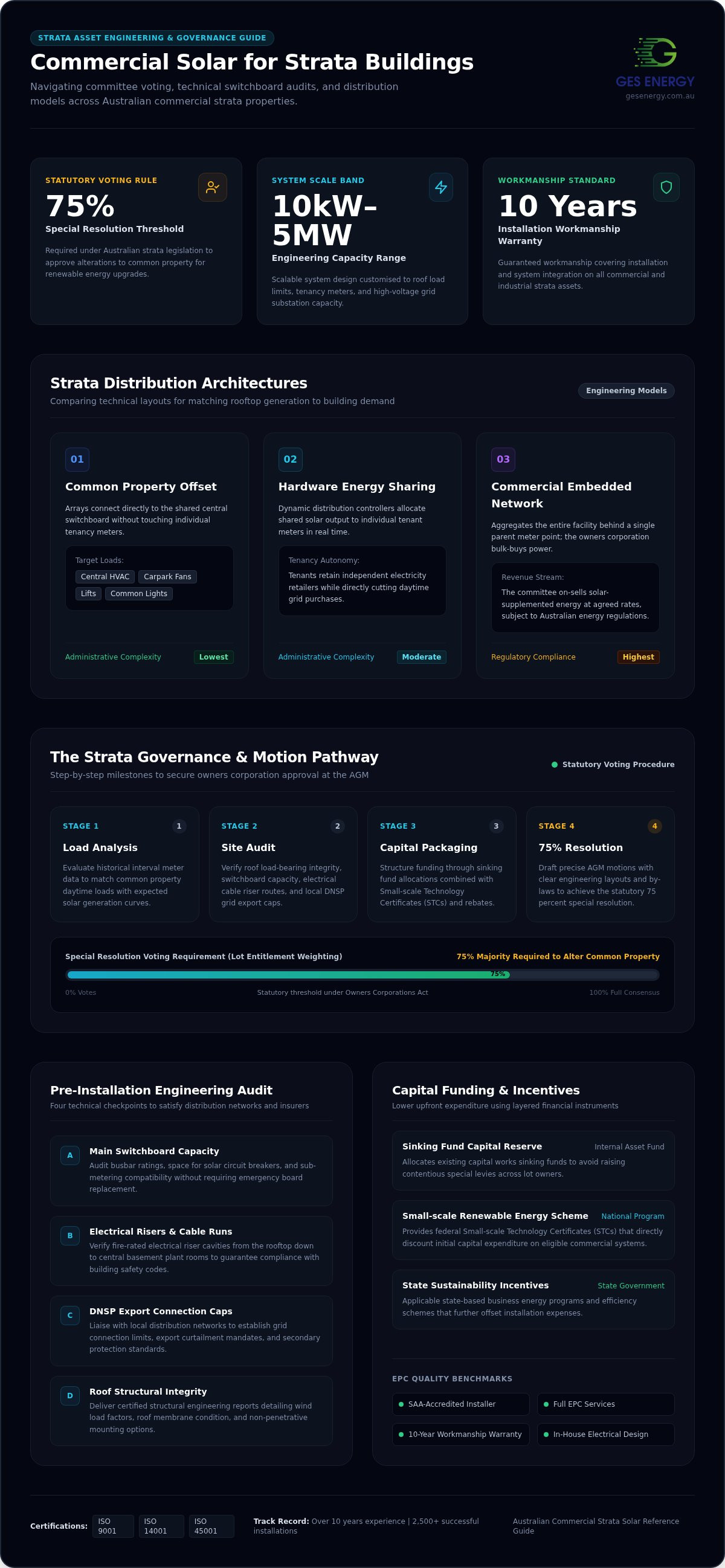
Commercial strata properties operate primarily during daylight hours, creating consumption curves that align closely with solar generation. Choosing how that generation flows through your switchboards dictates both return on investment and administrative overhead. Deploying commercial solar for strata buildings requires a defined engineering model that establishes clear capital allocation, metering paths, and governance boundaries before equipment arrives on site.
To see how an Australian owners corporation integrated solar, battery storage, and charging infrastructure, watch this project breakdown:
Modern photovoltaic (PV) technology offers flexible deployment pathways. Evaluating your building roof area against daytime load profiles determines whether your asset benefits most from a unified common system or an integrated multi-tenant network.
Offsetting Common Property Power Demands
Directly wiring solar arrays to the common property switchboard is the most straightforward pathway. It powers shared infrastructure, including central HVAC systems, carpark ventilation, lifts, and common-area lighting. Because individual tenant retail electricity accounts remain untouched, this configuration avoids billing complexity. It lowers the owners corporation utility expenditure, stabilises quarterly levies, and simplifies administrative oversight.
Hardware Energy Sharing and Embedded Networks
When bodies corporate want to share rooftop generation across multiple commercial tenancies, two primary architectures exist:
- Hardware-Based Energy Sharing: Dynamic controllers allocate solar generation to individual tenancy meters in real time. Tenancies retain their choice of electricity retailer, avoiding utility licensing burdens while cutting daytime reliance on the grid.
- Commercial Embedded Networks: The owners corporation aggregates the building into a single grid connection point. The committee bulk-purchases electricity at wholesale commercial rates and on-sells solar-supplemented power to occupants.
Embedded networks require ongoing billing administration and strict compliance management under Australian energy regulations. For a broader analysis of commercial energy configurations, read this commercial solar 2026 guide for Australian businesses. Matching the physical distribution architecture to tenant occupancy arrangements ensures that commercial solar for strata buildings delivers immediate utility savings without triggering ownership disputes.
Strata Committee Approvals: Navigating By-laws, Voting, and Governance
Gaining consensus across commercial property owners is often the steepest hurdle in the project lifecycle. While residential strata owners might focus on sustainability outcomes, commercial lot owners prioritise balance sheet stability, asset valuation, and predictable operating expenditure. Securing approval for commercial solar for strata buildings demands methodical preparation months ahead of the formal Annual General Meeting (AGM). Presenting incomplete technical specs or vague savings projections almost guarantees a deferred vote.
Passing Sustainability Infrastructure Resolutions
Under the Victorian Owners Corporations Act and equivalent interstate strata legislation, altering common property to install renewable infrastructure typically requires a special resolution, demanding a 75 percent majority vote. Overcoming conservative owner hesitation requires packaging the business case with absolute clarity:
- Include structural engineering certifications that verify the roof's load-bearing integrity.
- Detail precise inverter mounting locations, switchboard interfaces, and fire-rated cable riser pathways.
- Address regulatory safety checkpoints, noting that municipal and electrical permits are required alongside distribution network connection approvals before commissioning begins.
Partnering early with a proven provider of commercial solar EPC services allows SAA-accredited engineers to attend committee meetings directly, answering technical questions regarding grid protection and system safety before votes are cast.
Drafting Clear Strata By-laws and Roof Rights
A successful motion must be accompanied by a registered special privilege by-law or common property rights by-law. Rooftops are common property, meaning ongoing access rights and maintenance liabilities must be formally recorded. Your committee's drafted by-law should resolve several critical points:
- Asset ownership and maintenance: Clarify that the array remains common property managed under the capital works fund, supported by manufacturer warranties and installer workmanship guarantees.
- Roof membrane preservation: Outline explicit procedures for disassembling and reinstating arrays if future roof repairs or waterproofing maintenance arise.
- Revenue and savings allocation: Define how meter savings reduce common levy contributions or how export credits flow back into the administrative fund.
Establishing these governance rules early transforms commercial solar for strata buildings from an administrative headache into an orderly, long-term capital improvement that protects owner equity.
Commercial Strata Solar ROI: Capital Funding, Sinking Funds, and Rebates
Evaluating commercial solar for strata buildings requires looking beyond simple equipment costs. Committees must examine net financial yields, reserve fund health, and statutory incentives. The federal Small-scale Renewable Energy Scheme offers upfront point-of-sale discounts via Small-scale Technology Certificates (STCs) for eligible arrays, directly reducing initial balance-of-system capital outlay. For larger industrial roofs hosting installations over 100 kW, systems can create Large-scale Generation Certificates (LGCs), generating ongoing revenue based on verified clean energy production. To calculate multi-variable cash flows across different panel capacities, consult this detailed commercial solar return on investment Australia guide.
Funding Mechanisms for Strata Schemes
Owners corporations possess multiple avenues to finance capital works without exhausting their general liquidity:
- Capital Works Reserve Allocations: Deploying existing sinking funds avoids striking disruptive special levies. Solar replaces recurring operational power expenses with an appreciating physical asset on common property.
- Strata Green Loans: Specialist clean-energy debt facilities spread upfront expenditure across manageable terms. Matching quarterly repayments directly against realized utility bill reductions delivers a cash-flow-positive outcome from the first billing cycle.
- Environmental Upgrade Agreements (EUAs): In participating Victorian councils, EUAs allow building owners to access low-interest capital tied directly to the property rather than individual lot owners. Council collects servicing charges alongside standard statutory rates.
Maximising Self-Consumption to Cut Operational Levies
Modern commercial retail electricity tariffs sit between 26 and 32 cents per kilowatt-hour, while grid feed-in rates often drop below 5 cents. Financial performance relies entirely on self-consumption rather than grid export. Structuring commercial solar for strata buildings to offset heavy daytime equipment delivers immediate fiscal returns.
Aligning output with three-phase basement extractors, mechanical chillers, circulating pumps, and shared lifts ensures every generated kilowatt-hour offsets grid purchases at full retail pricing. Integrating storage solutions like an Alpha ESS battery lets your scheme bank midday solar surplus, discharging during high-cost late afternoon and evening demand spikes. Forward-thinking committees also future-proof common switchboards for EV charging infrastructure. Review our complete guide to EV charging in Australia to see how smart load-management prevents expensive network capacity upgrades.
Engineering Strata Installations: Switchboards, Risers, and Grid Capacity
Physical integration often presents greater technical hurdles than the governance process. Multi-storey commercial strata assets were rarely constructed with renewable generation in mind. Installing commercial solar for strata buildings requires thorough electrical surveys to identify infrastructure bottlenecks long before mounting brackets touch the roof. Detailed feasibility studies prevent unexpected switchboard retrofits or hazardous cable modifications from inflating the body corporate budget midway through delivery.
Main Switchboard Compliance and Space Constraints
Ageing main switchboards (MSBs) are the primary engineering chokepoint in established buildings. Decades-old infrastructure often lacks spare chassis space for high-amp circuit breakers or lacks fault loop impedance ratings matching current safety codes. Key engineering challenges include:
- Physical Space Shortages: Crowded electrical cupboards often lack the clearance needed for isolation gear. Installing dedicated external distribution sub-boards resolves footprint limits without requiring an entire MSB rebuild.
- Cable Riser Penetrations: Running heavy copper AC cabling from high-level roof arrays down multiple floors requires clear electrical service risers. Installers must maintain fire-rated sealing across each floor slab penetration to preserve building insurance compliance.
- Structural Rooftop Loads: Commercial rooftops house cooling towers, plant rooms, and exhaust shafts. Wind uplift calculations and parapet shading assessments determine whether ballasted racking or anchored roof framing protects the underlying membrane.
DNSP Grid Connections and Export Limitation
Securing connection approval from your local Distribution Network Service Provider (DNSP), such as CitiPower, AusNet, or Endeavour Energy, requires active technical coordination. Local zone substations frequently face reverse power constraints during midday hours. When network operators encounter localized voltage rise, they impose strict export limits or mandate zero-export thresholds on new commercial connections.
To overcome network limits without slashing solar array capacity, engineers implement dynamic export control systems. These secondary protection relays actively throttle inverter generation only when building loads drop below instantaneous generation. By measuring real-time demand at the site boundary, dynamic control ensures your building absorbs clean solar energy across common mechanical systems without breaching network injection caps.
Eliminate engineering risk and secure grid approvals smoothly by booking a GES Solar System Design service for your strata building today.
Selecting an Accredited Solar EPC Contractor for Your Strata Asset
Delivering solar within a strata title framework is fundamentally different from a standalone commercial fit-out. Between body corporate presentations, multi-stakeholder consultations, and strict common-property risk management, you need an engineering, procurement, and construction (EPC) partner capable of managing the entire delivery lifecycle. Implementing commercial solar for strata buildings demands contractors who communicate clearly with executive committees and manage distribution networks effectively. Review our guide to solar EPC Australia capabilities to explore how turnkey contracting keeps complex projects on schedule.
Critical Accreditations and Quality Standards
Conservative strata committees require demonstrable proof of engineering capability and safety compliance before releasing sinking funds. When evaluating tender submissions, mandate these core qualifications:
- Solar Accreditation Australia (SAA): Ensure lead engineers and field installers hold current commercial SAA accreditation to protect statutory compliance and certificate eligibility.
- Triple ISO Certification: Choose contractors with verified management systems certified under ISO 9001 (Quality), ISO 14001 (Environmental), and ISO 45001 (Occupational Health and Safety). These standards protect against site liability during multi-storey works.
- Manufacturer Authorisations: Partner with certified installers, such as certified Enphase Silver Installers, who can direct-order tier-one equipment and expedite warranty claims with manufacturers.
Workmanship Warranties and Long-Term Asset Management
Standard statutory warranties often expire after 12 or 24 months, leaving strata schemes exposed to roof penetration leaks, premature isolator degradation, or inverter faults. Protect your common property by insisting on a guaranteed 10-year workmanship warranty covering all mounting fixtures, balance-of-system electrical switchgear, and structural waterproofing seals.
Long-term generation performance also requires planned maintenance. Establish an ongoing service agreement incorporating annual thermal imaging switchboard scans, solar inverter diagnostic testing, array cleaning schedules, and detailed production monitoring. Reliable engineering protects owner capital, avoids common property friction, and ensures high yields across the asset lifecycle.
To design a compliant generation asset tailored to your building profile, consult with the engineering team at GES Energy. With over 10 years of commercial renewable experience and more than 2,500 completed installations, they provide end-to-end EPC services delivering commercial solar for strata buildings nationwide.
Take Control of Your Strata Scheme's Energy Future
Transitioning to commercial solar for strata buildings protects your owners corporation from escalating utility rates while enhancing common property value. Realising these financial gains requires matching system architecture to daytime operational loads, drafting clear by-laws covering asset maintenance, and engineering switchboard interfaces to satisfy network connection standards without project delays.
Guiding an owners corporation through governance, distribution approvals, and physical delivery requires a specialised partner. With over 10 years in renewable energy and more than 2,500 successful installations completed nationwide, GES Energy manages every stage of project development. In-house engineering and delivery teams certified under ISO 9001, ISO 14001, and ISO 45001 standards back all commercial installations with a guaranteed 10-year workmanship warranty, giving strata committees complete confidence.
Equip your executive committee with verified performance projections and an actionable engineering roadmap. Request a strata solar feasibility assessment with GES Energy and start lowering your shared operating levies today.
Frequently Asked Questions
Can an owners corporation install solar without unanimous agreement from all lot owners?
Yes, Australian strata legislation doesn't require a unanimous resolution for renewable energy additions. In Victoria and across other states, sustainability infrastructure motions generally require a special resolution, representing a 75 percent majority vote. If your committee submits verified engineering plans and structural surveys within the AGM agenda papers, you can pass the motion even if a vocal minority votes against the project.
How does commercial strata solar lower energy bills for individual business tenants?
Solar directly lowers tenant operating costs when configured through an embedded network or automated energy-sharing hardware. These systems dynamically route generation from commercial solar for strata buildings directly into tenant distribution boards during daylight hours. By supplying power below standard retail electricity rates, lot owners pass tangible utility savings to occupants without disrupting underlying commercial leases. Alternatively, common property systems reduce tenant outgoings by slashing shared HVAC operational levies.
What happens to the existing commercial roof warranty when installing solar panels?
Installing solar panels won't void your building's roof warranty if completed in direct coordination with the original membrane manufacturer. Professional engineering teams review existing warranty documentation before installation. By using non-penetrating ballasted frames on flat roofs or certified flashing brackets signed off by structural engineers, installers preserve membrane integrity. Quality contractors provide a 10-year workmanship warranty, safeguarding your common property envelope against leaks and penetrations.
Can commercial strata schemes install battery storage alongside a rooftop solar array?
Yes, strata schemes across Melbourne and regional Victoria frequently pair commercial battery storage with solar PV systems. Adding commercial batteries, such as an Alpha ESS battery system, allows the owners corporation to capture daytime solar surplus rather than exporting it for negligible feed-in tariffs. The stored power runs shared central chillers, ventilation fans, and common lighting through evening peak-tariff windows. It also establishes the electrical foundation for tenant EV charging.
Who maintains the solar power system after commissioning on a strata property?
The owners corporation holds statutory responsibility for maintaining common property solar assets through its capital works and administrative budgets. Routine servicing is typically managed through an ongoing maintenance agreement with an accredited EPC contractor. Technicians conduct periodic thermal switchboard scans, solar inverter performance testing, and panel washdowns. For schemes investing in commercial solar for strata buildings, selecting an installer that handles manufacturer warranty claims simplifies long-term operations.
What is the difference between an embedded network and common property solar?
The core difference lies in how electricity flows and who receives the financial benefits. Common property solar wires directly into the shared building meter to power central mechanical plant, lifts, and car park lighting, directly lowering quarterly strata levies for all owners. An embedded network aggregates the entire building under a single parent meter, allowing the owners corporation to buy bulk grid electricity and sell on-site solar generation directly to individual commercial tenants.
How long does the entire commercial strata solar approval and installation process take?
The complete lifecycle typically spans four to nine months from initial feasibility assessments to final commissioning. Preparing engineering designs, holding committee workshops, and voting at an Annual General Meeting accounts for two to four months. Once approved, securing network connection approvals from distribution providers like CitiPower, Powercor, or AusNet takes four to eight weeks. Physical installation and switchboard integration are usually completed within two to three weeks, minimising building disruption.


