

The financial return of an industrial renewable investment is rarely decided on the roof; it is determined in network negotiations and switchboard engineering long before the first module arrives on site. Without disciplined commercial solar project management, Australian businesses regularly face months of distributor delays, unbudgeted electrical upgrades, and disruptive operational downtime during installation.
You already recognise that lowering peak demand charges and taking control of operational energy costs makes sound financial sense. Even so, balancing complex Distribution Network Service Provider (DNSP) approvals, high-risk work compliance, and multi-trade contractors can quickly stall your capital works programme and trigger unexpected expenses.
Discover how professional commercial solar project management eliminates grid connection delays, controls budgets, and ensures seamless delivery. This guide outlines the structured milestone framework Australian operators use to move smoothly from initial feasibility through Chapter 5A grid approvals to final commissioning, all while maintaining zero disruption to your daily trade.
Key Takeaways
- Learn how structured commercial solar project management eliminates capital budget blowouts and establishes transparent milestones from site feasibility to grid energisation.
- Understand how to navigate complex DNSP Chapter 5A connection approvals and secondary protection requirements across Victorian distribution networks.
- Identify the structural engineering and workplace safety verifications needed under Australian standards to safeguard daily business operations during installation.
- Discover why engaging an established EPC provider with certified in-house teams and a 10-year workmanship warranty avoids the costly disputes common to sales broker models.
Commercial Solar Project Management: Why It's Critical
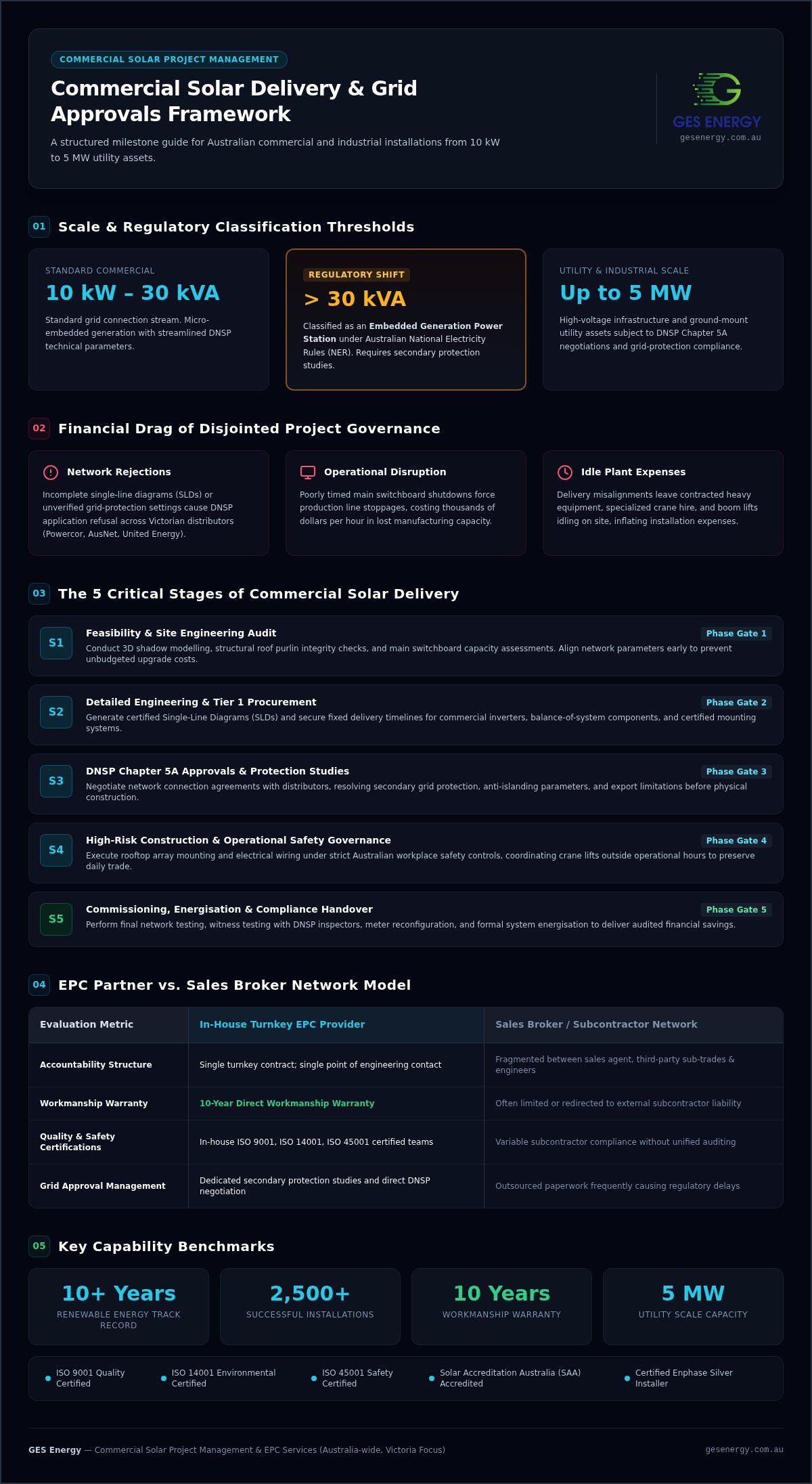
Commercial solar installations are no longer simple rooftop electrical jobs. Once a system exceeds 30 kVA, Australian distribution networks classify it as an embedded generation power station. Transitioning to medium-voltage generation assets requires disciplined technical oversight, regulatory negotiation, and strict construction governance. Dedicated commercial solar project management acts as the protective shield around your capital investment, ensuring your planned energy savings translate into audited cash flow rather than stranded capital sitting inactive on your roof.
Engaging a single provider through a turnkey engineering, procurement, and construction (EPC) contract ensures total accountability across the entire installation lifecycle. When project governance is disjointed, small technical omissions quickly snowball into prolonged regulatory delays and budget blowouts.
The Scope of Commercial Project Management
Professional delivery unites several competing technical and regulatory disciplines into a coordinated execution timeline:
- Multi-discipline technical coordination: Aligning structural engineering certifications, switchboard protection studies, and distribution network service provider (DNSP) technical parameters.
- Operational continuity: Scheduling heavy plant movements, crane lifts, and switchboard tie-ins around your daily manufacturing, warehousing, or retail trade hours.
- Scalable systems oversight: Delivering bespoke engineering controls for systems starting at 10 kW rooftop arrays up to complex 5 MW ground-mount utility assets.
- Compliance and quality assurance: Enforcing strict adherence to Australian workplace safety legislation and National Electricity Rules (NER).
The Real Financial Costs of Unmanaged Solar Projects
Uncoordinated installations carry immediate, compounding business costs. When electrical designers, equipment suppliers, and network operators fail to communicate, project schedules break down rapidly.
Unplanned operational disruptions represent the steepest hidden cost. Poorly timed main switchboard shutdowns force production lines to stop, costing thousands of dollars per hour in lost manufacturing capacity. Simultaneously, equipment delivery misalignments leave expensive crane hire and access boom lifts idling on site, inflating your installation expenses.
Regulatory holdups create long-term financial drag. Submitting incomplete single-line diagrams (SLDs) or unverified grid-protection settings to your local DNSP routinely triggers formal application rejections. In Victoria, network distributors such as Powercor, AusNet, or United Energy will not energise a system until every protection study satisfies technical compliance. Every week your system sits disconnected is an unrecoverable week of retail electricity charges paid directly to your energy retailer.
The 5 Critical Stages of the Commercial Solar Delivery Lifecycle
Executing an industrial installation demands a structured phase-gate model. Without clear technical sign-offs between milestones, unresolved design oversights inevitably compound into expensive site modifications. Disciplined commercial solar project management enforces rigorous quality gates across five defined stages, aligning financial targets directly with Australian engineering standards.
A professional commercial solar installation requires seamless coordination between desk assessments, physical roof work, and network energisation. Understanding this lifecycle ensures your internal stakeholders remain informed at every milestone.
Stage 1 & 2: Feasibility, Detailed Engineering, and Procurement
Execution begins with thorough technical verification rather than equipment sales. Engineers perform 3D shadow modelling alongside physical site audits to confirm roof purlin integrity and switchboard capacity. For systems subject to distributor scrutiny, project managers align network capital requirements against the AER Connection charge guidelines early to prevent unexpected network upgrade costs.
Once engineering validation concludes, designers generate certified single-line diagrams (SLDs) and procure Tier 1 commercial components. Securing fixed delivery dates for high-capacity inverters, balance-of-system equipment, and structural mounting gear shields your budget from global logistics disruptions.
Stage 3: Turnkey Construction and Installation Oversight
Site operations require strict daily governance to preserve your ongoing commercial operations. Dedicated site managers supervise installation crews to guarantee compliance with WorkSafe guidelines and Australian electrical standards:
- SAA-accredited trades: Deploying an experienced SAA-accredited installer workforce certified under ISO 9001, ISO 14001, and ISO 45001 management systems.
- Operational traffic planning: Staging mobile crane lifts, scissor lifts, and equipment delivery bays outside standard logistics operating hours.
- Rooftop integrity: Implementing non-invasive penetration techniques and certified fall-arrest infrastructure that protect existing roofing warranties.
Stage 4 & 5: Network Commissioning and Ongoing Stewardship
Physical completion represents only a preliminary milestone; grid synchronisation demands rigorous electrical validation. Commissioning engineers carry out secondary injection testing on protection relays, conduct string-level open-circuit voltage tests, and verify active anti-islanding mechanisms. Following third-party inspection, the installer submits compliance documentation to the DNSP to execute the formal connection agreement and finalise bidirectional revenue metering.
Following energisation, project managers establish your real-time telemetry portal and transition the plant into an active asset management schedule. If you want structured governance across your energy transition, consider a proven specialist like GES Energy to oversee your deployment from feasibility to long-term generation.
Navigating DNSP Approvals and Australian Grid Compliance
Securing network connection approvals represents the single largest operational risk for commercial energy programmes. In Australia, each Distribution Network Service Provider (DNSP) enforces distinct technical thresholds, export limits, and protection requirements. Partnering with a team experienced in solar EPC Australia services de-risks this approval process, converting complex regulatory criteria into practical engineering solutions.
In Victoria, system approvals vary significantly across the five distribution businesses: CitiPower, Powercor, Jemena, AusNet, and United Energy. While metropolitan feeders under CitiPower frequently impose strict static export limits due to congested distribution assets, regional Powercor zones often present high grid impedances. Navigating these regional network variations demands precise commercial solar project management backed by dedicated electrical engineering expertise.
The Connection Application Process
Once an installation moves past 30 kVA, the Australian Energy Market Commission classifies it under National Electricity Rules (NER) Chapter 5A as a non-registered negotiated connection. Crossing this threshold introduces mandatory engineering assessments:
- Preliminary connection inquiry: Assessing local feeder capacity and substation head-room before ordering hardware.
- Protection coordination studies: Designing secondary protection relays, neutral displacement schemes, and rate of change of frequency (ROCOF) settings to prevent grid instability.
- Inverter compliance: Aligning power quality response modes, such as volt-watt and volt-var response curves, with AS/NZS 4777.2 requirements.
- Dynamic export negotiations: Implementing Dynamic Operating Envelopes (DOEs) under CSIP-Aus protocols to maximise solar export revenue instead of accepting zero-export constraints.
Safety documentation must mirror technical precision. Aligning contractor site documentation with Safe Work Australia's rooftop solar installation guide guarantees that high-voltage safety controls satisfy both the network inspector and statutory workplace authorities.
Integrating Storage and Micro-Grid Infrastructure
Where local network infrastructure restricts generation export, commercial batteries change the economic equation. Adding storage lets your business harvest excess generation during high solar irradiance and dispatch it during expensive peak operational periods, avoiding costly network augmentation charges.
Pairing commercial PV with industrial battery storage solutions creates a resilient on-site micro-grid. In-house engineering teams model your exact facility load profile against DNSP capacity constraints, installing smart export limiting devices that regulate current flow at the point of common coupling. This integration controls maximum demand charges and secures system approval without expensive upstream network line upgrades.
Mitigating Structural, Safety, and Operational Risks on Commercial Sites
Executing rooftop works on an active industrial facility introduces physical and statutory liabilities that directly impact company directors. Under Australian Work Health and Safety (WHS) legislation, facility managers and building owners share duty-of-care obligations for any high-risk construction activity occurring overhead. Rigorous commercial solar project management treats safety governance and structural engineering as core operational prerequisites, isolating live commercial operations from construction hazards.
Balancing risk mitigation alongside capital return is essential when planning major upgrades. When evaluating your projected commercial solar return on investment australia, factoring in upfront structural verification prevents unforeseen engineering rectifications from eroding your financial model.
Structural Integrity and Wind Load Engineering
Mounting hundreds of solar modules fundamentally alters roof loading dynamics. Professional delivery requires independent structural engineers to inspect shed framing, purlin spacing, and roof sheet corrosion before any racking hardware touches the facility:
- Wind uplift compliance: Calculating site-specific wind pressure coefficients to satisfy AS/NZS 1170.2 standards, factoring in building height, terrain category, and local cyclonic or non-cyclonic wind regions.
- Dead and live load calculations: Verifying purlin load tolerances to support the dead weight of panels and ballasts, alongside maintenance traffic loads.
- Substrate-specific racking: Selecting engineered non-penetrating clamping profiles for Klip-Lok metal sheeting, or specialised ballast layouts on flat concrete slabs to preserve roof waterproofing.
Accreditation, Workmanship Warranties, and Quality Assurance
Protecting site personnel demands verified installation standards. Since early 2024, Solar Accreditation Australia (SAA) acts as the sole national Accreditation Scheme Operator appointed by the Clean Energy Regulator. Engaging an SAA-accredited installer ensures the electrical leads executing your installation maintain current high-voltage competencies and meet mandated continuing education requirements.
Contractor vetting must extend beyond basic electrical licensing. Tier-one project governance requires delivery partners to operate under formal, audited frameworks:
- ISO 9001: Verifying standardised quality control across procurement, layout engineering, and torque-checking procedures.
- ISO 14001: Managing environmental factors, including waste disposal of packaging and obsolete switchgear recycling.
- ISO 45001: Enforcing strict occupational health and safety systems, documented Safe Work Method Statements (SWMS), and perimeter edge protection.
A reliable EPC contractor backs their site governance with a 10-year workmanship warranty covering all structural fixings, conduit runs, and electrical switchboard works. To safeguard your assets with certified ISO and SAA-backed engineering, partner with the commercial solar team at GES Energy for your next generation project.
Selecting an EPC Partner: In-House Delivery Versus Broker Networks
Many commercial energy projects stumble because of how they are contracted. Sales broker networks operate on an aggregator model, securing client contracts through aggressive sales pitches before auctioning the electrical installation off to the lowest-bidding subcontractor. When switchboard faults occur or network distributors demand unexpected secondary protection studies, this broker model fragments. The sales broker blames the sub-contractor, the contractor blames the equipment supplier, and your installation stalls while capital sits idle.
Engaging a dedicated engineering, procurement, and construction (EPC) company eliminates this risk. Dedicated commercial solar project management ensures a single team oversees the technical lifecycle from concept to connection. Direct access to the supervising project engineer establishes clear operational accountability, keeping construction timelines rigid and capital commitments predictable.
Key Evaluation Criteria for Commercial Solar Partners
Before executing capital works contracts, corporate boards and procurement directors should verify these essential criteria:
- Direct engineering capability: Partner with providers employing in-house electrical designers and engineers rather than firms that outsource core design responsibilities.
- Proven project history: Look for seasoned specialists with verified track records of delivering commercial systems, including experience executing over 2,500 successful installations.
- Transparent supply chains: Require tier-one modules, commercial-grade inverters, and certified balance-of-system hardware backed by Australian direct warranty agreements.
- Integrated compliance systems: Demand formal verification of certified ISO 9001, ISO 14001, and ISO 45001 operating standards.
Why Australian Businesses Partner with GES Energy
Headquartered in Melbourne and delivering generation assets across Victoria and Australia, GES Energy provides end-to-end EPC services that bridge complex engineering with commercial discipline. Backed by over a decade of renewable industry experience, the company engineers and delivers commercial generation assets spanning from 10 kW rooftop arrays to 5 MW ground-mount installations.
Every project is installed by our certified, SAA-accredited workforce under strict quality controls. As an accredited Enphase Silver Installer with certified ISO management systems, GES Energy stands firmly behind its installations with an industry-leading 10-year workmanship warranty. Long-term performance is preserved through our structured maintenance program and rapid inverter warranty claim support, protecting your operational returns across the asset's operating life.
Ready to de-risk your commercial transition and lock in measurable energy savings? Contact the GES Energy engineering team today to review your site feasibility and initiate your solar system design service.
Deliver Your Commercial Energy Asset On Time and On Budget
Transitioning to commercial-scale solar generation demands far more than buying panels. It requires disciplined technical governance, early DNSP engagement, and rigorous on-site safety controls. High-performing Australian facilities avoid expensive grid delays and budget creep by treating commercial solar project management as an engineering discipline rather than a sales exercise.
With over 10 years in the renewable sector and more than 2,500 successful installations across Australia, GES Energy provides the certainty your balance sheet needs. Our in-house engineering and installation teams operate under certified ISO 9001, ISO 14001, and ISO 45001 management systems, protecting your capital expenditure with an industry-leading 10-year workmanship warranty on commercial and industrial projects.
Take control of rising demand tariffs and build long-term operational resilience today. Discuss your commercial solar project with the engineering specialists at GES Energy to turn your clean energy targets into dependable generation assets.
Frequently Asked Questions
What is the role of a commercial solar project manager?
A commercial solar project manager directs technical engineering, regulatory approvals, procurement, and physical construction from inception through commissioning. They coordinate structural engineers, distribution network operators, and installation crews to keep milestones on schedule. By supervising safety, supply chains, and network compliance, disciplined commercial solar project management protects your capital investment and ensures the completed installation meets Australian electrical standards without disrupting daily operations.
How long does a commercial solar installation take from start to finish?
Most commercial installations require twelve to twenty weeks from feasibility assessment to final energisation. Physical rooftop mounting typically takes just two to four weeks for mid-scale systems. The preliminary phase requires six to twelve weeks to complete detailed engineering, structural certification, and DNSP connection approvals. In Victoria, network reviews by distributors like Powercor or Jemena dictate the overall timeline before final meter reconfiguration can take place.
What permits and network approvals are required for commercial solar in Australia?
Deployments over 30 kVA require a negotiated Chapter 5A connection agreement with your local distribution network service provider, alongside grid protection studies. Projects must also secure local council planning permits where applicable and structural engineering certificates under AS/NZS 1170.2. In Victoria, an independent Licensed Electrical Inspector must inspect the works and issue a Certificate of Electrical Safety before the distributor approves final grid synchronisation.
How do project managers prevent operational downtime during installation?
Effective project managers design site delivery plans that isolate construction activity from your facility's daily traffic. Heavy equipment deliveries, crane lifts, and roof staging occur early in the morning or across scheduled maintenance windows. Crucially, main switchboard shutdowns required for final interconnection are booked after hours or on weekends. This careful staging guarantees your manufacturing equipment, cold storage, or logistics lines run without interruption.
What is the difference between an EPC contractor and a solar broker?
An EPC contractor provides turnkey in-house accountability, employing qualified engineers and SAA-accredited installers who manage the build directly under a single contract. Solar brokers are sales-driven aggregators who sell projects and auction the physical installation to third-party subcontractors. When technical complications or switchboard faults arise, broker models often lead to finger-pointing, whereas an established EPC partner assumes sole responsibility for workmanship, warranties, and performance.
What happens if our distribution network operator restricts solar export?
When network congestion restricts feed-in, project managers negotiate Dynamic Operating Envelopes rather than accepting static zero-export caps. Dynamic controls adjust your export levels in real time based on local network capacity. Alternatively, integrating commercial battery storage allows your facility to capture surplus generation during the day and discharge it during peak tariff hours, bypassing network export constraints while driving down maximum demand charges.
What safety accreditations should a commercial solar project team possess?
Your delivery team must feature Solar Accreditation Australia (SAA) accredited designers and installers holding high-risk work licences for working at heights. Top-tier providers maintain verified ISO 9001 quality, ISO 14001 environmental, and ISO 45001 occupational health and safety certifications. In regional Victoria and Melbourne, project leads must also coordinate with accredited Licensed Electrical Inspectors to ensure switchboard modifications strictly adhere to Australian electrical safety standards.


