

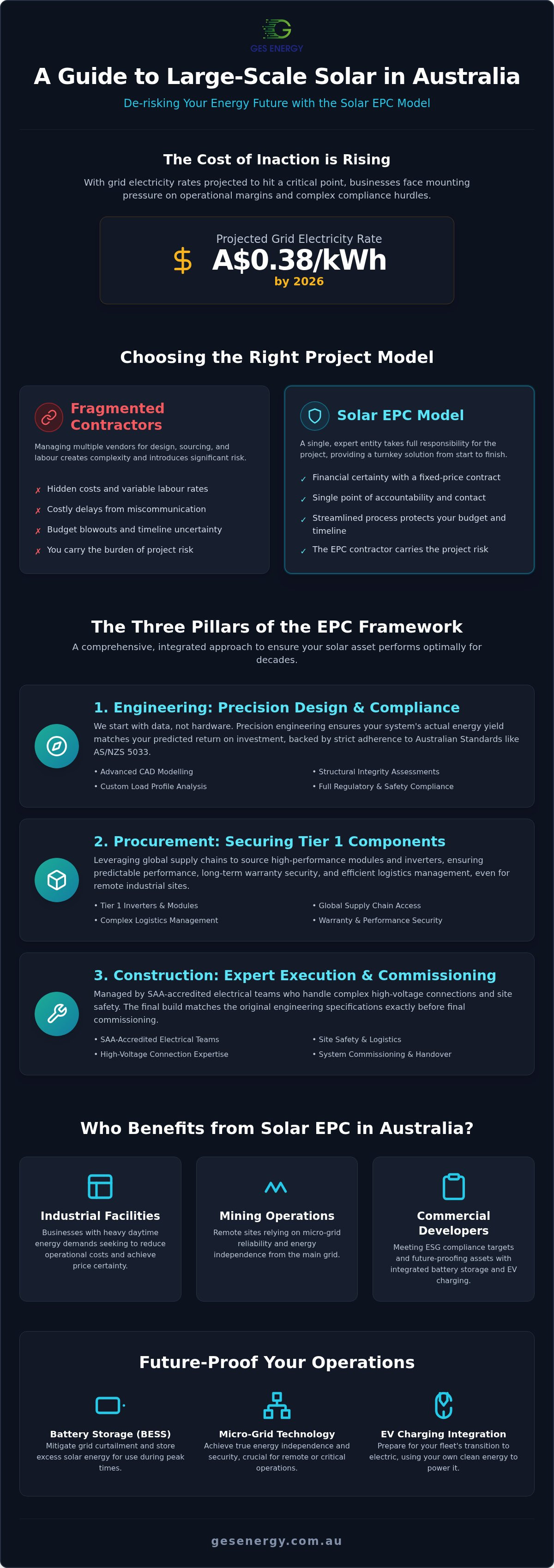
With grid electricity rates hitting A$0.38/kWh in 2026, the cost of inaction is now a line item your business can't afford to ignore. You've likely felt the pressure of rising energy costs on your operational margins, compounded by the daunting complexity of Australian electrical standards and ISO compliance. When you're managing a 100kW to megawatt-scale project, the traditional method of hiring fragmented contractors often leads to costly delays. Finding a specialist for solar epc australia solves this by providing a single point of accountability that protects your budget and your timeline.
This 2026 guide demonstrates how the EPC model de-risks large-scale projects by managing the entire lifecycle from design to commissioning. You'll discover how to leverage the latest SRES expansion for significant upfront discounts and how to integrate battery storage to mitigate grid curtailment. We'll walk through the engineering requirements, procurement strategies, and construction standards necessary to ensure your system remains a high-performing asset for decades to come, ensuring long-term energy independence for your business.
Key Takeaways
- Understand why a turnkey solar epc australia model is the most effective way to de-risk large-scale energy projects by providing a single point of accountability for the entire project lifecycle.
- Learn how precision engineering through CAD modelling and strict adherence to AS/NZS 5033 standards ensure your system's actual energy yield matches your predicted return on investment.
- Discover the procurement strategies used to source Tier 1 components and manage complex logistics for regional or remote Australian industrial sites.
- Compare the financial certainty of fixed-price EPC contracts against the hidden risks and variable labour costs associated with managing fragmented contractors.
- Explore how integrating battery energy storage systems (BESS) and micro-grid technology can future-proof your operations against grid curtailment and rising network charges.
What is Solar EPC? Understanding the Model for Australian Industry
For large-scale energy transitions, the traditional approach of managing multiple vendors often leads to miscommunication and budget blowouts. The Engineering, procurement, and construction (EPC) model offers a streamlined alternative. In a solar epc australia framework, a single entity takes full responsibility for the project from the initial site assessment through to the final commissioning. This turnkey approach means you don't have to juggle separate contracts for electrical design, equipment sourcing, and site labour.
An EPC contractor acts as a diligent steward of your investment. Unlike a standard residential installer who might focus only on a simple roof layout, an EPC partner oversees the entire energy ecosystem. This includes ensuring all components work in harmony and meet strict Australian ISO standards. It represents a shift from a transactional service to a comprehensive management partnership where the contractor carries the project risk.
The Three Pillars of the EPC Framework
The engineering phase starts with custom design. We use advanced CAD modelling to map your specific industrial load profile, ensuring the system is sized correctly for your operational needs. Procurement involves leveraging global supply chains to secure Tier 1 inverters and modules. This provides predictability in performance and long-term warranty security for your asset. Finally, the construction phase is handled by SAA-accredited electrical teams. They manage the complex logistics of high-voltage connections and site safety, ensuring the build matches the original engineering specifications exactly.
Who is Solar EPC for in Australia?
This model is specifically designed for high-stakes environments where reliability is non-negotiable. Industrial facilities with heavy daytime energy demands benefit from the reduced operational costs and price certainty. Mining operations in remote areas rely on the micro-grid reliability that a structured EPC process provides, often requiring systems that operate independently of the main grid. Additionally, large-scale commercial developers use this framework to meet ESG compliance targets while ensuring their assets are future-proofed with integrated battery storage and EV charging capabilities.
The Engineering Phase: Precision Design and Compliance
Engineering is where the long-term profitability of your energy asset is decided. In a professional solar epc australia framework, we don't start with hardware; we start with data. Advanced CAD modelling allows us to create a digital twin of your facility, accounting for roof pitch, shading from adjacent structures, and local irradiance levels. This precision removes the guesswork from system yield, providing a financial roadmap that your board can trust.
Structural integrity is equally vital for large-scale arrays. Every roof has a weight limit, and our engineering team conducts thorough assessments to ensure your building can safely support the added load for the next 25 years. This includes managing wind load calculations and mounting system specifications that meet the harsh Australian climate. These technical details ensure that the physical installation is as robust as the financial model supporting it.
Custom Load Profile Analysis
Industrial energy needs are rarely static. A "one size fits all" approach fails because it doesn't account for your specific operational peaks. By analysing your interval data, we can size your solar and battery storage systems to match your load profile exactly. This ensures you aren't over-investing in capacity you don't use, or under-sizing a system that leaves you exposed to peak grid prices. We also look ahead at your future needs, such as integrating EV charging infrastructure, so your system doesn't require a costly overhaul as your fleet transitions.
Regulatory and Safety Compliance
Compliance with Australian Standards, specifically AS/NZS 5033 and AS/NZS 4777, is the bedrock of a safe installation. As the peak industry body, the Clean Energy Council provides the framework for these best practices, ensuring that every component and installation method meets national safety requirements. Our SAA-accredited engineers manage these complexities, including mandatory power quality monitoring and secondary protection injection testing.
Securing approval from your Distributed Network Service Provider (DNSP) is the critical path for any grid-connected project. We handle these technical negotiations on your behalf, ensuring your system meets grid stability requirements without unnecessary delays. If you're ready to see how precision design can secure your energy future, you can explore our custom engineering solutions tailored for Australian industry.
Procurement and Construction: Executing the Vision
Moving from a digital CAD model to a physical energy asset requires meticulous coordination. This is where the solar epc australia model proves its value by consolidating procurement and construction under one management umbrella. This integrated approach is why professional EPC services are the preferred choice for the mining and industrial sectors. As noted in PwC Australia's analysis of EPC contracts, having a single point of responsibility is vital for managing the complex logistics and risk profiles of utility-scale energy projects.
The execution phase follows a methodical five-step progression to ensure project integrity:
- Step 1: Strategic Sourcing. We secure Tier 1 components that meet bankability standards for long-term investment security.
- Step 2: Logistics Management. Moving megawatt-scale equipment across Australia's diverse and often remote landscapes requires precise timing and specialised transport.
- Step 3: Site Supervision. A single supervisor manages civil and electrical works, preventing trade overlap and keeping the project on schedule.
- Step 4: Commissioning. Rigorous injection testing and performance verification ensure the system meets the original engineering yield.
- Step 5: Handover. We provide comprehensive documentation, O&M manuals, and full access to monitoring platforms.
Tier 1 Procurement Strategy
Large-scale solar is a 25-year investment. Bankability matters because it ensures that the manufacturers of your panels and inverters will exist to honour warranties in a decade. Choosing an Australian-based EPC partner simplifies this process. If a component fails, you deal with a local team rather than a foreign factory. We prioritise high-performance inverters from established brands like Sigenergy, Deye, or Enphase to ensure maximum uptime and system reliability.
Construction Excellence in the Australian Climate
The Australian climate is unforgiving. Heat-related derating can significantly reduce energy output if it's not managed during the build. Our teams use specific spacing and ventilation techniques to keep equipment cool even in extreme conditions. Safety remains paramount for high-voltage industrial solar. We follow strict safe work protocols to protect both personnel and your facility. By carefully staging the installation, we keep your business running with minimal operational downtime throughout the construction phase.
Comparing EPC to Fragmented Solar Contracting
Choosing the right delivery model for a megawatt-scale project is just as critical as the solar technology itself. Many businesses attempt to save on upfront costs by hiring separate designers and electrical contractors, but this fragmented approach often creates a management vacuum. When you opt for a solar epc australia partner, you eliminate the "blame game" that typically occurs when a system underperforms. Because the same entity handles the engineering and the physical build, there's no room for the designer to blame the installer for poor output, or vice versa. This single point of accountability ensures that the project steward remains focused on the final performance rather than just completing a single task.
Budget certainty is another primary driver for the EPC model. Traditional contracting often relies on variable labour costs and unforeseen variations that can bloat a budget mid-project. A fixed-price EPC contract provides a transparent financial framework, allowing boards to approve Capex with confidence. This stability is essential for maintaining operational margins, especially when navigating the complexities of large-scale infrastructure. You aren't just buying panels; you're buying a guaranteed energy outcome within a strictly defined budget.
Risk Mitigation for Stakeholders
An EPC framework acts as a safeguard for your capital investment. By providing performance guarantees, the contractor ensures that the system produces the exact energy yield promised during the design phase. This protection is backed by the comprehensive CAD modelling discussed earlier, which identifies potential on-site errors before a single panel is installed. For investors and boards, this level of predictability turns a complex construction project into a reliable financial asset. It moves the risk from your balance sheet to the contractor's expertise, providing peace of mind for the duration of the build.
Total Cost of Ownership (TCO)
The lowest initial quote often leads to the highest lifetime cost. Fragmented contractors rarely include long-term maintenance or repair services in their scope, leaving you to source a new partner for O&M (Operations and Maintenance) later. An EPC steward integrates these services from day one, ensuring the system's health is monitored and maintained. This long-term view reduces the risk of equipment failure and ensures the system operates at peak efficiency for its 25-year lifespan. To understand how these factors influence your long-term savings, you can consult our Commercial Solar Guide for detailed ROI calculations.
If you want to move away from the risks of fragmented contracting and secure a turnkey energy solution, contact our expert team today to discuss your project requirements.
The Future of EPC: Micro-grids and Energy Security
The evolution of the Australian energy market means that simple rooftop solar is no longer the ceiling for industrial efficiency. In 2026, the focus has shifted toward total energy security through industrial micro-grids. These systems act as localised energy networks that can operate independently or in conjunction with the main grid. When you engage a specialist for solar epc australia, you aren't just installing panels; you're commissioning a sophisticated micro-grid that integrates solar, battery storage, and smart control systems into a single, manageable ecosystem.
Integrating Battery Energy Storage Systems (BESS) into the EPC contract is now a standard requirement for mitigating grid curtailment. This integrated approach ensures that the engineering phase accounts for the complex discharge cycles and thermal management required for large-scale storage from the outset. For the mining and agricultural sectors, this provides off-grid reliability that doesn't falter during peak demand or grid outages. These systems are also increasingly designed to participate in Virtual Power Plants (VPPs), allowing businesses to trade excess energy back to the market during periods of high demand, turning a cost-saving measure into a potential revenue stream.
Achieving Energy Independence
Micro-grids empower industrial sites by decoupling them from the volatility of the national grid. By utilising commercial battery storage, businesses can perform load shifting. This involves storing solar energy during periods of high production and using it to avoid expensive peak tariffs in the late afternoon. This strategy directly protects operational margins and ensures energy price predictability. For temporary construction sites or remote mining exploration, portable off-grid solutions offer this same level of reliability without the need for permanent infrastructure, providing the flexibility needed in dynamic industrial environments.
Partnering with GES Energy for EPC Success
GES Energy provides a comprehensive, end-to-end approach for systems ranging from 100kW to megawatt scale. As an Australian-owned specialist, we act as the diligent steward for your project lifecycle, ensuring every installation meets ISO certified processes and utilises SAA-accredited labour. Our national capability allows us to manage complex, multi-site rollouts across regional Australia with the same precision as a single metropolitan installation. We don't just provide a product; we remain committed to the ongoing performance and health of your energy infrastructure.
If you're ready to secure your business's energy future and move beyond the limitations of the traditional grid, enquire about our Solar EPC services today to learn how we can tailor a micro-grid solution for your specific operational needs.
Securing Your Operational Future with Solar EPC
Transitioning to a large-scale energy system requires more than just hardware; it demands a robust framework that manages risk and ensures performance. By choosing a comprehensive solar epc australia model, you consolidate accountability and eliminate the technical gaps often found in fragmented contracting. Whether you're implementing a 100kW system or a megawatt-scale micro-grid, the focus remains on long-term energy independence and financial predictability for your business.
As a diligent steward of your project, GES Energy brings an SAA-accredited engineering team and ISO certified processes to every installation. Our proven track record in 1MW+ utility-scale projects ensures that your transition to renewable infrastructure is handled with technical precision and professional transparency. We remain committed to the ongoing health and performance of your energy ecosystem, providing the stability you need to grow in a shifting market.
Secure your industrial energy future with a GES Energy EPC consultation and take the first step toward a resilient, future-ready energy asset that protects your operational margins for decades to come.
Frequently Asked Questions
What is the difference between a solar installer and a solar EPC contractor?
A solar EPC contractor provides a turnkey solution that includes custom engineering, strategic procurement, and construction under a single management umbrella. While a standard installer typically focuses on the physical mounting of panels, an EPC partner acts as a project steward for the entire lifecycle. This model eliminates the risk of miscommunication between separate designers and contractors, ensuring that the final energy yield matches your original financial projections.
How much does a commercial solar EPC project cost in Australia?
The cost for industrial solar power systems between 100kW and 1MW generally ranges from A$0.80 to A$1.20 per watt installed. These figures can vary based on site complexity, mounting requirements, and whether the system includes integrated battery storage. It's important to consider the levelised cost of energy (LCOE), which for industrial solar currently sits between A$0.04 and A$0.06/kWh over a 25-year period, offering a typical payback of two to four years.
Does a solar EPC contract include ongoing maintenance?
Most comprehensive solar epc australia contracts include a provision for ongoing operations and maintenance (O&M) to protect the long-term health of the asset. This service often covers performance monitoring, regular site inspections, and cleaning to ensure the system operates at peak efficiency. Having the original EPC partner manage maintenance is beneficial because they already possess the detailed CAD models and engineering specifications required to troubleshoot issues quickly and honour warranty claims.
What are the benefits of an EPC model for mining and remote sites?
The EPC model provides critical logistics management and micro-grid reliability for remote mining and agricultural operations. Managing a megawatt-scale project in the Pilbara or regional Queensland requires a partner with national capability to coordinate specialised transport and SAA-accredited labour. By integrating solar with battery storage and smart controls, an EPC contractor delivers a self-sustaining energy ecosystem that protects these sites from grid volatility and high diesel fuel costs.
Can an EPC project include battery storage and EV charging?
Yes, modern EPC projects frequently integrate Battery Energy Storage Systems (BESS) and EV charging infrastructure into the initial design phase. Including these components from the outset ensures that the electrical engineering and DNSP negotiations account for the increased load and discharge profiles. This structured approach allows businesses to perform load shifting to avoid peak tariffs and future-proof their facilities for the transition to electric commercial fleets without requiring later retrofitting.
How long does a typical 100kW+ solar EPC project take to complete?
A typical 100kW to megawatt-scale project generally takes between three to six months from the initial engineering phase to final commissioning. The timeline is largely influenced by the complexity of the DNSP approval process and the lead times for Tier 1 components. A structured solar epc australia framework minimises delays by using a single site supervisor to coordinate all civil and electrical works, ensuring that construction milestones are met without the trade overlaps common in fragmented contracting.
What warranties should I expect from a solar EPC provider?
You should expect a combination of product warranties, performance guarantees, and workmanship warranties from a reputable provider. Tier 1 solar modules typically carry a 25-year performance warranty, while high-quality inverters offer 10 to 15 years. The EPC contractor should also provide a workmanship warranty, often ranging from five to ten years, which covers the integrity of the installation itself. These protections ensure your capital investment remains a high-performing asset throughout its operational life.
Is EPC suitable for smaller commercial solar installations?
The EPC model is most effective for systems starting at 100kW, where the complexity of engineering and procurement justifies a single point of accountability. For smaller commercial installations, the overhead of a full EPC framework might not always be necessary, though the principles of precision design still apply. However, for any project involving high-voltage connections, complex load profiles, or integrated storage, the risk-mitigation benefits of the EPC model remain highly valuable regardless of the system's total size.


