

Treating renewable energy infrastructure solely as an operational hedge against volatile electricity prices overlooks its most immediate financial advantage. Correctly structuring the depreciation of commercial solar assets Australia transforms your clean power investment from a basic utility offset into a high-performing balance-sheet asset. You already know that large-scale capital upgrades must justify their outlay through predictable operational savings, yet working through Australian Taxation Office (ATO) effective life determinations across panels, inverters, and batteries often complicates capital forecasting.
Selecting the right depreciation pathway provides immediate clarity, whether your business prioritises accelerated early deductions or steady accounting write-downs over twenty years. This guide explains how Australian taxation rules, ATO effective life schedules, and depreciation methods maximise commercial solar return on investment. You will discover the practical differences between Prime Cost and Diminishing Value models, determine how federal incentives adjust your net asset cost base, and evaluate strategies that align certified engineering with your financial reporting.
Key Takeaways
- Understand the Australian Taxation Office rules governing the depreciation of commercial solar assets Australia to strengthen post-tax returns on clean energy investments.
- Compare the financial mechanics of Prime Cost and Diminishing Value methods to match deduction schedules with your corporate cash-flow strategy.
- Determine how annual business turnover thresholds establish eligibility for simplified asset pooling versus general corporate tax allowances.
- Calculate your net depreciable asset cost base accurately by factoring in upfront discounts from the Small-scale Renewable Energy Scheme and state incentives.
- Procure itemised component documentation and certified EPC engineering to ensure physical generation assets reliably outlast their statutory effective life.
Understanding Tax Depreciation for Commercial Solar Assets in Australia
Commercial solar installations deliver immediate reductions in operational power expenditure, but their tax treatment unlocks an equally critical revenue driver. Capital allowance provisions governed by the Australian Taxation Office (ATO) permit businesses to deduct the declining value of renewable plant and equipment directly against taxable income. Understanding the depreciation of commercial solar assets Australia ensures that your corporate entity recovers capital quickly while lowering its annual tax liabilities. For a complete financial breakdown of initial outlays versus lifetime generation, read our guide to commercial solar systems.
Rather than treating clean energy infrastructure as a sunk cost, Australian tax frameworks recognise that solar machinery undergoes steady wear and tear. By claiming these statutory capital allowances across consecutive income years, commercial enterprises turn high-yield hardware into active tax shields.
To see how federal tax write-offs function for capital equipment purchases, review this concise breakdown:
How the ATO Classifies Commercial Solar PV Systems
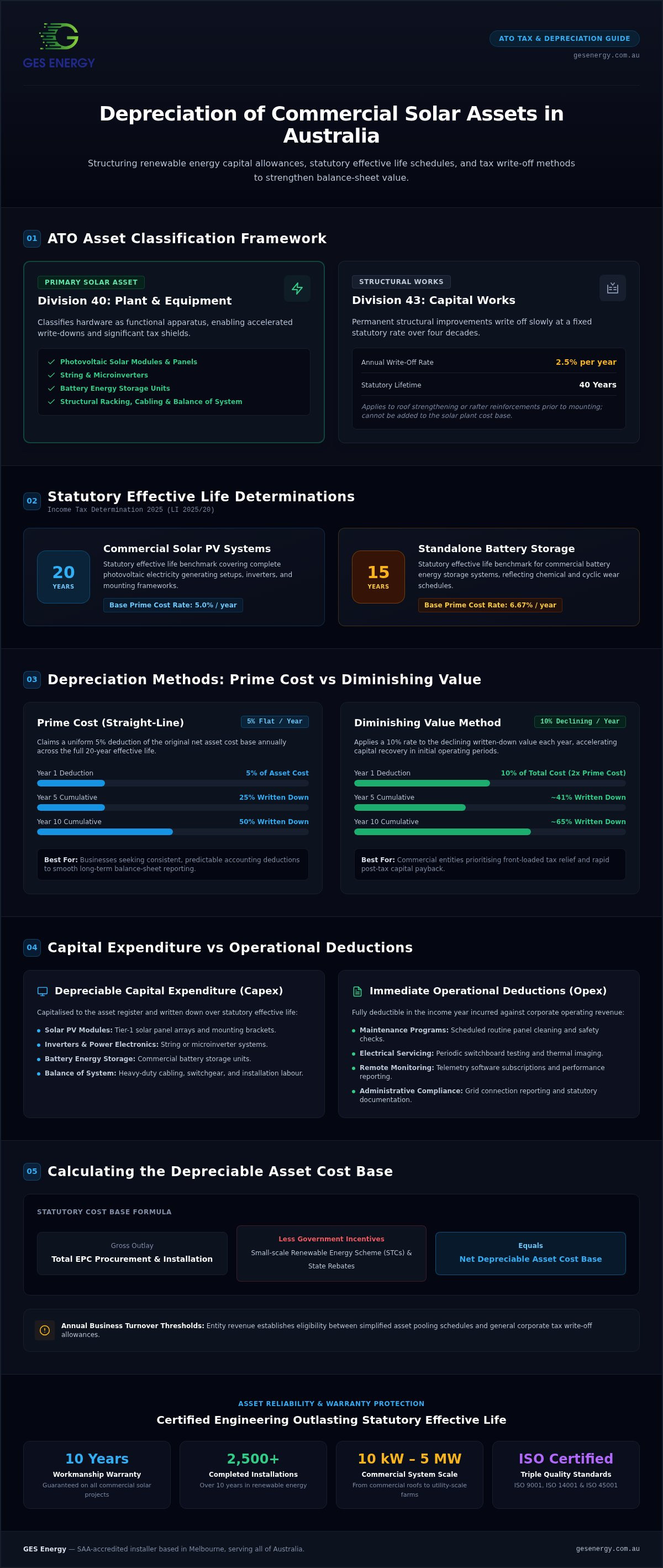
The ATO categorises commercial solar arrays under Division 40 as depreciating plant and equipment, distinct from permanent building works governed by Division 43. This distinction proves critical for corporate cash flow. Division 43 structural capital works write off slowly at 2.5% per year over 40 years. In contrast, Division 40 classifies photovoltaic panels, string or microinverters, battery units, and structural racking as functional apparatus, enabling significantly accelerated write-downs.
Capital Expenditure Versus Operational Deductions
Accurate accounting requires separating upfront capital expenditure from ongoing operational costs. Your primary depreciable asset cost base consists of initial hardware procurement, electrical balance-of-system engineering, and installation labour:
- Depreciable capital expenditure: Solar PV modules, inverters, cabling, battery storage, and structural mounting equipment.
- Immediate operational deductions: Routine maintenance programs, scheduled electrical servicing, remote system monitoring, and administrative compliance.
- Division 43 building works: Structural roof enhancements or rafter reinforcement required before mounting solar arrays. These works cannot be lumped into the solar plant cost base.
Documenting these asset divisions properly establishes compliant depreciation of commercial solar assets Australia from the day of commissioning.
ATO Effective Life Rulings and Depreciation Calculation Methods
Calculating the depreciation of commercial solar assets Australia requires aligning physical equipment performance with statutory Australian Taxation Office (ATO) benchmarks. Under the Income Tax (Effective Life of Depreciating Assets) Determination 2025 (LI 2025/20), the ATO establishes a 20-year effective life for complete photovoltaic electricity generating systems. Standalone battery storage systems carry a shorter 15-year effective life. Businesses apply these benchmarks using one of two statutory calculation methods to write down their net capital expenditure.
Prime Cost vs Diminishing Value Methods for Solar Assets
The choice between calculation methods directly affects your early post-tax cash flows:
- Prime Cost (Straight-Line) Method: Claims a uniform 5% deduction of the original net asset cost each year over 20 years. This delivers consistent, predictable write-downs suited to entities seeking stable accounting deductions.
- Diminishing Value Method: Applies a 10% rate to the declining written-down value annually. This approach front-loads tax relief, generating the largest deductions in years one to five when capital recovery matters most.
High-growth commercial entities often prefer the Diminishing Value method because accelerating early deductions improves working capital right after commissioning.
ATO Effective Life Determination for PV Panels and Inverters
While the ATO groups integrated solar arrays under a default 20-year period, real-world engineering data tells a different story. Tier-1 solar panels regularly maintain generation for 25 to 30 years, but string and central inverters face heavy electrical stress and thermal cycling. They often require servicing or replacement between years 10 and 12. Corporate taxpayers may self-assess a separate effective life for power electronics under section 40-105 of the ITAA 1997, provided verifiable operating environments and engineering logs support the faster write-down.
Component-Level Depreciation: Solar Panels, Inverters, and Battery Storage
Treating a multi-hundred-kilowatt plant as a single balance-sheet entry limits financial flexibility. Breaking a project into an itemised register allows distinct write-down schedules across photovoltaic panels, inverters, switchgear, and commercial storage units. When inverters reach the end of their service life, any remaining undepreciated book value can be written off immediately as a balancing adjustment.
Securing an itemised asset schedule from an experienced provider like GES Energy during commercial solar system design ensures your balance sheet aligns technical reliability with ATO compliance standards.
Small Business Entities vs Corporate Tax Treatment in 2026
Your company’s aggregated annual turnover dictates the depreciation rules available when deploying commercial solar infrastructure. For the 2026–27 income year, the Australian Taxation Office (ATO) applies distinct write-down pathways depending on whether your business qualifies as a Small Business Entity (SBE) or an enterprise corporation. Correctly applying these rules directly influences your corporate tax liabilities, with base rate entities paying a 25% company tax rate and non-base entities paying 30%.
Small Business Concessions and Asset Pooling
Businesses with an aggregated annual turnover below $10 million qualify for simplified depreciation rules. Under current tax legislation, the instant asset write-off threshold is permanently established at $20,000 on a per-asset basis for SBEs. Because most commercial solar installations exceed this threshold, the balance of the system is allocated into a general small business pool:
- First-year deduction: SBEs claim an immediate 15% deduction on the net capital value of the solar asset in the financial year it is installed and ready for use.
- Subsequent years: The remaining pool balance depreciates at an accelerated rate of 30% each income year.
- Low pool balance write-off: If the closing balance of your pool falls below $20,000 at the end of any financial year, you can deduct the entire remaining balance at once.
General Depreciation Rules for Large Commercial Enterprises
Entities with aggregated turnover exceeding $10 million cannot use simplified asset pooling. Instead, these corporations apply standard Division 40 capital allowance schedules, selecting either the Prime Cost or Diminishing Value methods discussed earlier. Large commercial systems write down against corporate income to reduce tax payable dollar-for-dollar at the 25% or 30% corporate rate. Explore our commercial solar return on investment guide to model these tax outcomes alongside avoided grid electricity expenditure.
Interplay Between STCs, LGCs, and Asset Tax Value
A common compliance error involves calculating the depreciation of commercial solar assets Australia using the gross system quotation rather than the net asset cost base. Federal renewable energy incentives fundamentally alter this calculation:
- Small-scale Technology Certificates (STCs): Under the Small-scale Renewable Energy Scheme, STC eligibility extends up to 1 MW. STCs provide an upfront point-of-sale discount, reducing capital outlay by approximately 20%. Tax law requires that you calculate depreciation strictly on the net cost of the system after subtracting these certificates.
- Large-scale Generation Certificates (LGCs): Systems larger than the expanded 1 MW scheme generate LGCs per megawatt-hour produced. Unlike STCs, LGCs do not lower the capital asset cost base. Instead, revenue derived from surrendering or selling LGCs is treated as assessable operating income as it is realised.
Steps to Optimise Commercial Solar Tax Write-Offs and Cash Flow
Maximising post-tax returns on renewable energy projects requires a structured approach before installation begins. Following a methodical implementation plan ensures you claim every eligible capital deduction without encountering compliance hurdles with the Australian Taxation Office (ATO):
- Step 1: Conduct pre-feasibility modelling: Integrate expected solar generation profiles with your corporate tax position to model post-tax cash flows.
- Step 2: Procure itemised EPC invoicing: Contract your installer to break down invoices into modules, inverters, racking, balance-of-system electricals, and ongoing servicing.
- Step 3: Consult tax specialists: Involve a registered quantity surveyor or corporate tax agent before energisation to confirm asset treatment under Division 40.
- Step 4: Select your calculation method: Formally adopt either the Prime Cost or Diminishing Value approach based on your multi-year revenue projections.
- Step 5: File with precise commissioning records: Lodge deductions based strictly on the date the system was first installed ready for use.
Engaging Qualified Tax Professionals and Quantity Surveyors
A quantity surveyor translates complex commercial electrical infrastructure into an ATO-compliant tax depreciation schedule. They assign precise depreciable baselines to each balance-of-system asset. Maintaining clear documentation with serial numbers, single-line diagrams, and grid connection sign-offs ensures your tax agent claims write-downs that withstand regulatory scrutiny.
Aligning System Design with Tax Write-Off Milestones
Timing determines which financial year receives your deductions. Under statutory rules, equipment must be installed and fully operational before 30 June to claim allowances for that income year; paying a procurement deposit alone is not sufficient. For enterprise facilities requiring staged rollouts across multiple buildings, staging grid connections allows you to plan capital write-offs across successive reporting periods. Discover how our solar EPC services streamline engineering execution and compliance documentation from initial feasibility through to final commissioning.
Calculating Post-Tax Payback and Internal Rate of Return
Accounting solely for retail electricity offsets understates the speed of capital recovery. Combining annual kilowatt-hour bill savings with early tax write-downs can trim one to two years off standard commercial payback horizons while increasing project internal rate of return. Correct structuring of the depreciation of commercial solar assets Australia gives finance directors predictable balance-sheet clarity from day one.
To evaluate pre-feasibility yields and receive engineering documentation tailored to your corporate balance sheet, contact GES Energy for a commercial solar assessment.
Engineering Commercial Solar Projects to Maximise Balance Sheet Value
A tax depreciation schedule is only as reliable as the physical machinery generating clean electricity. If an array fails prematurely, businesses face unplanned capital replacement outlays, messy balancing adjustments, and lost energy yields. Aligning the depreciation of commercial solar assets Australia with high-specification engineering guarantees that your physical generation infrastructure remains productive long after its statutory tax write-downs conclude.
High-Yield Engineering for Long-Term Asset Integrity
To realise maximum return on investment, physical assets must outlast their 20-year ATO effective life benchmark. Sub-standard racking, inferior balance-of-system cabling, and poorly ventilated power electronics degrade quickly under harsh Australian conditions. Engineering systems to match specific operational demand curves preserves generation efficiency over multi-decade lifespans. With over 10 years in renewable energy and more than 2,500 successful installations, GES Energy designs commercial solar systems ranging from 10 kW to 5 MW. In-house delivery teams certified under ISO 9001, ISO 14001, and ISO 45001 maintain strict quality oversight across structural engineering, electrical design, and environmental management.
Complete Project Delivery and SAA-Accredited Commissioning
Accurate corporate balance-sheet tracking requires meticulous documentation from project kick-off to energisation. Solar Accreditation Australia (SAA) accredited personnel commission each electrical sub-system to exact regulatory standards, verifying string performance, inverter efficiency, and export limits. Turnkey delivery includes thorough handover packs featuring as-built schematics, single-line diagrams, serialised equipment registers, and formal commissioning documentation. These itemised records provide your accounting team with the clear proof needed to defend asset classifications during tax audits.
Securing Investment with 10-Year Workmanship Warranties
Sub-standard installation practices threaten long-term asset value and create unforeseen operational liabilities. GES Energy provides a 10-year workmanship warranty on all commercial and industrial projects, protecting your capital expenditure against installation-related defects. This sustained engineering reliability ensures solar generation hardware continues producing power and offsetting utility tariffs well past the conclusion of your depreciation period. For tailored engineering, procurement, and construction support across Australia, contact GES Energy to design your commercial solar installation.
Turn Clean Energy into Measurable Balance Sheet Value
Structuring the depreciation of commercial solar assets Australia correctly ensures your organisation captures substantial tax relief while insulating itself from volatile power tariffs. Selecting between the Diminishing Value and Prime Cost methods, accurately accounting for Small-scale Renewable Energy Scheme incentives, and maintaining itemised component registers converts your solar investment into an immediate corporate financial asset.
Sustained post-tax returns depend on engineering quality that keeps photovoltaic panels, inverters, and commercial storage performing long past their statutory write-down timelines. Backed by over 10 years of industry experience and more than 2,500 successful installations, GES Energy engineers high-yield clean energy systems designed to deliver multi-decade reliability. Our in-house teams are certified under ISO 9001, ISO 14001, and ISO 45001 standards, providing end-to-end quality management and compliance documentation. Every installation includes a 10-year workmanship warranty on all commercial and industrial projects, safeguarding your capital outlay. Partner with GES Energy for expertly engineered commercial solar to secure operational independence and strengthen your balance sheet.
Frequently Asked Questions
Can my business claim instant asset write-off for a commercial solar installation?
Yes, but only if your enterprise qualifies as a Small Business Entity with aggregated annual turnover below $10 million and the net system cost sits under the permanent $20,000 threshold. Most commercial solar installations across industrial hubs in Melbourne, Geelong, or Ballarat exceed this cost. Any investment beyond $20,000 is allocated to a small business asset pool, allowing an immediate 15% write-down in year one and 30% in subsequent years.
How does the ATO define the effective life of commercial solar panels?
The Australian Taxation Office specifies a statutory 20-year effective life for complete photovoltaic electricity generation systems under Determination LI 2025/20. This benchmark applies to panels, inverters, and mounting frames as an integrated asset. Calculating the depreciation of commercial solar assets Australia using this standard allows companies to claim a uniform 5% annual deduction under the Prime Cost method, or a 10% declining deduction under the Diminishing Value method.
Is Prime Cost or Diminishing Value better for commercial solar depreciation?
Diminishing Value suits growing commercial businesses seeking to improve early cash flow by claiming higher deductions in the initial years following commissioning. Prime Cost suits entities requiring steady, predictable write-downs across the full 20-year operational lifecycle. Your decision depends on projected corporate revenues, debt servicing obligations, and whether your business pays tax at the 25% base rate or the 30% general company tax rate.
What happens to remaining solar asset depreciation if our business sells the property?
Selling your commercial property triggers a balancing adjustment under Division 40 of the ITAA 1997. If the sale proceeds apportioned to the solar array exceed its written-down balance-sheet value, the difference is treated as taxable assessable income. If the sale allocation is lower than the remaining book value, your business can claim an immediate tax deduction for the difference in that financial year.
How do Small-scale Technology Certificates (STCs) affect our depreciable cost base?
Small-scale Technology Certificates directly lower the depreciable cost base of your solar system. The point-of-sale discount provided by STCs reduces your invoice outlay, and Australian tax law strictly mandates that capital allowances are calculated only on the net amount paid. Businesses commissioning solar PV arrays up to 1 MW across regional Victoria, including Bendigo, Shepparton, and Mildura, must exclude the STC subsidy value from their tax depreciation register.
Can commercial battery storage be depreciated on the same schedule as solar panels?
Commercial battery storage systems often follow a separate write-down schedule because the ATO establishes a 15-year effective life for standalone emergency power and storage assets. Separating battery units from photovoltaic panels on your itemised asset register accelerates annual deductions for your storage investment. This division ensures power electronics with shorter expected lifespans are depreciated independently from long-life solar arrays.
Do leased commercial solar systems qualify for asset depreciation deductions?
Operating leases do not allow the host business to claim the depreciation of commercial solar assets Australia because legal ownership remains with the lessor. Instead, your business deducts the monthly solar lease payments as regular operating expenses. If your facility finances the array through a capital finance lease or chattel mortgage, your company retains beneficial ownership and can claim both tax depreciation allowances and interest expenses.


