

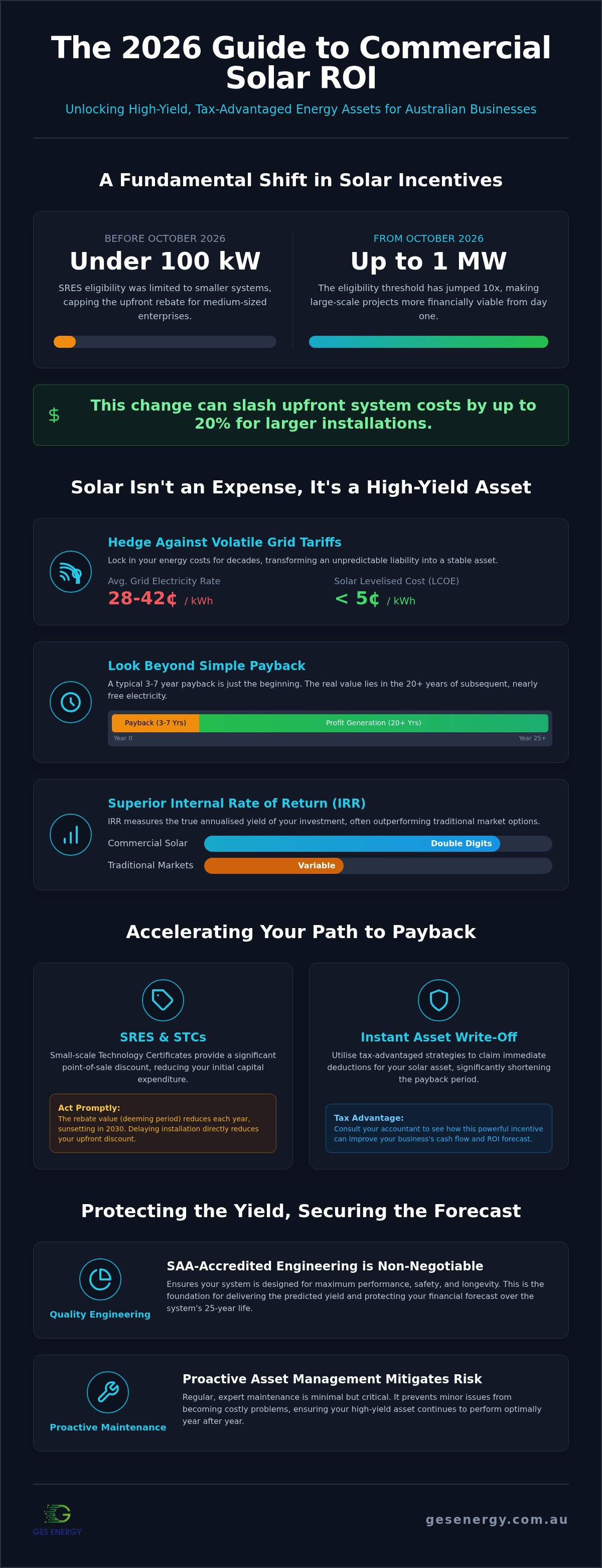
Did you know that as of October 2026, the eligibility threshold for the Small-scale Renewable Energy Scheme has jumped from 100 kW to 1 MW, potentially slashing your upfront costs by 20%? It's a significant shift that fundamentally changes the commercial solar return on investment australia offers to medium-sized enterprises. You're likely watching rising grid energy tariffs impact your margins while feeling uncertain about which government incentives actually apply to your facility. It's frustrating to manage overheads when the goalposts for rebates seem to move every season.
This 2026 guide provides the clarity you need to treat solar as a high-yield, tax-advantaged asset rather than just another utility expense. We'll show you how to calculate a bankable financial forecast, navigate the latest battery incentives, and utilise the Instant Asset Write-off to accelerate your payback period. You'll also discover how SAA-accredited engineering and proactive asset management ensure your system delivers the predicted yield long after the initial installation. By the end of this guide, you'll have a clear, methodical path toward energy independence and long-term financial stability.
Key Takeaways
- Learn to move beyond simple payback periods by calculating Internal Rate of Return (IRR) to reflect the true long-term value of your energy assets.
- Discover how the 2026 SRES eligibility changes have redefined the commercial solar return on investment australia provides for projects up to 1 MW.
- Identify the tax-advantaged strategies, including the Instant Asset Write-off, that can significantly accelerate your system's path to payback.
- Understand the critical role of SAA-accredited engineering and proactive maintenance in protecting your system yield and financial forecast.
- Explore how integrating energy storage into a total energy ecosystem allows your business to bypass rising grid tariffs and maximise self-consumption.
Understanding Commercial Solar Return on Investment in Australia
In 2026, evaluating the commercial solar return on investment australia provides is no longer about simple bill reduction. It's about securing a strategic financial hedge against a volatile energy market. With commercial electricity rates currently averaging between 28 and 42 cents per kWh across the nation, the grid has become an unpredictable liability for heavy energy users. Transitioning to a solar-first model allows businesses to lock in their energy costs for decades, effectively turning a variable expense into a high-yield asset. The maturity of Solar power in Australia has proven that these systems aren't just environmental statements; they're essential infrastructure for modern margin protection.
Professional financial modelling for solar now prioritises Internal Rate of Return (IRR) over simple payback. While payback tells you when you'll break even, IRR demonstrates the annualised yield of the investment over its 25-year lifespan. This shift in perspective is what defines the commercial solar return on investment australia delivers to the C&I sector. For most Australian businesses, a well-engineered solar system offers an IRR that significantly outperforms traditional market investments, often reaching double digits. This is because solar is a predictable asset where the primary fuel is free, and the maintenance requirements are minimal when handled by expert technicians.
Simple Payback vs. Lifetime ROI
Most commercial systems achieve a simple payback within 3 to 7 years. However, focusing solely on this figure ignores the most lucrative part of the investment. Once the system has paid for itself, it generates nearly free electricity for the remainder of its operational life. When you compare the Levelised Cost of Energy (LCOE) from a solar system, which is often under 5 cents per kWh, to the 30 cents or more charged by retailers, the long-term profit is substantial. A system that pays for itself in four years essentially provides 21 years of pure, untaxed profit through avoided costs.
The Strategic Value of Energy Independence
Energy independence provides a level of cash flow predictability that is otherwise impossible in the current market. Beyond the raw kilowatt-hour savings, solar helps businesses mitigate expensive peak demand charges and network tariffs that can make up to 50% of a commercial bill. There's also a significant cost of delay to consider. Every month a business spends waiting for hardware prices to drop further is a month spent paying high retail rates. In most cases, the lost savings from a six-month delay far outweigh any marginal decrease in equipment costs, making immediate action the most financially sound decision.
The 99.9kW Threshold: Optimising Your Upfront Investment
For years, the 99.9kW mark was the definitive boundary for maximising commercial solar return on investment australia. This was largely dictated by the Small-scale Renewable Energy Scheme (SRES), which provided an upfront discount for systems under 100kW. However, the landscape has shifted significantly in 2026. As of October 1, the eligibility threshold for the SRES has expanded to include systems up to 1 MW. This change is a massive win for medium-sized enterprises, allowing larger installations to benefit from the same immediate capital reduction that was once reserved for smaller projects.
While the rebate threshold has moved, the 99.9kW figure remains a technical "sweet spot" for many businesses due to grid connection requirements. Most Distribution Network Service Providers (DNSPs) have streamlined approval processes for systems under 100kW. Once you cross this line, you often face more rigorous protection settings and engineering studies. Balancing the increased rebate potential of a 200kW or 500kW system against these additional grid integration costs is a critical part of your initial feasibility study.
STCs: The Upfront ROI Booster
Small-scale Technology Certificates (STCs) function as the primary mechanism for reducing your initial capital expenditure. The Clean Energy Regulator calculates the number of certificates based on your system's size and its geographic location, known as an STC zone. Small-scale Technology Certificates act as a point-of-sale rebate that effectively reduces the net cost of your solar installation by thousands of dollars. It is vital to note the "deeming period" is currently reducing annually as we approach the scheme's 2030 sunset date. Delaying your installation by just one year can result in a measurable loss of rebate value, directly extending your payback period.
LGCs and Large-Scale Systems
For systems that exceed the new 1 MW SRES limit, or for businesses that prefer ongoing revenue over an upfront discount, the Large-scale Renewable Energy Target (LRET) provides a different path. These systems generate Large-scale Generation Certificates (LGCs) for every megawatt-hour of electricity produced. Unlike the "set and forget" nature of STCs, LGCs require ongoing monitoring, reporting, and registration as a power station. This path provides a recurring revenue stream that can be sold on the spot market, which is currently seeing prices between $38 and $45 per MWh. If your facility has a massive roof footprint and high energy demand, our specialists can help you compare the long-term yields of LGCs versus the upfront simplicity of the expanded SRES.
The 2026 ROI Equation: Components of a Fast Payback
Calculating the true commercial solar return on investment australia provides requires looking at four distinct financial pillars. It is no longer a simple calculation of "energy in versus energy out." Instead, a fast payback is achieved through a combination of direct bill offsets, tax efficiencies, revenue from environmental certificates, and the reduction of expensive peak demand charges. For a business spending $50,000 annually on electricity, a 100kW system can often save between $25,000 and $35,000 per year, but these figures only tell half the story. The speed of your payback depends heavily on how effectively you align your operational load with your solar generation window.
Direct savings remain the most visible component of the equation. With commercial rates reaching up to 42 cents per kWh in some regions, every unit of solar energy consumed on-site is a unit you don't have to purchase from the grid. This makes self-consumption the primary driver of ROI. While feed-in tariffs have declined, they still offer a minor secondary revenue stream for excess energy. However, the real financial gains in 2026 come from more sophisticated asset management strategies like load shifting and tax optimisaton.
Tax-Advantaged Energy Assets
The Australian tax system offers powerful incentives that can front-load your ROI. The Instant Asset Write-off allows eligible businesses to deduct the full cost of the solar system in the first year of installation, rather than depreciating it over decades. This creates a "solar tax shield" that significantly improves first-year cash flow. We recommend consulting with a tax professional to ensure you are maximising these benefits alongside traditional accelerated depreciation for commercial property improvements. When these tax savings are factored in, the effective net cost of the system drops, often shortening the payback period by twelve to eighteen months.
The Role of Industrial Battery Storage
Integrated C&I Energy Storage Systems are becoming essential for fast-tracking ROI by capturing "clipped" energy. This occurs when your solar array produces more power than your inverter can process or more than the grid allows you to export. Instead of losing this energy, a Battery Energy Storage System (BESS) stores it for use during expensive peak tariff windows, which often occur in the late afternoon. This load shifting allows you to bypass the highest grid prices of the day. Furthermore, batteries help reduce peak demand charges, which are fixed costs based on your highest point of usage. By using stored energy to "shave" these peaks, you can lower your entire bill structure, not just the usage component.
Protecting the Yield: Risk Mitigation and Maintenance
Adopting a "set and forget" mentality is the fastest way to erode your commercial solar return on investment australia. While solar is a durable technology, it's not maintenance-free. Environmental factors like dust accumulation, bird droppings, and thermal stress can cause "hot spots" or micro-cracks that significantly reduce output. Even a minor 5% reduction in yield on a large-scale C&I system can result in thousands of dollars in lost savings over a single season. Protecting your financial forecast requires a proactive approach to asset management that treats solar as a critical piece of industrial machinery.
Long-term yield is also threatened by natural component degradation and inverter efficiency losses. Most high-quality panels are rated to maintain at least 80% of their original output after 25 years, but this assumes the "balance of system" is functioning correctly. The solar inverter is the hardest-working component and typically requires a mid-life replacement or repair. Proactive monitoring ensures these issues are identified before they impact your cash flow. To ensure your system continues to meet its financial targets, you can book a national maintenance review with our SAA-accredited engineering team.
O&M: The Guardian of Your ROI
Professional Operations and Maintenance (O&M) isn't just a cost; it's a yield-guarantee strategy. A single day of downtime on a 1 MW array can cost hundreds of dollars in unearned savings. We utilise SAA-accredited labour for all inspections, conducting thermal imaging and string testing to ensure every panel performs to its design specification. By using advanced solar analytics, we can track real-time performance against your original ROI forecast. This allows for immediate corrective action if the yield drops below predicted levels, ensuring your payback period remains on track.
Micro-grids and Off-Grid ROI
For remote industrial sites, the ROI of Micro Grid Solutions is often even more compelling than grid-connected systems. These sites frequently rely on expensive diesel generation, where the cost of fuel, transport, and engine maintenance is substantial. By integrating solar with C&I Energy Storage Systems, businesses can avoid the exorbitant costs of grid extensions or primary diesel reliance. This provides a predictable, low-cost energy source for 24/7 operations and future-proofs your assets against grid instability and rising fuel prices. In these scenarios, the ROI is driven not just by bill savings, but by the total replacement of high-cost, high-maintenance energy infrastructure.
Securing the Best Commercial Solar Deals with GES Energy
Achieving a superior commercial solar return on investment australia depends on moving from generic hardware to a custom-engineered energy ecosystem. At GES Energy, we act as a comprehensive, end-to-end specialist for projects ranging from standard commercial arrays to utility-scale installations up to 5 MW. Our national reach allows corporate partners to standardise their energy infrastructure across multi-site portfolios, ensuring consistent yield and performance from every facility. By managing the entire lifecycle of the project, we remove the financial and technical risks that often stall large-scale energy transitions.
Our national maintenance and repair service is designed to preserve your financial forecast over the system's 25-year life. We understand that a commercial solar return on investment australia is only as strong as the system's uptime. By providing consistent oversight and SAA-accredited technical support, we ensure that your yield remains high even as environmental conditions change. Whether you're managing a single industrial site or a national retail chain, our expertise in Micro Grid Solutions and C&I Energy Storage Systems allows us to design a resilient energy strategy that meets your specific commercial objectives.
The EPC Advantage for Business
Choosing an Engineering, Procurement, and Construction (EPC) model provides boards with the financial certainty they require. We provide fixed-price contracts that cover everything from the initial solar design to the final commissioning by SAA-accredited labour. This model ensures that hardware procurement is optimised for your specific site conditions and that every component is integrated into a total energy ecosystem. For many businesses, this now includes the seamless integration of EV Charging Stations. This methodical approach to procurement allows us to leverage high-quality components at competitive rates, directly improving your initial capital efficiency. We handle the complex regulatory approvals and grid connection negotiations, allowing your team to focus on core business operations while we build your path to independence.
Your Next Steps to Energy Independence
Protecting your long-term yield requires more than just a successful installation. It demands a dedicated partner who remains committed to the ongoing health and performance of your assets. We don't just provide a product; we provide a bankable financial forecast backed by rigorous engineering. Our feasibility studies go beyond surface-level estimates. We perform deep-dive data analysis of your 15-minute interval data to identify the exact "sweet spot" for your system size and battery capacity. Our bespoke design process ensures that your system is sized correctly for your operational load, maximising your self-consumption and accelerating your path to payback. To begin your transition, you can organise a commercial solar feasibility audit with GES Energy. Our team will provide a detailed ROI study tailored to your specific energy profile, helping you secure the best possible deal for your business's future.
Future-Proofing Your Business with Strategic Solar Investment
The Australian energy landscape has reached a point of maturity where the financial benefits of renewable transitions are both predictable and substantial. By leveraging the expanded 1 MW SRES threshold and taking advantage of current tax incentives, your organisation can secure a rapid payback while hedging against future grid volatility. Achieving a bankable commercial solar return on investment australia depends on more than just hardware; it requires a commitment to diligent maintenance and precise engineering. GES Energy stands as your dedicated partner in this transition, offering end-to-end EPC management and national maintenance support to ensure your system performs exactly as forecasted.
Our SAA-accredited engineering team focuses on building total energy ecosystems that provide stability and control over your long-term operational costs. To see exactly how these variables align for your specific facility, you can Request a Comprehensive Commercial Solar ROI Forecast today. Taking control of your energy future is a practical and rewarding step toward lasting financial resilience.
Frequently Asked Questions
What is the average payback period for commercial solar in Australia?
The average payback period for commercial solar in Australia typically ranges between three and seven years. This timeframe is primarily influenced by your facility's daytime energy consumption and the current retail electricity rates you pay. High-irradiation zones across the country often see faster returns due to increased system yields. Once the initial capital is recovered, the system continues to generate nearly free electricity for the remainder of its twenty-five-year operational life.
Can my business still claim the Instant Asset Write-off for solar in 2026?
Eligible Australian businesses can still utilise tax incentives like the Instant Asset Write-off to significantly accelerate their commercial solar return on investment australia. This mechanism allows you to deduct the full cost of the system in the first year of installation, rather than depreciating it over decades. Because tax regulations are subject to annual federal budget updates, we recommend consulting with a qualified tax professional to confirm your eligibility for the 2026 financial year.
Is it better to install a 99kW or 100kW solar system?
While 99.9kW was historically the limit for upfront rebates, the October 2026 expansion of the SRES threshold to 1 MW has changed the decision-making process. The choice now depends more on your specific grid connection requirements and engineering complexity than just the rebate cap. Systems under 100kW often benefit from simpler network protection settings, whereas larger systems may require more intensive grid integration studies despite their increased rebate potential.
How do Large-scale Generation Certificates (LGCs) work?
Large-scale Generation Certificates (LGCs) are environmental commodities created for every megawatt-hour of renewable energy produced by systems larger than the SRES threshold. Unlike upfront rebates, LGCs provide an ongoing revenue stream that you can sell on the open market at current spot prices. This requires ongoing monitoring and reporting to the Clean Energy Regulator, making it a preferred financial strategy for utility-scale industrial projects with massive roof footprints.
Does commercial solar increase the value of my business premises?
Installing a commercial solar system typically enhances the market value of your business premises by improving its NABERS rating and reducing long-term operational overheads. Prospective buyers or tenants view energy-efficient infrastructure as a high-value asset that provides cost certainty. By lowering the building's carbon footprint and energy expenses, you make the property more competitive in the commercial real estate market, often resulting in higher lease yields or a better sale price.
What are the ongoing maintenance costs for a commercial solar system?
Ongoing maintenance costs are relatively low but essential for protecting your long-term yield. A standard programme includes annual electrical inspections, thermal imaging of panels, and periodic cleaning to ensure maximum irradiance. Budgeting for these services ensures that minor technical issues don't escalate into expensive repairs or significant downtime. Proactive maintenance by SAA-accredited technicians typically pays for itself by ensuring the system performs at its maximum design capacity throughout its operational lifespan.
Can I include EV charging stations in my solar ROI calculation?
Yes, integrating EV Charging Stations into your solar ROI model is an effective strategy for modern businesses. By using self-generated solar power to charge a company fleet or provide staff amenities, you replace expensive liquid fuel or grid-purchased electricity with low-cost renewable energy. This integration improves the overall utilisation of your solar array and can be factored into a comprehensive energy forecast to demonstrate a faster path to total project payback.
How does a Battery Energy Storage System (BESS) improve ROI?
A Battery Energy Storage System (BESS) improves your return by allowing for sophisticated load shifting and demand management. It captures excess energy produced during the day and stores it for use during expensive peak tariff windows. This maximises your self-consumption and helps reduce peak demand charges on your electricity bill. Additionally, battery storage provides essential backup power, protecting your industrial operations from grid instability and the high cost of unplanned outages.


