

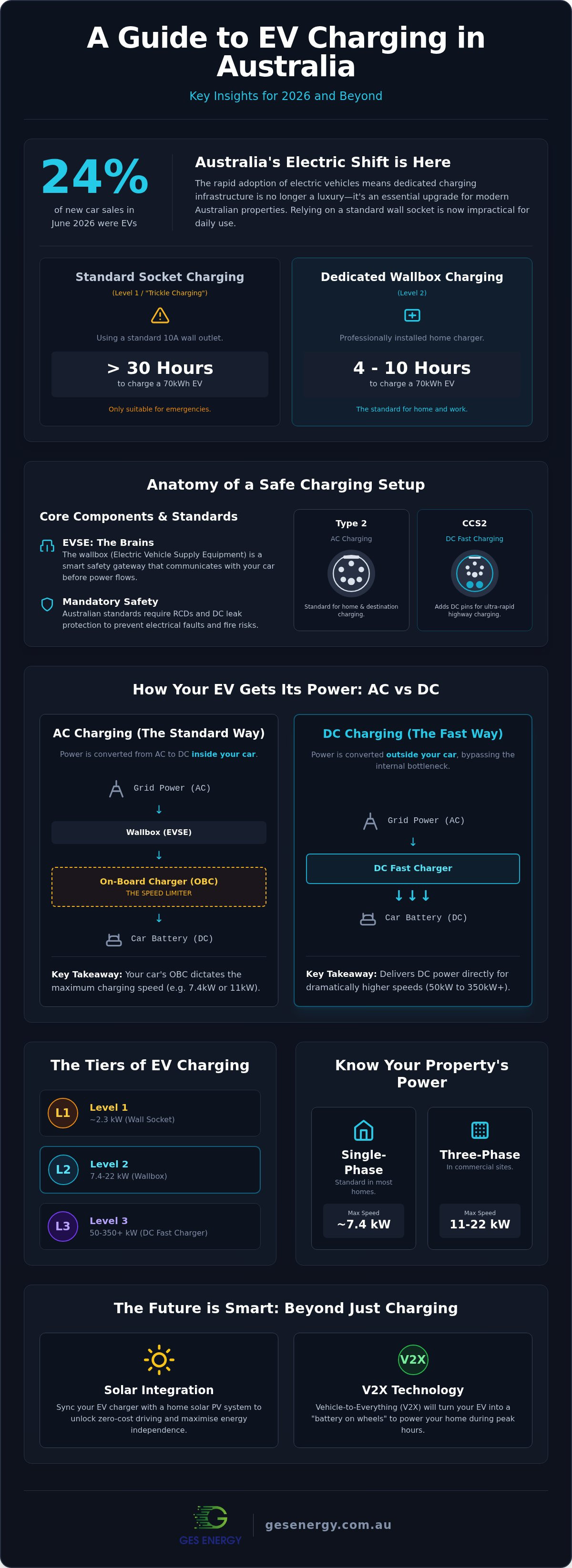
24% of new car buyers in Australia chose an electric vehicle in June 2026, marking a massive leap in how we move. This rapid shift means that ev charging is no longer a niche luxury but a core component of modern Australian infrastructure. You likely feel the pressure to adapt but find yourself confused by technical jargon surrounding AC versus DC speeds or worried that a new charger might overload your electrical switchboard. It’s a common concern, especially as rising grid prices threaten to make your commute more expensive than it needs to be.
This guide will help you master the technical and practical essentials of EV charging to future-proof your property and maximise your energy independence. We'll explore the hardware required for a reliable setup, how to integrate charging with solar for zero-cost driving, and the latest 2026 regulations you need to know. By the end, you'll have a clear roadmap to a fast, cost-effective charging solution that puts you back in control of your energy costs and ensures your property is ready for the electric future.
Key Takeaways
- Differentiate between AC and DC power and understand why your vehicle’s on-board charger, rather than the wallbox alone, dictates your actual charging speed.
- Discover how to synchronise ev charging with solar PV systems to bypass rising electricity prices and move towards a self-sustaining energy ecosystem.
- Prepare your electrical infrastructure for the long term by conducting site audits that ensure your switchboard can handle increased loads without compromising safety.
- Gain insights into the future of V2X technology and how your vehicle can serve as a "battery on wheels" to power your property during peak demand.
Understanding the EV Charging Landscape in Australia
At its simplest level, ev charging is the technical process of converting electrical energy from the grid or a solar PV system into chemical energy stored within a vehicle's battery. While this sounds straightforward, the EV Landscape in Australia has shifted dramatically over the last few years. 2026 represents a definitive tipping point for infrastructure. With EV market share reaching 24% of new car sales in June 2026, the transition from early adoption to mass-market necessity is complete. This growth requires a move away from makeshift solutions toward robust, engineered systems.
The Clean Energy Council plays a vital role in this transition by setting rigorous installation standards for ev charging systems. These guidelines ensure that every setup is safe, efficient, and capable of handling the high electrical loads required. Relying on "trickle charging" from a standard 10A domestic socket is no longer a viable strategy for modern EVs. Most new vehicles have battery capacities exceeding 70kWh. A standard plug would take over 30 hours to reach full charge, which is impractical for daily use. Dedicated infrastructure is now essential for both residential and commercial properties to remain functional.
The Core Components of a Charging Station
The heart of any installation is the EVSE (Electric Vehicle Supply Equipment). This is the wallbox or pedestal that manages the flow of electricity. It acts as a safety gateway rather than just a power point. Complex communication protocols between the car and the charger ensure that power only flows when a secure connection is established and the battery is ready to receive it. Safety features such as Residual Current Devices (RCDs) and DC leak protection are non-negotiable requirements under Australian standards to prevent electrical faults or fire risks.
The Australian Standard: Type 2 and CCS2
Australia has aligned with international best practices by adopting the European Type 2 Mennekes standard for AC charging. It’s helpful to distinguish between the plug on your wall and the port on your car. While the physical connector looks standard, the technology inside manages everything from locking the cable to thermal monitoring. For rapid charging networks, the industry has shifted toward CCS2. This "Combined Charging System" adds two large DC pins to the base of the Type 2 connector, allowing for the high-speed energy transfer needed for long-distance travel and commercial fleet operations.
Technical Fundamentals: AC vs DC and Charging Levels
Electricity from the Australian grid is Alternating Current (AC), but your vehicle's battery stores energy as Direct Current (DC). For most ev charging, the conversion happens inside the car via the On-Board Charger (OBC). This internal component is the silent gatekeeper of your charging speed. Even if you install a high-capacity wallbox, your car will only draw the maximum power its OBC can handle. This is why some vehicles charge at 11kW while others are limited to 7kW on the same hardware. DC fast charging bypasses this internal bottleneck by converting power externally, feeding energy directly into the battery at much higher rates.
Physics dictates that charging isn't a linear process. As your battery fills up, the charging speed tapers off to protect the cells. This is similar to how you slow down when filling a glass of water to avoid spilling as it reaches the rim. Environmental factors also play a role. Australian summer heat can lead to thermal throttling, where the car reduces its intake to manage internal battery temperatures. Understanding these variables helps you set realistic expectations for how long your vehicle stays plugged in.
Level 1 vs Level 2 vs Level 3
Understanding the tiers of infrastructure is essential for effective planning. Level 1 involves a standard 10A socket, providing a slow 2.3kW top-up that is best reserved for emergencies. Level 2 is the standard for Australian workplaces and homes, ranging from 7.4kW to 22kW. Level 3 covers ultra-rapid highway stations that deliver 50kW to over 350kW. These tiers are central to Australia's National Electric Vehicle Strategy, which aims to standardise fast-charging access across the country to support long-distance travel.
Single-Phase vs Three-Phase Power
Most residential properties in Australia operate on single-phase power, which typically caps your charging at 7.4kW. Commercial sites often have three-phase power available, allowing for 11kW or 22kW chargers that can significantly reduce downtime for fleet vehicles. You can identify your supply by checking your switchboard for a main switch that spans three poles or by counting the number of wires entering your property from the street. If you are unsure about your site's electrical capacity, consulting an expert for an ev charging infrastructure audit is the safest way to avoid overloading your local grid connection.
The Synergy: Integrating Solar and Battery Storage
Relying on grid electricity for ev charging during peak evening periods often negates the financial benefits of owning an electric vehicle. High retail tariffs make charging expensive, while simultaneous demand from household appliances can strain a property's electrical capacity. Data from Electric Vehicle Council industry reports suggests that the most efficient way to manage this is through integrated system design. By synchronising your vehicle's energy intake with solar PV generation, you can achieve a "Zero-Emission Mile" where your transport costs are effectively decoupled from grid price volatility. This approach transforms the car from a liability on the bill into a productive asset within your energy ecosystem.
Solar-aware charging works by monitoring the excess generation from your solar array in real-time. Instead of exporting that power to the grid for a minimal feed-in tariff, the system diverts it directly into the vehicle's battery. Adding a battery storage system provides an additional buffer. It allows you to store solar energy during the day and use it for ev charging at night, ensuring that your car is always powered by clean, locally generated energy. This integration is particularly valuable for commercial sites where fleet vehicles might be stationary during high-generation periods, allowing for maximum self-consumption and rapid payback on infrastructure investments.
Smart Charging and Load Balancing
Many Australian properties face the risk of "nuisance tripping" when high-draw appliances like ovens or air conditioners run at the same time as a car charger. Dynamic load management solves this by monitoring the total site load and adjusting the charger's output accordingly. Load balancing is the intelligent distribution of available power to prevent circuit overload. If the property's total consumption nears its safety limit, the smart charger automatically reduces the current to the vehicle until other loads decrease. This ensures your electrical switchboard remains stable without requiring expensive upgrades to the local grid connection.
Off-Grid EV Charging Solutions
Charging in remote Australian locations presents unique engineering challenges that require a departure from standard residential setups. Without a reliable grid connection, the system must rely entirely on a standalone solar array and a substantial battery bank to support vehicle charging. Sizing these components requires meticulous planning to ensure the system can deliver the high currents required for an EV without depleting the property's primary energy reserves. For those operating in remote areas, specialized Off Grid Solar System Design is essential to maintain mobility and energy security while ensuring the longevity of the battery hardware.
Planning Your Infrastructure: From Homes to Commercial Sites
Success in ev charging starts long before the hardware arrives on site. A comprehensive site audit is the first non-negotiable step for any property owner. This process involves more than just finding a spare spot in the switchboard. It requires a detailed analysis of your property's maximum demand versus its actual supply capacity. Skipping this step often leads to expensive retrofits or safety risks from overloaded circuits. We focus on a meticulous design process to ensure your system remains reliable for years to come.
Future-proofing is a core pillar of professional infrastructure planning. While you might only have one electric vehicle today, Australian market trends suggest that multi-EV households and fully electric commercial fleets will be the norm by the end of the decade. Installing sub-mains with higher capacity than your current requirements is a strategic move. It prevents the need for disruptive excavation or rewiring when you decide to add a second or third charging point. Cable management and physical accessibility also demand attention. Chargers should be positioned to minimise trip hazards while ensuring that the charging port is easily reached regardless of how a vehicle is parked.
Residential Installation Checklist
Homeowners must evaluate their switchboard for available space and circuit breaker compatibility. You'll also need to choose between a tethered charger, which has the cable permanently attached, and an untethered unit that requires you to use your own cable. Tethered units offer daily convenience. Untethered sockets provide a cleaner aesthetic and better compatibility with various vehicle types. Selecting a location close to the main switchboard is the most effective way to reduce cabling costs and installation complexity.
Commercial and Industrial Scale Considerations
Managing ev charging at a commercial scale introduces layers of complexity regarding access and reporting. Fleet managers require sophisticated scheduling software to ensure vehicles are charged and ready for operation without exceeding site power limits. Implementing RFID access control and public billing systems allows you to recover costs and prevent unauthorised use of your infrastructure. This setup often works best when viewed as a natural extension of a Commercial Solar Installation: A Strategic Guide, allowing you to power your fleet with onsite generation. If you are ready to secure your property's energy future, you can book a professional site assessment with our engineering team today.
The Future of Charging: Smart Grids and V2X
The evolution of ev charging in Australia is moving toward a bidirectional model where the vehicle functions as a "battery on wheels." This technology, known as Vehicle-to-Home (V2H) and Vehicle-to-Grid (V2G), allows your car to do more than just consume energy. It can actively support your property or the wider electrical network. In a V2H setup, your car's battery can power your building during a blackout or during expensive peak tariff periods. This capability transforms an electric vehicle into a high-capacity storage asset that complements your existing solar and battery infrastructure.
Australia is already seeing the growth of Virtual Power Plants (VPPs), where distributed energy resources like EVs are orchestrated to stabilise the grid. GES Energy plays a critical role in this ecosystem by commissioning future-ready energy systems that are compatible with these emerging technologies. By designing your infrastructure with bidirectional potential in mind, you ensure that your property remains at the forefront of the energy transition. Our team focuses on the end-to-end lifecycle, ensuring your system is ready for the smart grid requirements of 2026 and beyond.
Bidirectional Charging: Is Your Car Ready?
Not all vehicles are currently equipped for bidirectional flow, but the list of compatible models is expanding. Cars like the Nissan Leaf and certain Mitsubishi PHEVs have led the way with CHAdeMO-based V2G, while newer models like the Kia EV9 and various Hyundai Ioniq versions offer Vehicle-to-Load (V2L) capabilities. To move energy from the car back into your home or the grid, you need specialised ev charging hardware. Standard wallboxes cannot handle the reverse flow of power, so selecting the right equipment during the initial design phase is vital. V2G technology allows an EV to discharge power back into the grid during peak demand periods.
Conclusion: Building Your Energy Independence
Transitioning to electric transport is a journey that begins with a simple plug but ends with a fully integrated, self-sustaining power system. We have moved from basic trickle charging to sophisticated, solar-aware environments that prioritise energy independence and long-term value. Achieving this level of sophistication requires meticulous planning and expert oversight. Using SAA-accredited labour is non-negotiable to ensure the safety of your property and the validity of your equipment warranties.
GES Energy remains a committed partner in this transition, acting as both a technical specialist and a diligent steward of your infrastructure. Whether you are managing a commercial fleet or future-proofing a residential property, our team provides the engineering expertise needed to navigate these complex systems. Contact GES Energy today to discuss a comprehensive site design that secures your energy future and maximises your return on investment.
Securing Your Energy Independence through Modern Infrastructure
Mastering your ev charging setup is the final step in creating a truly self-sustaining energy ecosystem. You now understand that the transition involves more than choosing a wallbox; it requires a deep dive into your property's electrical capacity, the nuances of AC and DC speeds, and the intelligent integration of solar PV generation. By prioritising future-ready technologies like bidirectional charging and smart load management, you protect your investment against rising grid prices and evolving network demands.
GES Energy has been a specialist in complex commercial solar and battery integration since 2018. Our SAA-accredited engineering team focuses on the complete design-to-maintenance lifecycle, ensuring your infrastructure is built for long-term reliability. As an Australian owned and operated business, we act as a supportive partner to guide you through every technical hurdle. Take the next step toward total control over your transport costs and consult with GES Energy for your custom EV charging infrastructure design. Your property is ready for the electric future; it’s time to ensure your infrastructure matches that vision.
Frequently Asked Questions
How much does it cost to install an EV charger in Australia?
The national average cost for a home EV charger installation in Australia was A$2,237 as of July 2026. This investment covers the hardware and labour required for a standard residential setup. Prices for commercial sites vary significantly based on the existing electrical capacity and the need for trenching or switchboard upgrades. We recommend a professional site audit to determine the exact requirements for your specific property.
Can I charge my EV with my existing solar panels?
You can charge your vehicle using your existing solar panels by installing a solar-aware charger. This technology monitors your PV generation and directs excess energy into the car instead of the grid. It’s the most effective way to achieve zero-cost driving. If your current system is undersized, adding more panels or a battery storage unit can further enhance your vehicle charging efficiency and energy independence.
Do I need to upgrade my electricity meter for an EV charger?
An electricity meter upgrade isn't always mandatory, but you will likely need a smart meter to access EV-specific off-peak tariffs. These meters provide the data transparency required to manage your energy costs effectively. Our SAA-accredited engineers check your meter box during the design phase to ensure compliance with the latest Australian wiring rules. This ensures your system is safe and ready for high-demand operation.
What is the difference between a tethered and untethered charger?
The main difference is that a tethered charger has the cable permanently fixed to the unit, whereas an untethered charger has a socket for a removable cable. Tethered chargers are often preferred for home use because they save time during daily plug-in routines. Untethered chargers are common in commercial settings as they allow drivers to use their own cables, making the station compatible with any vehicle port type.
How long does it take to charge an EV from 0 to 100% at home?
Charging a standard 73kWh battery from 0 to 100% takes about 10 hours on a 7.4kW single-phase home charger. Most Australians drive less than 50km per day, so they rarely need a full charge from empty. A typical daily top-up usually takes less than 3 hours. This ensures your vehicle is ready every morning without placing excessive long-term stress on your home's electrical infrastructure.
Is it safe to charge an electric car in the rain?
Yes, it's entirely safe to charge an electric vehicle in the rain. The hardware is engineered with robust weatherproofing and high IP ratings to handle Australian conditions. The electrical pins don't become live until the car and the charger have completed a digital handshake and confirmed a secure, dry connection. Built-in safety sensors will immediately cut the power if any moisture-related fault is detected.
What is a smart EV charger and do I really need one?
A smart ev charging unit connects to your Wi-Fi to provide advanced features like remote scheduling and real-time energy tracking. While a basic charger is functional, a smart unit is highly recommended for its ability to balance loads and integrate with solar. This intelligence prevents you from overloading your switchboard when other appliances are running. It also allows you to automate charging for when electricity prices are lowest.
Can an EV charger be installed in an apartment building car park?
Installing ev charging in apartment car parks is possible but requires coordination with the body corporate or owners' corporation. New buildings under the latest National Construction Code must include provisions for EV infrastructure, which makes the process much simpler. For older buildings, we conduct a site audit to assess the shared electrical capacity. This ensures that adding chargers doesn't compromise the power supply to other residents in the complex.


