

Solar panels can reduce the electricity you buy without removing every charge from your bill. Understanding your electricity bill with solar means separating imported grid power, daily supply charges and any feed-in credits for exported energy. If solar credits exceed grid-use charges, your bill can show a credit.
A solar electricity bill can be harder to interpret because generated power may be used onsite, exported to the grid or stored in a battery, and each affects the bill differently. Billing dates and meter readings show which period the charges and solar exports cover.
This guide explains usage and supply charges, billing periods, solar generation and export data, feed-in tariffs, and actual or estimated meter readings. You’ll learn how these entries fit together, what a zero feed-in credit may indicate, and how to distinguish solar generation from electricity imported from the grid.
Key Takeaways
- Separate usage charges from daily supply charges to see what you’re paying for grid electricity and what remains fixed.
- Use the billing dates and meter readings to understand which period each charge and solar credit covers.
- Compare inverter monitoring data with your bill to distinguish solar generation, onsite use and exported electricity.
- A zero feed-in credit can relate to export readings or your energy plan, so look at both when interpreting the bill.
- Understand whether a meter reading is actual or estimated, as this affects how the billed usage is calculated.
Understanding consumption charges and supply charges
Your bill separates electricity bought from the grid from solar power exported to it. Read each charge alongside its rate and billing period to understand how solar affects the amount due.
Grid imports and solar exports
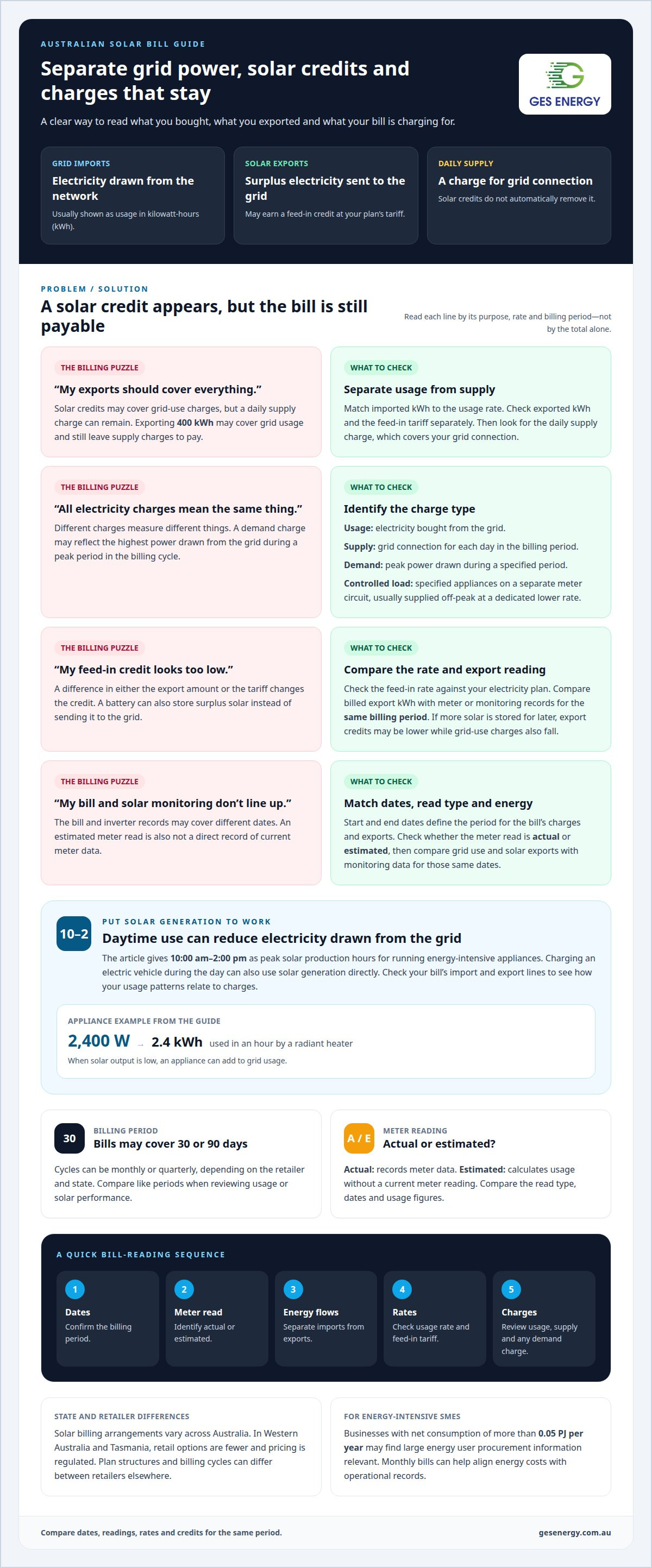
Grid imports are electricity drawn from the network; solar exports are surplus electricity sent back to it. Your bill usually lists imported usage in kilowatt-hours (kWh) and exported energy separately, with feed-in credits calculated from the export amount and tariff.
To check whether your feed-in tariff is correct, compare the rate on your bill with the rate in your electricity plan. Then compare the billed export kWh with your meter or monitoring records for the same billing period. A mismatch in either figure changes the credit.
Australian electricity usage charges are expressed in cents per kWh. For example, a household exporting 400 kWh may have enough solar credits to cover grid usage, but still pay daily supply charges.
Usage, supply and demand charges
A usage charge bills the electricity you buy, while a supply charge covers grid connection for each day in the billing period. A demand charge may reflect the highest power drawn from the grid during a peak period in that cycle. These charges measure different things, so solar exports do not automatically remove them.
A controlled load tariff applies to specified appliances on a separate meter circuit, usually powered during off-peak hours at a dedicated lower rate. Check whether its usage appears as a separate line instead of assuming it is included in general household consumption.
Power usage on a solar bill refers to purchased electricity after onsite generation has been exceeded. A 2400-watt radiant heater uses 2.4 kWh in an hour, illustrating how one appliance can add grid usage when solar output is low. Electricity rates also vary by plan, so check the applicable usage rate and any estimated reading.
A solar battery stores surplus solar energy for later use, which can reduce electricity bought from the grid. If more energy is stored rather than exported, feed-in credits may be lower. The bill may therefore show reduced usage charges alongside smaller export credits.
For a practical way to reduce imported power, run energy-intensive appliances during peak solar production hours, given as 10:00 a.m.-2:00 p.m. Charging an electric vehicle during the day can also use solar generation directly, reducing the amount drawn from the grid. Check your bill’s import and export lines to see how these patterns relate to your charges.
Australian electricity bill sections and billing periods
Read the billing dates first, then match meter readings, solar exports and charges to that period. Australian bills may cover 30 or 90 days, depending on the billing cycle.
Actual and estimated meter reads
An actual read records meter data, while an estimated read calculates usage without a current meter reading. This distinction matters because estimated usage may differ from the energy recorded by your meter. Compare the read type, dates and usage figures, then check whether solar exports appear for the same period.
For example, if your bill marks a reading as estimated, treat the billed amount as an estimate of electricity use, not a direct meter record. Keep the bill’s start and end dates in view when comparing it with solar monitoring data.
State differences in solar billing
Solar billing arrangements vary across Australia, so your state and retailer affect how bills and plans are presented. In Western Australia and Tasmania, retail options are fewer and pricing is regulated. Elsewhere, plan structures and billing cycles can differ between retailers.
For rooftop solar, read export and feed-in credit entries alongside the billing period and plan details. This helps you distinguish a difference in billing presentation from a change in measured exports or credited energy.
Most bills group information into sections showing account and billing dates, meter readings, electricity usage, charges, credits and the amount payable. With rooftop solar, identify the grid usage and exported electricity entries. Match each quantity to its rate or credit rather than comparing the total alone.
Billing cycles can be monthly or quarterly, depending on the retailer and state regulations. A bill covering 30 or 90 days changes the period represented by its totals, so compare like periods when reviewing seasonal usage or solar performance. Note the dates before comparing one bill with another.
Energy-intensive Australian SMEs may receive monthly bills rather than quarterly ones. For businesses with net consumption of more than 0.05 PJ per year, energy procurement information for large energy users is relevant. A finance or facilities team can use billing periods to align energy costs with operational records.
If a charge or solar credit looks wrong, compare the bill’s dates, meter readings, rates and calculations. Keep the bill and relevant meter or solar records together. An Australian energy retailer must review a customer’s bill if the customer requests a review. Identify the disputed line and explain which reading, rate or period appears inconsistent.
For a rooftop solar bill, start with the billing period, identify whether readings are actual or estimated, then review grid use and export credits. This gives you a clear basis for comparing charges across bills or raising a specific billing issue with your retailer.
Reading solar generation, self-consumption and export data
Your bill’s export figure is only part of your solar system’s energy picture. Compare it with inverter records to see what your panels generated, what your property consumed and what reached the grid.
Solar generation and self-consumption
Solar generation is the electricity produced by your panels; self-consumption is the portion used onsite. These figures explain why generation and grid exports aren’t interchangeable. For example, a household using 800 kWh and generating 600 kWh can still import electricity while using some solar energy directly.
Your bill may not show total generation or onsite use separately. Check your inverter’s monitoring app for those readings, then compare its date range with the bill. The difference between generation and exports includes solar energy consumed onsite or stored, if you have a battery.
Checking meter and export readings
A meter records electricity flowing between your property and the grid, while inverter data tracks solar generation. Comparing both helps you interpret billed imports and exported energy. For example, a household may import 500 kWh and export 300 kWh during a period, even though its panels generated electricity throughout that time.
Match the meter’s start and end dates to your bill before comparing totals. Check that export readings cover the same period, and note whether the bill uses actual or estimated readings. Different date ranges can make otherwise accurate figures appear inconsistent.
Monitoring exports and energy use
Monitoring compares exported electricity with grid imports and onsite use over matching periods. Australian businesses with solar PV have exported power metered, and the exported amount is normally shown on their energy bill. Inverter apps can add generation and onsite-use information that the bill may not display.
To calculate average daily exports, divide the export kWh shown for a billing period by the number of days it covers. Compare the result with another period of similar length. Seasonal variation can affect how much solar power a household uses onsite and how much it imports or exports.
Smart meter import and export measurements
A smart meter measures electricity imported from the grid separately from solar electricity exported to it. This distinction matters because imports are charged under your plan, while exports may earn feed-in credits. Your bill presents the measured quantities for its billing period.
Use the bill’s import and export figures alongside inverter records to understand energy flows. Compare matching dates, then review the meter readings if totals differ. The meter measures grid flows; inverter monitoring helps show how much solar energy the panels generated and how much was consumed onsite.
For a year-on-year comparison, set the bill’s export total beside the same period last year. Align the billing dates, then consider seasonal variation and changes in household energy use. A difference in exports alone doesn’t show whether generation changed or more solar energy was consumed onsite.
Understanding a bill showing 0kWh of feed-in tariff
A 0 kWh feed-in tariff entry means no exported electricity appears as credited for that billing period. In Australia, the meter or energy plan may have an issue, so compare the export reading with your plan details and bill dates.
Supply and usage charges vary by plan and location, so check the daily supply amount and usage rate printed on your bill.
Start with the feed-in tariff line and check whether it shows 0 kWh, a zero credit, or both. A zero export quantity differs from a recorded export receiving no credit. Then compare the meter’s export reading with the bill’s billing period. Check the plan’s feed-in tariff terms and confirm that the account details still match the premises and solar system.
A change of account name is a useful time to review these details. Compare the new bill’s account information and energy plan with the previous bill, then inspect the export entry and tariff. The name change itself does not explain a missing export quantity; the reading, billing dates and plan terms are the useful details to compare.
Single-rate plans apply one usage rate regardless of the time electricity is consumed. Time-of-use tariffs divide usage into peak, shoulder and off-peak periods, with peak rates typically highest and off-peak rates lowest. Peak electricity use generally falls on weekdays from 4pm to 8pm; off-peak use generally falls from 10pm to 7am on weekdays and weekends.
Feed-in tariffs can also vary by plan. A flat-rate tariff pays the same rate whenever solar electricity is exported. Time-of-use feed-in tariffs can vary by export time, with peak export periods typically 4-8 PM. Some Victorian retailers offer higher solar export rates during peak periods, so compare the export tariff alongside usage rates and daily supply charges.
That comparison matters because a higher feed-in rate alone doesn’t show the full value of a plan. Review when your system exports, when your household imports electricity, and which rates apply at those times. If your bill records no export, compare its meter data and dates with your solar monitoring records before drawing conclusions about the tariff.
Check the export figure, tariff type, relevant time periods and account plan details together. These entries help distinguish a missing export reading from a plan that credits exports differently.
Actual and estimated meter readings
An actual meter reading records measured electricity use, while an estimated reading indicates calculated usage without a current read. The distinction matters because a bill based on an estimate may not match the meter’s recorded energy use for that period.
Look for the reading type beside the meter data, then compare the dates and figures. An actual read gives a specific meter value for the stated date. An estimated read is a billed estimate, not a direct record taken on that date. The billing period shows which days the bill’s usage covers.
Check the meter details, including its identifier and read dates, against previous bills. The next read date can indicate when another reading is due; it isn’t the end date of your current bill. Keep that distinction clear when comparing solar power data with billed electricity use.
For an estimated bill, compare its energy usage with the meter readings on the next bill. A later actual reading can account for usage across the interval since the previous actual read. This may make one bill look unusually high or low, while the combined readings give a fuller view of consumption across both periods.
Solar adds another layer. Your meter records electricity flowing between your property and the grid, while inverter monitoring records solar generation. Compare the meter’s import and export readings with the inverter’s dates. Different time periods can make the figures appear inconsistent, even when each record covers a different interval.
Net usage may be shown as imported electricity minus exported electricity. For instance, if a bill lists imports of 600 kWh and exports of 200 kWh, the net figure is 400 kWh. This is a billing calculation, not the total electricity your property consumed, because solar power used onsite isn’t included in grid imports.
Use these checks when a reading or net figure seems inconsistent:
- Match the bill’s start and end dates with meter and inverter records.
- Identify whether each meter reading is actual or estimated.
- Compare import and export quantities separately before interpreting net usage.
- Check the meter identifier and read dates against the previous bill.
If an estimated reading appears to distort your bill, keep that bill and its meter details together. An Australian energy retailer must review a customer’s bill if the customer requests a review. Describe the specific reading or calculation in question, and include the relevant dates and figures. This creates a clear basis for reviewing billed energy use alongside solar imports and exports.
GES ENERGY: Commercial and Industrial Solar
GES ENERGY’s Commercial and Industrial Solar offering can help businesses plan a solar system around their energy use. Bill data, including grid imports and solar exports, gives a clearer view of when a site uses electricity and how much it sends to the grid. That information can inform system design for commercial projects ranging from 10 kW to 5 MW.
For homes, Solar + Batteries for Homes can suit households looking to store solar power for later use. Off Grid Solar Systems support sites planning to operate without a grid connection, while EV Charging Stations can form part of a business energy plan.
If your electricity data is guiding a solar decision, contact GES Energy to discuss your project.
Turn bill insights into an energy plan
Use your bill as a starting point for setting energy priorities, not as the only measure of what your property may need. Consider upcoming changes to operating hours, equipment or household routines, and note which decisions need to come first. A short list can turn bill observations into a practical planning brief.
Keep that brief focused on your goals, such as improving energy independence or planning for future electricity demand. Record any assumptions you want to revisit, then use a clear project plan to guide your next step with GES ENERGY.
Defining the outcome you want makes future energy decisions easier to assess. Start with one priority and build from there.
Frequently Asked Questions
What do electricity bill charges and credits mean in Australia?
Charges add amounts to your bill, while credits reduce the balance payable. To interpret a line item, match its description with the billed amount and the rate or unit shown beside it. A credit is a monetary adjustment to the account, not a measurement of solar generation. If the final balance seems unexpected, compare individual entries before focusing on the total.
How are solar feed-in tariffs calculated in Australia?
Your feed-in credit depends on the tariff terms attached to your energy plan and the exported energy accepted for credit. To check the arithmetic, read the export quantity and tariff rate together, then compare the resulting credit with the amount shown. If your bill separates export periods or tariff types, assess each line on its own before adding the credits.
How do time-of-use electricity rates affect solar bills in Australia?
With time-of-use rates, the timing of imported electricity affects your overall plan costs. To assess the effect, review your usage across the plan’s time bands and identify which bands account for most grid imports. Then consider whether your routine could shift some electricity use to another band. This profile helps show whether a time-based plan suits your household.
How to compare Australian electricity plans for a home with solar
Compare plans using your own import and export pattern, not a headline rate in isolation. Gather bills that reflect different seasons, then check each plan’s supply charge, usage rates, feed-in terms and any time-based conditions. Apply those terms to the same household pattern for each option. This like-for-like comparison helps avoid choosing a plan simply because one rate looks attractive.
What rules apply to solar feed-in tariffs and electricity bills in each Australian state?
There isn’t one feed-in tariff rule that makes every Australian bill identical. Retail arrangements and plan terms depend on the state and retailer, so use the conditions attached to your account when interpreting export credits. In particular, distinguish a retailer’s plan rate from state-level pricing arrangements. If a bill entry appears inconsistent, a customer can request a bill review from their retailer.
What are typical Australian electricity supply charges, usage rates and solar feed-in tariffs in 2026?
Usage charges are expressed in cents per kWh, while daily supply charges cover grid connection.


