

Can solar panels make a green claim credible, or just make it look greener? Using commercial solar for green marketing can give your claims a practical basis: your business generates some of the electricity it uses from sunlight, reducing reliance on grid electricity and the emissions associated with conventional electricity generation. You can explain that contribution while making clear that solar does not erase every source of your business’s environmental impact.
It’s understandable to want sustainability commitments to mean more than a slogan. The strongest message is specific and proportionate: explain how solar supports your operations, helps reduce your carbon footprint and fits your wider sustainability and renewable energy goals.
This article explains how commercial solar can support credible green marketing, reduce emissions linked to electricity use and contribute to sustainability goals. It also covers practical considerations for choosing a suitable system, including energy use, site capacity, batteries and continued reliance on grid electricity, so you can communicate the benefits clearly and responsibly.
Key Takeaways
- Match a commercial solar system to your electricity use, available space and future plans, rather than choosing the biggest possible system.
- Explain how solar supports your operations and reduces reliance on grid electricity, without implying it removes every source of emissions.
- Consider how batteries, grid connections and your business’s energy use affect the role solar can play in your sustainability plans.
- Make environmental claims specific, accurate and supported by evidence to help keep your green marketing credible.
- Connect your solar investment to clear sustainability and renewable energy goals, then communicate its contribution plainly.
Using commercial solar to improve a business’s green image
Commercial solar can support a greener business image when claims reflect what the system actually does. A well-sized installation connects sustainability messaging to your premises, electricity use and daily operations.
Marketing solar to local customers
Using commercial solar for green marketing means explaining how solar panels contribute to the electricity your business uses. A local café, retailer or workshop, for example, could describe how daytime solar power supports refrigeration, lighting or customer services.
Brick-and-mortar businesses can make this message visible through window signage, menus, in-store displays or social media. Keep each example specific: say solar helps power daytime operations, rather than suggesting every product is entirely emissions-free.
Match the system to your premises and operating needs. Available roof or land area, electricity consumption and planned expansion all affect system size. Installing the biggest possible system does not automatically support the strongest claim.
Linking solar to sustainability
Solar power can reduce greenhouse gas emissions associated with a business’s electricity use by supplying some power on site. Solar panels convert sunlight into electricity through an inverter, giving a business another source alongside grid electricity.
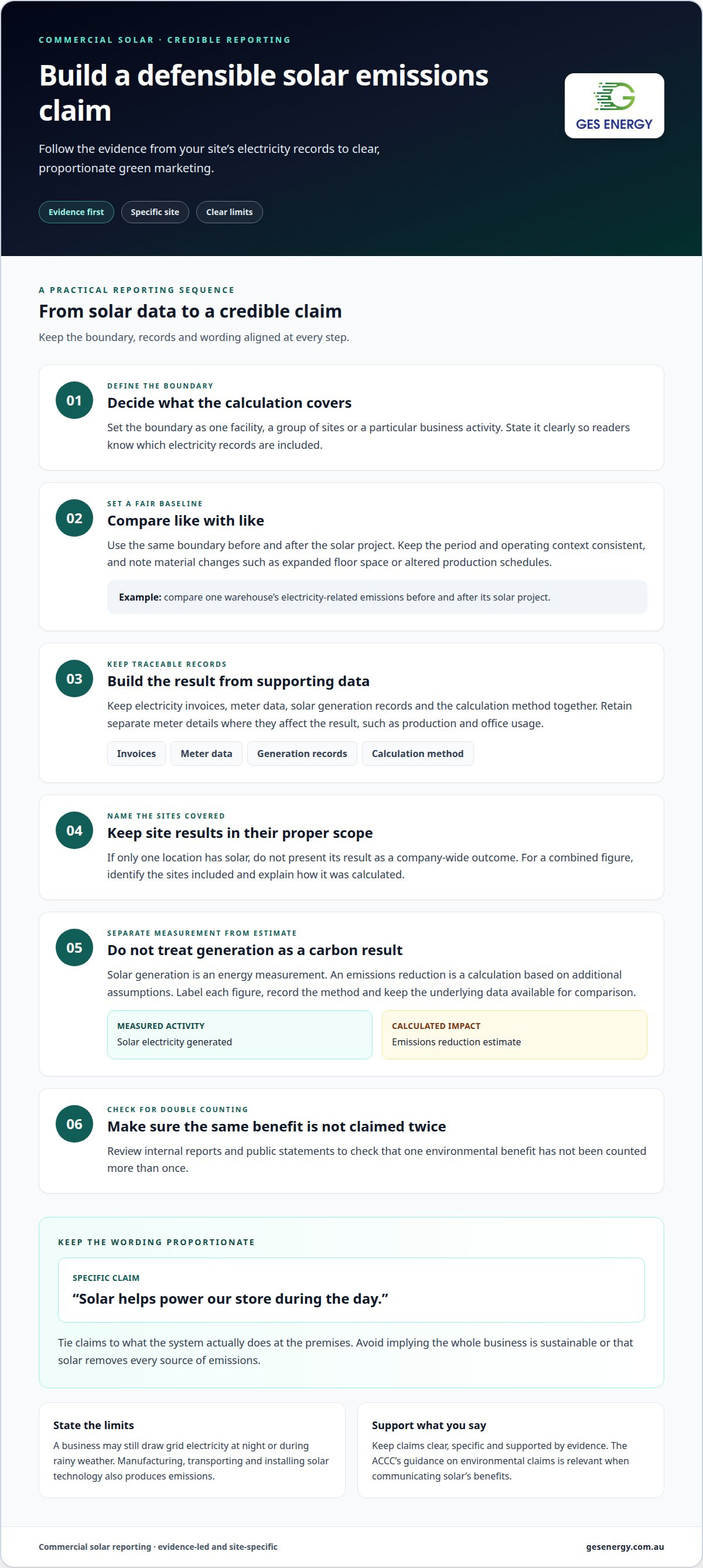
Solar’s contribution has limits. A business may still draw grid electricity at night or during rainy weather, and manufacturing, transporting and installing solar technology also produces emissions.
For example, a warehouse can explain that rooftop solar supplies some daytime energy for its operations. This links the claim to a real activity without suggesting solar removes all business emissions or provides power during every outage.
Making accurate environmental claims
Accurate green marketing describes the solar system’s actual contribution and avoids claims broader than the supporting evidence. For example, distinguish “solar helps power our store during the day” from an unqualified claim that the whole business is sustainable.
Overstating environmental benefits can mislead customers and damage trust if a claim conflicts with the business’s actual electricity use. The ACCC’s guidance on environmental claims is relevant when communicating these benefits. Keep claims clear, specific and supported by evidence.
Keep records that link marketing statements to system generation and business operations. If a post says solar supports a particular site, identify that site and describe the contribution accurately, rather than implying the claim applies across every location.
Commercial solar differs from GreenPower or a renewable energy power purchase agreement because it generates electricity at your premises. GreenPower and power purchase agreements involve purchasing renewable electricity, but the arrangements and their connection to your site differ from on-site generation.
There is no single average cost or payback period for every Australian commercial solar project. System size, premises, electricity use, installation requirements and the share of solar power consumed on site all affect project economics.
Eligible systems may earn small-scale technology certificates: according to the Clean Energy Regulator, each megawatt hour of renewable electricity generated earns one certificate. Tax deductions are separate; their treatment depends on the business and its assets, so solar incentives should not be presented as automatic.
Commercial solar and carbon-footprint reduction
To assess commercial solar’s carbon contribution, define the accounting boundary before comparing results. The boundary might cover one facility, a group of sites or a particular business activity. This choice determines which electricity records belong in the calculation, so state it clearly in internal reports and customer communications.
Set a baseline using the same boundary. For example, a business might compare one warehouse’s electricity-related emissions before and after its solar project. Keep the period and operating context consistent, and note material changes such as expanded floor space or altered production schedules. This helps separate the project’s effect from other changes in the business.
Build an emissions record from traceable inputs, rather than using panel capacity as a proxy. Keep invoices, meter data, generation records and the calculation method together. If a site has separate meters for production and offices, retain those distinctions when they affect the result. A documented calculation is easier to reproduce than a headline figure without supporting working.
If your business has several premises, do not present one location’s result as a company-wide outcome. Report which sites are covered and explain how any combined figure was calculated. If only a warehouse has solar, a group-level statement should distinguish that facility’s contribution from other locations’ electricity-related emissions.
Separate measured activity from estimated impact. Solar generation is an energy measurement; an emissions reduction is a calculation based on additional assumptions. Label each figure accordingly, record the method and keep the underlying data available for later comparisons. This prevents a generation total from being mistaken for a directly measured carbon result.
Check that the same environmental benefit has not been counted twice in separate internal reports or public claims. For instance, if a business attributes a site’s electricity improvement to a sustainability initiative, explain how that result is allocated across departments. Clear allocation makes the accounting easier to follow.
Carbon accounting can also guide operational decisions. A facility manager can compare energy records across site areas, identify where electricity demand is concentrated and assess whether future equipment changes affect the baseline. This gives the business a practical way to connect its solar project with broader emissions planning without treating the installation as a complete measure of its carbon footprint.
Keep a short methodology note with each reported result. It can state the sites covered, data sources, comparison period and material assumptions. When the business updates a sustainability report, the note helps staff explain why a figure changed and whether the change reflects improved performance, a revised boundary or different operating conditions.
Sustainability credentials and corporate responsibility
A commercial solar project can form part of a business’s corporate responsibility program, but it does not define the whole program. Connect the investment to an approved sustainability objective, assign an internal owner and establish a review process. For example, a procurement team can include energy initiatives in its supplier assessment while management tracks whether those commitments remain aligned with business priorities.
Customers and business partners may see environmental commitments as evidence of how a company makes decisions. Consistency matters across channels. If a tender describes a renewable energy commitment, the sustainability report and customer communications should use compatible language. Conflicting descriptions can make a genuine initiative harder to understand and weaken confidence in the business’s broader commitments.
Employee involvement can make the initiative meaningful within the organisation. A facilities team can explain how energy decisions relate to the site, while communications staff use agreed language in public material. Give staff a concise description of the project’s purpose and boundaries. This helps prevent an informal conversation from turning a limited operational claim into a company-wide environmental promise.
For sustainability reporting, assign responsibility for approving environmental statements before publication. A useful review can involve the team responsible for energy, the person preparing the report and the staff member accountable for marketing. Together, they can check that the wording matches the approved objective, suits the intended audience and does not imply achievements beyond the business’s actual commitments.
Can businesses claim renewable energy certificates or carbon credits for commercial solar in Australia? A solar installation alone does not establish a claim to carbon credits. Keep any certificate claim separate from a carbon-credit claim, and describe the basis for each without implying that one automatically creates the other.
That distinction matters when communicating with investors, customers or suppliers. A business discussing certificates should be precise about what it holds or claims, while carbon-credit language should refer only to the relevant credit activity. Avoid combining both under a broad phrase such as “carbon-neutral solar” unless the statement accurately reflects the business’s documented position.
Corporate responsibility also means keeping commitments current. If a business changes its sustainability priorities, update internal guidance and external materials together. For instance, a new procurement policy may broaden the company’s environmental focus beyond energy. Aligning those documents helps employees and partners understand how the solar project fits within the organisation’s wider approach.
Treat sustainability credentials as an ongoing management responsibility, not a one-off announcement. Review approved statements when the business changes its objectives, reporting approach or operating structure. A consistent process gives decision-makers a clearer view of what the business has committed to, what it can communicate and how solar fits within its wider responsibilities.
Commercial solar and renewable energy goals
A commercial solar project can turn a broad renewable energy ambition into a defined business objective. State which part of the organisation the goal covers, who owns it and how progress will be reviewed. For example, a facilities manager could track a site-level energy target, while senior management reviews its place in the company’s sustainability plan.
Choose a goal that reflects the business’s wider priorities, rather than treating an installation as an end in itself. A manufacturer might link its solar investment to a site energy plan, while a retailer could include it in a broader environmental program. This gives the project a clear role alongside other operational decisions and helps staff understand what the business intends to achieve.
Use staged planning to connect current decisions with future needs. A business could identify its current project, record the assumptions behind it, then revisit the plan when a facility expands or changes function. For new developments or extensive fit-outs, engaging a LEED BD+C consultant can help incorporate on-site renewables into formal green building standards. Keeping those stages distinct prevents planned work from being presented as completed progress and gives managers a practical basis for revising priorities.
Renewable energy goals can also guide investment across a portfolio. A company with offices, warehouses and production sites can set priorities based on operational plans, site requirements and available resources. It can document why one facility comes first and what would trigger a later project. That rationale makes the investment sequence easier to explain to staff and business partners.
Align energy planning with related infrastructure decisions. For example, a transport business considering electric vehicles can assess how charging requirements fit its wider energy objectives. This brings solar and EV planning into the same discussion without assuming one project automatically fulfils the other. Clear responsibilities help facilities, fleet and finance teams coordinate their decisions.
Set review points that prompt a management decision, not just a communications update. At each review, assess whether the project remains aligned with business operations, whether planned changes affect its purpose and whether the next investment still fits. A board or sustainability committee can use the review to approve changes to the organisation’s renewable energy priorities.
Separate commitments, work in progress and completed outcomes in internal plans. For instance, label a proposed site expansion as planned until it is operating, and report the existing project on its own terms. This distinction helps managers allocate resources responsibly and gives employees a reliable account of progress towards the business’s renewable energy goals.
What are the ACCC rules for green marketing and environmental claims?
For Australian businesses, environmental marketing should describe what a product, service or operation actually does. Apply that principle to every solar claim, from a website headline to a sign at a shop entrance. “Solar supplies some daytime electricity at this site” sets a clearer boundary than “our business is green”.
Make each claim specific enough for customers to understand its scope. Name the site, activity or product covered, and avoid suggesting the result applies to every location. For example, a retailer with solar at one store should not imply all its stores use solar electricity. The ACCC’s guidance on environmental claims is relevant when preparing this messaging.
Keep evidence connected to the wording. If a business says solar supports its daytime operations, retain generation and electricity-use records for that site. If a claim describes a reduction, identify the comparison period and calculation method. A solar installation alone does not establish a specific emissions reduction, so do not turn system capacity into a carbon-saving figure without supporting calculations.
Images and design can also shape the impression a claim creates. For instance, a green leaf beside a solar image may imply broader environmental benefits than the text explains. Review the complete advertisement, including headings, icons and qualifications. A small clarification should not be expected to correct a prominent message suggesting the business has no environmental impact.
Be careful with comparisons and future targets. A claim that one site uses more renewable electricity than before needs a consistent comparison basis. Label a target as a target, not an achieved result. If a business changes its operations or adds another premises, update the wording so the original claim still describes current performance accurately.
Claims about certificates, carbon credits or renewable energy purchases also need precise wording. Keep each instrument distinct from electricity generated and consumed on site. For example, describe eligible small-scale technology certificates separately from any statement about carbon credits. This helps customers understand what the business generated, purchased or received.
Before publishing a claim, link each key phrase to its supporting record and scope. A practical review can ask: which site does this cover, what evidence supports it, and could a customer read it more broadly? Apply the same review to social posts, packaging, tenders and staff-facing sustainability material, then revise statements when the underlying information changes.
Clear claims make solar’s contribution easier to communicate. Plan a commercial solar project around your site’s energy use and the environmental outcomes you intend to report.
GES ENERGY: Commercial and Industrial Solar
GES ENERGY designs commercial solar systems for projects ranging from 10 kW to 5 MW, helping businesses match generation to their premises and electricity needs. This is a practical next step if you’re planning to reduce grid electricity use and communicate solar’s contribution accurately. System design considers factors such as site conditions, current demand and future expansion, so the project supports your operations and sustainability objectives. For businesses also planning electric vehicle infrastructure or energy storage, these can form part of wider energy planning. Clear project data can then inform specific environmental claims about the system’s role, without overstating its impact. Contact GES ENERGY to discuss your commercial solar project.
Make your next energy decision count
Let your next energy decision reflect both your operational needs and the environmental commitments you are prepared to communicate. As your sites, equipment or electricity demand change, revisit how your solar plans fit those priorities. A clear process for updating sustainability statements helps keep future marketing aligned with actual performance.
For businesses planning on-site generation, GES ENERGY offers Commercial and Industrial Solar. Off Grid Solar Systems and an EV charging station can also support different energy requirements. The right approach depends on your project and how it fits your operations. A considered approach to using commercial solar for green marketing keeps customer communication grounded in what your business can demonstrate.
Discuss your project and the next practical step with GES ENERGY. A well-planned energy transition can give your business a clear foundation for progress.
Frequently Asked Questions
Can I tell customers I am reducing my environmental impact with solar panels?
Yes, if your statement accurately describes the contribution your solar panels make. For example, say they supply some electricity to a named site or support particular daytime operations. Avoid implying that solar removes emissions from your entire business. Keep records to support the wording, and update customer communications if the system or the operations it serves change.
What environmental benefits could solar have for your business?
Solar can supply some of the electricity your business would otherwise draw from the grid, reducing reliance on grid power and the emissions associated with that electricity. It can also help your business track renewable generation as part of its sustainability work. The effect depends on how your site uses electricity and how much solar generation it consumes during operating hours.
How can Australian businesses use commercial solar in green marketing?
Use specific, site-based messages across channels customers already see, such as shop signage, menus, invoices or social media. A Melbourne retailer, for example, could explain that rooftop solar supports some daytime store operations. Keep the message consistent across customer-facing materials, and avoid implying that the same solar arrangement applies to other branches or products.
What environmental claims can businesses legally make about solar power in Australia?
Businesses should make claims that are accurate, clear and supported by evidence, and avoid wording that could give customers a broader impression than the facts support. The ACCC’s environmental claims guidance can inform how you present solar’s contribution. For instance, describe solar electricity used at a particular premises rather than making an unqualified claim that the whole business is environmentally friendly.
How much carbon emissions can a typical Australian commercial solar system avoid?
There is no single emissions figure for every commercial solar system. The estimate depends on solar electricity generated and used on site, the grid electricity it displaces, and the emissions factor for the relevant location and reporting period. A business can calculate its result from those inputs, then state the system boundary and method alongside any reported figure.
How can businesses measure and report solar performance in sustainability reports?
Track solar generation, electricity consumed on site and electricity imported from the grid for each premises. Keep reporting periods and site boundaries consistent, and note operational changes that affect comparisons, such as altered production hours. Present the figures with a short explanation of how the system supports business operations. This gives readers context without suggesting solar accounts for every environmental impact.


