

Solar can address two business priorities at once: electricity bills and carbon emissions. For Australian businesses, improving company sustainability with solar means generating renewable electricity on site and using it to reduce reliance on grid power.
Look beyond the panels themselves when assessing solar. Your energy use, demand patterns and project funding all affect its value. Solar and battery agreements can shape how your business accesses and stores electricity, while incentives may influence the decision depending on the program and project.
This article explains how commercial solar can affect operating costs and emissions, what influences payback and return on investment, and how agreements, battery storage and incentives fit into the decision. It also explains why a tailored system design matters when assessing solar for a business site.
Key Takeaways
- Match a solar system to your site’s energy use and demand patterns to understand its potential effect on electricity bills.
- Compare the terms of solar and battery agreements to see how they may affect energy supply, storage and long-term planning.
- Estimate payback using system size and usage: Australian businesses typically recover their initial solar investment within 3-5 years.
- Assess return on investment alongside available incentives, as both can influence the financial case for a project.
- Use solar generation and emissions data to help track progress towards your company’s sustainability goals.
Business electricity bill savings
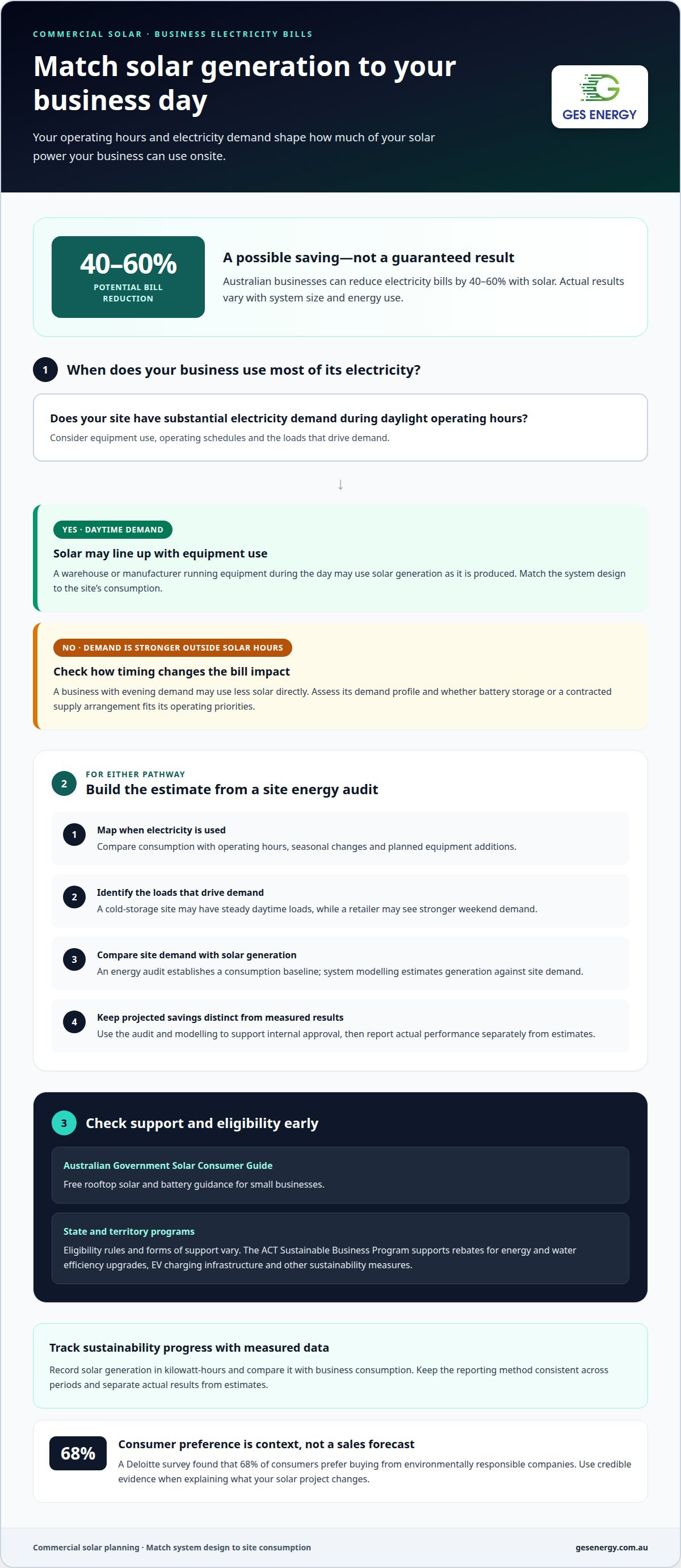
Solar can lower business electricity bills by generating power where it’s used. Australian businesses can reduce electricity bills by 40-60% with solar, though results vary with system size and energy use. A daytime operation, such as a warehouse or manufacturer, can use solar generation as equipment runs. A business with evening demand may use less solar directly, changing the bill impact. Matching system design to site consumption is essential.
Start with an energy audit. Map when your business uses electricity, which loads drive demand and where solar generation could meet that demand. Compare consumption with operating hours, seasonal changes and planned equipment additions. A cold-storage site, for example, may have steady daytime loads, while a retailer may see stronger weekend demand. These patterns determine how much generated electricity the business can use onsite.
Government support can also affect the business case. The Australian Government’s Solar Consumer Guide provides free rooftop solar and battery guidance for small businesses. State and territory programs have different eligibility rules and forms of support. The ACT Sustainable Business Program supports rebates for energy and water efficiency upgrades, EV charging infrastructure and other sustainability measures. Assess eligibility and timing early in the planning process.
Industry support can help businesses assess technical and financial fit. An energy audit establishes a consumption baseline, while system modelling estimates generation against site demand. Together, these inputs support internal approval and help explain projected bill savings. In Victoria, businesses can include sustainability measures in facilities planning and communicate the project’s purpose to employees and customers. Updates should clearly distinguish projected outcomes from measured performance.
Solar can support a company’s reputation as customers and staff pay greater attention to climate impacts. A Deloitte survey found that 68% of consumers prefer buying from environmentally responsible companies. Treat this figure as context, not a forecast of sales. Explain what the project changes, how electricity use is measured, and how progress will be reported. A positive reputation depends on credible claims and consistent evidence.
Renewable electricity generated onsite can reduce emissions associated with grid electricity use. Track generation in kilowatt-hours and compare it with business consumption for sustainability reporting. Keep the reporting method consistent across periods, and separate actual results from estimates. A practical route to improving company sustainability with solar is to connect measured generation with operational goals. For businesses improving company sustainability with solar, this evidence makes progress clearer to staff, customers and investors.
Australian corporate solar and battery agreements
Corporate solar agreements can secure renewable electricity through onsite generation or longer-term supply arrangements. Battery storage changes when a business can use that electricity.
Energy independence and security
Battery storage holds generated electricity for later use, giving a business more control over its energy supply. It can support resilience during outages, including those caused by bushfires or storms, but it does not make a grid-connected site fully independent. The value depends on system design, storage capacity and site demand.
Agreements can also set out how a business purchases renewable electricity or storage capacity. Review the contract’s supply terms, duration, responsibilities and performance measures together. For a Victorian manufacturer, predictable supply arrangements may help coordinate energy planning with production needs and planned site changes.
Assessing your electricity use and choosing a commercial solar system size with a provider
A provider assesses electricity use by reviewing consumption patterns, operating schedules and site loads. This evidence informs a system size suited to the business, rather than a generic estimate. The assessment considers when electricity is used, how much solar generation the site can consume, and whether battery storage supports its operating priorities.
A business with steady daytime equipment loads may use more solar as it is generated. A site with demand outside generation hours may value storage or contracted supply differently. The Australian Government’s Solar Consumer Guide provides rooftop solar and battery guidance for small businesses. Larger projects need an assessment suited to their site and scale.
Rules and approvals for installations
Commercial solar installations need to address electrical safety, grid connection requirements and any approvals relevant to the site. Requirements depend on project location, design and network connection. Identify approval pathways during project development and coordinate technical information for the installation. Connection constraints can affect both system design and project planning.
Project agreements should define responsibilities for equipment, installation work, maintenance and faults. Distinguish equipment warranties from workmanship warranty, and specify how claims are managed. Insurance arrangements should reflect the project scope, site conditions and ownership, keeping responsibilities clear during construction and operation.
Before signing, align the agreement with the business’s energy strategy. Clarify how electricity or storage capacity is supplied, how performance is measured, and which party manages operating obligations. These terms help decision-makers assess energy costs and security together. A site energy profile can help connect project planning with actual business demand.
Commercial solar payback and energy-bill savings
Commercial solar payback is the time needed for bill savings to recover the system’s initial investment. Australian businesses typically recover that investment within 3-5 years, depending on system size and usage. Large businesses may have a 5-7-year payback period, while commercial systems often pay back in under 7 years. These ranges show why modelling should use site-specific electricity demand rather than a generic forecast.
Solar panels generate electricity a business can use instead of buying the same supply from the grid. The value depends on how closely generation matches operating hours and how electricity tariffs apply to the site. Solar can also reduce exposure to energy price volatility and supply disruptions. A business with consistent daytime demand may use more generation onsite, supporting savings and reducing reliance on grid electricity.
To assess payback, compare the project’s initial investment with expected savings over time. The calculation should reflect system size, electricity use and the share of solar generation consumed onsite. Changes in operating hours or production can alter the balance. Treat payback as one financial measure alongside system performance, energy security and the company’s longer-term plans.
Measurable renewable energy targets make project outcomes easier to track. Set an electricity consumption baseline, then define a measure such as the proportion of site demand supplied by solar. Record generated kilowatt-hours and compare them with grid electricity use over consistent reporting periods. Connect targets to business operations, so new sites or changing production schedules do not obscure performance.
Australian greenhouse and energy reporting has a formal framework: the National Greenhouse and Energy Reporting Scheme was established by the National Greenhouse and Energy Reporting Act 2007. Solar generation data can support internal emissions tracking, but records should follow the company’s reporting approach. Keep actual generation data distinct from estimates, and document the reporting period and sites included.
A Melbourne retail chain achieved a 50% reduction in energy costs at each of its five store locations after installing solar systems. That example shows how outcomes can be assessed across multiple sites, rather than treating a company as one undifferentiated load. For a Victorian business with several premises, record each site’s consumption and generation before combining results for company-wide reporting.
Corporate commitments can set direction, but progress needs operational evidence. Walmart has committed to transition to 100% renewable energy by 2035. An Australian company can connect its renewable energy commitment to site-level measures, tracking solar supply against electricity demand. Regular reviews help identify whether changes in operations affect results and whether targets remain relevant to the business.
Solar return on investment and government incentives
Solar return on investment measures the financial value a business receives relative to its investment. Government incentives can affect the project’s financial model, but eligibility and tax treatment depend on the business and system.
Upfront investment and government assistance
The initial investment covers the equipment and work needed to deliver a functioning solar project. Compare that commitment with the value of electricity the business expects to generate and use. Ten-year return on investment estimates are 200% or more for small businesses, 300% or more for medium-sized businesses, and 400% or more for large businesses. These estimates offer a planning reference, not a project-specific forecast.
Build the business case around expected cash flows, not a single headline return. Account for electricity consumed onsite, exported generation where relevant, operating costs and changes in site demand. This allows a business to compare the solar investment with other capital priorities using consistent assumptions. Sensitivity analysis can show how different consumption patterns affect the projected result.
Business solar systems typically have a lifespan of 25-30 years. Assessing value across that operating period gives decision-makers a longer view than the initial outlay alone. The analysis should also identify when assumptions may change, such as a facility expansion or altered operating schedule. That makes the investment case more useful for budgeting and future planning.
Government incentives and tax breaks
Government assistance can take different forms, so identify each item separately in the project model. The Small-scale Renewable Energy Scheme provides small-scale technology certificates for eligible small solar installations. Check the scheme’s eligibility scope: a business should not assume a commercial project qualifies simply because it involves solar.
Record eligible certificates or other assistance separately from projected electricity savings. This makes the financial model clearer and shows decision-makers how much each factor contributes to the proposed return. Keep the assumptions and eligibility basis with the project records, particularly if the business operates multiple sites or plans staged upgrades.
Tax treatment is separate from a rebate or certificate. Its effect can depend on the business’s circumstances and how the project is structured, so do not treat a possible tax benefit as guaranteed project income. A tax professional can assess the relevant treatment. Keeping tax assumptions separate from energy savings helps finance teams review the project consistently.
Use the resulting model to connect the investment decision with the company’s capital planning. Separating project costs, expected energy value, eligible assistance and tax considerations helps directors understand the assumptions behind the proposed return.
Reducing a company’s carbon footprint
Solar reduces a company’s carbon footprint by replacing some grid electricity with onsite renewable generation. The emissions benefit depends on how much solar power the business uses and the electricity sources it displaces. Rooftop solar supplied 11.2% of Australia’s electricity in 2023. That national figure shows solar’s growing contribution, but each company’s results depend on its own generation and consumption.
Record electricity use and solar generation over consistent reporting periods. Compare the site’s grid electricity consumption before and after installation, while making operational changes visible. If a factory adds a production line, for example, separate the increase in demand from the solar system’s effect. Tracking kilowatt-hours generated and carbon dioxide saved clarifies emissions reporting and supports decisions about future energy projects.
Separate emissions sources in company records so the effect of solar is not overstated. Electricity purchased from the grid differs from emissions produced directly by onsite activities, such as fuel use. Solar primarily changes the electricity component. Document which sites and activities the calculation covers, then apply the same method in each reporting period.
Large projects illustrate how solar and battery supply can affect industrial emissions. Queensland solar and battery agreements are expected to reduce the Boyne smelter’s direct emissions by 70%, or 5.6 million tons of carbon dioxide annually. This example connects renewable electricity supply with a specific industrial emissions outcome. It also shows why companies should distinguish projected results from measured performance in public reporting.
Corporate commitments can set direction, but progress needs operational evidence. Google reached its goal of powering 100% of its global operations with wind and solar energy by 2017. Australian businesses can translate a similar commitment into site-level measures, such as the share of electricity supplied by solar. Record generation, grid purchases and relevant operational changes together to explain what has changed.
Use the resulting data to connect emissions performance with practical decisions. If a site’s electricity demand grows, compare that change with solar generation before revising targets. If solar output exceeds daytime use, assess whether storage or another use can absorb more generation. These steps tie carbon claims to actual electricity use, rather than relying on a headline commitment alone.
For a project grounded in site demand, plan a commercial solar assessment around the electricity use and emissions data your business tracks.
GES ENERGY
GES ENERGY helps local businesses assess how solar can support lower electricity bills and emissions. Its Commercial and Industrial Solar offering suits organisations considering onsite renewable generation as part of their sustainability plans. The right design depends on site conditions, electricity use and operating priorities, bringing the project into line with the business’s energy goals.
GES ENERGY also offers Off Grid Solar Systems and EV charging station solutions for projects where they fit the site’s needs. For households, it provides Solar + Batteries for Homes. These offerings address different energy requirements. Discuss your business’s priorities and how a solar project could fit its operations with GES ENERGY.
Contact GES ENERGY to discuss your company’s solar and sustainability goals.
Turn your sustainability plans into action
Improving company sustainability with solar starts with a decision your business can put into its planning process. Assign an internal owner for the next assessment, agree on the information decision-makers need, and determine how the project will be evaluated alongside other capital priorities. A clear process helps teams move from broad intent to a considered business decision.
Bring operations, finance and sustainability stakeholders into the discussion early. Their perspectives can clarify site constraints, investment priorities and how progress should be reviewed. Agreeing on responsibilities before a project moves forward helps coordinate later decisions and keep the plan connected to your organisation’s needs.
For support with your next step, discuss your plans with GES ENERGY. A focused conversation can help your team consider how to progress with confidence.
Frequently Asked Questions
How can Australian businesses improve sustainability by installing solar power?
Use solar as part of an operational sustainability plan, with clear responsibilities for facilities, finance and reporting teams. A Victorian business, for example, can document which sites the project covers and how generated electricity supports its environmental objectives. Include planned changes, such as new equipment or site expansions, in internal reviews. This keeps sustainability claims connected to business decisions and the project’s actual scope.
What emissions reductions can commercial solar deliver in Australia?
There is no single emissions reduction figure that applies to every commercial installation. A credible estimate needs the system’s measured generation, the reporting period and the method used to calculate avoided emissions. Keep meter records and calculation assumptions together. This makes estimates easier to explain and distinguish from measured emissions data, particularly when reporting covers several sites or changing operations.
How much does commercial solar cost in Australia in 2026?
Commercial solar cost depends on project capacity, site conditions, equipment selection and construction requirements. Battery storage, grid connection work and project scope can also affect the quote. There is no single price for every Australian business. Request a quote based on the specific site and its requirements, rather than relying on a figure that may not suit the project design.
What are typical payback periods and returns for business solar in Australia?
Australian businesses typically recover their initial solar investment within 3-5 years, while large businesses may have a 5-7-year payback period. These figures are planning benchmarks, not a substitute for modelling a specific site. To interpret a forecast, separate projected bill savings from other project benefits and test how changes in operating hours or electricity demand could affect the expected cash flow.
What Australian rebates, tax incentives, and financing options are available for business solar?
Options can include eligible small-scale technology certificates, state or territory business programs, tax treatment and commercial finance. Which options apply depends on the project and the business’s circumstances. Record incentives separately from the underlying project return, and assess tax treatment independently. This gives decision-makers a clearer view of how assistance, financing obligations and expected energy value contribute to the investment case.
How does rooftop solar compare with solar plus battery storage for businesses?
Rooftop solar is a simpler fit when daytime generation aligns with site operations. Adding a battery lets stored energy support later demand or selected resilience needs. That choice can affect system design, operating arrangements and project economics. Weigh these factors against the operating schedule and the impact an interruption would have on essential site activities.
What are the steps a provider follows to install and maintain solar panels at an Australian business?
A solar project typically involves assessing the site, developing the design, arranging equipment, completing construction and commissioning the system. After installation, maintenance can include system health checks and attention to inverter faults or warranty claims. GES Energy offers solar installation and maintenance services, including inverter repairs and warranty assistance. The project scope and site requirements shape the work and ongoing maintenance approach.
How can businesses verify solar emissions savings and report them under Australian sustainability standards?
Keep generation meter records, electricity invoices and the emissions calculation method together for each reporting period. Record the sites included and any operational changes that could affect comparisons. If reporting under the National Greenhouse and Energy Reporting Scheme, align solar records with the organisation’s reporting process. Clear documentation explains the basis for reported figures and supports consistent review of sustainability claims.


