

The largest electricity cost opportunity may come from limiting your highest grid demand, not simply reducing total energy use. Peak demand shaving with battery storage works by charging a battery when demand is low or solar generation is available, then discharging it during peak periods to reduce the power drawn from the grid. Demand charges are based on peak power in kilowatts, not total consumption in kilowatt-hours, and tariffs commonly use the highest average load over a 15-minute interval, though this can vary by region.
If your facility faces demand charges, shifting some electricity use to quieter periods can help, but it will not necessarily lower the maximum demand recorded by the grid. Peak demand shaving with battery storage can target short peaks while storing surplus renewable energy for later use. The value depends on your tariff, load profile, battery capacity and how often peaks occur.
This article explains how peak demand shaving with battery storage works alongside renewable energy, and where load shifting fits. You’ll see how the approaches differ, what affects potential electricity savings, and why system design should reflect actual demand patterns at Australian businesses.
Key Takeaways
- Understand how a battery charges during periods of lower demand or surplus solar generation, then supplies energy when grid demand rises.
- See how solar generation and battery storage can work together to better match a facility’s energy use with its demand profile.
- Learn why load shifting and peak shaving address different parts of an electricity bill, and when combining them may be useful.
- Identify the tariff, load profile and battery operating characteristics that shape potential cost reductions.
- Explore how commercial and industrial energy storage can fit into a broader solar and energy system design.
What is peak shaving control method for energy storage?
Peak shaving manages how much electricity a site draws from the grid by combining energy storage with demand monitoring. The battery charges during lower-demand periods or when solar generation exceeds site use, then discharges as grid demand approaches a set limit.
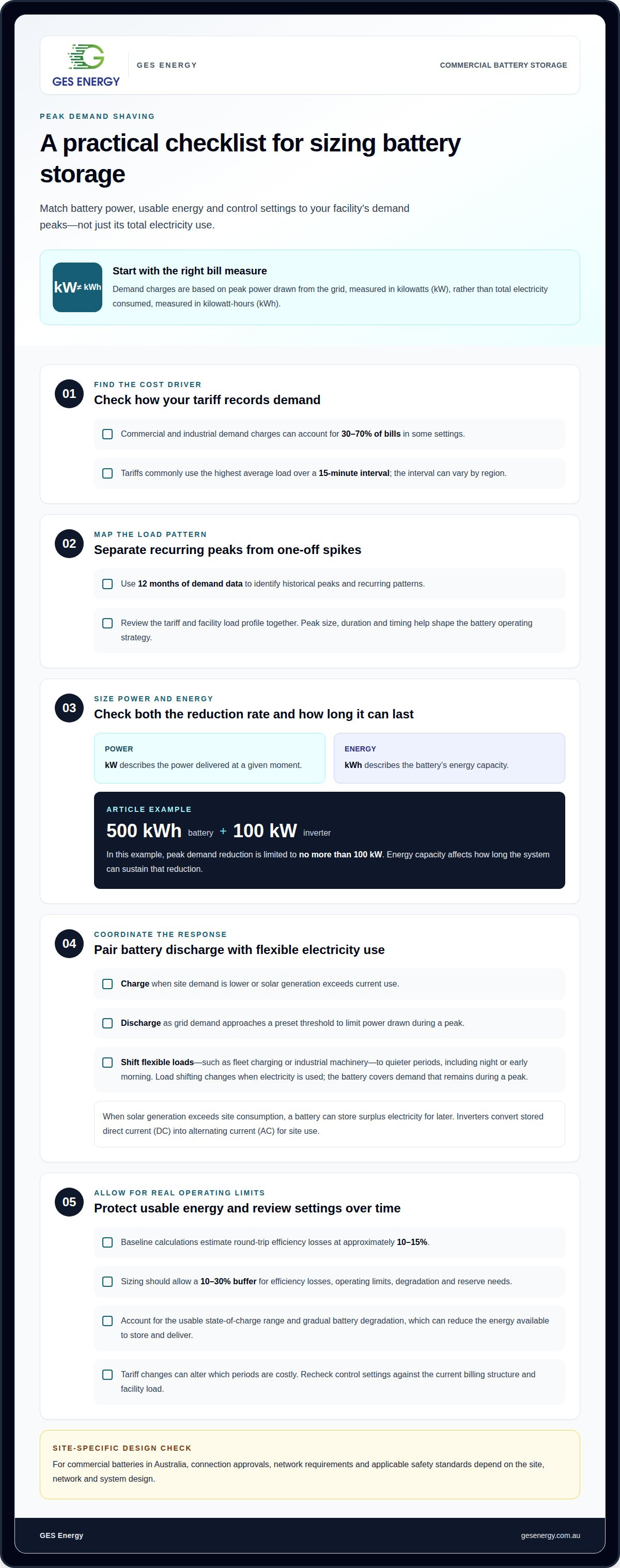
Commercial electricity bills may include demand charges based on the highest power drawn during a billing period. These charges measure power in kilowatts (kW), rather than total electricity use in kilowatt-hours (kWh), and can account for 30-70% of bills in some commercial and industrial settings. Tariffs commonly calculate peak demand using the highest average load over a 15-minute interval, although the interval can vary by region.
Battery Charging and Discharging
Charging stores electricity for later; discharging supplies energy to a facility when grid demand rises. A control system can charge when site loads are low or solar generation is available, then discharge as consumption approaches a preset threshold. This limits grid demand during a peak interval. The operating strategy should match the facility’s demand pattern and tariff periods.
Smart scheduling can reduce avoidable peaks without relying on the battery alone. A facility might shift fleet charging or industrial machinery operation to night or early morning, when demand is lower. Load shifting changes when electricity is used; battery discharge covers the demand that remains during a peak. Coordinating both approaches can reduce a sudden load spike while preserving battery energy for higher-demand periods.
Battery Efficiency and Operating Limits
Battery efficiency describes how much stored electricity can be returned after charging, while state of charge indicates the energy held at a given time. Baseline calculations estimate round-trip efficiency losses at approximately 10-15%. The usable state-of-charge range also limits available energy. Sizing should allow a 10-30% buffer for efficiency losses, operating limits, degradation and reserve needs.
Battery degradation gradually reduces how much energy it can store and deliver, so the control strategy needs to account for changing usable capacity. Tariff changes can also affect which periods are costly and the value of reducing a peak. Reviewing the tariff and demand profile together helps keep charging schedules aligned with the site’s current cost drivers.
For commercial batteries in Australia, connection approvals, network requirements and applicable safety standards depend on the site, network and system design. Project engineering and installation address these requirements; one setting does not suit every facility.
The main limitations are finite stored energy, conversion losses, state-of-charge limits and gradual battery degradation. A tariff change can also reduce the value of a schedule based on previous peak periods, so control settings should reflect the current billing structure and facility load.
Renewable energy integration
Battery energy storage can work with photovoltaic generation to reduce grid demand when a site needs power. Its value depends on coordinating generation, consumption and storage.
Integrating Renewable Generation with Batteries
Battery integration stores surplus renewable electricity for use when generation falls or site demand rises. This helps a business use more of the energy it generates instead of drawing the same amount from the grid throughout the day. Battery cells store energy, while inverters convert stored direct current (DC) into alternating current (AC) for site use.
For example, a site can charge its battery when photovoltaic generation exceeds current consumption. Later, stored electricity can supply loads that would otherwise increase grid demand. The operating strategy should consider the site’s historical load profile, renewable output and tariff periods together, rather than treating generation and storage as separate systems.
Energy Management and Demand Monitoring
An energy management system tracks site consumption and coordinates generation, storage and electricity use. Monitoring helps identify recurring demand peaks and shows when battery energy can reduce grid imports. A peak-shaving control strategy can use 12 months of demand data to identify historical peaks and recurring patterns.
This data also helps distinguish a one-off load spike from a predictable operating pattern. A controller, for example, can compare current demand with a configured threshold and direct the battery to respond. Better visibility supports decisions about charging times, reserve capacity and the balance between renewable self-consumption and peak reduction.
Battery Sizing and Peak Demand Reduction
Battery sizing matches stored energy and discharge power to the facility’s load and the duration of its demand peaks. The distinction matters: kilowatt-hours (kWh) describe energy capacity, while kilowatts (kW) describe the power delivered at a given moment.
A 500 kWh battery paired with a 100 kW inverter can reduce peak demand by no more than 100 kW. The system’s energy capacity also affects how long it can sustain that reduction. A suitable design therefore considers the peak’s size and duration, historical load, renewable output and usable battery capacity, not storage capacity alone.
Peak Prediction and Energy Controllers
An energy controller uses monitored demand and operating rules to predict or identify approaching peaks. The timing matters because a battery can limit grid demand only if it discharges at the right time and has energy available.
Control strategies can prioritise peak reduction, renewable energy use or a reserve for later operating periods. Forecasts based on site demand and photovoltaic output can guide charging, while live measurements trigger a response as demand changes. The controller must balance these priorities against the facility’s reserve needs and tariff structure.
Investment analysis should include the battery, inverters, installation, and ongoing operation and maintenance. Potential returns depend on the site’s energy costs, tariff, load profile, renewable generation and battery operation. Australian business incentives are specific to the program and location; eligibility and terms determine whether support belongs in a project’s financial assessment.
For sites assessing coordinated solar and storage, solar and battery project planning can connect generation, demand monitoring and storage decisions.
Peak shaving compared with load shifting
Peak shaving targets the highest grid demand, while load shifting moves electricity use between periods. Automated controls can combine both when a facility has predictable peaks and flexible loads.
Automated Controls and Load Forecasting
Automated controls use demand measurements and forecasts to decide when a battery should discharge or recharge. This matters when a short surge could lift a facility’s average demand across a billing interval. For example, a controller can respond within seconds to rising load, helping keep a 15-minute average below its target.
Load forecasting can use operating schedules, past demand and expected renewable generation. A site with scheduled production may anticipate a recurring peak, while an unexpected equipment start creates a different control challenge. Forecasts help preserve stored energy for peak hours instead of discharging it too early.
Choosing a Demand Management Approach
Peak shaving suits sites where a brief high load drives demand charges; load shifting suits processes that can move to quieter periods. For example, a business might schedule fleet charging overnight, then use stored energy to cover a remaining production peak. Combining both can reduce grid demand without requiring every activity to move.
Seasonal load changes affect the demand patterns a control strategy must address. Cooling needs, production schedules and renewable output can vary across the year. Future load growth, such as adding equipment or EV charging, can also change the timing and size of peaks. Review these changes to avoid basing the strategy only on last season’s demand.
Savings Across Demand Management Options
Battery peak shaving, solar generation, load shifting and demand response reduce energy costs in different ways. Solar can lower grid imports when generation matches site use; load shifting moves consumption to other periods; demand response changes use when a grid or retailer program requests it. Battery discharge specifically limits grid demand during targeted peaks.
No single savings figure ranks these options for every Australian business. Results depend on the tariff, load profile, solar output, battery operation and demand response arrangements. A facility with flexible machinery may benefit from shifting, while a site with fixed peak-hour processes may place greater value on battery integration.
Peak Shaving in Distribution Networks
At distribution-network level, peak load shaving reduces demand on local electricity supply during high-load periods. A study analysed battery storage for peak-load shaving using a 22-bus distribution-network model. The same principle applies at a facility: discharge stored energy when local demand rises, then recharge when demand eases.
Network-level and site-level controls serve related but distinct purposes. A distribution network considers demand across connected loads, while a business controller responds to its own consumption and tariff signals. Coordinating these approaches can support local supply needs while helping a facility manage peak charges and scheduled operations.
How do battery storage systems reduce operational costs?
Pairing photovoltaic generation with a battery can change when an industrial site imports electricity. Solar generation supplies daytime consumption, while stored energy can support operations during later peak periods. This can reduce grid consumption and exposure to demand charges, particularly when site demand continues after solar output falls.
A battery can also help manage a mismatch between generation and consumption. When a site produces more solar electricity than it uses, the battery can store some of the surplus. When production drops or demand rises, stored energy can supply site loads. The value depends on generation timing, the site’s consumption profile and the electricity tariff.
Project analysis can compare three operating cases: a baseline without battery storage, a centralised battery system, and a centralised battery system combined with photovoltaic generation. This comparison shows what storage adds beyond solar alone and whether the combined system better matches the facility’s load. It also helps separate savings from reduced grid imports from savings linked to lower peak demand.
Solar generation can reduce the electricity a business buys from the grid when output coincides with its operating schedule. A facility running equipment during daylight hours, for example, may use solar power as it is generated. A battery can shift some of that generation to later use, such as evening operations. This can better align solar supply with demand, although charging and discharging losses reduce the usable energy returned.
Diesel generator replacement is another potential application for battery storage. A battery can supply stored electricity instead of relying on a diesel generator for some operating periods, depending on the site’s load and energy supply. Market estimates list diesel generator replacement as typically saving 30-60% on fuel. Actual fuel use depends on generator operation, battery dispatch and the facility’s energy consumption.
Return on investment depends on more than a battery’s ability to reduce one peak. Costs include the battery, inverters, installation, and ongoing operation and maintenance. A financial assessment should compare these costs with expected changes in grid imports, demand charges and fuel use. Tariff structure, battery size and efficiency, load profile, and the frequency of peak events all affect the result.
For an industrial site, the operating plan should account for production schedules, solar generation and times when stored energy must remain available. If a facility has a consistent daytime load, solar may directly offset consumption. If demand continues after generation falls, storage can extend the use of solar energy. Sites using diesel generation should also assess how battery dispatch affects generator runtime and fuel consumption.
Battery storage is not automatically the lowest-cost option for every application. A site with flexible operations may first reduce peak demand by changing schedules, while a facility with fixed loads may gain more from coordinated solar and storage. Comparing the baseline, battery-only and solar-plus-battery cases gives decision-makers a clearer view of which system best matches their operating costs.
Battery storage for peak shaving
Battery storage reduces grid demand by discharging during a facility’s highest-load periods. For businesses considering peak demand shaving with battery storage, effectiveness depends on discharge power, usable energy, demand patterns and the utility’s billing structure. Understanding how demand charges are calculated is essential: reducing total electricity use and reducing the billed peak are related but distinct outcomes.
Consider a facility with a historical peak of 800 kW that sets a target of 600 kW. The battery must supply the 200 kW difference while site load exceeds that target. If the peak lasts one hour, the example requires 200 kWh of energy storage; if it lasts two hours, it requires 400 kWh. These figures show why duration matters alongside power.
The inverter’s discharge rating sets the maximum power available at once, while battery capacity determines how long it can sustain that output. Commercial peak-shaving systems can range from 100 kW to several megawatts, depending on facility load and the utility billing structure. A system with enough stored energy but insufficient discharge power may not reduce a sharp peak to its target.
Control settings should reflect the facility’s operating patterns, not just one historic maximum. A site with a brief equipment start-up surge needs a different discharge profile from one with a sustained production load. Monitoring and historical demand data help identify recurring peaks, set a practical grid-demand target and preserve stored energy for the periods that matter.
Peak shaving can reduce total electricity costs by 10-40% in typical project estimates, but results depend on tariff structure, battery size and efficiency, consumption patterns, and peak frequency. Assess the bill’s demand component alongside energy charges. If demand charges are small, reducing maximum grid draw may contribute less than other operating changes.
For a facility with rising loads, such as additional EV charging, planning should account for both peak size and duration. Peak demand shaving with battery storage can complement load shifting, solar generation or other demand-side measures. Compare these approaches using the same facility load profile and tariff to assess their likely effect on grid demand.
To assess a commercial battery system against your facility’s demand profile, explore commercial battery storage solutions.
GES ENERGY: C&I Energy Storage Systems
GES ENERGY designs and installs C&I energy storage systems for businesses assessing how batteries can manage demand peaks and support operations. System design can take account of your facility’s load patterns, electricity use, and the relationship between generation and storage, rather than treating battery capacity as a standalone decision.
For sites planning a broader energy upgrade, GES ENERGY also offers Commercial and Industrial Solar, Off Grid Solar Systems and EV Charging Stations. These solutions can be relevant when peak demand is linked to daytime operations, limited grid access or growing vehicle-charging loads. GES ENERGY delivers large-scale energy projects up to 5 MW.
If you’re considering battery storage for your facility, contact GES ENERGY to discuss your project requirements.
Plan your next energy decision
Make peak demand shaving with battery storage part of a wider energy plan, not an isolated equipment decision. Set a clear priority for your site, such as aligning energy investment with operating plans or preparing for future changes.
Bring operational and financial priorities into the same planning process. This keeps energy decisions connected to business needs as they evolve, rather than locking the site into assumptions that may no longer fit.
A considered plan gives your next energy decision a clear purpose and a practical role in your business’s long-term direction.
Frequently Asked Questions
What is peak shaving and how does it reduce electricity costs?
Peak shaving limits the maximum grid demand recorded for a business, potentially reducing the demand component of its electricity bill. In Victoria, distinguish demand charges from usage charges when reviewing an invoice: lower total energy use does not automatically mean a lower billed peak. Check which meter or site the charge applies to, especially if several buildings share one account.
What Is Load Shifting?
Load shifting moves a controllable task to another time so it draws electricity outside the site’s busiest period. For a Victorian business, start by mapping operating hours against production, cleaning or charging schedules. Keep essential processes fixed and identify tasks that can move without disrupting staff, output or delivery commitments. The aim is a schedule that suits the operation, not simply a change in timing.
How much can battery peak demand shaving save Australian businesses?
There is no single savings figure for every Australian business, including Victorian sites. A useful estimate compares actual bills with a model of the same operation under a proposed battery strategy. Include seasonal differences, such as changes in heating or cooling demand, and test the estimate against more than one representative operating period. This helps show whether projected savings rely on an unusual month or reflect normal site activity.
What are current commercial battery storage prices in Australia?
Commercial battery storage pricing depends on the project and is provided after a quote request. The scope can include battery equipment, inverters, installation, commissioning and site integration. A Victorian example of project scale is GES ENERGY's 80 kW solar and 184 kWh battery installation in Wheelers Hill; it is a project reference, not a price guide. Battery system requirements and site conditions shape each project quote.
How should a business assess its load profile and calculate battery payback for peak shaving?
Base the assessment on actual operating records, not just the highest reading on a bill. For a Victorian site, record unusual shutdowns, seasonal production changes and planned equipment additions alongside interval demand data. Then model how the proposed battery would operate under those conditions, including charging energy and ongoing maintenance. This gives finance and operations teams a clearer basis for reviewing payback assumptions together.


