

In 2026, an ev car charging station is no longer just a piece of hardware you bolt to a wall; it is a critical component of your property's total energy ecosystem. You have likely felt the pressure to keep pace with the rapid shift toward electric mobility, yet the technical jargon surrounding AS/NZS standards and switchboard capacities can be overwhelming. It is natural to feel uncertain about whether your current infrastructure can handle the demands of 2026 vehicle models without risking a costly system failure or an overloaded circuit.
This guide provides a definitive engineering and procurement checklist to ensure your installation is compliant, reliable, and fully integrated with your existing solar or battery systems. We understand that true value lies in long-term stability rather than a quick fix. By following this roadmap, you will gain a clear understanding of the necessary regulatory hurdles and technical requirements for a successful deployment. We will walk you through site assessment, load management, and future-ready design to ensure your investment delivers predictable performance and peace of mind for years to come.
Key Takeaways
- Learn why a modern ev car charging station should be managed as an integrated energy asset rather than a standalone hardware purchase.
- Understand the critical role of a professional maximum demand assessment in protecting your existing switchboard from electrical overloads.
- Identify whether Level 2 AC or Level 3 DC fast charging is the more efficient choice for your specific site requirements and vehicle turnover.
- Access a structured, multi-phase installation checklist that covers everything from preliminary site audits to final regulatory approvals.
- Discover how to future-proof your infrastructure by synchronising EV charging demand with solar generation and battery storage systems.
The State of EV Car Charging Station Infrastructure in 2026
By 2026, the perception of an ev car charging station has fundamentally shifted. It's no longer viewed as a standalone appliance, but rather as an integrated energy asset that must be managed with the same precision as a commercial HVAC system or a solar array. As the Australian market moves toward higher-speed AC and DC charging solutions, businesses are realising that simple hardware installation is only the first step. Success now requires a holistic strategy that balances vehicle demand with site capacity and grid stability.
The previous "set and forget" approach to infrastructure has become a liability for Australian organisations. Without active load management, a fleet of vehicles charging simultaneously can easily exceed a building's maximum demand, leading to tripped breakers or expensive peak demand charges. An electric vehicle charging station today must be "smart," meaning it communicates with the grid and other onsite assets to optimise power flow. This connectivity ensures that charging occurs when energy is cheapest or when solar generation is at its peak, providing both financial predictability and operational reliability.
The Evolution of Australian Charging Standards
Compliance with Australian Standards is non-negotiable for safety and insurance purposes. While AS/NZS 3000:2018 (The Wiring Rules) provides the foundational framework, 2026 updates have introduced stricter protocols for industrial deployments. Every ev car charging station circuit must now feature dedicated Residual Current Devices (RCDs), typically Type B or equivalent, to protect against specific DC leakage currents that standard household RCDs cannot detect. Additionally, the industry has solidified around the Type 2 (Mennekes) universal socket, ensuring that infrastructure remains compatible with the vast majority of new vehicle models entering the Australian market.
Why Businesses are Leading the Charge
Australian businesses are driving the transition because EV infrastructure has become a powerful tool for employee retention and brand positioning. With many corporate fleets committed to being 100% electric by 2030, providing reliable onsite charging is a practical necessity for daily operations. Retailers are also capitalising on this trend through destination charging. Destination charging in the context of Australian retail centres is the provision of charging facilities at locations where drivers naturally dwell for extended periods, allowing them to replenish their vehicle's range while engaging with local services.
Technical Requirements: Assessing Your Site Capacity
Before any hardware arrives on site, the electrical foundation of your property must be rigorously verified. A professional maximum demand assessment is the first step in any successful ev car charging station deployment. This process involves calculating the total potential load of your existing appliances, lighting, and HVAC systems to determine how much spare capacity remains for vehicle charging. Overlooking this step often leads to unexpected power outages or the need for emergency electrical repairs during peak usage times.
Identifying bottlenecks early is essential. In many Australian commercial buildings, the primary constraints are found in the main switchboard or the sub-mains feeding the car park. If your existing infrastructure is already operating near its limit, adding even a single high-power charger could push the system into a failure state. For a detailed look at the broader phases of planning, the U.S. Alternative Fuels Data Center offers a foundational perspective on EV charging infrastructure development that aligns with international best practices. To ensure your specific Australian site meets local safety standards, a comprehensive site capacity audit is highly recommended.
Load Management and Dynamic Balancing
Static load management assigns a fixed, permanent amount of power to your chargers. While simple, it's often inefficient because it doesn't account for fluctuating building demands. Dynamic load balancing is the superior 2026 standard. This software-driven approach monitors real-time energy usage across the entire site. If the building's air conditioning ramps up on a hot afternoon, the system automatically throttles the ev car charging station output to prevent tripping the main circuit breaker. This orchestration is made possible through the Open Charge Point Protocol (OCPP), which allows different hardware brands to communicate seamlessly with a single management platform.
Upgrading the Main Switchboard (MSB)
If your MSB shows signs of heat stress, outdated fusing, or lacks physical space for new circuit breakers, a significant upgrade is likely required. This process often involves coordination with your local Distribution Network Service Provider (DNSP) to increase the incoming power supply to the property. However, upgrading the mains is not the only solution. Many Australian businesses now find it more cost-effective to install on-site battery storage. By buffering energy in a battery system, you can support high-speed charging during peak periods without needing a massive upgrade to the grid connection. Future-proofing your site means planning for 2x or 4x more chargers than you currently need, ensuring your infrastructure grows alongside your fleet.
Comparing Level 2 and Level 3 Charging for Commercial Use
Choosing the right ev car charging station depends entirely on how long vehicles remain stationary at your site. While high speed charging sounds universally appealing, the capital expenditure (CAPEX) and ongoing operational costs (OPEX) differ significantly between Level 2 and Level 3 systems. For most Australian businesses, the goal is to balance charging speed with infrastructure costs and site capacity. Understanding the functional differences between these two tiers is essential for a successful procurement strategy.
Level 2 AC chargers are the reliable workhorses for offices, apartment complexes, and long stay parking facilities. They are generally easier to integrate with existing electrical systems and require less maintenance than their DC counterparts. Conversely, Level 3 DC fast charging is designed for high throughput. These units are essential for logistics hubs and courier fleets where rapid turnaround is the priority, but they demand a much more robust electrical foundation to operate safely.
Level 2 AC Charging: The Strategic Choice
Typical power outputs for Level 2 chargers range from 7kW to 22kW. In a commercial setting, 22kW is often considered the "sweet spot" because it matches the maximum AC intake of many modern electric vehicles while aligning perfectly with commercial solar generation. By installing Level 2 infrastructure, you can synchronise charging cycles with peak solar output during the day. This reduces your reliance on the grid and lowers OPEX. Because these units are less complex than DC chargers, they offer a more predictable long term maintenance profile, making them the preferred choice for fleet overnighting and employee parking.
Level 3 DC Fast Charging: When Speed is Critical
Level 3 infrastructure delivers power between 50kW and 350kW, bypassing the vehicle's onboard converter to feed electricity directly to the battery. This speed comes with massive infrastructure demands. Installing a Level 3 ev car charging station often requires dedicated transformers and specialised liquid cooling systems to manage the intense thermal load generated during the process. These systems are ideal for heavy haulage, rapid transit routes, or short stay retail environments where drivers only dwell for 20 to 30 minutes. However, the high CAPEX means they are typically reserved for sites where vehicle turnover is the primary revenue driver or an operational necessity.
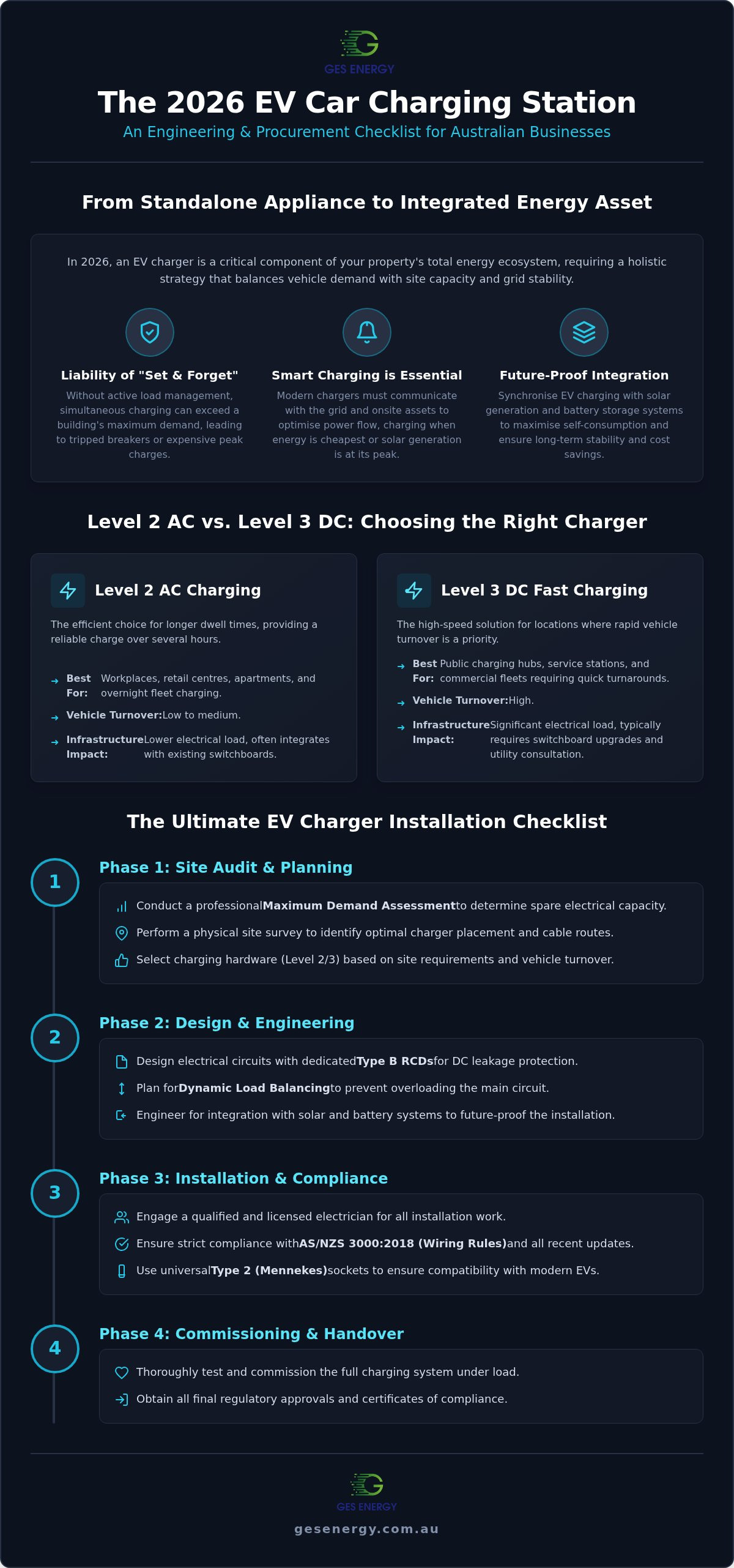
The Ultimate EV Car Charging Station Installation Checklist
Deploying a reliable ev car charging station requires a methodical project management approach to avoid operational disruptions. A successful installation isn't merely a weekend task but a structured process that moves through five distinct phases. These include a preliminary site audit, securing stakeholder approval, procuring SAA-approved hardware, professional commissioning, and establishing a post-installation maintenance schedule. Following this sequence ensures your infrastructure is safe, compliant, and ready for long term use.
By treating the installation as a formal engineering project, you mitigate the risks of cost overruns and technical failures. Each phase builds upon the previous one, creating a robust framework for your energy ecosystem. To get started on your own project, you can request a professional site assessment to identify the best configuration for your property.
Step 1: The Site Audit and Power Analysis
Connectivity is often the most overlooked technical requirement in a car park environment. You must verify Wi-Fi or 4G/5G signal strength at the specific charger location to ensure the software can communicate with the grid. If the signal is insufficient, you'll need to install signal boosters or hardwired ethernet cables. It's also vital to measure the physical cable runs from the switchboard to the parking bays. Longer runs increase voltage drop and installation costs. Finally, assess the need for physical protection such as heavy duty bollards or wheel stops to protect the hardware from accidental vehicle impact.
Step 2: Compliance and Safety Checks
Australian regulations are strict, and non-compliance can void your insurance or manufacturer warranties. Ensure all hardware carries the Regulatory Compliance Mark (RCM), which confirms it meets local safety standards. You must confirm that your installer is SAA-accredited and possesses specific experience with EV circuits, as these require different protection profiles than standard power outlets. Detailed documentation of the installation, including circuit diagrams and test results, should be filed immediately to support future maintenance and safety audits.
Step 3: Software and Billing Integration
Software is what transforms a simple plug into a sophisticated energy asset. You'll need to determine if you need to charge users via RFID cards, mobile apps, or credit card readers. Integrating this data with your commercial solar installation monitoring allows you to synchronise charging times with peak solar generation. This integration helps you maximise your return on investment by using free energy from the sun. Additionally, setting up automated reporting for fleet energy consumption and carbon offsets provides the necessary data for your corporate sustainability and ESG reporting.
Integrating EV Infrastructure with GES Energy EPC Services
Successfully deploying an ev car charging station at scale requires more than just electrical work; it demands a sophisticated approach to Engineering, Procurement, and Construction (EPC). While many contractors can install a single unit, managing a fleet-wide rollout or a high-capacity commercial hub involves complex energy balancing and infrastructure design. GES Energy provides an end-to-end service that ensures your charging assets are not just functional, but optimised for your property's specific energy profile and long-term financial goals.
Our approach treats EV infrastructure as a building block within a larger energy ecosystem. By choosing a partner that understands the intricacies of utility-scale projects and micro-grid development, you avoid the common pitfalls of fragmented installations. We manage every detail, from the initial site audit and maximum demand calculations to the final SAA-accredited commissioning, providing a single point of accountability for the entire project.
The GES Energy EPC Advantage
The primary benefit of our EPC model is the ability to perform custom engineering that matches solar generation to vehicle demand. We design systems that prioritise self-consumption, ensuring your vehicles charge using the cleanest and cheapest energy available. This often involves seamless integration with industrial battery storage solutions, which allow you to buffer solar energy during the day for use by vehicles arriving in the evening or during peak demand periods. This level of coordination is essential for maintaining site stability and reducing reliance on the national grid.
Our procurement process is equally rigorous. We source only industrial-grade, SAA-approved hardware that is built to withstand the harsh Australian climate. By managing the supply chain directly, we ensure that every ev car charging station we install meets the highest standards for durability and technical compatibility, future-proofing your investment against the evolving needs of 2026 vehicle models.
Ongoing Maintenance and System Health
Reliability is the cornerstone of any successful EV strategy. A charging station that is frequently offline is a liability for your operations and a frustration for your employees or customers. We offer comprehensive maintenance contracts designed to ensure 99.9% uptime. These agreements cover regular firmware updates, which are critical for maintaining software security and vehicle communication, as well as physical inspections to check for wear and thermal stress.
Our team utilised SAA-accredited labour for all maintenance tasks, ensuring that your system remains compliant with the latest Australian safety regulations. Whether it's a routine health check or a rapid repair service, our goal is to provide peace of mind through predictable performance. By combining high-quality engineering with diligent stewardship, we help you transition to electric mobility with confidence and control.
Securing Your Energy Future
Transitioning to electric mobility is a strategic infrastructure investment that requires meticulous planning and technical oversight. By treating each ev car charging station as an integrated asset rather than a standalone device, you ensure your property remains resilient against shifting grid demands. We've explored the critical importance of site capacity audits and the functional differences between Level 2 and Level 3 charging systems. Success in this space depends on matching your charging demand with intelligent load management and onsite solar generation.
GES Energy brings a wealth of expertise to your project with our SAA-accredited electrical engineers and a proven track record in 5 MW utility-scale developments. We offer national coverage for commercial energy solutions, ensuring your transition is handled with professional precision. Request a professional site audit for your EV infrastructure from GES Energy to begin your journey toward a more sustainable and efficient operation.
With the right partner, you can deploy a reliable charging network that provides value for years to come.
Frequently Asked Questions
Do I need a special permit to install an EV car charging station in Australia?
You generally don't need a specific permit for private installations, but you must adhere to the AS/NZS 3000 wiring rules. A Development Application (DA) may be necessary if the installation involves significant structural changes or heritage-listed sites. It's always best to consult your local council planning scheme to ensure your specific project meets all zoning and safety requirements before starting any civil works.
Can I use my existing commercial solar panels to charge my EV fleet?
You can definitely use existing commercial solar panels to power your fleet. This integration requires a smart energy management system to monitor your solar production and direct excess power to your vehicles. By prioritising solar self-consumption, you significantly reduce your operational costs and lower your property's overall carbon footprint. This approach turns your solar array into a high-value fuel source for your corporate vehicles.
What is the average cost of installing a Level 2 commercial charger?
Installation costs depend on several site-specific factors such as the distance from your main switchboard and the current capacity of your sub-mains. While hardware prices are relatively stable, the cost of electrical upgrades and civil works can vary significantly between properties. We recommend a comprehensive site audit to identify any potential bottlenecks that could influence the total investment required for your infrastructure project.
How much power does an EV charging station actually draw from the grid?
A standard commercial ev car charging station typically draws between 7kW and 22kW of power. For comparison, a single 22kW unit uses as much electricity as multiple large industrial air conditioning systems. This high draw is why a maximum demand assessment is critical; it ensures your building can support the additional load without tripping the main circuit breaker during peak operational hours.
Is it better to have a tethered cable or a universal socket for a public station?
Universal sockets are usually the superior choice for public-facing stations because they allow drivers with different vehicle types to use their own cables. This flexibility reduces your maintenance burden as there are no tethered cables to be damaged or tangled. Tethered units are more convenient for private fleet bays where the same vehicle models are charged daily, but universal sockets offer better long-term future-proofing.
How do I manage billing for different users at my business premises?
Billing is managed through OCPP-compliant software that tracks every charging session in real time. You can choose to authorise users via RFID cards, smartphone apps, or integrated credit card readers. These systems provide detailed reporting on energy consumption per user, allowing you to automate invoicing for tenants or monitor the fringe benefit tax implications for employees using company-provided charging facilities.
What happens if my building does not have enough power for multiple chargers?
If your property lacks sufficient power, you can implement dynamic load balancing to distribute electricity based on real-time demand. This software ensures your chargers don't exceed the building's total capacity. For sites with more significant power gaps, installing industrial battery storage provides a buffer that supports high-speed charging without the need for a costly and time-consuming upgrade to your grid connection.
Are there government rebates available for EV infrastructure in 2026?
Government incentives for an ev car charging station remain available across many Australian states in 2026. These programs often focus on "make-ready" costs and co-funding for commercial charging hubs to meet national emissions targets. Some federal tax credits are scheduled to expire in mid-2026, so businesses should act promptly to secure available funding and maximise their investment in charging technology.


