
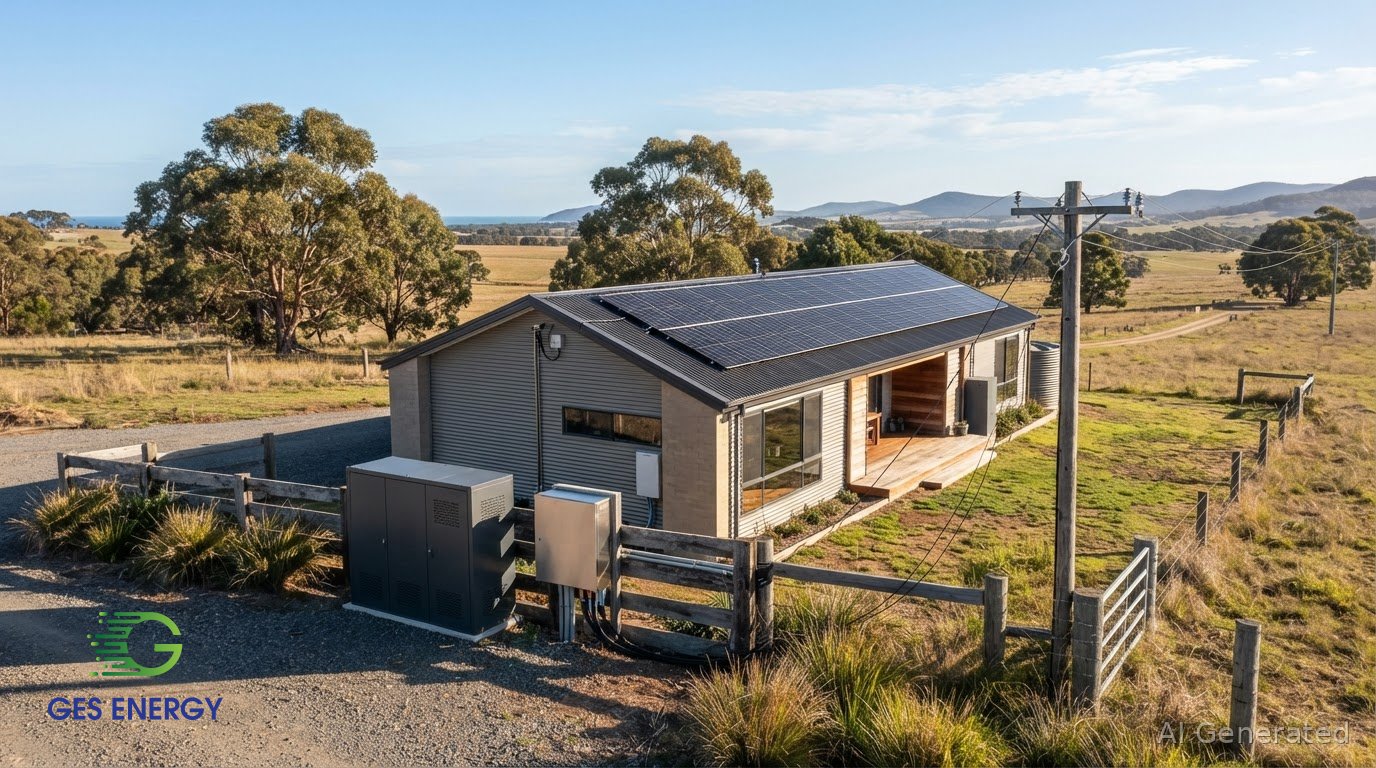
The network operator, not the solar farm developer, controls the physical connection to the grid. In Victoria, the relevant Distribution Network Service Provider (DNSP) handles that connection, and the grid connection process for solar farms may require distributor pre-approval before installation. For utility-scale, transmission-connected projects, the period from connection enquiry to GPS approval is typically 18 to 36 months.
It’s understandable to focus first on the site and the panels, but available grid capacity and the connection point can shape a project’s feasibility and economics just as strongly. AEMO advises that the connection process may take from 2 to 24 months, depending on the project and connection pathway.
This guide explains the Australian authorities and rules involved in the grid connection process for solar farms, how grid capacity can affect a project’s size and financial case, and what feasibility and connection-point assessments consider. It also sets out how planning, technical studies and connection approvals fit together, with a focus on Victoria.
Key Takeaways
- In Victoria, the local Distribution Network Service Provider oversees the physical grid connection, and distributor approval may be needed before installation.
- Available grid capacity and connection distance can affect a solar farm’s feasible size, approval pathway and project economics.
- Understand how on-site electricity use, exports and grid operating requirements shape the plant’s connection design.
- Compare potential connection points by assessing network constraints, including voltage control, power quality and line capacity.
- Australian connection standards depend on the generating plant and the grid, so technical studies and authority approvals are central to project planning.
Who Governs Solar Farm Grid Connection in Australia?
In Victoria, the Distribution Network Service Provider (DNSP) manages the physical connection to the distribution grid. Developers also need to coordinate network approval with planning, environmental and construction approvals.
For an overview of grid capacity constraints, watch this video:
DNSP connection approval
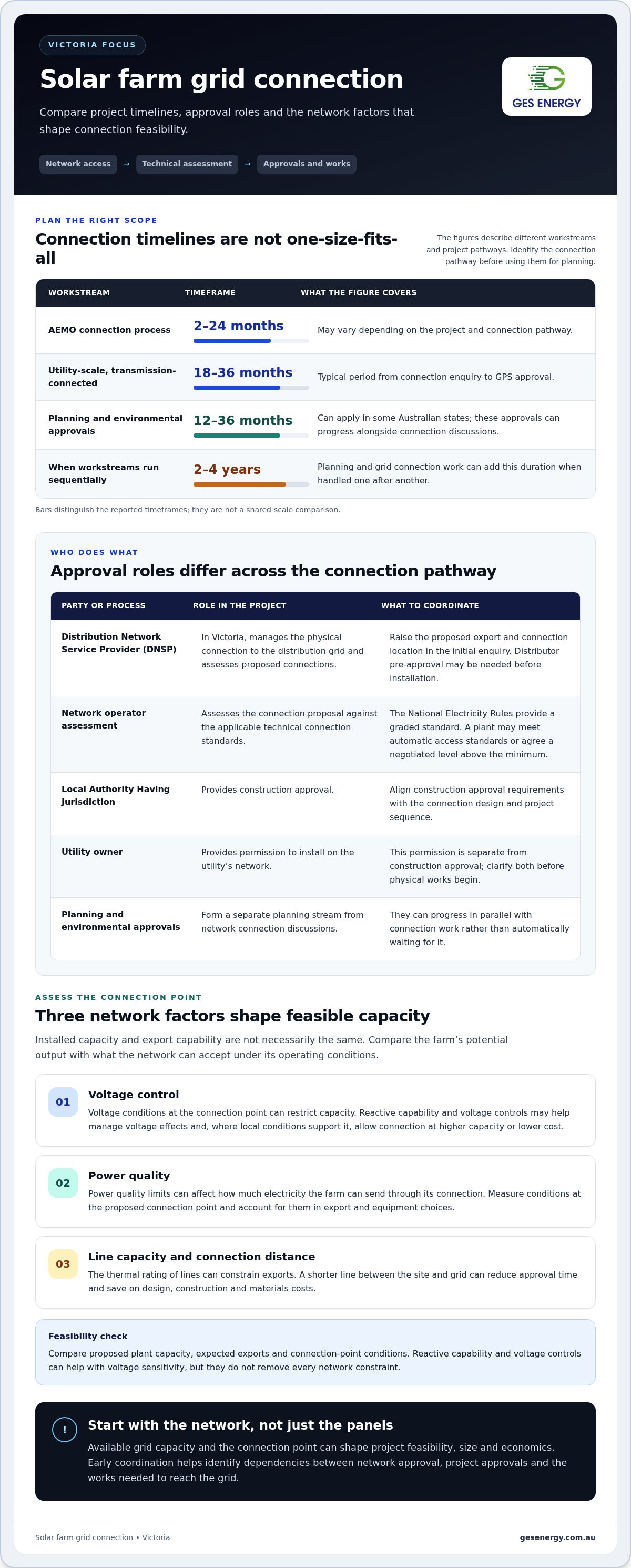
A DNSP assesses and manages a proposed connection to its distribution network, including the physical grid connection in Victoria. A solar farm owner may need distributor pre-approval before installing the system. This approval matters because network capacity, voltage and the proposed connection point affect whether and how the project can connect. Developers should raise the proposed export and connection location in their initial enquiry.
Connection enquiries start the network assessment, but they are only one planning stream. Developers can progress land-use and environmental approvals alongside connection discussions, so one process does not automatically wait for the other. Planning and environmental approvals can take 12 to 36 months in some Australian states. A shorter line between the site and grid can reduce approval time and save on design, construction and materials costs.
Approval timelines and delays
AEMO advises that a solar farm grid connection process may take from 2 to 24 months. For utility-scale, transmission-connected solar farms, the typical period from connection enquiry to GPS approval is 18 to 36 months. These timelines describe different scopes, so developers should identify the project’s connection pathway before using either figure for planning.
Planning and grid connection work can add two to four years to a project when they are handled sequentially. Delays can arise when network studies, connection design and planning approvals proceed one after another instead of in parallel. The connection line also affects the design and construction programme. Early coordination helps developers identify dependencies between network approval, project approvals and the works needed to reach the grid.
Applying under the National Electricity Rules
Developers start by making a connection enquiry to the relevant network operator, then progress through the technical connection assessment. How do developers apply for a connection under the National Electricity Rules? They submit a proposal for assessment against the applicable connection standards, then work through the required technical and approval steps with the network operator.
The National Electricity Rules provide a graded connection standard based on plant capacity and grid conditions. A generating plant may connect if it meets automatic access standards or agrees a negotiated level above the minimum standard. The applicable pathway shapes the technical information and network studies required, so developers need to discuss the proposed plant and connection point with the operator.
Network approval does not replace construction or utility permissions. A solar farm owner must obtain construction approval from the local Authority Having Jurisdiction and installation permission from the utility owner. These approvals cover different parts of the project: one addresses construction, while the other authorises work on the utility’s network. Aligning their requirements with the connection design helps clarify the sequence before physical works begin.
Grid capacity and the economic size of a solar farm
A solar farm’s proposed capacity must fit the network’s ability to accept and manage its electricity. The connection limit can therefore shape the project’s viable size, operating design and revenue potential.
Capacity and project economics
Grid capacity is the amount of generation a network can accept at a connection point under its operating conditions. A farm’s installed capacity and export capability are not necessarily the same. If the network can accept less output than the farm could generate, the project’s design and financial case must account for that limit. Assessing both figures helps developers compare options.
Network conditions also affect which capacity is technically viable. Solar farms with reactive capability and voltage controls may connect at higher capacity or lower cost where nearby customers or network equipment are sensitive to voltage swings. These controls can help manage the farm’s effect on local voltage. Their value depends on the connection point and network conditions, not panel capacity alone.
Interconnection constraints
Interconnection constraints limit how much electricity a solar farm can send through its connection. Voltage control, power quality and the thermal rating of lines can each restrict capacity. A project assessment needs to measure these conditions at the proposed connection point, then determine how they affect export and equipment choices.
For example, a line may have enough capacity under some conditions but face limits when voltage or power quality becomes difficult to manage. Reactive capability and voltage controls can help address voltage sensitivity, but they do not remove every network constraint. Developers should compare the project’s potential output with what the connection can accommodate. That distinction informs plant design and expected use.
Project capacity categories
Project categories describe scale, but labels alone do not establish available network capacity. The Australian National Electricity Rules use a graded connection standard based on plant capacity and grid conditions. A generating plant may connect by meeting automatic access standards or negotiating a level above the minimum standard.
Community-scale and commercial projects should be assessed against their proposed connection and export requirements, not just a category name. A larger plant may need different technical studies and controls from a smaller one. The category helps frame the project, while network capability determines what can connect at that location. Developers can use this distinction to compare capacity options before settling on a design.
For each option, assess proposed generation, export capability and voltage-control needs against the connection point’s constraints. If a network limit reduces the output the project can export, that may change the viable plant size or operating design. If voltage sensitivity is a key constraint, reactive capability and voltage controls may inform the technical response. These findings give developers a clearer basis for comparing site and capacity choices.
Capacity planning works best when generation design and connection assessment progress together. A solar farm designed around panel output alone can overlook limits on the network’s ability to accept exports. Comparing connection scenarios early helps identify which design assumptions depend on network capacity and which technical measures may address voltage conditions. The findings can then inform the project’s next feasibility decisions.
How grid-connected solar systems use and export electricity
A grid-connected solar farm generates renewable electricity and exports it through an approved connection point. Its technical standards, electrical equipment and metering must support safe, measurable flows between the plant and network.
Connection standards
The Australian National Electricity Rules set connection standards according to generating plant capacity and grid conditions. A plant can connect by meeting automatic access standards or negotiating a level above the minimum standard. These standards shape the technical assessment and help developers understand what the network requires for the proposed generation.
This graded approach means a solar farm’s connection requirements depend on both its design and the network it joins. Developers need to account for applicable standards during design and construction, rather than treating approval as a final paperwork step. The agreed connection conditions inform how the plant can operate and export electricity.
Electrical construction must also pass the relevant inspection process. A solar farm owner must obtain construction approval from the local Authority Having Jurisdiction and installation permission from the utility owner. After an inspection, owners can seek the approvals needed before a solar farm operates on the grid. This sequence links completed works to authorisation for grid operation.
Equipment at the connection point
The connection point is where the solar farm’s electrical system interfaces with the network. A new or existing substation can receive electricity from the farm through a generation intertie line. Some projects instead connect by tapping directly into a transmission line. The selected arrangement determines how the project’s electrical infrastructure links generation to the wider network.
Equipment at this interface must suit the approved design and connection conditions. The network assessment considers factors such as voltage control and power quality, while line thermal ratings can constrain electricity flows. These factors help determine which connection arrangement and equipment design can support the project’s planned output. They also make the connection point central to technical design and network approval.
Metering electricity flows
A bidirectional meter measures electricity flowing both to and from the grid. At an approved point of interconnection, the utility owner installs the meter to record these flows. For a solar farm, readings distinguish electricity exported from generation from electricity imported from the network when required.
In Victoria, grid connection requires a meter that records flows in both directions. Victorian solar systems can feed surplus electricity into the mains grid, with a feed-in tariff paid to the system owner. Metering records imports and exports, rather than treating generation as a one-way flow.
Grid-interactive solar inverters in Victoria shut down when mains grid voltage is absent and do not supply energy again until the grid returns to normal. This affects how a connected system responds during an outage. Approved metering and connection arrangements establish how generation, exports and imports are recorded during normal operation.
Pre-application feasibility and connection point assessment
Developers assess network capacity, connection options and technical constraints before finalising a solar farm design. A NEM GPS R0 submission includes more than 200 simulations, alongside project information needed for technical assessment.
Assessing connection points
Connection-point assessment compares possible network locations against the project’s export needs and technical constraints. Utility-scale farms commonly connect through a substation or tap directly into a transmission line. Community-scale projects may seek a distribution connection, where line capacity, voltage control and power quality shape the assessment.
Distance matters too. A shorter connection line can reduce approval time and save on design, construction and materials costs. For community solar, proximity to a distribution line can be one factor in assessing whether interconnection is cost-effective. Developers can weigh that proximity against available network capacity when choosing a site.
Solar farm interconnection points
A point of interconnection is where the solar farm’s electrical infrastructure joins the network. For a substation connection, a generation intertie line carries electricity to a new or existing substation. Another option is tapping a transmission line, with utility-scale projects able to connect to lines at 69 kV or higher.
Neither option is suitable by voltage alone. The assessment considers line thermal ratings, voltage control and power quality at the proposed location. A transmission line’s presence alone does not determine whether it is a suitable connection point. Developers need to compare the line or substation’s technical conditions with the plant’s proposed export.
Application studies and documents
Technical studies and project submissions allow the network operator to assess how a proposed generator will perform at its connection point. In the NEM, a solar farm’s GPS R0 submission includes more than 200 simulations. These simulations form part of the technical evidence considered during connection assessment.
The assessment needs to address the proposed plant and connection design. Relevant constraints include voltage control, power quality and line thermal ratings. Developers should align the technical submission with the selected point of interconnection, since a substation connection and a transmission-line tap involve different network interfaces.
Commissioning planning has defined timing. For transmission-connected solar farms, the commissioning programme must be agreed at least three months before commissioning starts. For distribution-connected projects, it must be agreed at least one month before commissioning starts. These milestones help developers plan technical work around the connection pathway.
GPS R2 validation is a post-energisation hold point, typically adding three to six months after energisation for solar farms. This validation checks the project against its approved models and performance requirements after connection. Developers should include this stage in commissioning plans, because energisation alone does not complete the GPS validation process.
Australian grid connection authorities and rules
Australia’s connection pathway depends on the network and jurisdiction. In the National Electricity Market (NEM), the National Electricity Rules (NER) set the framework for generator access standards.
For a solar farm, distinguish the rule-maker, network operator and approval authorities. The Australian Energy Market Commission (AEMC) makes changes to NEM rules, while the relevant network operator assesses the proposed connection. In Victoria, the Distribution Network Service Provider manages the physical connection to its distribution network. Construction and utility permissions are separate approvals.
The NER uses a graded connection standard based on generating plant capacity and grid conditions. A plant may connect by meeting automatic access standards or negotiating a level above the minimum standard. This distinction matters because the connection agreement must reflect the plant’s technical capability and the network conditions at its connection point.
The AEMC’s overhaul of NEM access standards was described as the most significant since 2018. This makes the applicable standard and the project’s connection pathway important early design considerations. Developers need to establish which access standard applies, then align technical submissions and proposed plant performance with the network assessment.
Scale also affects technical requirements. Dynamic models are mandatory for generating plants over 30 MW. These models form part of the technical material used to assess how generation interacts with the power system. Developers should account for modelling requirements when defining project capacity and preparing connection documents, rather than leaving them until construction planning.
How do connection requirements differ between the National Electricity Market and areas outside it? NEM projects follow the NER connection framework, including its graded access standards. Outside the NEM, developers need to identify the applicable jurisdictional and network requirements rather than assume the NER pathway applies.
For transmission-connected projects, the network operator assesses the proposed generator and connection arrangement against applicable technical requirements. The project agreement records the agreed connection conditions and standards. For distribution-connected projects, the relevant network operator assesses the proposed connection within its network. In Victoria, the DNSP manages the physical connection.
Keep the approval streams distinct. The network operator’s connection assessment does not replace construction approval from the local Authority Having Jurisdiction or installation permission from the utility owner. The connection agreement, construction approval and utility permission each address different parts of the project. Coordinating them helps developers identify which approval governs each stage, from network design through installation.
The practical takeaway is to identify the project’s jurisdiction, network operator and access-standard pathway before fixing technical design assumptions. For NEM projects, the NER provides the graded standards framework. For projects outside the NEM, the relevant jurisdictional connection requirements set the pathway. This distinction informs connection studies, modelling and agreement negotiations.
NEM projects follow the NER framework, including graded access standards. In Western Australia, developers need to identify the applicable jurisdictional and network requirements rather than assume the NER pathway applies. The relevant network operator assesses the proposed connection.
GES ENERGY: Commercial and Industrial Solar
GES ENERGY provides Commercial and Industrial Solar for businesses assessing generation projects alongside grid capacity and connection requirements. Its commercial solar system designs cover projects from 10 kW to 5 MW, supporting planning for sites in Melbourne, Geelong and Ballarat.
Turn to GES ENERGY for commercial solar design and installation that accounts for your project’s intended capacity and grid connection. This can help align system planning with your site’s technical and operational needs. For projects without a suitable grid connection, Off Grid Solar Systems may be a better fit.
To discuss your commercial solar project, contact GES ENERGY or visit gesenergy.com.au.
Keep project decisions aligned as plans develop
Carry connection assumptions forward as the site layout, generation design and operating plans take shape. Record which decisions depend on network requirements and the evidence supporting them. This gives project, engineering and commercial teams a shared reference when design choices change.
A considered grid connection process for solar farms keeps these choices aligned. If a proposed change affects the connection concept, revisit its impact on project design and the commercial case before proceeding. Clear decision records help teams understand why an approach was selected and what needs review as plans develop.
GES ENERGY offers Commercial and Industrial Solar, Off Grid Solar Systems and EV Charging Stations for different project needs. To discuss how your site requirements could inform the next step, contact GES ENERGY about your connection. A well-defined project direction is a practical foundation for moving forward.
Frequently Asked Questions
What else do I need to consider?
Consider site access, land arrangements and how the plant will be operated and maintained. Layout decisions can affect where electrical infrastructure sits and how maintenance teams reach equipment. Distinguish the farm’s installed generation capacity from its export limit when assessing performance. Record these assumptions in the project model so commercial planning reflects intended operating conditions, not just panel output.
What are the steps to connect a utility-scale solar farm to the Australian electricity grid?
The grid connection process for solar farms begins with a clear project definition: document the site, proposed generation, intended export and preferred network interface. Prepare coordinated plant and electrical design information, then align it with the relevant network’s technical requirements. Keep design revisions controlled as the project develops so submitted models, equipment selections and construction drawings describe the same plant.
Which Australian agencies and network operators approve solar farm grid connections?
Different organisations oversee different parts of the process, so there is no single approval authority for every project. The Australian Energy Market Commission makes National Electricity Market rule changes, while AEMO provides connection-process advice. The relevant network operator assesses the connection proposal. Developers should identify the applicable jurisdiction and network early, then map each authority’s role against the approvals and technical decisions the project needs.
How long does the Australian solar farm grid connection process take?
The schedule depends on the connection pathway, required technical studies and how quickly design decisions are resolved. Network changes, land access and planning work can also affect when construction can proceed. Build the programme around dependencies, such as completing design inputs before assessment and coordinating approvals with procurement. Track these interfaces in one schedule so delays in one workstream are visible to the wider project team.
What are typical grid connection costs for an Australian solar farm, including network upgrades?
Connection costs vary according to the work required for each project. A budget should separate dedicated connection assets from wider network upgrades, and account for studies, protection and control equipment, civil works and construction. The network assessment helps define the required items. Keeping these cost categories distinct makes it easier to compare connection options and see how a design change could alter project scope.
What are the AEMO registration and performance standards requirements for connecting a solar farm?
AEMO registration and technical performance standards address related but distinct requirements. Registration information should describe the plant accurately, while performance evidence needs to align with its control systems and intended operation. Keep the design basis, equipment details and operating assumptions consistent across project documents. This helps prevent discrepancies between the plant described during assessment and the facility presented for registration and operation.
What network capacity, constraints and curtailment risks affect solar farm grid connections in Australia?
Export limits can reduce the electricity a farm sends to the network compared with its potential generation. This can affect revenue assumptions, particularly if a project model treats all generated electricity as exportable. A weakening grid may also constrain or disconnect substandard generating systems during weak system conditions. Assess how the project behaves under its agreed operating conditions, and reflect possible export restrictions in its commercial assumptions.
What are the key connection agreement, commissioning and testing requirements for an Australian solar farm?
Use the connection agreement to define the project’s operating conditions, technical responsibilities and interfaces with the network. Commissioning tests then provide evidence that installed equipment operates consistently with the approved design. Keep test results, settings and equipment records together for handover and future operation. Clear records help the operating team understand the plant’s approved configuration and identify when a later change may affect its connection obligations.


