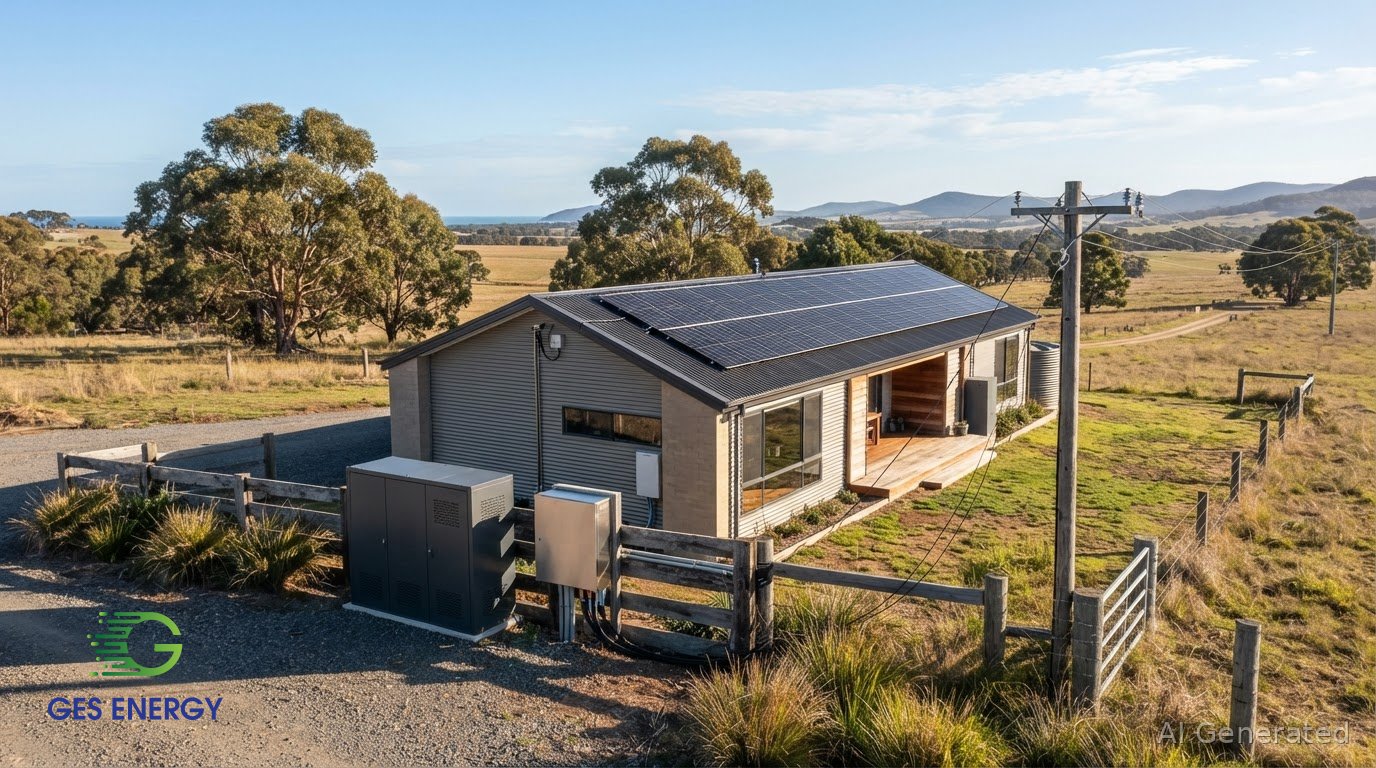
Yes, off-grid power systems are legal in NSW, and property owners aren’t required to connect to the electricity grid. The legal requirements for off-grid power systems in NSW include compliance with applicable Australian Standards, including AS/NZS 4509 for stand-alone power systems and AS/NZS 5139 for battery installations. Electrical work must be carried out by appropriately licensed or supervised people, with safety documentation provided after installation.
Going off-grid can give you greater control over how your property generates and stores electricity. But a system still needs to be designed, installed and checked with safety, battery placement and site conditions in mind.
This guide explains the standards that apply, what to consider when locating batteries, and which electrical safety checks and documents matter. It also covers NSW-specific considerations, including council approval factors and what changes when disconnecting an existing grid connection, so you can understand the compliance picture before planning your system.
Key Takeaways
- Off-grid systems are legal in NSW, but they still need to meet applicable Australian Standards and electrical safety requirements.
- Battery placement depends on the building type and must account for separation, wall materials and clearances around habitable spaces, doors and windows.
- AS/NZS 4509 covers stand-alone power system design, installation and maintenance, while battery installations must follow AS/NZS 5139.
- After installation, the electrical work must be checked for safety and documented with a Certificate of Compliance for Electrical Work.
- Council approval for an array or associated shed can depend on your land zoning, the structure’s size and position, and the relevant council.
Battery installation location requirements
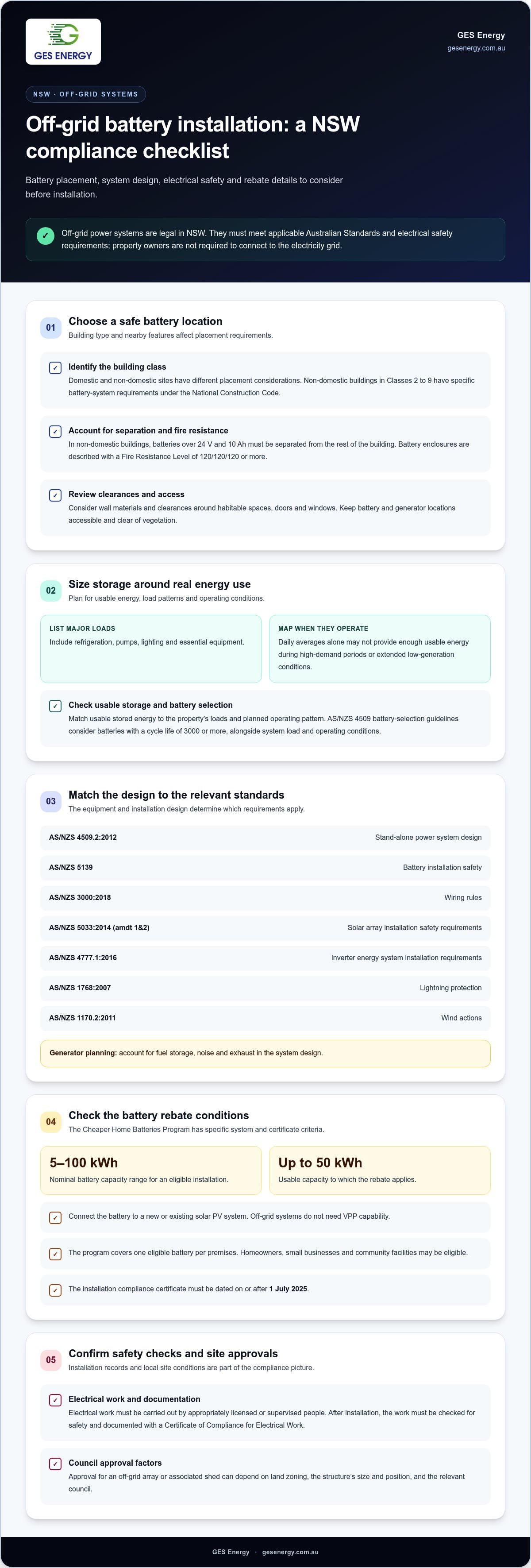
Battery placement affects fire safety, access and the usable space around your system. In non-domestic buildings, batteries over 24 V and 10 Ah must be separated from the rest of the building. Battery installations in NSW must also follow AS/NZS 5139, which addresses battery installation safety.
Wall materials and clearances matter. The installation must account for nearby habitable spaces, doors and windows. Battery and generator locations should remain accessible and clear of vegetation. For non-domestic buildings in Classes 2 to 9, battery systems have specific requirements under the National Construction Code.
To understand how off-grid systems support everyday energy needs, watch this video:
For non-domestic buildings, battery enclosures are described with a Fire Resistance Level of 120/120/120 or more. The building class and installation design affect which provisions apply. Domestic and non-domestic sites don’t follow identical placement considerations, so the building’s use matters when planning storage.
Battery size should reflect the property’s usable kilowatt-hour requirements. List major loads such as refrigeration, pumps, lighting and essential equipment, then consider when each operates. A system sized around daily averages alone may not provide enough usable energy during high-demand periods or extended low-generation conditions.
Battery performance also depends on how much stored energy you can use. Owners need to understand battery limitations and adjust consumption to match available usable energy. AS/NZS 4509 battery-selection guidelines consider batteries with a cycle life of 3000 or more. Cycle life is one selection factor, alongside the system’s load and operating conditions.
The Cheaper Home Batteries Program offers a rebate through Small-scale Technology Certificates. Eligible installations must connect the battery to a new or existing solar PV system, and off-grid systems don’t need VPP capability. The program covers one eligible battery per premises, with nominal capacity between 5 and 100 kWh and rebates applying to up to 50 kWh of usable capacity. The installation compliance certificate must be dated on or after 1 July 2025.
Check how the proposed battery’s usable storage matches the property’s loads and planned operating pattern. Homeowners, small businesses and community facilities may be eligible for the program. Battery location, building class, capacity and solar connection all affect compliance and rebate eligibility.
Australian Standards compliance for stand-alone systems
NSW stand-alone systems must meet the applicable Australian Standards for electrical work, solar generation, batteries and generators. The specific requirements depend on the equipment and installation design.
Safety and environmental compliance
Safety and environmental compliance means designing the system to manage electrical, fire, structural and site-related risks. This matters because off-grid equipment operates independently of the electricity network.
For a remote property, the design must consider the solar array, battery storage and any backup generator as connected parts of one system. Generator design should account for fuel storage, noise and exhaust. Array installation must also address safety requirements under AS/NZS 5033:2014 (amdt 1&2), while wind actions are covered by AS/NZS 1170.2:2011. These standards help guide decisions about equipment, placement and site conditions.
Electrical installation compliance
Electrical installation compliance means selecting and installing wiring, inverters and other equipment in accordance with relevant standards. This matters because faults can affect people as well as the reliable operation of a stand-alone system.
Electrical installations should be designed and installed with appropriate attention to wiring and cable selection. Inverter energy system installation requirements are addressed by AS/NZS 4777.1:2016. AS/NZS 1768:2007 covers lightning protection. Together, these standards relate to practical design decisions, including cable selection, electrical installation and protection. A system’s equipment and configuration determine which requirements apply to each part of the installation.
Benefits of standards compliance
Following applicable standards provides a structured basis for system design, installation and maintenance. A stand-alone system combines equipment that must work together as generation and household demand change.
For example, AS/NZS 4509.2:2012 addresses stand-alone power system design, while AS/NZS 3000:2018 covers wiring. Applying the relevant requirements helps align the array, inverter, cables and storage with the system’s intended use. It also gives installers and owners a clearer reference for maintenance and fault assessment. The practical benefit is a system designed around recognised technical requirements rather than isolated equipment choices.
NSW laws and standards
In NSW, stand-alone solar systems must comply with applicable Australian Standards, including AS/NZS 4509 for stand-alone power systems and AS/NZS 5139 for battery installations. AS/NZS 4509.2:2012 covers stand-alone system design, and AS/NZS 3000:2018 sets out the Wiring rules.
For diesel or petrol generators, the system design should account for fuel storage, noise and exhaust. Whether council approval is needed for an off-grid array or associated shed depends on land zoning, the structure’s size and position, and the relevant council. These factors help identify approvals that may apply to the site and its structures. Generator integration must also suit the stand-alone system’s electrical design.
AS/NZS 4509 requirements for stand-alone power systems
AS/NZS 4509 sets a design, installation and maintenance framework for stand-alone power systems. It forms part of the legal requirements for off-grid power systems in NSW, alongside standards for batteries and electrical equipment.
Stand-alone system requirements
AS/NZS 4509 applies to different types of stand-alone systems and varied energy needs. It matters because panels, batteries and inverters must be designed to operate together at the property.
AS/NZS 4509.2:2012 covers stand-alone system design. Its guidance includes battery selection, with cycle life of 3000 or more considered. It also sets maximum cable lengths for specified inverter configurations and cable sizes at a 1% voltage rise. These details influence component selection and how equipment connects across the system.
For a remote NSW property, the design should reflect actual electrical loads and the site layout. A system combining panels, battery storage and a backup generator needs each component considered as part of a coordinated supply. The legal requirements for off-grid power systems in NSW therefore connect equipment choices with intended energy use and installation conditions.
AS/NZS 4509 covers different stand-alone power system types, so the design approach depends on the configuration. The standard provides a technical basis for matching generation and storage to the system’s purpose, whether it supplies a home, farm or remote facility.
Inverter and equipment standards
Inverter and equipment standards cover the installation and operation of key system components. They matter because an inverter’s role differs between a fully stand-alone installation and one designed to interact with the grid.
Stand-alone systems typically integrate panels, batteries and inverters, and may use one or more inverters. AS/NZS 4777.1:2016 covers inverter energy system installation requirements. For grid-interactive inverters, guidelines specify testing under AS/NZS 4777.2:2015 and IEC 62109 parts 1 and 2. Those testing references relate to grid-interactive equipment, not every stand-alone inverter.
Other standards cover distinct installation elements. AS/NZS 3008.1.1:2017 concerns electrical cable selection, AS/NZS 1768:2007 addresses lightning protection, and AS/NZS 1170.2:2011 covers wind actions in structural design. Each reference concerns a different part of the system, from wiring to array support.
Applying the relevant standards gives the design a consistent technical basis. Inverter configuration, cable selection and panel support, for example, each involve separate requirements. Together, they shape a solar system around its equipment and intended operation.
Electrical safety checks and CCEW documentation
In NSW, electrical work on an off-grid system must be completed by appropriately licensed or supervised people. After installation, the electrician must check the system’s safety and provide a Certificate of Compliance for Electrical Work (CCEW).
Electrical licensing and safety paperwork
Electrical licensing determines who can carry out or supervise solar wiring and related electrical work. It matters because the completed system must be checked and documented, not simply switched on.
In NSW, solar panels must be installed by a licensed builder or licensed electrical contractor. Wiring must be done by an electrical contractor licence holder, an electrical qualified supervisor certificate holder, or someone working under a certificate holder’s supervision. These roles define who can perform the relevant installation work.
After the work, the installing electrician checks the system’s safety and provides a CCEW. An accredited person may sign off a system only if they installed it or supervised its installation. Keep the paperwork with the system records so future maintenance or fault assessments can refer to the work completed and its safety documentation.
This paperwork applies to electrical work, not automatically to separate planning or building approvals. A CCEW, for example, records compliance of electrical work; it does not replace a council decision about a shed or array structure.
Permits, inspections and certificates
Permits and approvals depend on the property and proposed structures, while the CCEW documents the electrical work. Understanding the distinction helps you identify which compliance records relate to the system and which relate to the site.
Whether an off-grid array or associated shed needs council approval in NSW depends on land zoning, the structure’s size and position, and the relevant council. These factors determine the planning context for the proposed work. Electrical work should be checked for safety after installation, with the appropriate compliance paperwork provided.
There isn’t a single site approval that replaces these separate considerations. A homeowner planning panels and a battery system should consider both the electrical work and any associated building or land-use requirements. Council approval centres on the location and structure; the CCEW concerns the completed electrical work.
Fire safety and access also affect a system’s ongoing operation. Battery and generator locations should remain accessible and clear of vegetation. For battery placement, consider wall materials and distances from habitable spaces, doors and windows. These details support safe access for inspection and servicing and help keep equipment areas clear.
Generators need careful consideration in the system design, including fuel storage, noise and exhaust. These are practical site factors alongside safe electrical installation. For a grid-connected solar system, network approval and metering requirements are separate matters. They do not apply in the same way to a fully stand-alone system that is not connected to the grid.
NSW off-grid power system considerations
Whether council approval or a development application is needed for an off-grid solar array or associated shed in NSW depends on land zoning, the structure’s size and position, and the relevant council. NSW property owners aren’t required to connect to the electricity grid, but site planning and electrical compliance still apply.
The distinction matters: a stand-alone system operates independently of the electricity network, while a grid-connected system can export excess electricity and draw power when solar generation is unavailable. If you’re planning solar panels on rural land, consider the array and any equipment shed as separate parts of the proposal. Their location, dimensions and relationship to the property’s zoning help determine the council approval pathway.
Disconnecting an existing grid connection also requires coordination beyond equipment installation. Property owners planning a disconnection should discuss how and when to do it with their electricity retailer and network. This differs from installing a stand-alone system at a property without a grid connection. Tell your insurer when adding solar and battery equipment or going off-grid so the property’s energy arrangements are reflected in its insurance information.
Generator size and connection method can affect the process. Larger generators above the relevant distribution network service provider (DNSP) thresholds may be subject to registered embedded-generation processes under the National Electricity Rules. This process concerns generator connection arrangements; it does not make every stand-alone system a grid-connected installation. Generator design should also account for fuel storage, noise and exhaust, alongside safe access to the equipment.
System sizing is another practical NSW consideration, particularly at remote properties. Design the system around the usable kilowatt-hours required by the property’s electrical loads. A home with pumps, refrigeration and other high-demand equipment has a different load profile from a small weekend dwelling. Consider when those loads operate, not just their total consumption, then match available battery energy and solar generation to that pattern.
Off-grid operation also requires owners to understand battery limitations and adjust energy use to match available usable storage. Solar production changes with conditions, so system design should account for low-generation periods rather than average output alone. A backup generator can support remote setups during extended low generation, with fuel supply and operating conditions factored into the design.
Before planning work, separate the key decisions: whether a structure needs council approval, whether an existing grid connection will be disconnected, and how the system will meet site loads. For a property-specific system plan, map out your off-grid power requirements with the GES ENERGY design team.
GES ENERGY: Commercial and Industrial Solar
GES ENERGY designs and installs off-grid solar systems and commercial and industrial solar for energy projects. For property owners in NSW and customers in Melbourne, system planning can account for site needs and the project's intended operation.
If you're moving from compliance research to a project plan, GES ENERGY can help shape an off-grid or commercial solar system around your site. Solar plus batteries for homes is also available when household storage is part of the design.
Contact GES ENERGY to discuss your off-grid or commercial solar project.
Plan your next step with confidence
Understanding the legal requirements for off-grid power systems in NSW is a strong starting point. The next step is turning that understanding into a design shaped around the property, its energy use and how the system will operate over time. Planning these elements together can help you make informed decisions before installation begins.
GES Energy offers Off Grid Solar Systems and Commercial and Industrial Solar, with EV Charging Stations for projects that include vehicle charging. The right option depends on whether you’re planning an independent power supply, a business energy project or connected infrastructure. A clear project brief covering your site, loads and intended system use can help guide the discussion.
Contact GES ENERGY about your off-grid project to discuss a practical next step. A considered design can put you on a clear path towards dependable energy for your property.
Frequently Asked Questions
Is it legal?
Yes, off-grid power systems are legal in NSW. A system can supply a property without a grid connection, and owners aren’t required to connect to the electricity network. One practical point is safe shutdown: NSW homeowners shouldn’t switch off solar panels without following the system’s specific shutdown procedure. Keep the shutdown instructions accessible to anyone who may need to isolate the equipment for planned work or maintenance.
Who handles the paperwork?
The installing electrician provides the electrical compliance documentation, while the homeowner should retain the installation and contract records. NSW solar installation work also has consumer paperwork requirements: before payment or work begins, the installer must provide a written contract and the free Building Commission NSW Consumer Building Guide. For work costing A$20,000 or more for labour and materials, a certificate of cover under the Home Building Compensation Fund is required before payment or installation starts.
What electrical work licences and inspections are required to install an off-grid system in NSW?
Electrical work must be completed by appropriately licensed or supervised people, and the installation needs a safety check. On a farm or business site, plan the work record alongside workplace safety arrangements. SafeWork NSW is a workplace health and safety information contact for the state. Keeping installation documentation with site records can help staff understand which equipment is present and what work has been completed.
Which Australian Standards apply to stand-alone power systems, batteries, inverters and wiring?
Relevant standards include AS/NZS 4509 for stand-alone systems, AS/NZS 5139 for batteries, AS/NZS 3000:2018 for wiring and AS/NZS 4777.1:2016 for inverter installation. A useful distinction is whether an inverter operates only within an isolated system or interacts with the grid. Grid-interactive inverter testing involves AS/NZS 4777.2:2015 and IEC 62109 parts 1 and 2, so the system’s connection design affects the standards to consider.
Are NSW grid-connection rules relevant if an off-grid system has a generator or backup grid connection?
A generator used as backup doesn’t, by itself, connect the property to the grid. Adding a backup grid connection changes that arrangement: the property then has a network interface, and the network owner may set system-size or export limits, including zero export. For example, a system designed to use the grid only when generation is unavailable still needs its grid-interactive equipment and connection arrangements treated as such.
What are the NSW rules for installing and storing home batteries, including fire safety and location?
Home battery installation must follow AS/NZS 5139, with placement assessed against the building and nearby openings. A practical example is a proposed garage location near a door or window: those distances and wall materials need consideration before fixing the battery position. Keep the equipment accessible and the surrounding area clear. The battery’s usable storage and the household’s expected use also matter when planning how the system will operate.
What NSW requirements apply to stand-alone systems for rural homes, farms and remote properties?
Rural, farm and remote installations remain subject to electrical and site-planning requirements, though their operating needs can differ. A farm may depend on equipment that must keep running during low solar generation, while a remote home may have limited maintenance access. Include access to the system and any generator in site planning, and tell your insurer when adding solar and battery equipment or moving off-grid.
Are there NSW or Australian government rebates or incentives for off-grid solar and batteries?
Australian battery support includes the Cheaper Home Batteries Program, while the previous NSW battery rebate ended in June 2025. The federal program uses Small-scale Technology Certificates, and an installation compliance certificate must be dated on or after 1 July 2025. Before relying on a rebate in your project planning, distinguish program eligibility from the system’s separate electrical and site compliance obligations.