

As of July 2026, nearly one in three new cars sold in Australia is an electric vehicle, yet many organisations realise that a solar powered ev charging station for business must be more than a simple plug-and-play addition. You've likely noticed that relying solely on the grid for fleet or staff charging often results in punishing peak demand charges and complex integration hurdles. It's a valid concern for leaders who want to modernise their infrastructure without risking the stability of their existing electrical systems or facing uncertain returns.
Integrating solar PV with EV infrastructure is transforming Australian business assets into self-sustaining energy hubs that offer genuine independence from the main grid. By combining on-site generation with intelligent charging, you can lower your carbon footprint for ESG reporting and attract high-value employees who prioritise sustainability. This strategic approach turns a potential utility burden into a future-proofed asset. In this analysis, we'll explore the 2026 shift in federal incentives, the importance of load management, and the practical steps to achieving a scalable energy ecosystem for your business.
Key Takeaways
- Learn why commercial EV charging has shifted from a simple amenity to a core strategic energy asset that enhances property valuation in the 2026 Australian market.
- Understand the technical ecosystem required to deploy a solar powered ev charging station for business, including the vital role of smart charging software in prioritising renewable energy.
- Discover how to maximise ROI by utilising load-shifting techniques that align high-demand charging windows with peak solar production periods.
- Identify the critical steps for infrastructure planning, from professional energy audits to ensuring your site is ready to scale for future fleet requirements.
- Recognise the long-term operational benefits of an end-to-end partnership, focusing on custom micro-grid design and ongoing maintenance for system health.
The Rise of Solar-Integrated EV Charging in Australian Business
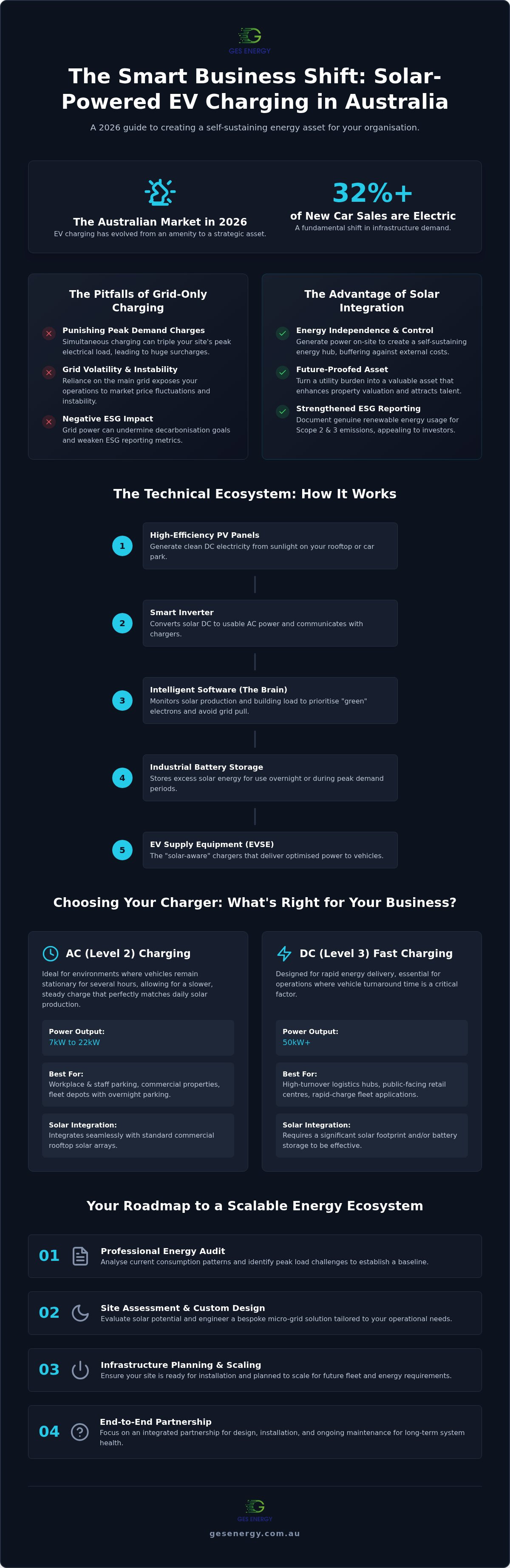
The Australian commercial landscape has reached a decisive tipping point in 2026. What was once considered a minor parking amenity has evolved into a high-value strategic energy asset. National decarbonisation targets and the rapid uptake of electric vehicles, which now account for over 32% of new car sales, have fundamentally shifted how organisations view their physical infrastructure. Relying solely on the grid for charging is no longer a sustainable long-term strategy. Instead, businesses are recognising that a solar powered ev charging station for business is a primary method for securing energy independence while simultaneously enhancing commercial property valuations.
Decarbonisation and ESG Reporting in 2026
In the current regulatory environment, Scope 2 and Scope 3 emission reductions are critical metrics for annual ESG reporting. Investors and stakeholders now scrutinise green infrastructure as a key indicator of a company's resilience. Integrating solar PV with charging infrastructure allows businesses to document genuine renewable energy usage rather than relying on expensive grid-sourced offsets. Beyond the balance sheet, this commitment serves as a significant drawcard for attracting top-tier talent. Professionals in 2026 increasingly choose employers whose values align with their own; this makes sustainable workplace benefits a competitive necessity for any growing organisation.
The Economic Pressure of Peak Demand
Standard grid-tied charging is rapidly becoming a financial liability due to escalating peak demand charges. When a fleet of EVs plugs in simultaneously, it can triple a business’s peak electrical load, leading to substantial surcharges from network providers. Modern EV charging station technology solves this by decentralising energy production. By generating power on-site, organisations transition from passive consumers to "prosumers". This shift provides a necessary buffer against grid volatility. It ensures that the transition to an electric fleet doesn't compromise the site's overall energy budget or operational stability. Reliable on-site generation offers the peace of mind that your infrastructure remains under your control, regardless of external market pressures.
How Solar-Powered EV Stations Work: The Technical Ecosystem
A solar powered ev charging station for business operates as a unified energy ecosystem rather than a collection of separate components. Solar-Integrated EV Charging is a system that synchronises real-time PV output with vehicle intake. This technical synergy relies on three primary pillars: high-efficiency photovoltaic (PV) panels, smart inverters, and Electric Vehicle Supply Equipment (EVSE). While standard chargers simply draw power upon demand, a solar-integrated system uses intelligent software to prioritise "green" electrons. This software monitors your building's load and solar production, dynamically adjusting the charging speed to match available sunlight.
Choosing between AC and DC charging depends heavily on your operational needs and solar capacity. AC (Level 2) chargers, typically 7 to 22kW, are ideal for workplaces where vehicles remain stationary for several hours. They integrate seamlessly with standard commercial rooftop solar arrays. Conversely, DC (Level 3) fast chargers start at 50kW. These require significant solar footprints or supplemental power, making them better suited for high-turnover logistics hubs or public-facing retail centres. Matching your charging hardware to your specific solar generation capacity is the first step in avoiding unexpected grid costs.
The Hardware Handshake: Inverters and Chargers
The efficiency of your system depends on the "handshake" between the solar inverter and the EVSE. Modern "solar-aware" chargers communicate directly with the inverter to detect excess generation. If a cloud passes over, the system automatically throttles the vehicle's intake to prevent pulling expensive power from the grid. For industrial sites, managing three-phase solar output is essential to ensure balanced loads and faster charging speeds across multiple bays. If you're looking to optimise this technical balance, exploring C&I energy storage systems can provide the necessary stability for your infrastructure.
Integrating Industrial Battery Storage
Battery storage serves as a critical buffer within the ecosystem. Many commercial fleets return to base in the evening, long after peak solar production has ceased. By storing excess midday energy in a stationary battery, you can charge your fleet overnight using yesterday's sunshine. This approach mitigates the need for costly grid transformer upgrades, which can often exceed six figures in infrastructure costs. It also provides essential reliability, ensuring your charging bays remain functional during grid brownouts or local outages. This level of control transforms your parking area into a resilient, off-grid-capable micro-grid.
The Business Case: ROI, Load Shifting, and Energy Independence
Investing in a solar powered ev charging station for business represents a shift from operational expenditure to long-term asset management. While grid-tied electricity prices remain volatile, the cost of sunshine is fixed at zero. By generating your own power, you bypass commercial energy tariffs that often exceed $0.30 per kWh. A typical Australian warehouse can offset roughly 70% of its total charging costs simply by synchronising its fleet's intake with peak solar production hours. This load shifting strategy ensures that the heaviest energy draws occur when your PV array is at maximum capacity, effectively decoupling your transport costs from the grid.
Beyond internal savings, businesses are exploring diverse monetisation models. Some offer charging as a premium employee benefit to attract high-value talent, while others implement user-pays systems. In 2026, market rates for public AC charging range between $0.40 and $0.65 per kWh. For organisations with high-traffic retail sites, this transforms a parking space into a predictable revenue stream that also increases customer dwell time.
Eliminating Demand Charges through Solar Buffering
Demand charges are often the most significant portion of a commercial electricity bill. These fees are based on the highest level of electricity used at any single point during the billing period. Plugging in multiple EVs simultaneously can create a massive spike, triggering these penalties. On-site solar acts as a buffer, shaving these peaks by providing the necessary current from your own panels rather than the grid. This provides price certainty and protects your bottom line from the unpredictability of the wider energy market.
Tax Incentives and Australian Government Support
The financial landscape for 2026 is particularly favourable for early adopters. From October 1, 2026, the Small-scale Renewable Energy Scheme (SRES) expands to include systems up to 1MW. This change is a significant jump from the previous 100kW limit and can reduce upfront costs for a mid-sized commercial solar installation by approximately 20%. Additionally, the NSW EV Fleets Incentive Kick-start funding remains open for applications until November 30, 2026. Combined with instant asset write-off opportunities, these incentives drastically shorten the payback period for new infrastructure while supporting national electrification goals.
Planning Your Infrastructure: From Site Assessment to Installation
Transitioning to a solar powered ev charging station for business requires meticulous planning to avoid costly retrofits. A professional energy audit is the foundational step in this process. It ensures that your existing electrical infrastructure can handle the increased load without compromising site safety. In Australia, all installations must comply with AS/NZS 3000:2018 and the latest NCC 2025 standards. These regulations mandate dedicated circuits and specific RCD protection for each charging port. By engaging an EPC (Engineering, Procurement, and Construction) specialist, you ensure that every stage of the project is managed by a single authoritative partner. This approach is particularly critical for large-scale industrial projects up to 5 MW, where complexity requires precise oversight.
Scalability is a common pitfall for many organisations. If you install two chargers today without considering your 2030 requirements, you'll likely face expensive switchboard upgrades later. A future-proof design accounts for the eventual electrification of your entire fleet. This involves installing oversized conduits and ensuring your communication network can support a larger density of smart chargers as your business grows. Planning for growth from day one protects your capital investment and ensures long-term operational continuity.
Step 1: Capacity and Load Analysis
Our engineering team begins by assessing your current switchboard and transformer limits to prevent overloads. We determine the optimal solar array size by cross-referencing your fleet's daily mileage with local irradiance data. This phase also includes identifying "dead zones" in your carpark. These underutilised spaces are often perfect candidates for solar canopy installations. These structures provide shade for vehicles while generating the clean energy required for the charging bays below, effectively turning a simple parking space into a power plant.
Step 2: Custom Engineering and Design
Designing for the Australian sun requires more than just placing panels on a roof. We optimise the panel tilt to ensure maximum charging hours during the winter months when solar production naturally dips. Depending on your site's layout, we select between ground-mount systems, rooftop arrays, or integrated solar carpark structures. It's essential that high-quality commercial solar systems are integrated with robust EVSE that can withstand our harsh UV levels and coastal salt spray. If you're ready to begin your transition with a partner who understands complex energy systems, you can contact GES Energy for a site assessment today.
Future-Proofing with GES Energy: Custom Solar EV Solutions
Selecting a hardware vendor for your solar powered ev charging station for business might seem like a simple procurement task, but a hardware-only approach often fails to account for the intricate balance of a site's energy profile. GES Energy acts as a comprehensive partner. We don't just supply chargers; we design unified energy ecosystems. This ensures that every component, from the PV panels to the smart software, functions as a single, cohesive unit. This holistic strategy is significantly safer than piecing together disparate systems from multiple vendors. It provides the stability and predictability that commercial operations require to thrive.
Our team specialises in custom micro-grid and off-grid EV solutions, particularly for regional or industrial sites where grid capacity is limited. We treat your infrastructure as a long-term energy hub. This perspective allows us to turn your existing roof space into a primary fuel source, effectively eliminating the ongoing costs of traditional fleet refuelling. By integrating generation and storage, we provide a level of control that standard installations simply cannot match.
EPC Services for Complex Industrial Projects
Our firm manages the full lifecycle of utility-scale energy projects, navigating the technical, regulatory, and financial hurdles on your behalf. GES Energy provides comprehensive EPC services for sites up to 5 MW. This includes everything from custom engineering to final commissioning. We offer fixed-price certainty to protect your capital budget from unexpected variations. Every installation is performed by SAA-accredited labour, ensuring that your system meets the highest safety and performance standards in Australia. This meticulous approach guarantees that your transition to renewable transport is both seamless and legally compliant.
Maintenance and Long-Term System Health
A high-performance energy system requires more than just expert installation; it demands ongoing stewardship. We provide scheduled health checks for inverters and charging units to identify potential issues before they cause downtime. Our team manages warranty assistance and provides technical support that aligns with 2026 industry standards. This commitment to system health ensures that your infrastructure continues to deliver peak ROI for decades. By maintaining the health of your hardware, we protect your independence from the grid and ensure your fleet remains operational at all times.
Secure your energy future by taking the first step toward independence. You can contact GES Energy for a bespoke solar EV assessment to discover how your specific site can be transformed into a self-sustaining power centre.
Your commercial roof is no longer just a structural necessity. In the 2026 economy, it's your company’s private fuel station. By capturing the energy that already falls on your site, you gain total control over your transport costs and environmental impact.
Securing Your Business Energy Independence
The transition to electric transport is no longer a distant prospect but a current commercial reality. By integrating a solar powered ev charging station for business, you move beyond being a passive consumer and become an active manager of your own energy ecosystem. This shift provides long-term price certainty in a volatile market while significantly improving your ESG reporting and property valuation. It represents a fundamental move toward operational control and predictability.
Success depends on precise engineering and a scalable design that anticipates your fleet's needs for the next decade. As an Australian owned and operated specialist since 2018, GES Energy brings an SAA-accredited engineering team to every project. We specialise in large-scale EPC projects up to 5 MW, ensuring that your infrastructure meets the rigorous standards required for industrial reliability. If you're ready to transform your commercial roof into a high-performance fuel station, enquire about a custom solar EV charging solution for your business today. Taking control of your energy future is a practical step toward lasting operational resilience and sustainability.
Frequently Asked Questions
Is it possible to charge an EV fleet entirely with solar power?
Yes, charging a fleet entirely with solar is achievable by integrating a robust solar powered ev charging station for business with high-capacity battery storage. This setup creates a self-sustaining micro-grid that captures energy during the day for use whenever vehicles return to base. While it requires careful engineering to match generation with fleet demand, it provides total independence from grid fluctuations and eliminates fuel costs entirely.
What is the difference between AC and DC charging for a commercial site?
AC charging is generally suited for vehicles parked for several hours, while DC charging provides rapid power for high-turnover environments. AC units are more cost-effective to install and integrate easily with standard commercial solar arrays. DC fast chargers require significantly higher current and are typically used in logistics or public retail hubs. Choosing the right hardware depends on your specific fleet dwell times and available on-site electrical capacity.
Do I need to upgrade my business switchboard to install EV chargers?
A switchboard upgrade isn't always mandatory if you implement sophisticated load management software. This technology monitors the building's total electrical draw and dynamically allocates available power to the charging bays. However, an initial audit by an SAA-accredited engineer is essential to confirm your current capacity. In many cases, adding a solar powered ev charging station for business actually reduces the strain on your switchboard by providing power locally.
Can I install a solar-powered EV station if my business is off-grid?
Yes, off-grid businesses can successfully operate EV charging infrastructure by using a custom-engineered solar and battery ecosystem. GES Energy specialises in off-grid solar systems designed for remote industrial applications where grid connection is unavailable or prohibitively expensive. These systems rely on oversized PV arrays and industrial-grade storage to ensure that your fleet remains powered regardless of your location or the time of day.
How much solar capacity is required to charge one electric vehicle daily?
The solar capacity required depends on the vehicle's daily mileage and efficiency, but most commercial EVs require between 2kW and 5kW of dedicated solar generation. For a fleet vehicle travelling 50 kilometres daily, a small portion of a standard commercial array is often sufficient. Our engineering team calculates the exact requirements by cross-referencing your fleet's telemetry with local irradiance data to ensure your system is never undersized.
What are the maintenance requirements for a commercial solar EV station?
Maintenance for a commercial system involves annual health checks of the inverters, cable inspections, and ensuring the charging units remain free of debris. Software updates are also critical to maintain compatibility with new vehicle models and security protocols. Using SAA-accredited labour for these checks ensures that your warranties remain valid and your system continues to operate at peak efficiency for its full lifecycle.
Are there Australian government rebates for business EV charging in 2026?
Several incentives are available in 2026, including the expansion of the Small-scale Renewable Energy Scheme (SRES) for systems up to 1MW. This federal initiative significantly reduces the upfront cost of mid-sized commercial solar installations. Additionally, programs like the NSW EV Fleets Incentive provide targeted funding for businesses piloting electric vehicles. These financial levers, combined with instant asset write-off opportunities, drastically improve the initial business case.
How does smart charging software prevent grid overload?
Smart charging software prevents overload by using dynamic load balancing to synchronise vehicle intake with the building’s real-time demand. If the building’s air conditioning or machinery spikes, the software automatically throttles the chargers to stay within safe limits. This technology prioritises solar generation over grid power, ensuring that your EV fleet charges using the cleanest and cheapest energy available without risking a site-wide blackout.


