

If your business operations still rely entirely on the national grid in 2026, you aren't just buying power; you're inheriting a liability that could jeopardise your long-term stability. You likely feel the constant pressure of unpredictable price hikes and the threat of costly downtime during sudden outages. It's a frustrating position for any Australian enterprise trying to balance rising operational expenses with ambitious corporate ESG targets. Understanding the strategic benefits of microgrid systems for business is no longer a luxury for the few, but a necessity for any firm seeking to protect its margins.
We've reached a point where energy sovereignty is the only way to ensure your facility remains resilient and profitable. This article explores how industrial microgrids provide a clear path to energy independence and drastic cost reductions. We'll preview how the seamless integration of commercial solar, battery storage, and EV charging can lower your OPEX and provide total control over your power supply. By the end, you'll see why a custom energy ecosystem is the most reliable tool for future-proofing your Australian commercial enterprise in an increasingly volatile market.
Key Takeaways
- Understand how "islanding" technology keeps your facility powered during a total grid failure, preventing costly production halts and operational downtime.
- Discover the specific financial benefits of microgrid systems for business, including how to bypass expensive peak demand tariffs through smart load shifting and battery storage.
- Learn why a custom-engineered EPC approach is vital for matching energy generation to your site's unique load profile and specific operational requirements.
- Explore the tactical advantages of combining EV charging infrastructure with on-site storage to meet ESG targets without the need for expensive utility upgrades.
- Find out how to protect your revenue from "lost-load" expenses by leveraging localised energy generation and industrial-grade battery storage systems.
What is a Microgrid System for Business?
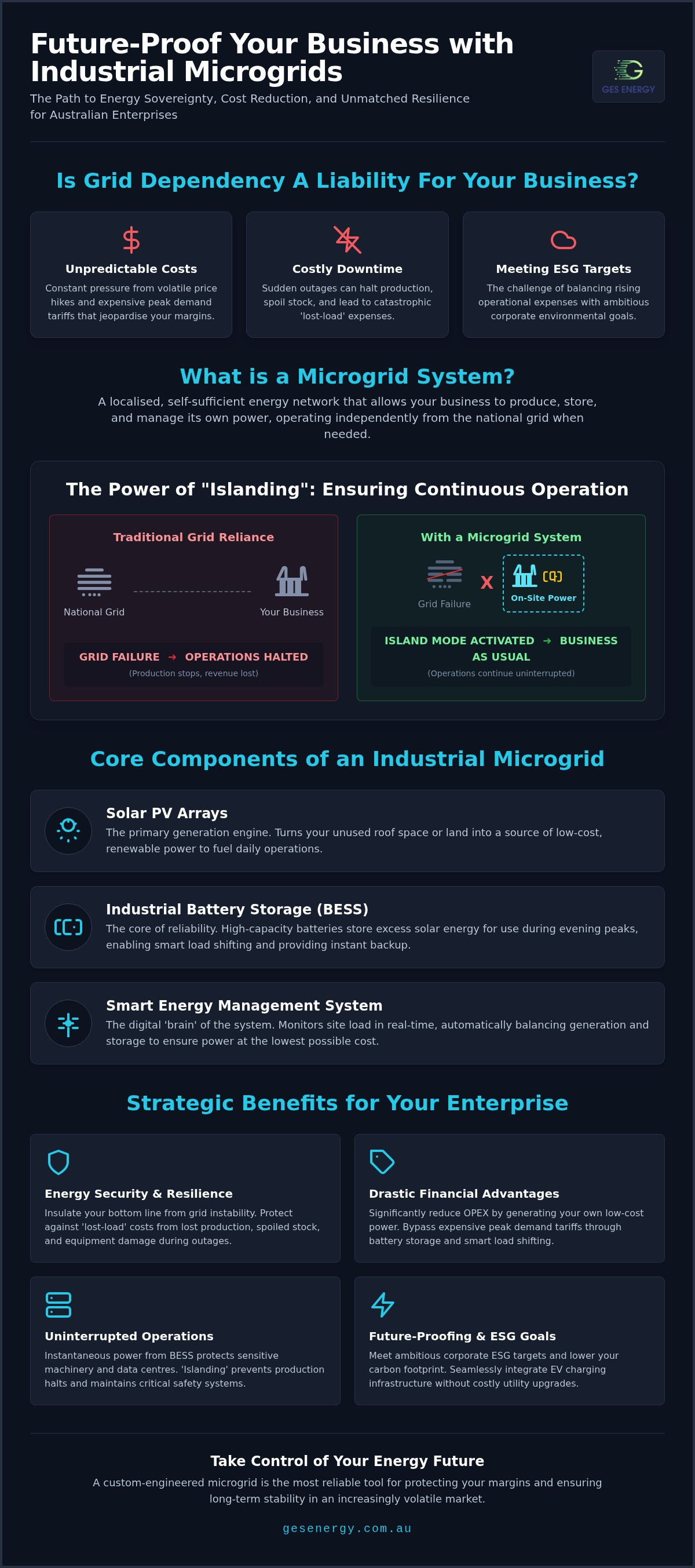
A Microgrid is a localised energy network that functions as a self-sufficient power system. For an Australian enterprise, it's a strategic move away from total reliance on the traditional utility provider. By integrating on-site generation with sophisticated storage, your business can produce, store, and manage its own electricity. This isn't just about adding a few solar panels; it's about creating a resilient energy ecosystem that operates on your terms.
The defining feature of these systems is their "islanding" capability. When the main grid fails due to weather or infrastructure issues, a microgrid can automatically disconnect and continue to run independently. This prevents the "lost-load" costs that often cripple industrial sites during unexpected blackouts. Exploring the benefits of microgrid systems for business reveals that this resilience is often the difference between a productive shift and a total operational standstill.
The Core Components of Industrial Microgrids
To function effectively, an industrial-scale microgrid requires three integrated technologies working in unison. Each piece of hardware is selected to withstand the harsh Australian climate while delivering high-efficiency performance.
- Solar PV arrays: These act as the primary generation engine. They turn your roof space or unused land into a source of low-cost, renewable power that fuels your daily operations.
- Industrial battery storage (BESS): Storage is what makes the system reliable. These high-capacity batteries manage load shifting by storing midday solar energy for use during expensive evening peaks.
- Smart energy management systems: This is the digital "brain" of the operation. It monitors site load in real-time, automatically balancing generation and storage to ensure your facility always has the power it needs at the lowest possible cost.
Grid-Connected vs. Off-Grid Microgrids
The way your system interacts with the wider network depends on your specific site requirements. Most Australian commercial enterprises opt for a grid-connected model. This setup allows you to draw from the grid when necessary but also lets you trade surplus energy back to the National Electricity Market (NEM) when prices are favourable. It's a high-ROI strategy that turns your energy infrastructure into a revenue stream.
In contrast, off-grid systems are the standard for remote mining or agricultural operations where grid connection is either impossible or prohibitively expensive. These setups provide 100% independence, removing the risk of volatile market pricing entirely. Many modern businesses are now adopting a hybrid approach. They treat the grid as a secondary backup rather than a primary source, ensuring that the benefits of microgrid systems for business are realised even during prolonged periods of low solar generation.
Energy Security and Resilience in the Australian Climate
Australia's energy landscape is increasingly defined by its vulnerability. With a vast, ageing transmission network and a climate prone to extremes, the risk of grid instability has never been higher for commercial operators. For many, the true benefits of microgrid systems for business lie in their ability to mitigate 'lost-load' costs. These are the hidden expenses, such as lost production hours, spoiled stock, and damaged equipment, that occur the moment the lights go out. By integrating a microgrid, you effectively insulate your bottom line from the failings of the centralised network.
Industrial battery storage (BESS) plays a critical role here. Unlike traditional backup generators that may take seconds or even minutes to kick in, a BESS provides an instantaneous response. This is vital for facilities running sensitive industrial machinery or data centres where even a millisecond of power fluctuation can cause catastrophic system failures. For site managers in remote or regional areas, this level of reliability provides a profound sense of security that the main grid simply cannot guarantee.
Protecting Operations from Grid Instability
The ability to 'island', which involves disconnecting from the main grid while maintaining full site power, ensures that manufacturing lines don't grind to a halt. It also protects critical safety systems and cold storage facilities that must remain active regardless of regional outages. While many businesses traditionally relied on diesel generators, a modern microgrid reduces this dependency. This shift not only lowers your carbon footprint but also removes the logistical headache and rising costs of fuel procurement. If you are looking to secure your facility's future, exploring professional microgrid solutions is a logical first step.
Bushfire and Storm Resilience
Environmental events like bushfires and severe storms frequently lead to prolonged power cuts as main lines are damaged or de-energised for safety. A microgrid allows your facility to operate safely as a self-contained energy hub when the surrounding infrastructure is compromised. Resilience is the ability to maintain 100% uptime regardless of external grid health. To achieve this, infrastructure must be hardened and designed specifically for Australian conditions, ensuring panels, inverters, and battery enclosures can withstand extreme heat and high-wind events. This proactive engineering ensures that one of the primary benefits of microgrid systems for business is the long-term protection of your physical and financial assets.
Financial Advantages: Reducing OPEX and Demand Charges
Many Australian businesses view energy as an uncontrollable overhead. It isn't. One of the primary benefits of microgrid systems for business is the ability to transform energy from a volatile expense into a predictable, managed resource. By combining on-site generation with intelligent storage, you can bypass the most expensive components of a standard utility bill. These savings are achieved through a combination of smart technology and strategic energy usage.
Peak shaving is a core strategy for any high-load facility. It involves using stored battery energy during periods of high demand to avoid expensive peak tariffs. Load shifting complements this by moving energy-intensive processes, such as heavy machinery operation or thermal cooling, to periods of high solar production. This ensures you're running your facility on on-site solar power rather than drawing from the grid when rates are highest. It's a methodical way to ensure your operational expenditure remains steady regardless of market fluctuations.
Mastering Demand Charge Management
Demand charges are based on the highest rate of power consumption during a billing period, not just total usage. For an industrial site, a single 15-minute spike in power draw can inflate the entire month's bill. Microgrid intelligence prevents this by capping grid draw. When the system detects a surge in demand, it automatically supplements the load with battery power. A typical industrial site can save thousands of dollars annually simply by smoothing their energy profile and keeping their peak demand below a specific threshold.
Beyond internal savings, microgrids enable new revenue streams. Participating in Demand Response programmes allows your business to get paid for supporting the grid during emergencies. Additionally, setting up an embedded network allows for bulk energy purchasing. This allows you to buy power at wholesale rates and distribute it across your site more effectively, further lowering your average cost per kilowatt-hour.
Long-term ROI and Asset Value
Investing in a microgrid turns energy from a sunk cost into a controlled, depreciable asset. It provides a 20-year hedge against energy market volatility. As the Australian microgrid market is projected to reach US$8,562.5 million by 2033, these systems also significantly increase the value of commercial and industrial real estate. You aren't just saving on bills; you're building equity in your infrastructure. This shift from operational expenditure to capital investment offers a stable financial foundation for the next two decades of growth.
The EPC Lifecycle: From Design to Commissioning
Constructing a reliable energy network is a sophisticated infrastructure project. It requires a methodical Engineering, Procurement, and Construction (EPC) approach to ensure long-term performance. One of the primary benefits of microgrid systems for business is that an end-to-end specialist handles the technical complexity, allowing you to focus on your core operations. This lifecycle starts with precise data collection and ends with a system that is fully integrated into your facility's daily workflow.
Engineering begins with a deep dive into your specific site load profiles. We don't guess. We use data to size the solar PV and battery storage components to match your peak demand. Procurement follows, where we source Tier-1 hardware, including industrial-grade inverters and batteries, specifically rated for the harsh Australian climate. During the construction phase, SAA-accredited technicians manage the physical installation. Finally, rigorous commissioning tests every safety protocol and islanding transition to ensure the system performs exactly as designed under real-world conditions.
Custom Engineering for Industrial Loads
Detailed energy audits are the foundation of a successful microgrid. We analyse your existing infrastructure, such as backup generators and HVAC systems, to ensure they integrate seamlessly with the new solar and storage assets. This process ensures the system is neither under-powered nor over-specified. It also guarantees full compliance with Australian standards and the specific grid connection requirements of your local network service provider. A well-engineered system is the only way to lock in the long-term financial benefits of microgrid systems for business.
Professional Maintenance and Repair
The commitment to your energy security doesn't end at commissioning. Scheduled health checks are essential to maintain system efficiency and protect your investment. We use remote monitoring technology to track performance in real-time, allowing us to identify and rectify performance dips before they lead to hardware failure. For more information on maintaining high installation standards, you can read our Commercial Solar: 2026 Guide for Australian Businesses. Ongoing maintenance ensures your system remains a high-performing asset for its entire 20-year lifespan. If you're ready to discuss a custom build for your facility, you should consult with an EPC microgrid specialist today.
Future-Proofing with EV Infrastructure and ESG Goals
The transition to electric transport is no longer a distant possibility; it's a current operational requirement. For many commercial sites, the sudden addition of high-capacity EV charging stations can exceed the capacity of their existing grid connection. This often leads to massive, unbudgeted utility upgrade costs. One of the strategic benefits of microgrid systems for business is the ability to bypass these infrastructure bottlenecks. By using on-site generation and storage to buffer the high power draw of chargers, you can deploy a full EV fleet without needing a costly new transformer from the local distributor.
Beyond the technical hurdles, modern infrastructure is a powerful tool for commercial positioning. Attracting premium tenants and high-value partners now requires more than just floor space; it requires a facility that supports their own green energy mandates. A microgrid transforms your property into a high-tech energy hub, offering a level of sophistication and reliability that traditional buildings cannot match. This creates a clear competitive advantage in the Australian commercial real estate market.
Supporting the Transition to Electric Fleets
Managing a transition to electric logistics requires a smart energy ecosystem. Industrial battery storage (BESS) allows you to capture solar energy during the day and discharge it into your vehicles overnight or during peak operational windows. This smart charging approach ensures you aren't stressing the main connection or paying premium rates for fast charging. Preparing now for the 2030-2040 shift to zero-emission logistics ensures your facility remains capable as traditional fuel becomes a legacy expense. It's a methodical way to ensure your fleet operations remain resilient and cost-effective.
Achieving Net Zero Targets
Corporate social responsibility is now a measurable financial metric. Most Australian enterprises face increasing pressure from stakeholders to meet ambitious Environmental, Social, and Governance (ESG) targets. When you consider the benefits of microgrid systems for business, the ability to produce verifiable sustainability metrics is often as valuable as the electricity itself. A microgrid provides the transparent data needed for rigorous carbon reporting and sustainability audits. By generating and storing clean power on-site, you directly reduce your Scope 2 emissions, which are the indirect greenhouse gas emissions associated with the purchase of electricity.
GES Energy acts as a comprehensive, end-to-end partner for these complex energy ecosystems. We don't just provide hardware; we act as a diligent steward for your transition, handling everything from custom engineering to ongoing health checks. Our expertise ensures that your microgrid is a cohesive system designed to meet your specific long-term sustainability and operational goals.
Ready to secure your energy future? Consult with GES Energy on a custom microgrid solution today.
Securing Your Energy Sovereignty for the Decade Ahead
Transitioning to a localised power network is a decisive step toward long-term operational stability. By integrating solar generation, industrial storage, and smart controls, you eliminate the risks associated with an ageing national grid while locking in predictable costs. Recognising the strategic benefits of microgrid systems for business means moving away from being a passive energy consumer and becoming an active manager of your most critical resource.
GES Energy acts as your dedicated partner in this transition. We provide comprehensive EPC services for projects up to 5 MW, backed by SAA-accredited engineering and installation teams. As a specialist in remote and off-grid reliability, we understand how to design infrastructure that thrives in the harshest Australian conditions. Our team handles the full lifecycle of your project, from initial energy audits to ongoing system health checks and performance monitoring.
Taking control of your energy future today ensures your enterprise remains competitive, sustainable, and resilient for years to come. Secure your business with a custom GES Energy microgrid solution and gain the peace of mind that comes with true energy independence.
Frequently Asked Questions
What is the difference between a microgrid and a standard solar system?
A standard solar system is typically grid-dependent and will shut down during an outage to prevent power from being exported to the lines. In contrast, a microgrid includes advanced controllers and battery storage that allow it to function as an independent energy island. One of the key benefits of microgrid systems for business is this ability to maintain full power when the utility grid fails.
Can a microgrid operate during a total grid blackout?
Yes, a microgrid is designed specifically to operate during a total grid blackout through its islanding capability. When the system detects a grid failure, it automatically disconnects from the utility network and switches to on-site generation and battery storage. This ensures that your facility remains fully operational without any interruption to critical machinery, safety systems, or data centres, providing total energy security in volatile conditions.
How much does a microgrid system cost for a typical Australian business?
The total investment for an industrial microgrid varies significantly based on your site's load profile and the required storage capacity. Factors like the scale of the solar array, the size of the Battery Energy Storage System (BESS), and the complexity of existing infrastructure integration all influence the final budget. We recommend a detailed energy audit to determine the specific engineering requirements and potential ROI for your commercial facility.
How long does it take to design and install an industrial microgrid?
A typical industrial microgrid project generally takes between six and twelve months from the initial energy audit to final commissioning. This timeline includes several distinct phases: detailed engineering and load profiling, procurement of Tier-1 hardware, physical installation by SAA-accredited technicians, and rigorous safety testing. The duration often depends on the complexity of your site's existing electrical infrastructure and the lead times for specific industrial-grade components.
What is islanding and why is it important for energy security?
Islanding is the process where a microgrid disconnects from the main utility grid to operate as an independent power source. It's critical for energy security because it allows your business to maintain 100% uptime during regional outages or storm-related failures. Without this capability, even a facility with solar panels would lose power during a blackout to ensure the safety of utility workers repairing the main lines.
Does a microgrid require constant maintenance?
While microgrids are designed for high reliability, they do require scheduled professional health checks to ensure peak efficiency. These checks involve inspecting physical hardware like inverters and battery enclosures, along with software updates for the energy management system. We also utilise remote monitoring technology to track performance data in real-time. This proactive approach helps us identify potential issues or performance dips before they lead to operational downtime.
Can I add EV charging stations to an existing microgrid later?
You can certainly add EV charging stations to an existing microgrid later, provided the initial system architecture is designed with future expansion in mind. Integrating EV infrastructure is one of the major benefits of microgrid systems for business as it allows for smart charging. This means you can use your stored solar energy to fuel your fleet without needing to pay for expensive grid upgrades or high peak-demand charges.
Are there government incentives for microgrid development in 2026?
As of August 2026, several incentives are available. The Small-scale Renewable Energy Scheme now includes solar PV systems up to 1MW. Additionally, the federal DRIVEN program offers rebates up to $3,000 for eligible EV charging plugs. For businesses in New South Wales, the EV Fleets Incentive may cover up to 50% of charging infrastructure costs, capped at $60,000, provided applications are submitted before the November 2026 deadline or before the fund is exhausted.


