

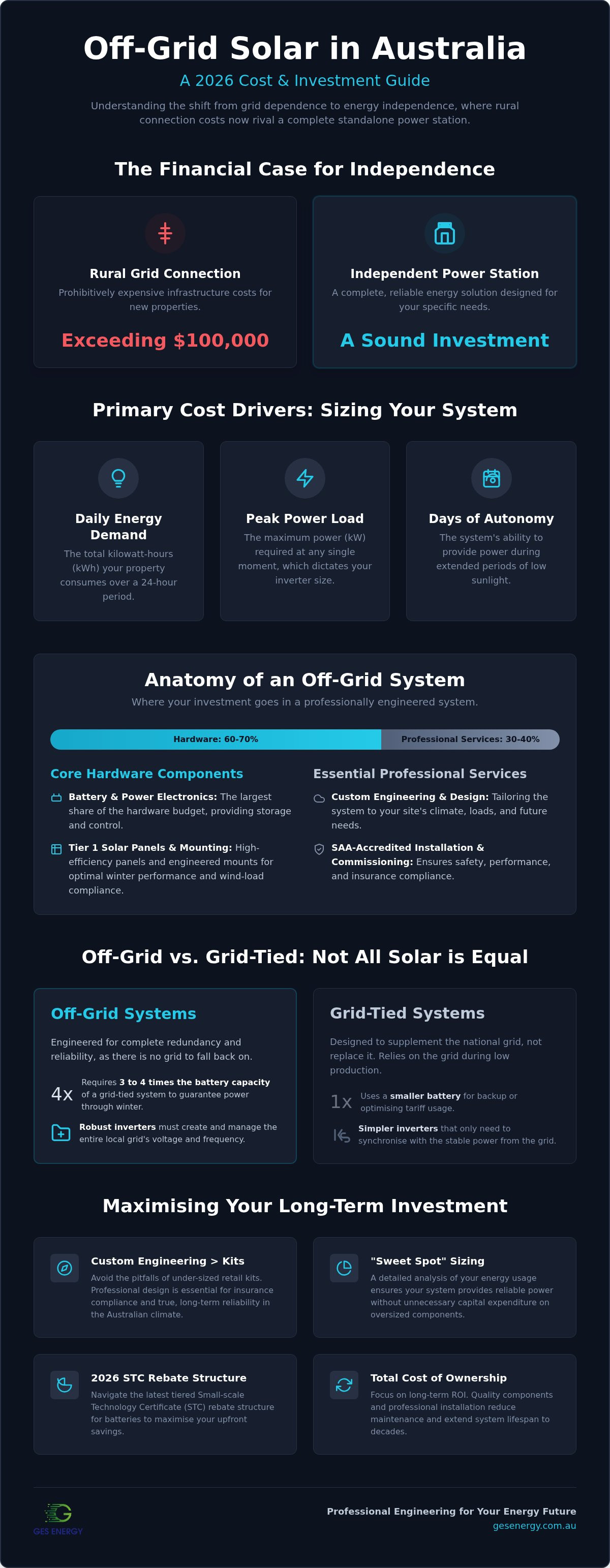
In many rural parts of the country, the price of simply connecting a new home to the national grid has now surpassed the total investment required for a high-end, independent power station. It is a frustrating reality for many Australians watching electricity bills climb while facing quotes that can exceed $100,000 just to run a cable to a property boundary. You have likely felt the weight of these rising costs and perhaps a bit of apprehension about whether a standalone system can truly handle your daily requirements without failing in a remote location.
We believe that transitioning to energy independence is a major infrastructure project that requires professional oversight. This guide provides a detailed breakdown of the off grid solar system cost australia residents should anticipate in 2026, moving beyond hardware to include the vital engineering and installation fees that ensure reliability. You will gain a clear understanding of the latest tiered STC rebate structures and how they impact your initial investment. We will also explore the practicalities of system sizing and the long-term ROI of modern infrastructure, giving you the confidence to secure your energy future with a solution that is designed to perform for decades.
Key Takeaways
- Understand how the total off grid solar system cost australia residents face in 2026 now rivals the expense of rural grid connections, making independence a financially sound infrastructure choice.
- Identify the critical hardware components, such as high-performance inverters and charge controllers, that represent the core of your investment and system longevity.
- Learn how to navigate the 2026 tiered STC rebate structure for batteries to maximise your upfront savings on both residential and commercial projects.
- Discover why custom engineering and SAA-accredited commissioning are essential for maintaining insurance compliance and avoiding the pitfalls of under-sized retail kits.
- Gain insights into the "sweet spot" for system sizing to ensure your standalone power system (SAPS) provides reliable energy without unnecessary capital expenditure.
Understanding the Investment: Off-Grid Solar Costs in 2026
A stand-alone power system (SAPS) is no longer just a niche solution for remote cabins; it's a sophisticated energy infrastructure choice for Australian properties where traditional grid connection is either impossible or prohibitively expensive. In 2026, this technology has matured into a reliable alternative to the national grid. The shift is driven by the stabilisation of battery supply chains and more efficient system integration, making energy independence a practical reality for a wider range of applications.
The year 2026 marks a turning point for off-grid viability because battery storage has reached a level of density and cost-efficiency that allows for consistent performance. However, calculating the off grid solar system cost australia requires looking past the hardware alone. While "DIY kits" might appear attractive on a spreadsheet, they often fail to account for the unique environmental stresses of the Australian climate. A project-based solar design approach treats the installation as a custom engineering task. It focuses on long-term stability and reliability, ensuring the system doesn't just work on a sunny afternoon but remains operational through every season.
The primary drivers of your investment include:
- Daily energy demand: The total kilowatt-hours (kWh) your property consumes over a 24-hour period.
- Peak load: The maximum amount of power required at any single moment, which dictates the size of your inverters.
- Days of autonomy: The system’s ability to provide power during extended periods of low sunlight without needing a generator.
The Difference Between Grid-Tied and Off-Grid Pricing
An off-grid system is fundamentally different from a standard rooftop setup. Because there's no grid to fall back on, these systems require three to four times the battery capacity of a grid-tied equivalent. You aren't just buying storage; you're buying redundancy. This means building for the worst-case winter weather to ensure the lights stay on. Additionally, off-grid inverters must be far more robust. They manage the entire local grid's voltage and frequency without external support, which contributes to a higher initial investment compared to grid-connected hardware.
The Total Cost of Ownership (TCO) vs. Upfront Price
Focusing solely on the initial invoice often obscures the true value of an engineered system. Total Cost of Ownership factors in maintenance, repair services, and planned component replacements over time. For instance, high-quality off-grid inverters typically require replacement every 10 years. By investing in professional design and SAA-accredited labour from the start, you reduce the frequency of emergency repairs and extend the overall system lifespan. This methodical approach significantly improves your long-term ROI by ensuring the system performs as expected for decades.
Anatomy of an Off-Grid System: Where Your Money Goes
Hardware components typically account for 60% to 70% of the total project budget. While the solar panels are the most visible element, the battery bank and power electronics represent the most significant financial commitments. Understanding the off grid solar system cost australia requires a granular look at these components to ensure you aren't sacrificing long-term reliability for a lower upfront price. Every component must be selected for its ability to withstand the harsh Australian environment without constant intervention.
Solar Arrays and Mounting Infrastructure
Rooftop solar arrays are generally more cost-effective because they utilise existing structures. However, ground-mounted systems are often preferred for off-grid properties to achieve the perfect orientation and tilt for winter performance. These ground mounts require additional investment in steel, concrete, and trenching. We recommend Tier 1 panels for every remote project. These panels offer the high-efficiency ratings and robust warranties necessary for locations where a single hardware failure can lead to a total power loss. Engineering these mounts to meet Australian wind load standards is a non-negotiable part of the design process.
Industrial Battery Storage Solutions
Lithium-ion battery costs have stabilised in the Australian market, making them the standard for modern energy storage. Commercial and industrial (C&I) storage systems are priced differently than residential units because they are built for higher duty cycles and include sophisticated thermal management. A high-quality Battery Management System (BMS) is your primary insurance policy. It protects the cells from over-discharging and temperature extremes, which directly extends the life of your investment. Opting for modular battery designs allows for future scalability, enabling you to increase capacity as your energy needs grow without replacing the entire stack.
Inverters and Power Electronics
The off-grid inverter is the brain of your energy ecosystem. It converts DC power from your batteries into the clean AC power required for your appliances. Pure sine wave inverters are mandatory for modern electronics; cheaper modified sine wave alternatives can damage sensitive equipment like computers or medical devices. Investing in smart monitoring, such as Solar Analytics, allows for remote oversight of your system's health. This proactive approach ensures that any performance dips are identified before they lead to a blackout. Our team can help you design a custom energy ecosystem that balances these hardware costs with long-term performance.
Finally, a reliable backup power source is essential for any stand-alone system. While solar provides the bulk of your energy, a diesel or emerging hydrogen generator acts as a safety net during extended periods of low sunlight or "black start" events. This ensures that your property remains powered regardless of weather conditions or seasonal shifts.
Estimating Your Project: From Rural Homes to Industrial Sites
Calculating the off grid solar system cost australia property owners face depends heavily on your specific operational requirements. A small remote cabin has vastly different needs than a multi-million dollar mining camp or a regional industrial facility. While total daily energy use (kWh) is a factor, the primary cost driver is actually peak demand (kW). This figure determines the capacity of your inverters and their ability to handle "surge" loads, such as starting heavy machinery or running multiple air conditioning units simultaneously. In 2026, the "sweet spot" for sizing involves balancing your battery capacity with a precisely calculated solar array to minimise expensive generator run-time.
Residential Off-Grid Price Brackets
Residential systems generally fall into three distinct investment tiers based on lifestyle and demand. For basic weekenders or those seeking portable off-grid solutions, budgets typically range from $10,000 to $20,000. These systems power lights, a small fridge, and basic electronics. Standard 3-4 bedroom family homes, which require reliable power for modern appliances and laundry, usually see investments between $30,000 and $60,000. For luxury estates or high-demand properties with electric vehicle charging and pool pumps, costs can exceed $70,000 to ensure total energy security without compromise.
Commercial and Industrial Off-Grid Costs
Large-scale projects for remote construction sites or mining camps require a different approach. These installations involve significant Engineering, Procurement, and Construction (EPC) fees to ensure the system meets strict safety and performance standards. For regional businesses, a micro-grid solution is often the most viable path to energy independence. By integrating large-scale solar with industrial battery storage, these businesses can hedge against volatile fuel prices and eliminate the logistical challenges of transporting diesel to remote locations. The investment in a custom-engineered micro-grid is often recouped quickly through reduced operational overheads.
The Grid Connection Comparison
In rural Australia, the cost of extending the national grid is often the strongest argument for going off-grid. Grid extension can cost between $25,000 and $100,000 per kilometre, depending on the terrain and the number of poles required. When a $100,000 solar system is compared to a $150,000 grid connection quote, the stand-alone option is the clear winner. Choosing independence also eliminates the ongoing quarterly service-to-property charges. These mandatory fees are paid to the network provider regardless of how much electricity you actually use, representing a permanent saving over the life of your property.
Navigating Rebates and Incentives to Reduce Upfront Costs
The federal government's Small-scale Renewable Energy Scheme (SRES) remains a cornerstone for reducing the initial investment in standalone power. While the scheme is gradually phasing out toward its 2030 conclusion, it still provides significant financial relief in 2026. Understanding these incentives is vital for accurately calculating the off grid solar system cost australia homeowners and businesses will actually pay after all offsets are applied. These mechanisms are designed to reward early adopters before the subsidy levels decline further.
The value of Small-scale Technology Certificates (STCs) is currently subject to a six-monthly reduction in the deeming period. From May to June 2026, the STC factor sits at 6.8 certificates per kWh, dropping to 6.0 for the remainder of the year. This scheduled decline makes early installation more financially advantageous for those looking to maximise their return. Most accredited installers apply this rebate as a point-of-sale discount, which simplifies the transaction and reduces the immediate capital required for commissioning.
A significant regulatory update arrived on May 1, 2026, with a new tiered structure for battery rebates. The first 14kWh of capacity receives 100% of the STC factor, while capacity between 14.1kWh and 28kWh receives 60%. This shift rewards standard residential systems but requires more sophisticated financial planning for larger industrial storage projects. For commercial entities, the landscape changes again on October 1, 2026, when systems between 100kW and 1MW become eligible for STCs, providing a faster path to rebates for those who previously used the more complex Large-scale Generation Certificate (LGC) market.
How to Calculate Your STC Discount
The number of certificates your system generates is directly proportional to its solar capacity in kW and the remaining years of the scheme. Because the market price for an STC fluctuates, often sitting around $36 in mid-2026, the total discount can vary by several thousand dollars depending on the timing of your installation. Your total system size in kW serves as the primary multiplier that determines the final volume of certificates issued for your project.
Commercial Incentives and Financing
Industrial projects can leverage additional financial levers to manage upfront capital. Power Purchase Agreements (PPAs) allow regional businesses to host an off-grid system with zero upfront cost, paying only for the energy generated over a fixed term. The Clean Energy Finance Corporation (CEFC) also plays a critical role by providing low-interest loans specifically for large-scale micro-grid developments. Furthermore, the Instant Asset Write-Off provisions allow many Australian businesses to deduct the full cost of the system from their taxable income in the first year of operation. You can consult with our engineering team to determine which specific state-based battery incentives and federal tax benefits apply to your industry.
Why Custom Engineering Outperforms Off-the-Shelf Kits
Retail kits often appeal to those focused strictly on the bottom line. However, generic online calculators frequently underestimate real-world energy needs, leading to systems that fail during the first cloudy week. A project-based solar design ensures 99.9% uptime by accounting for the specific variables of your location. This rigorous approach is what separates a temporary fix from a permanent energy solution. When you factor in the longevity of the components, the total off grid solar system cost australia residents pay for an engineered system is often lower over twenty years than a series of failed DIY attempts.
SAA-accredited labour is a non-negotiable requirement for any system intended to provide long-term security. Professional commissioning ensures that your installation meets Australian safety standards and remains compliant with insurance policies. Without this certification, property owners risk total loss in the event of a fire or system failure. Custom engineering builds reliability into the foundation of the project, positioning GES Energy as a partner for high-stakes energy transitions where failure is not an option.
The Engineering and Design Process
Our process begins with detailed load profiling. We don't guess your requirements; we measure actual energy usage patterns to determine necessary peak capacity and storage. We also integrate site-specific climate data and shading profiles to optimise panel placement. This meticulous planning prevents the deep discharges that shorten battery life, ultimately protecting your investment and lowering the overall off grid solar system cost australia property owners experience over the life of the hardware.
The Importance of Ongoing Support
Reliable off-grid power requires more than just installation; it demands a diligent steward to oversee system health. Remote monitoring allows our technicians to identify and rectify performance issues before they impact your lifestyle or operations. While generic kits leave you to troubleshoot alone, we integrate ongoing maintenance and repair services into our delivery model. This proactive oversight ensures that your energy infrastructure continues to provide predictable value for decades, regardless of your location.
Next Steps for Your Off-Grid Journey
Transitioning to a standalone power system involves a methodical timeline, from initial site assessment to final commissioning. To prepare for a professional consultation, gather your recent energy bills or a list of high-demand appliances you intend to run. Having this data ready allows our engineers to provide a more accurate initial assessment. When you are ready to secure your energy future, you can request a custom off-grid design and quote from GES Energy to begin the process.
Securing Your Energy Independence with Precision Engineering
Investing in a standalone power system is a strategic decision that offers long-term predictability in an era of volatile energy markets. We've explored how the off grid solar system cost australia residents and businesses face in 2026 reflects a transition from simple hardware purchases to sophisticated energy infrastructure. By prioritising custom engineering over generic kits, you ensure your property remains operational through every seasonal challenge. Success in remote environments depends on meticulous planning and high-quality components designed for the Australian climate.
As specialists in remote industrial solutions, GES Energy provides comprehensive EPC services tailored to your specific load profile. Our SAA-accredited installers manage every detail from initial design to ongoing performance monitoring, ensuring your system delivers the reliability you expect. You can contact GES Energy for a professional off-grid feasibility study to begin your transition. Taking control of your power supply is a significant step toward future-proofing your assets and achieving true independence.
Frequently Asked Questions
Is it cheaper to go off-grid or stay on the grid in Australia?
It is often cheaper to go off-grid if your property requires a new grid connection in a rural area. While staying on the grid is typically less expensive for urban homes with existing infrastructure, rural connection fees can easily exceed $100,000. By choosing a stand-alone power system, you eliminate these high upfront connection costs and ongoing quarterly service fees. This makes the total investment more predictable and financially viable over a twenty-year period.
How much does a 10kW off-grid solar system cost with batteries?
A 10kW off-grid solar system generally costs between $25,000 and $50,000 in the current Australian market. This price range includes high-efficiency panels, industrial-grade batteries, and professional installation. The final figure depends on your specific battery capacity and the complexity of the engineering required for your site. Larger battery banks increase the upfront cost but provide greater autonomy during periods of low sunlight, which is vital for maintaining a reliable power supply.
Can I get a government rebate for an off-grid solar system in 2026?
Yes, you can still access federal government rebates through the Small-scale Renewable Energy Scheme (SRES) in 2026. The number of Small-scale Technology Certificates (STCs) you receive depends on your system's solar capacity and the installation date. For battery storage, a new tiered rebate structure was introduced on May 1, 2026. This scheme is being phased out annually; installing your system sooner ensures you capture a higher rebate value before the 2030 deadline.
How many solar panels do I need to run a house off-grid?
Most off-grid Australian homes require between 20 and 40 solar panels to maintain a reliable power supply throughout the year. This number varies based on your daily energy consumption and the peak load of your appliances. A small, energy-efficient cabin might function perfectly with a 5kW array, while a large family home often needs 10kW or more. Precisely sizing your array is a critical part of the engineering process to prevent excessive generator use during winter.
What is the average lifespan of an off-grid battery system?
Modern lithium-ion battery systems typically have an operational lifespan of approximately 10 years. While the solar panels themselves can last 25 years or more, the battery storage is the component most likely to require replacement first. The actual longevity depends on your discharge depth and how well the Battery Management System (BMS) regulates temperature. Investing in high-quality industrial storage solutions and regular maintenance can help you maximise the life of your cells and improve your long-term ROI.
Do I still need a backup generator if I have a large solar battery?
We strongly recommend a backup generator for every off-grid installation, even if you have a substantial battery bank. A generator acts as an essential safety net during extended periods of rain or heavy cloud cover when solar production is minimal. It ensures your batteries don't reach a critical low state, which can lead to system shutdowns or hardware damage. Having a diesel or hydrogen backup provides peace of mind and guarantees 100% power availability in all weather.
How much does it cost to maintain an off-grid solar system annually?
Annual maintenance costs are relatively low but essential for long-term reliability. You should budget for a professional inspection once a year to check electrical connections, clean panels, and update inverter firmware. These proactive services help identify potential issues before they cause a blackout. While the off grid solar system cost australia property owners face includes the initial hardware, regular servicing ensures the system performs at peak efficiency and avoids the high price of emergency repairs in remote locations.
What is the cost difference between lead-acid and lithium batteries for off-grid?
Lithium batteries have a higher upfront cost than traditional lead-acid options but offer significantly better value over their lifespan. Lithium units allow for a deeper depth of discharge and have a much higher cycle life; they don't need to be replaced as frequently. Lead-acid batteries require regular maintenance and have a lower energy density, often making them more expensive when you calculate the total cost of ownership. Most modern off-grid systems now exclusively use lithium for its superior efficiency.


