

What if the solar system you installed to protect your business margins became your greatest financial liability within just a few years? Most Australian business owners recognise that rising electricity costs are unsustainable and view renewable energy as the logical solution for long-term stability. However, the fear of hiring a solar installer who leaves behind a potential fire hazard or an unsupported system is a genuine concern as regulations evolve. Finding a reputable partner is no longer about chasing the lowest quote; it is about securing a high-performing asset that lasts for decades.
This guide provides the clarity you need to identify elite partners who prioritise engineering precision over high-pressure sales. We will explain how to navigate the 2026 SRES rebate changes, including the new 1MW eligibility cap for commercial projects and the reduced five-year deeming period. By understanding these shifts and the value of SAA-accredited labour, you can ensure your system delivers maximum ROI and energy independence for 25 years or more. We will also examine how a dedicated maintenance strategy prevents costly downtime in complex industrial environments.
Key Takeaways
- Learn why your choice of solar installer determines long-term ROI and how to distinguish between high-volume sales retailers and dedicated engineering specialists.
- Understand the mandatory transition to Solar Accreditation Australia (SAA) standards and why verified credentials are essential for rebate eligibility in 2026.
- Discover the specific technical requirements for scaling industrial projects, including structural integrity assessments and complex high-voltage grid integration.
- Follow a rigorous five-step vetting process to verify past performance and secure industrial references before committing to a major energy infrastructure investment.
- Identify how the "Engineering, Procurement, and Construction" (EPC) model provides the professional oversight needed to manage a system for its entire 25-year lifespan.
Beyond the Quote: Why Your Solar Installer Choice Dictates Your ROI
Selecting a solar installer is a decision that impacts your balance sheet for a quarter of a century. While the rapid expansion of Solar power in Australia has made renewable energy more accessible, it has also created a market where a low price often masks poor engineering. A cheap upfront quote might look appealing on a spreadsheet, but it rarely accounts for the long term performance or safety of the asset. True value is found in the reliability of the system over its entire lifecycle.
The distinction between a solar retailer and a solar installer is critical for business certainty. Many companies operate primarily as sales offices, using high pressure marketing to secure contracts before sub-contracting the actual work to the lowest bidder. This "sales first" model often leads to "orphaned systems" where the retailer vanishes during a market downturn, leaving the owner with no warranty recourse. ROI is protected when you partner with a firm that manages the entire Engineering, Procurement, and Construction (EPC) process in-house.
Your installer also plays a pivotal role in securing government incentives that offset capital expenditure. In 2026, the SRES expansion allows systems up to 1MW to claim Small-scale Technology Certificates (STCs), which can reduce commercial installation costs by approximately 20%. Navigating these certificates, or Large-scale Generation Certificates (LGCs) for utility-scale projects, requires meticulous documentation and strict compliance with Solar Accreditation Australia (SAA) standards. Mistakes in this process can result in significant financial losses.
The "Solar Cowboy" Problem in 2026
Identifying industry "cowboys" starts with recognising red flags like "one day only" discounts or a refusal to conduct a physical site visit. A desktop quote cannot identify structural integrity issues or subtle shading patterns that degrade energy output. Even the most expensive "Tier 1" panels will fail if the electrical balance of system components and labour do not meet Australian standards. Reliability is built on the roof, not in a sales brochure. Always demand a transparent breakdown of the components and the credentials of the team performing the work.
The Engineering-First Approach to Solar Design
Custom design is the only way to maximise self-consumption and shorten your payback period. Cookie-cutter bundles often ignore your specific load profile, leading to wasted energy or insufficient coverage during peak operational hours. A professional solar installer will analyse half-hourly usage data to size the system correctly for your specific needs. This level of detail ensures grid-connection approval from network service providers and guarantees the system integrates seamlessly with your existing electrical infrastructure without causing voltage instability.
Understanding Australian Solar Accreditation and Standards
The regulatory landscape for renewable energy in Australia has undergone a significant shift. Responsibility for industry oversight has transitioned from the Clean Energy Council (CEC) to Solar Accreditation Australia (SAA). This change ensures that every solar installer meets the current safety benchmarks required for modern energy infrastructure. SAA accreditation is now the mandatory requirement for accessing federal Small-scale Technology Certificates (STCs). If your system is not installed by an accredited professional, you will lose access to these significant upfront rebates.
Technical compliance is anchored by two primary Australian Standards. AS/NZS 4777 governs the grid connection of energy systems via inverters, while AS/NZS 5033 dictates the installation and safety requirements for photovoltaic (PV) arrays. These standards are designed to prevent electrical fires and ensure grid stability. If a system fails and is found to be non-compliant with these standards, insurance providers are unlikely to honour any claims. SAA-accredited labour provides the legal and technical assurance that your system is built to survive the harsh Australian climate.
Verifying Your Installer’s Credentials
You can verify a provider's status by checking the SAA public register online. It is vital to distinguish between a general electrical licence and solar-specific accreditation. While a standard licence allows for general wiring, it does not certify an individual to design or install complex DC high-voltage solar arrays. SAA accreditation serves as the definitive benchmark for Australian solar safety and technical proficiency. Checking these credentials before signing a contract protects you from the risks associated with uncertified labour.
Compliance and Safety Documentation
A professional handover must include a Certificate of Electrical Safety (CES). This document confirms the work meets all state-based safety regulations and is a prerequisite for grid connection. You should also receive a post-installation commissioning report that records the initial performance of the system. For commercial and industrial sites, detailed Operation and Maintenance (O&M) manuals are essential for ongoing safety and asset management. If your system is underperforming or requires a technical audit, seeking professional inverter repairs and warranties can help restore your ROI. These documents form the foundation of your system's long-term service history.
Scaling Your Energy Strategy: Commercial vs Residential Installers
Scaling a renewable energy system requires a fundamental shift in engineering perspective. A residential solar installer typically manages high-volume, standardised installations between 6.6kW and 13kW. These systems are relatively straightforward. However, industrial projects often exceed 100kW and can scale up to 5 MW. This jump in scale introduces technical complexities that residential teams are rarely equipped to handle. Structural integrity is a primary concern. Hundreds of panels add tonnes of weight to a warehouse roof, necessitating rigorous structural assessments before any hardware is mounted.
Grid integration at the commercial level also involves High Voltage (HV) requirements and sophisticated protection settings. While home systems are often "plug and play" in many respects, industrial systems must navigate complex network negotiations to secure connection approval. Adopting an Engineering, Procurement, and Construction (EPC) approach provides businesses with a single point of accountability. This model ensures that every phase, from feasibility to commissioning, is managed by specialists. For remote sites, off-grid solar systems and portable off-grid solutions require an even higher tier of reliability, as there is no grid to fall back on if the engineering fails.
Industrial Battery Storage (BESS) and Micro-grids
Industrial sites often face high peak-demand charges that inflate electricity bills. Implementing Commercial and Industrial (C&I) Energy Storage Systems allows for load shifting. This process stores excess solar energy during the day to be used when site demand peaks, a strategy known as peak shaving. For operations in remote areas, micro-grid solutions provide a self-sustaining energy ecosystem. These systems integrate solar, storage, and backup generation to ensure continuous power, protecting your operations from grid instability or total outages.
EV Charging Infrastructure Integration
Planning for future transport needs is now a standard part of industrial energy strategy. Integrating EV charging stations with your solar array allows you to fuel corporate fleets with self-generated energy. This integration presents unique electrical capacity challenges. A holistic solar installer manages these by balancing the demands of your facility, your storage, and your transport energy. This structured approach prevents site overloads and ensures your infrastructure is ready for the continued electrification of Australian transport. By coordinating these three pillars, businesses can achieve true energy independence and lower their long-term operational costs.
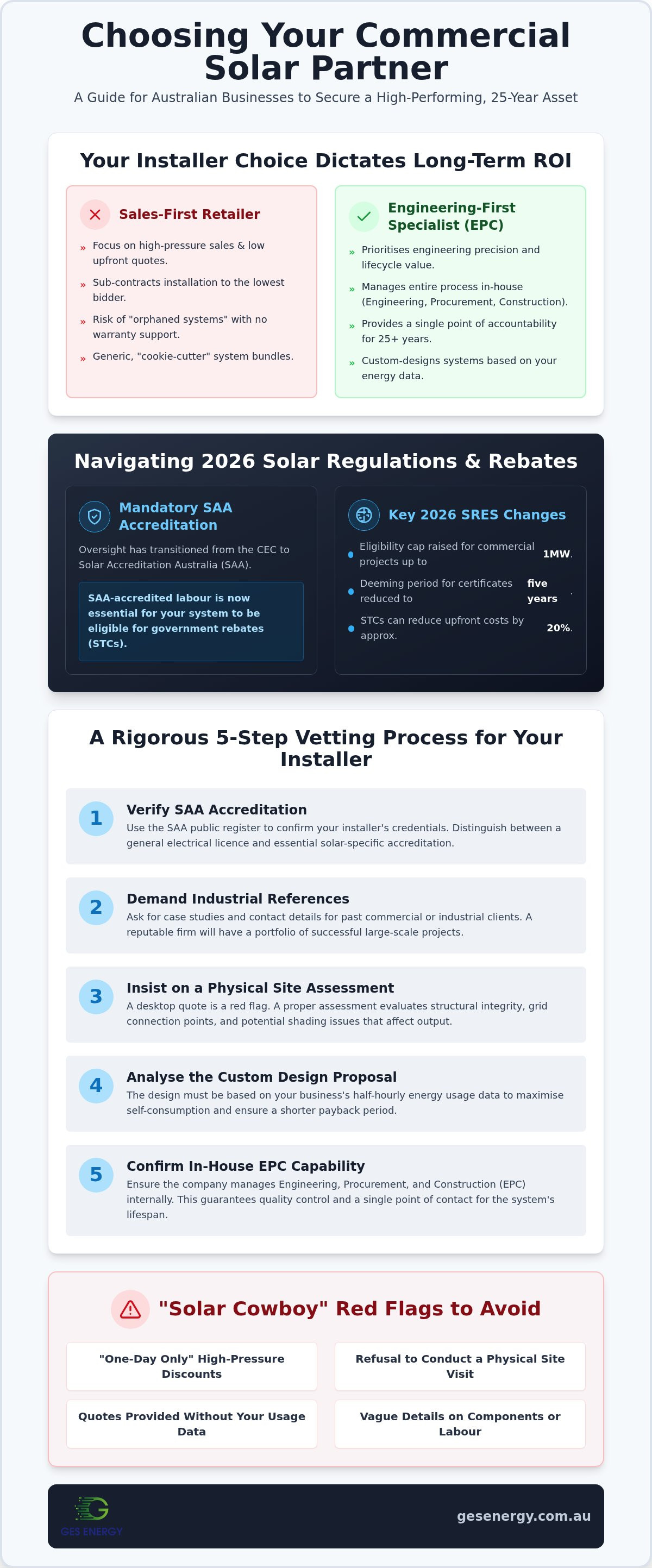
How to Vet an Australian Solar Installer: A 5-Step Process
Vetting a solar installer requires a methodical approach to ensure your capital investment is protected. While technical standards provide a baseline, your due diligence must go deeper to uncover operational reliability. Follow this five-step framework to secure your energy future:
- Verify Credentials: Cross-reference their SAA accreditation with a valid state electrical contractor licence to ensure they are legally authorised to perform the work.
- Review Portfolio: Demand case studies for industrial projects, ideally those exceeding 100kW, to prove they can manage the structural and electrical complexities of scale.
- Examine Technology: Scrutinise the proposed inverter brands; these are the most common failure points in any renewable energy system.
- Audit Maintenance SLAs: Ensure the Service Level Agreement includes clear response times for repairs and confirms who monitors the system's daily health.
- Confirm EPC Capacity: Verify the firm manages the design, procurement, and construction phases in-house to maintain total accountability for the project's success.
If you are seeking a partner who manages every detail from engineering to long-term care, explore our national solar solutions to see how we deliver certainty for Australian businesses.
Critical Questions for Your Solar Consultation
During your consultation, ask who actually performs the installation. High-volume retailers often use sub-contractors who may not have a long-term stake in your system's performance. You also need to know the exact process if a component fails in five years. A reputable solar installer will handle warranty claims directly with the manufacturer on your behalf, rather than leaving you to navigate international support lines alone. Understanding these operational details now prevents expensive headaches later.
Analysing the Solar Contract
Your contract should include clear performance guarantees and annual production estimates based on your site's specific load profile. Don't overlook the fine print on workmanship warranties; these cover the actual installation labour and are distinct from product warranties. Cheap quotes often hide savings found in inferior mounting systems or undersized cabling. These components are vital for safety and system longevity, so ensure they are specified in the final agreement. A transparent contract is the hallmark of a professional engineering firm.
Engineering the Future: GES Energy’s National Solar Solutions
GES Energy operates as a comprehensive EPC specialist, managing the full lifecycle of complex energy infrastructure. Unlike a standard solar installer, our approach integrates meticulous engineering with national procurement and construction capabilities. We specialise in large-scale projects, with the technical capacity to handle utility-scale developments up to 5 MW. This end-to-end management ensures that every component is selected for its performance in the specific environment where it will operate. Reliability is not just a goal; it is a baseline requirement for every industrial commission we undertake. This professional oversight provides the predictability businesses need when transitioning to renewable energy assets.
Specialists in Remote and Industrial Energy
Designing for the Australian outback requires more than just high-quality panels. Our engineering teams develop off-grid solar systems and portable off-grid solutions that withstand extreme heat, dust, and isolation. We act as diligent stewards of your energy assets, providing ongoing maintenance and technical support even for systems we did not originally install. This commitment to long-term health prevents the "orphaned system" problem discussed earlier in this guide. Our expertise also extends to solar inverter repairs and warranties, ensuring that your existing hardware continues to deliver a return on investment. For deeper business insights into scaling these technologies and navigating the current energy landscape, you can explore our Commercial Solar Guide.
Securing Your Energy Independence
True independence is achieved through the strategic integration of Commercial and Industrial (C&I) Energy Storage Systems. These industrial battery solutions provide 24/7 reliability, ensuring that your operations remain resilient against grid instability and rising peak-demand charges. We specialise in custom micro-grid development, creating a self-sufficient energy ecosystem that stabilises your long-term costs and provides total control over your energy supply. This structured approach mirrors the meticulous planning required for modern infrastructure and ensures that every building block of your system contributes to a larger picture of efficiency. If you are ready to future-proof your business and escape the volatility of the grid, contact GES Energy today for a comprehensive site assessment. Our team will determine the most efficient configuration for your facility, ensuring your partnership with a professional solar installer is handled with transparency and engineering precision.
Securing Your Energy Future with Engineering Precision
Transitioning to renewable energy is one of the most significant infrastructure decisions your business will make. The difference between a high-performing asset and a financial liability lies in the technical proficiency of your solar installer. By prioritising SAA-accredited engineering and an engineering-led EPC model, you ensure your system remains compliant with 2026 standards and continues to deliver maximum ROI for decades. Whether you are managing utility-scale projects up to 5 MW or require specialised off-grid expertise for remote operations, professional oversight is non-negotiable.
A resilient energy strategy provides more than just lower bills; it offers peace of mind and long-term control over your operational costs. Our team of national off-grid experts is ready to help you navigate these complexities with transparency and meticulous planning. Book a Comprehensive Solar Site Assessment with GES Energy to begin your transition with a partner committed to your system's ongoing health and performance. We look forward to helping you achieve true energy independence and building a future-ready infrastructure for your business.
Frequently Asked Questions
How do I check if a solar installer is accredited in Australia?
You can verify accreditation by searching the Solar Accreditation Australia (SAA) public register online. Every solar installer must have current SAA credentials to be eligible for federal rebates like STCs. Check that their accreditation matches your specific system type, such as grid-connect or off-grid. It is also vital to confirm they hold a valid state electrical contractor licence, as SAA accreditation alone does not legalise electrical work.
What is the difference between a solar retailer and an installer?
A solar retailer is primarily a sales and marketing entity that manages the contract and customer service. In contrast, a solar installer is the technical professional or firm that performs the actual engineering and physical mounting of the system. Many retailers sub-contract the work to third parties, which can lead to accountability issues. Choosing an EPC firm that handles both sales and installation in-house ensures a single point of responsibility.
Will my solar installer help with the government rebate application?
Yes, most professional installers manage the Small-scale Technology Certificate (STC) or Large-scale Generation Certificate (LGC) process as part of their service. They typically apply the rebate as an upfront discount on your quote. You'll need to provide proof of ownership and sign a mandate allowing them to create the certificates on your behalf. Ensure your installer is SAA-accredited, as the Clean Energy Regulator will reject applications from unaccredited providers.
What happens if my solar installer goes out of business?
If your original provider folds, you become an "orphaned" system owner. Your component warranties for panels and inverters usually remain valid with the manufacturers, but you lose your workmanship warranty. In this scenario, you should engage a specialist to manage ongoing maintenance and repairs. We provide technical support for systems installed by others, ensuring your infrastructure remains operational and safe even if the original company no longer exists.
Should I choose a national solar installer or a local one?
National installers offer greater stability, standardised engineering processes, and the capacity to manage multi-site portfolios across different states. They often have stronger relationships with manufacturers, which aids in warranty claims. While local installers provide proximity, they may lack the specialised equipment or in-house engineering depth required for 100kW+ industrial projects. A national firm with a localised service model provides the best balance of reliability and responsive on-site support.
Do solar installers also provide battery storage and EV charging?
Many specialist firms now offer integrated energy ecosystems. Beyond standard PV arrays, we provide C&I energy storage systems and EV charging stations as part of a holistic infrastructure plan. Integrating these components during the initial design phase allows for better load management and maximises your self-consumption. This approach prevents the need for expensive electrical upgrades later and ensures all your renewable assets work together to lower your total operational costs.
What qualifications should I look for in a commercial solar installer?
Look for SAA accreditation specifically for the design and installation of commercial-scale systems. You should also verify they have experience with High Voltage (HV) grid requirements and structural engineering assessments. A qualified partner will follow an EPC framework and provide a dedicated project manager. Ensure they can demonstrate a history of utility-scale projects up to 5 MW, which proves they have the technical depth to handle complex industrial energy challenges.
How often should a professional solar installer service my system?
We recommend a professional service and electrical audit at least once every twelve months. This maintenance check involves inspecting the DC isolators, checking for cable degradation, and cleaning the panels to ensure peak performance. Regular servicing is often a condition of your manufacturer warranties and is essential for fire safety. For large-scale industrial arrays, remote monitoring allows us to identify and rectify faults immediately, reducing downtime between scheduled physical inspections.


