

Solar can provide a substantial share of a healthcare facility’s electricity, with aged care systems in Australia commonly ranging from 30kW to 500kW. The right solar solutions for healthcare facilities depend on the site’s energy use, available space and operating priorities. For rural providers, the design also needs to reflect local grid access and the services that must keep running.
Cost is only one part of choosing solar solutions for healthcare facilities. Hospitals, clinics and aged care homes need to understand how solar generation matches daily demand, whether battery storage supports operational priorities, and how the system connects to existing electrical infrastructure. Rural sites may face different practical constraints from facilities in Melbourne and other larger centres.
This guide explains what shapes project scope and cost, how batteries and backup power fit into energy planning, and what influences payback. It also covers assessing solar performance, emissions reporting and rural energy needs. Use these considerations to develop a project brief around your facility’s operations and priorities.
Key Takeaways
- Learn which site conditions and energy-use patterns shape the cost of a healthcare solar project.
- Understand how battery storage and backup supply can help keep priority equipment powered during an outage.
- See which factors influence payback, including how much solar power the facility can use on site.
- Explore what healthcare solar case studies reveal about supplying hot water and supporting building energy loads.
- Find out why rural facilities need a design that accounts for grid access, essential loads and local operating conditions.
How much does solar cost for an aged care facility in Australia?
Project cost depends on site conditions, system capacity, electrical works and equipment selection. Tailored solar solutions for healthcare facilities start with energy records, operating priorities and a site assessment, rather than a standard package. Aged care solar systems in Australia commonly range from 30kW to 500kW, reflecting the different needs of smaller care homes and larger facilities.
Rooftop solar uses existing building space, while ground-mounted panels need suitable land and connection routes. Batteries store solar electricity for later use; a power purchase agreement allows a provider to supply electricity under contract. Compare available space, ownership arrangements, storage needs and contract terms to determine which approach suits the facility.
Australian solar projects must account for electrical safety, network connection requirements, and relevant building or planning approvals. Requirements vary with the project, location and system design. Include approval processes and any electrical work needed to connect the system in your cost planning.
System Capacity and Energy Production
PV capacity is a system’s rated power, while annual energy production measures its electricity generation over a year. A hospital study modelled a 400 kWp system with estimated annual production of 665,973.00 kWh/year.
The model used 1,000 panels and annual solar irradiation of 2,200 kWh/m2/year. Capacity alone cannot predict output, since placement, sunlight and system performance also matter. Comparing expected generation with facility demand helps frame the system size.
Healthcare Electricity Use and Demand
Electricity use varies between hospitals, clinics and aged care homes according to services, building size and operating patterns. Refrigeration, lighting, ventilation, hot water and medical equipment all contribute to site demand.
Demand can rise when clinical activity, resident care and heating or cooling needs overlap. Reviewing interval meter data alongside operating schedules helps estimate how much daytime solar generation the facility can use on site.
Site Assessment and Installation
A site assessment examines roof or ground space, shading, electrical infrastructure, energy records and connection options. At hospitals and clinics, designers also consider work areas, access routes and the need to maintain ongoing operations.
Installation planning maps equipment locations, cable routes, connection works and commissioning checks. Staging construction around clinical schedules can limit disruption. Rural projects also require planning for network access and equipment transport.
Safety and reliability planning should cover electrical isolation, equipment placement and maintenance access. Hospitals also need to manage construction dust, noise and movement near clinical areas, with infection-control procedures informing work staging. The design should specify which equipment receives battery backup and how staff can access operating information.
Choose an installer with relevant accreditation, such as Solar Accreditation Australia (SAA). Review design documents, commissioning records and performance monitoring arrangements. Comparing recorded generation with expected output can reveal differences that may need investigation or maintenance.
Plan costs around system capacity, site works, batteries, electrical upgrades and connection requirements. Solar solutions for healthcare facilities need to account for these project-specific factors. GES Energy provides project-based design and installation, with scope and cost determined by the project.
Solar batteries and backup power for critical operations
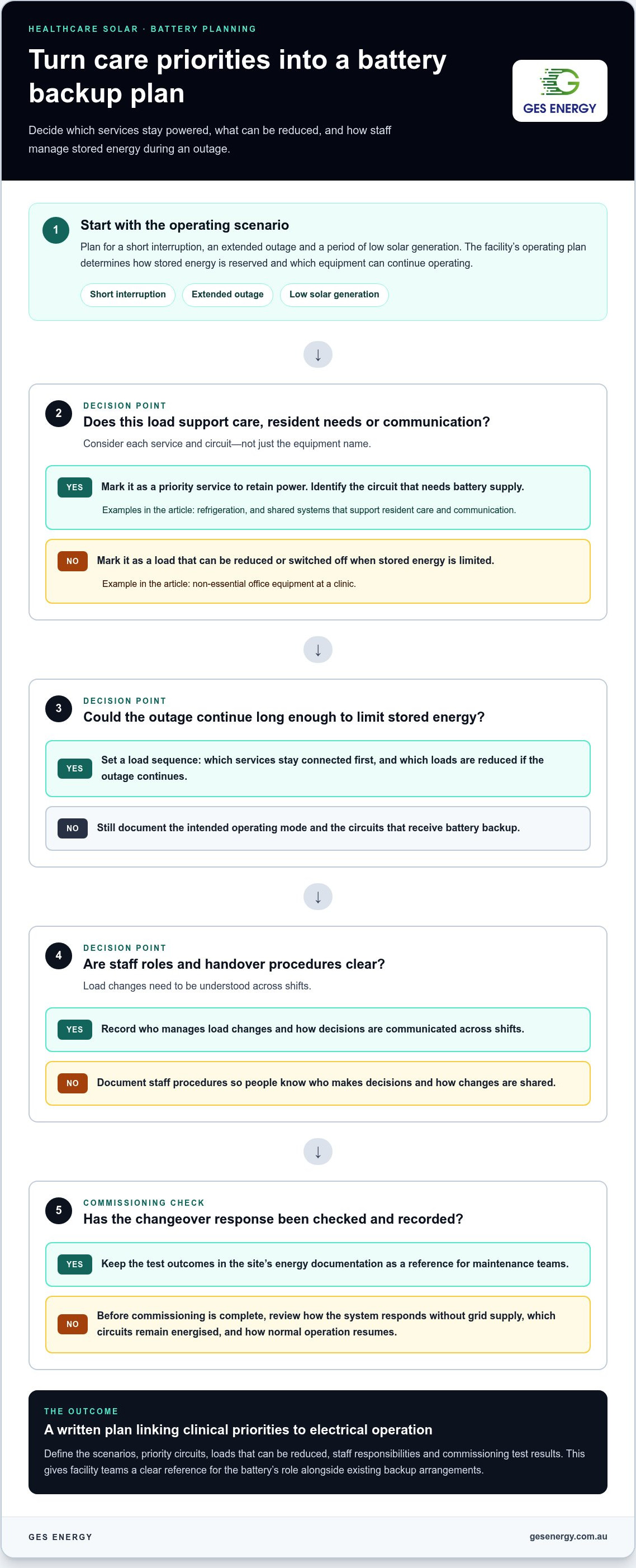
A battery stores electricity for later use, but its contribution depends on the facility’s operating plan. Healthcare teams should define what happens during a short interruption, an extended outage and a period of low solar generation. These scenarios determine how stored energy is reserved and which equipment can continue operating. A written plan also helps staff understand the battery’s role alongside existing backup arrangements.
Set priorities by service, not just by equipment name. A clinic, for example, may need refrigeration to stay powered while non-essential office equipment can be switched off. At an aged care home, staff may identify shared systems that support resident care and communication. Grouping loads this way translates clinical priorities into electrical requirements without assuming every circuit needs battery supply.
Plan how the facility will manage limited stored energy. A sequence can identify which loads stay connected first and which can be reduced if an outage continues. Staff procedures should explain who makes those decisions and how changes are communicated across shifts. This matters because a battery’s contribution depends on both system design and facility practices.
Before commissioning, document the intended operating modes and test relevant changeover arrangements. Facility representatives can review how the system responds when grid supply is unavailable, which circuits remain energised and how normal operation resumes. Record test outcomes in the site’s energy documentation. This gives maintenance teams a reference for later inspections and helps staff understand the system’s limits.
- Define scenarios: Consider interruptions, low solar generation and extended backup needs.
- Set priorities: Identify services to retain and loads that can be reduced.
- Assign roles: Document who manages load changes and informs facility staff.
- Record tests: Keep commissioning and maintenance observations with site records.
Battery maintenance planning should cover access, fault reporting and changes to facility operations. A new clinical service or equipment replacement can change which loads matter most. Review the priority list when facility use changes, and ensure updated procedures reach the staff who rely on them. Clear records help distinguish an equipment issue from a change in operating demand.
For rural facilities, include the battery plan in broader continuity procedures. Staff should understand what the system supports, what actions reduce demand and which existing backup arrangements remain relevant. A commercial solar and battery system design can account for these operating requirements alongside the facility’s electrical needs.
Solar project payback periods and return on investment
Solar payback estimates compare project costs with the value of electricity generated over time. Healthcare facilities are commonly reported to receive a return on investment within 3-5 years, but that figure is a guide, not a universal outcome. A facility’s own result depends on its electricity use, system design and the value of solar power consumed on site.
Start with the electricity the system can displace. Solar electricity used directly by a hospital or aged care facility reduces the amount it buys from the grid. Generation beyond immediate demand may be exported, with its value depending on the applicable feed-in tariff. A model that values exported electricity like on-site consumption can overstate savings.
Build the estimate around the facility’s actual operating pattern. Match expected solar generation with interval electricity data, then compare generation with daytime loads. A clinic that uses more power during sunny hours, for example, may consume more solar directly. A site with lower daytime demand may export more generation or consider storage to shift solar use.
Model the whole project, not just the panels. Include installation, electrical changes, ongoing maintenance and battery equipment. Then test how changes in energy use, export income and operating costs affect the result. A hospital’s investment case should also consider whether the system supports its energy priorities, including critical operations.
One study modelled a PV system over 25 years and estimated a 10-year payback at its assumed feed-in tariff. It also reported an 8% internal rate of return. These are model results, not a forecast for every Australian facility. The study illustrates why assumptions matter: changing the tariff or the share of generation used on site changes projected returns.
Use these measures to read a project assessment:
- Simple payback: The time taken for accumulated savings to match the initial project cost.
- Internal rate of return: A rate used to assess projected returns across the model’s timeframe.
- Net present value: The value today of projected future benefits after accounting for costs.
- Sensitivity analysis: A comparison of results under different assumptions for energy use, exports and operating costs.
Before assessing returns, compare the model’s assumptions with the healthcare facility’s actual bills and demand records. Check whether savings come from self-consumed solar, exported electricity or both. A transparent assessment links each projected benefit to a clear input, helping decision-makers compare solar with other infrastructure priorities and understand which operating conditions shape payback.
Healthcare solar case studies and emissions reductions
A useful healthcare solar case study connects system design to a defined building load. For a Victorian hospital, this could mean assessing solar PV against daytime electricity use and reporting how much generated power the site consumes. A separate solar thermal assessment would focus on hot-water demand. Keeping the applications distinct makes the project’s intended contribution clear.
Case studies from elsewhere can help facilities frame questions, but their results should not be transferred directly to Victoria. Solar generation, building use and system design vary between sites. A Victorian aged care operator can use its own energy records to identify loads that coincide with solar output, such as daytime cooling, shared-area lighting or hot-water heating.
To estimate emissions reductions, establish how much solar electricity is generated and what share is used on site. Then calculate the grid electricity displaced using an emissions factor appropriate to the location and reporting period. Keep exported electricity separate from on-site use. This makes the assumptions visible and avoids treating every unit generated as an identical emissions saving.
For a practical case study, record the project’s purpose, system design, metered generation and facility electricity use. Explain whether the analysis covers electricity alone or also includes a separate thermal system. For example, a hospital evaluating PV for daytime HVAC loads would compare generation records with the building’s electricity data for those operating periods.
Use a consistent set of details when assessing a project:
- Load assessed: Name the service, such as HVAC, hot water or clinical equipment.
- Generation measured: Record solar electricity produced and the measurement period.
- Energy used: Separate electricity consumed on site from electricity exported.
- Emissions method: Document the emissions factor and calculation period applied.
This approach gives Victorian clinics and aged care homes a relevant basis for comparing proposed systems with their own operating needs. It also avoids relying on an overseas example with different building loads or solar conditions. Facilities can use the findings to refine system design, set realistic performance expectations and explain project assumptions to boards or funding stakeholders.
Report generation and emissions as separate measures. Meter data records the electricity produced, while an emissions calculation estimates the grid impact of displaced electricity. Reviewing both helps facilities understand system performance and the basis for reported reductions. Clear records also make it easier to compare future system changes with the original project assessment.
Solar-powered rural healthcare facilities
Rural healthcare facilities may face limited grid access, long service travel and site constraints unlike those of metropolitan hospitals. Start solar planning with the services that must continue during interruptions. A regional clinic, for example, may prioritise medicine refrigeration, communications, lighting and essential clinical equipment. Mapping these loads helps shape generation, storage and backup around real operating needs.
Where a site has a reliable grid connection, solar can reduce electricity drawn during daylight hours. Where connection capacity is constrained, the design must account for supply limits and demand peaks. A remote clinic without practical grid access needs a different approach, with sufficient generation, storage and backup supply for periods without sunlight.
Rural systems should reflect local conditions. Assess roof or ground space, shading, access for installation vehicles, and the distance between panels, batteries and facility switchboards. A ground-mounted array may suit a site with suitable land, while rooftop panels may work better for a clinic with limited surrounding space. Cable routes and equipment locations also shape the design.
Plan operations before selecting equipment. Facility managers can document loads, operating hours and the consequences of losing each service. This helps distinguish essential systems from equipment that can pause or run at another time. The design should show which circuits receive backup power and how staff can identify system status during an outage.
- Clinical continuity: List priority loads, such as refrigeration, communications and treatment-room lighting.
- Site access: Record panel locations, equipment access and routes for maintenance visits.
- Supply arrangement: Map the existing grid connection, switchboards and backup sources.
- Operating plan: Document how staff respond when generation or stored energy is limited.
Maintenance planning is especially important when a technician must travel to a remote site. Keep equipment locations, system documentation, inspection tasks and fault-response procedures in an accessible operations plan. Clear records help facility staff describe faults and support maintenance without relying on one person’s memory. Seasonal access and local weather conditions can also affect inspection scheduling.
For a rural health service, the key takeaway is to design around continuity first, then match solar generation and storage to the site’s available supply and operating profile. Map your rural facility’s energy requirements to support a clear system design brief.
GES ENERGY: Commercial and Industrial Solar
GES ENERGY designs and installs Commercial and Industrial Solar for healthcare facilities planning around electricity use, site conditions and operational priorities. For hospitals, clinics and aged care operators, a project can bring solar generation into the facility’s wider energy plan, including consideration of storage and backup requirements.
Rural sites with limited grid access can explore off-grid solar systems to support local energy needs. Begin with a clear project brief covering site layout, energy use and priority operations. This gives the design process practical requirements and helps align the proposed system with how the facility operates.
Contact GES ENERGY to discuss your facility’s solar requirements, or visit gesenergy.com.au.
Turn your energy priorities into a project brief
The next step is to turn operational priorities into a clear planning brief. Bring together the facility’s energy records, critical-load requirements, site constraints and future plans. Include potential changes to clinical spaces or fleet charging so the proposed system reflects how the organisation expects to operate.
GES Energy provides commercial and industrial solar for healthcare sites, off-grid solar systems for facilities with limited grid access, and EV charging stations for organisations planning vehicle charging. These services can support a discussion about how solar fits the facility’s needs. A clear brief gives the design process a practical starting point while keeping energy resilience and day-to-day operations in view.
For aged care and rural healthcare operators, well-planned solar solutions for healthcare facilities can support a more considered approach to energy infrastructure. Discuss solar with GES ENERGY and take the next step towards defining your project requirements.
Frequently Asked Questions
Can solar panels provide reliable power for medical equipment?
Solar can power medical equipment when the system is designed for the facility’s electrical loads. For continuity during a grid outage, the design also needs suitable backup arrangements, such as battery storage or another supply. Identify equipment that cannot lose power, including a medicine refrigerator or communications system, and specify how it receives electricity. Solar generation varies with sunlight, so panels alone cannot provide uninterrupted supply.
Do aged care homes benefit more from solar with battery backup?
Battery backup can add value when an aged care home needs stored solar electricity after daylight hours or during an outage. Its value depends on which circuits need backup and how the home uses electricity. A facility, for example, may prioritise refrigeration and selected care equipment rather than backing up every building load. Compare the added battery cost with its expected operational and electricity-bill benefits.
How long does it take to install solar for healthcare providers?
Healthcare solar projects typically take around 6-10 weeks, including design, site assessment and installation. The programme can involve engineering, equipment procurement, electrical connection planning and commissioning. A hospital may also need installation staging that protects access to clinical areas and coordinates work with facility operations. Rural locations can add logistical considerations, such as equipment transport and site access, which should be reflected in project planning.
How quickly can facilities see ROI from solar energy?
Healthcare facilities commonly receive a return on investment within 3-5 years, while a separate study modelled a 10-year payback using its assumed feed-in tariff. These figures reflect different project assumptions, not a single outcome for every site. For a useful estimate, compare installation and operating costs with on-site electricity savings and export income. A battery should have its own assessment of added costs and benefits.
What rebates are available for healthcare and aged care solar projects?
Potential support depends on the system, site and current programme criteria. Australia’s Small-scale Renewable Energy Scheme provides STCs for eligible small solar, wind, hydro and battery installations, but this does not establish eligibility for a commercial healthcare project. Treat any incentive as a separate part of financial modelling. Confirm the project’s eligibility and applicable terms before including an incentive in its return estimate.
What solar systems are suitable for Australian hospitals, clinics and aged-care facilities?
Suitable options include grid-connected solar PV, solar paired with batteries, and off-grid systems for sites without practical grid access. A hospital with broad daytime demand may prioritise on-site solar use, while a rural clinic may need storage and backup planning. Choose a system based on the facility’s load profile, available roof or land area, connection capacity and priority operations, rather than building type alone.
How much does commercial solar cost for healthcare facilities in Australia?
There is no single cost for every healthcare site. Project scope depends on system capacity, usable roof or ground space, electrical infrastructure, grid connection requirements and whether battery storage is included. Hospital projects may also require installation staging around clinical operations. A cost assessment should separate these components and explain which site conditions or equipment choices shape the proposed budget.
What are typical solar panel and battery payback periods for Australian healthcare facilities?
Aged care solar systems in Australia are typically reported to have a 3-6 years payback period. That figure applies to solar projects generally, not necessarily a battery’s additional cost. Assess battery payback separately by comparing its cost with the value of stored electricity used later, alongside any operational value from backup. The result depends on the facility’s load pattern, battery use and energy tariff assumptions.


