

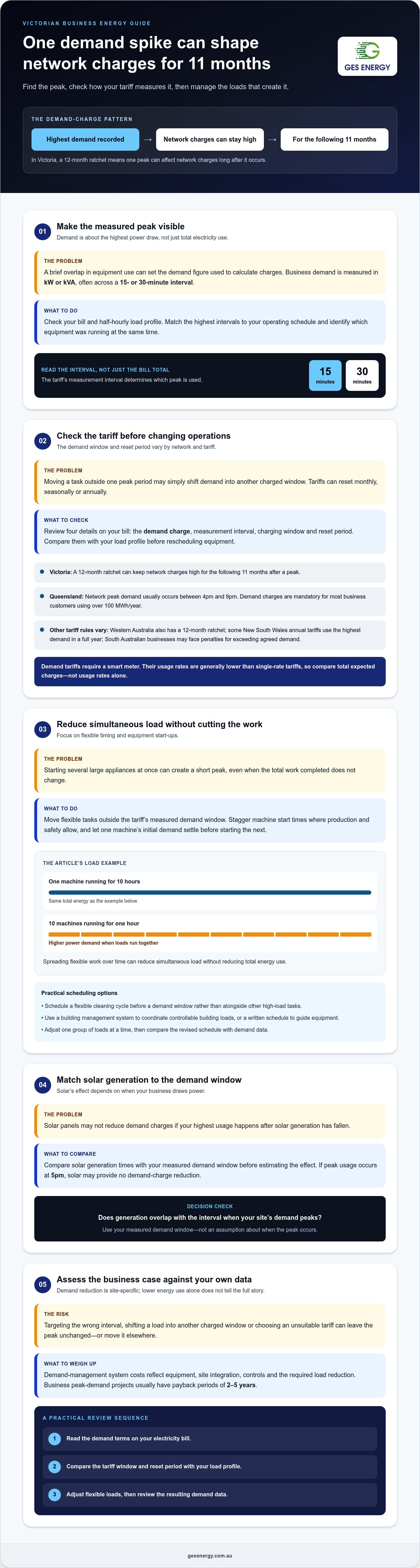
A single demand spike can shape your network charges long after it happens. In Victoria, one peak can keep network charges high for the following 11 months, so understanding how to reduce peak demand charges for a business starts with finding when your highest demand occurs. Business demand is measured in kW or kVA, and charges are typically based on the highest 15-minute average demand during a billing cycle.
It’s frustrating when a brief overlap in equipment use leaves a lasting mark on your bill. The practical response is to identify the peak, then reduce or shift the loads that create it, rather than cutting energy use across the board.
This guide explains how to find demand charges and peak periods on a business electricity bill, then outlines five ways to manage them: shifting appliance use, setting timers, upgrading equipment, and considering battery storage for peak lopping. You’ll also learn why battery storage is most useful when its operation is matched to your site’s demand pattern.
Key Takeaways
- Identify whether your tariff includes a demand charge, then compare its charging periods and reset method before considering a tariff change.
- Use your electricity bill and load profile to pinpoint when demand peaks and which equipment is running at the same time.
- Shift flexible tasks outside peak periods and stagger equipment start-ups to reduce simultaneous load without necessarily reducing total energy use.
- Timers and variable-speed equipment can help manage when machinery runs and how much power it draws.
- Assess battery storage for peak lopping against your site’s demand pattern; in Victoria, a single peak can keep network charges high for the following 11 months.
1. How Can Businesses Reduce Peak Demand Charges?
Start by checking whether your Victorian business tariff includes a demand charge. Demand tariffs add a demand or capacity charge to electricity supply and usage charges. The charge is calculated using your highest power demand, as well as total energy consumption. Demand is measured in kilowatts (kW) or kilovolt-amperes (kVA), often across a 15- or 30-minute interval. To work out how to reduce peak demand charges for your business, first identify how your tariff measures demand.
The network tariff and its reset period affect when a peak matters. In Victoria, a 12-month ratchet means a single peak can keep network charges high for the following 11 months. Western Australia also has a 12-month ratchet. In New South Wales, some annual demand tariffs use the highest recorded demand within a full year. Tariff rules vary between electricity networks, so compare your local tariff terms before choosing a demand-reduction approach.
Queensland businesses face different conditions: network peak demand usually occurs between 4pm and 9pm. Demand charges are mandatory for most Queensland business customers using over 100 MWh/year. South Australian businesses may have agreed demand, with penalties for exceeding nominated capacity. These differences make your site’s network, tariff terms and load profile important when comparing options.
To assess a tariff, review the demand charge, measurement interval, charging window and reset period on your bill. Compare these terms with your half-hourly load profile to see when demand rises. Demand tariffs require a smart meter. Their usage rates are generally lower than single-rate tariffs, so compare total expected charges, not usage rates alone.
Opting out may not be solely your choice: the distributor typically decides whether a customer is placed on a demand tariff. A business may be able to opt in or request one, while availability depends on the retailer and network. Consumption on an economy tariff doesn’t count towards demand charges, but check with your retailer whether that tariff is available for your premises.
Demand-management system costs reflect the equipment, site integration, controls and required load reduction. Business peak-demand projects usually have payback periods of 2–5 years. Use your own demand pattern and tariff terms to assess the business case, rather than relying only on lower energy consumption.
Solar panels can reduce grid demand when they generate during your site’s peak. If peak usage occurs at 5 PM, solar may provide no demand-charge reduction. Compare solar generation times with your measured demand window before estimating its effect on charges.
Australian distributors set demand windows and billing periods according to their network tariffs. Demand may be measured over 15 or 30 minutes, with charges reset monthly, seasonally or annually. Check the tariff’s stated interval and reset period: these determine which peak is used to calculate your bill.
Key risks include targeting the wrong interval, shifting a load into another charged window or choosing a tariff whose demand rules don’t suit your operating pattern. A short spike can affect a longer billing period, particularly under a ratchet. Review the tariff and load profile together before changing equipment schedules or selecting another plan.
2. Shifting appliance use outside peak demand periods
Load shifting means moving flexible electricity use away from the period when your tariff measures demand. Start with your business load profile, which commonly records consumption in half-hour intervals. Match the highest intervals to your operating schedule, then note which appliances or processes were running at the same time. This turns a broad energy-saving goal into a practical timetable for your site.
Choose loads that can move without disrupting production, service or safety. For example, schedule a flexible cleaning cycle before a demand window instead of running it alongside other high-load tasks. A building management system can coordinate controllable building loads, while a written schedule can guide equipment without automated controls.
Stagger equipment start times instead of switching on several large appliances at once. If production permits, start one machine, allow its initial demand to settle, then start the next. This reduces the chance that simultaneous start-ups create a short peak. The same approach can apply to pumps, compressors and process equipment when operating requirements allow separate start times.
Moving use to an off-peak period can lower demand during the tariff’s measured window, but the timing must match your actual tariff. Some business tariffs charge for demand during both peak and off-peak periods. Compare the tariff’s demand window with your load profile before moving a task, so the new schedule doesn’t simply shift the peak elsewhere.
Keep total energy consumption separate from maximum demand when planning changes. Running one machine for 10 hours uses the same total energy as running 10 machines for one hour, but the second pattern creates higher power demand. The example shows why spreading flexible work across time can reduce simultaneous load without reducing the amount of work completed.
Build a schedule around the full billing period, not one unusually quiet day. Record when key equipment runs, compare those times with half-hourly demand data, then adjust one group of loads at a time. This helps show whether the revised schedule changed the peak, rather than attributing the result to several simultaneous operational changes.
Review the revised schedule against operating needs and demand data. A building management system can control selected loads, while staff procedures can cover equipment that needs manual operation. Keep essential processes within their required operating times and shift only flexible tasks. This creates a repeatable load-shifting plan instead of relying on staff to react after demand rises.
After each billing period, compare the highest demand intervals with the previous schedule. If the peak moves to another time, identify the equipment operating in that interval and revise its start time. Review the schedule again after production changes or seasonal shifts, because a plan that spreads loads effectively under one operating pattern may not suit another.
3. How do I find the demand charge on my bill?
Start with the bill’s charge breakdown, not just its total. Look for a line labelled demand, maximum demand, capacity or network demand. Wording varies between retailers and tariffs. Check the unit beside the rate: demand is measured in kilowatts (kW) or kilovolt-amperes (kVA), while energy use is measured in kilowatt-hours (kWh). These units describe different things.
Next, compare the demand charge with supply and usage charges. A demand tariff adds a demand or capacity charge to other electricity costs. The demand component reflects your highest power demand under the tariff’s calculation method, while usage charges relate to total energy consumption. A short spike can therefore matter even if the site’s overall electricity use seems modest.
Use these bill details to identify how the charge was calculated:
- Charge name: Find the demand-related line and note whether it says maximum, peak, capacity or network demand.
- Unit and rate: Distinguish kW or kVA from kWh, then note the stated rate and billed quantity.
- Measurement period: Find whether the tariff uses a 15- or 30-minute demand interval.
- Billing period: Check the dates covered and whether the charge resets monthly, seasonally or annually.
Then locate the maximum-demand figure and its recorded date or time, if shown. Compare that interval with site operations. For example, a refrigeration system, production machine and air-conditioning plant starting together could explain a sudden rise. Treat the bill as a clue, then use interval data to see which loads were active.
A business load profile typically shows electricity demand in half-hour intervals. Compare those readings with the bill’s maximum-demand figure and your operating timetable. Look for recurring patterns, such as morning start-up or overlapping equipment cycles. An energy audit can also identify peak periods and inefficiencies across your site’s electricity use.
Separate the peak-demand record from total energy use when reviewing your bill. A high kWh total indicates substantial consumption over time; a high kW or kVA reading points to a concentrated power peak. Check whether the charge applies to peak periods, off-peak periods or both, because some business tariffs charge demand in each period.
Keep bills and load profiles for each billing period together. Note the maximum figure, unit, date, time and tariff wording. This creates a practical baseline for tracking changes after you adjust equipment schedules. If the bill shows a charge without enough detail to identify its measurement interval, use the tariff terms and available metering data to interpret it.
4. Using timers and variable-speed equipment
Timers can control when compatible equipment starts, runs or switches off. Use your demand data to identify intervals when several loads overlap, then schedule flexible appliances at different times. For example, a timer can delay a non-urgent water-heating cycle until another large load has finished.
Stagger start-ups rather than switching on several high-demand machines together. Motors and compressors can draw substantial power during start-up, so simultaneous starts may create a sharp demand peak. Set different start times where the operating process allows, then compare the resulting load pattern with your meter data.
Timers work best when settings reflect actual operations. Create a schedule for each controllable load, including its normal operating hours and periods when it can safely pause. Check that the programmed cycle won’t interrupt production, refrigeration or other essential processes. A timer should manage the schedule, not override required equipment controls.
Variable-speed equipment adjusts motor speed to match the task’s demand instead of running continuously at one speed. A variable-speed drive on a suitable pump or fan can adjust output as flow or ventilation needs change. Assess the equipment’s operating profile first, because the benefit depends on how the motor is used and the load it serves.
Energy-efficient equipment can reduce electricity consumption, but lower consumption doesn’t automatically lower the highest demand reading. The timing and overlap of loads still matter. Compare the equipment’s operating pattern and power draw with the tariff’s measurement interval, then assess both energy costs and peak-demand effects.
Consider a production floor with several machines scheduled for the same start time. Moving one start time and using a timer for another can spread demand across the interval. Running one machine for 10 hours uses the same total energy as running 10 machines for one hour, but the latter creates higher power demand.
Use this practical sequence to test a change:
- Identify the equipment operating during the site’s highest demand interval.
- Separate flexible loads from processes with mandatory operating sequences.
- Set timers or start times to avoid unnecessary overlap.
- Compare the next available demand readings with the original operating pattern.
Make changes to one group of loads at a time. If several schedules change together, it becomes harder to identify which adjustment affected demand. Record each timer setting and start time, then review the readings after the change. This gives you a repeatable way to refine equipment schedules without disrupting essential operations.
5. Battery storage and peak lopping
Battery storage can reduce the electricity drawn from the network during a demand peak. This strategy, called peak lopping, uses stored energy to supplement grid supply when site demand rises. The battery may charge during lower-demand periods or from available solar generation, then discharge as the site approaches its selected demand limit.
The control system needs to respond to the way your tariff measures demand. If a charge uses a 15- or 30-minute interval, a brief discharge may not lower the measured average enough. Battery output must continue across the relevant interval and match the site’s changing load. The measured demand profile helps show when discharge should begin.
Battery sizing involves two different measures. Power, in kW, indicates how much electricity the battery can supply at once. Energy capacity, in kWh, indicates how much electricity it can store. The system needs adequate power for the site’s peak and enough stored energy to cover its duration.
Set a maximum grid power limit that reflects the business’s demand target. For example, 100 kW is one example of a maximum grid power limit for battery peak lopping. A control system can discharge when grid demand approaches that limit. The site’s actual load, tariff calculation and operating schedule determine whether that approach suits its demand pattern.
Before selecting storage, compare these factors:
- Peak profile: Identify the time, duration and size of the site’s highest demand.
- Battery power: Match discharge output to the reduction needed at the grid connection.
- Stored energy: Check whether the available capacity can support discharge across the measured interval.
- Charging window: Schedule charging to avoid creating another peak under the applicable tariff.
Solar generation can charge a battery when output and site conditions align. However, solar alone may not address a late-day peak. Battery dispatch can shift stored energy to that period, while the control strategy must account for charging demand and the battery’s available state of charge.
Assess the business case using demand data, tariff charges, battery operation and project costs. Payback periods for business peak-demand projects are usually 2–5 years. That timeframe is not a universal battery payback: the calculation depends on measured peaks, tariff structure, system design and how often storage can discharge effectively.
Review battery performance against meter readings after commissioning. Compare the maximum grid demand with the original profile, and note whether charging created a new peak. For a site assessing commercial and industrial energy storage, this measured comparison can guide system design and operating controls.
GES ENERGY: Commercial and Industrial Solar
GES ENERGY can help Melbourne businesses assess whether commercial solar or battery storage fits their demand profile. This is a practical next step when interval data shows recurring peaks that scheduling changes alone may not address. Commercial and Industrial Solar can support on-site generation, while C&I Energy Storage Systems can store electricity for later use. Their value depends on how generation, storage and site demand align with the tariff’s measured periods.
Bring your electricity bills and load profile to the planning discussion. These records help connect system design with your site’s operating patterns, peak intervals and energy needs. Solar and storage aren’t a substitute for understanding the tariff, but a well-matched system can form part of a broader demand-management approach.
Contact GES ENERGY to discuss commercial solar and storage for your business.
Turn demand data into an operating plan
Make demand management part of routine energy planning, not a one-off bill review. Assign responsibility for reviewing interval data, recording operational changes and checking whether new equipment affects the site’s load profile. This gives your team a practical basis for deciding how to reduce peak demand charges for your business as operating needs change.
Where you’re considering equipment changes or on-site generation, GES ENERGY offers Commercial and Industrial Solar, Off Grid Solar Systems and EV Charging Stations. These offerings can support a broader energy project alongside your demand-management approach. Connect the project scope with your site’s energy needs and operating requirements to identify the right next step.
For a discussion about your business’s energy project, contact GES ENERGY about demand charges. A considered plan can help your team make informed decisions and keep energy use aligned with the way your business operates.
Frequently Asked Questions
How Can Businesses Reduce Peak Demand Charges?
Prioritise changes that reduce coincident loads without disrupting essential work. For example, a warehouse can assess whether charging equipment, ventilation and refrigeration can run on separate schedules. Rank possible adjustments by operational impact and the demand they could remove, then trial the least disruptive change first. This makes energy management a practical operating decision rather than a blanket cut to electricity use.
Can I just switch to a different electricity plan?
Not necessarily. A distributor may determine which tariff applies to your premises, and alternatives depend on the network and retailer. Before pursuing a switch, compare the plan’s full charging structure with your business’s operating calendar, including seasonal production changes and quieter periods. A tariff that suits one operating pattern may not suit a site with different shifts or production cycles.
How do I find the demand charge on my bill?
Use the bill’s charge breakdown and tariff information together, then compare the billed period with your business records. For example, match the invoice dates with production logs, opening hours or a maintenance shutdown. This can help explain unusual billing changes and distinguish operational causes from changes in tariff conditions. Keep the relevant bills and records together so future reviews use the same period and context.
What is a demand tariff?
A demand tariff is an electricity pricing arrangement that includes a charge linked to a business’s power demand. It makes the timing and concentration of electricity use relevant to the bill, not just total consumption. This structure may suit a site with consistent operations differently from one with occasional intensive production. Assess the tariff against your business model, including planned growth, seasonal work and the timing of major processes.
Will my bill increase on a demand pricing plan?
It may, if your site’s operating pattern creates a costly demand peak that outweighs any benefit from the plan’s other charges. Use bills from representative operating periods, including busy and quieter seasons, to compare likely outcomes. A single low-activity period can give a misleading picture for a business with seasonal production. Review the full bill impact before changing plans, rather than judging by one charge or rate.
How are business peak demand charges calculated in Australia?
The tariff applies its demand rate to the billable demand quantity under its stated calculation method. Broadly, higher billable demand means a higher demand component when the rate is unchanged. The tariff may also distinguish between demand periods or apply different reset rules. Read the rate and billed quantity together, and check whether the unit is kW or kVA before comparing bills.
What demand charge rates do Australian business electricity tariffs use?
There is no single rate across Australian business tariffs. Rates vary by tariff, network and demand unit. Compare the rate on your offer with its billed unit and charging period. Also consider whether separate demand rates apply at different times, as this can change which operating periods matter financially.
How can businesses identify peak demand periods from smart meter data?
Compare meter readings with operating records showing what was running at each time. Tag production shifts, cleaning cycles, deliveries and equipment maintenance, then look for repeated overlaps on high-demand days. Separate normal operating patterns from unusual events, such as a one-off production run. This makes the data more useful for choosing operational changes and avoids redesigning schedules around an event that is unlikely to recur.


