A delayed shipment can hold up a solar project even when the installation plan is ready. Managing solar project supply chain risks means mapping suppliers and transport routes, qualifying critical components from at least two geographic regions, and preparing contingency plans. These measures help limit disruption from shipping delays, trade restrictions and manufacturing bottlenecks.
It’s easy to focus on the panels, but a project depends on a wider chain that includes inverters, mounting structures and balance-of-system components. Every stage, from sourcing and transport to storage and installation, can affect quality, timing and project costs.
This article explains how to identify supply chain vulnerabilities, diversify suppliers and maintain consistent quality across regions. It also covers responses to geopolitical instability and trade changes, and why clear procurement and logistics planning matters for Australian solar projects.
Key Takeaways
- Map supplier locations, transport routes and potential chokepoints to identify where disruptions could affect delivery.
- Qualify alternative suppliers in different geographic regions for critical components to reduce dependence on a single source.
- Set consistent quality checks and clear contract terms so component standards, warranties and performance expectations are understood.
- Prepare contingency plans for shipping delays, trade restrictions and manufacturing bottlenecks before they disrupt project schedules.
- The Australian Government’s Future Made in Australia plan was valued at A$22.7 billion, placing domestic manufacturing in the broader supply-chain context.
How do you manage supply chain risk in renewable energy?
For Australian solar projects, key risks include concentrated international manufacturing, shipping delays, trade restrictions, raw-material shortages, currency fluctuations and production bottlenecks. Panels, inverters, batteries, mounting structures and grid equipment are exposed when sourcing, transport or manufacturing relies on a limited number of suppliers or routes.
Solar Builder’s video, “Power Forward: Solar supply chain overview and outlook for 2022”, discusses equipment disruption, supplier communication and project timelines.
Manufacturing concentration across solar components
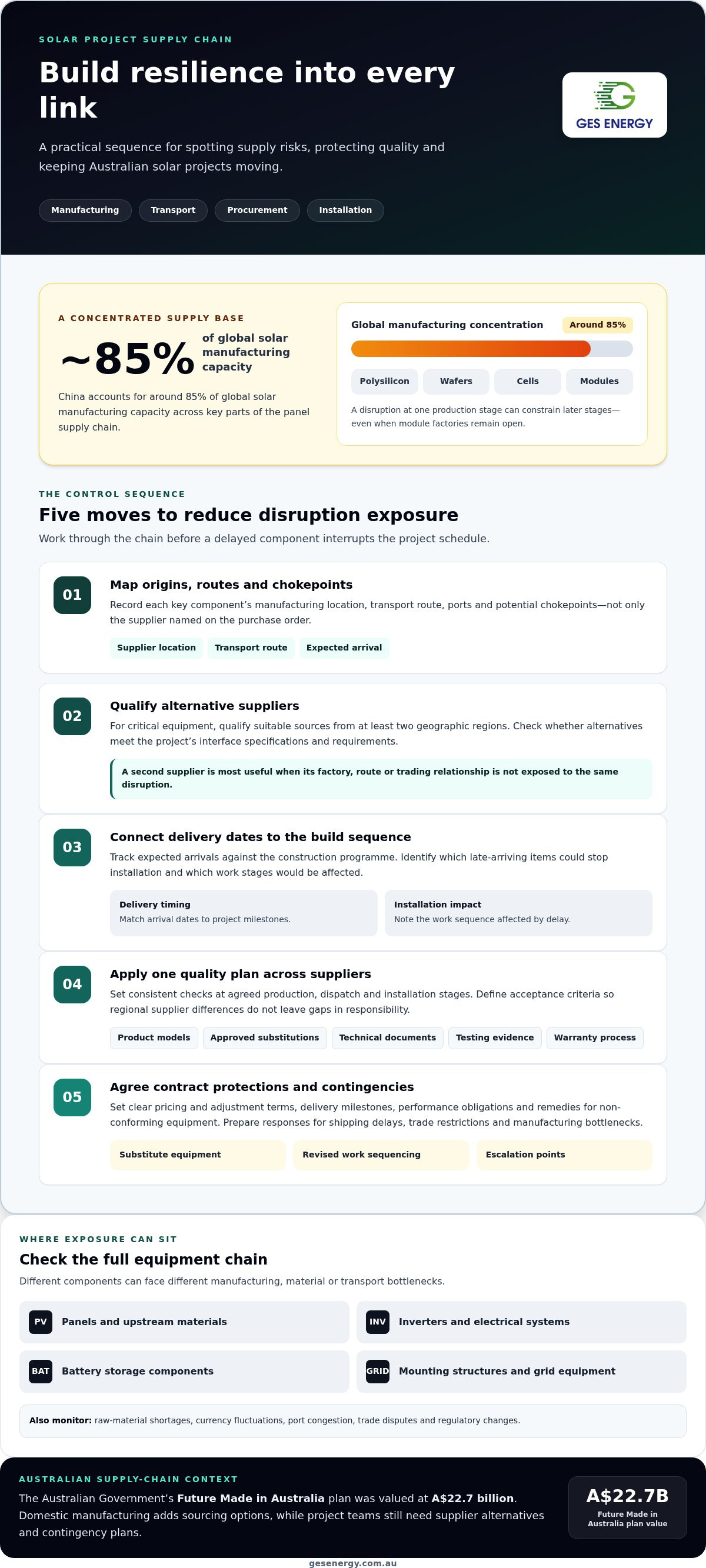
Manufacturing concentration means that multiple production stages depend on a small number of countries or industrial hubs. China accounts for around 85% of global solar manufacturing capacity, spanning key parts of the panel supply chain. Polysilicon is refined into wafers, which become cells and then modules. If a disruption affects one stage, later stages can face production constraints and delivery delays.
This concentration matters because a panel order depends on more than module assembly. Shortages of upstream materials can constrain production even when module factories remain open. Mapping where polysilicon, wafers, cells and finished modules originate helps reveal shared dependencies among suppliers that may appear separate.
International sourcing dependencies
International sourcing means procuring project equipment through manufacturers and transport networks operating across borders. Solar components can travel thousands of miles and pass through multiple jurisdictions before reaching an Australian project. Port congestion, trade disputes and regulatory changes along the way can affect delivery schedules.
Large projects also depend on imported inverters, electrical systems, mounting structures, battery storage components and grid equipment. A delay to one critical item can disrupt installation sequencing, even if other equipment has arrived. Track each key component’s origin, route and expected arrival, then align delivery dates with the construction programme.
Supplier and regional diversification
Supplier diversification means qualifying multiple suitable sources for critical equipment, ideally in different geographic regions. This gives project teams alternatives if a factory, transport route or trading relationship is disrupted. A supplier map should show manufacturing locations, ports, routes and potential chokepoints, not just the company named on a purchase order.
Regional manufacturing can broaden sourcing options, although local capacity does not remove every upstream dependency. Australia’s Future Made in Australia plan was valued at A$22.7 billion, according to the Australian Government. In the United States, the Inflation Reduction Act was a US$370 billion bill that subsidised solar-component manufacturing and generation. Its manufacturing credits included US$3 per kilogram for polysilicon, US$12 per square metre for wafers, and credits per watt for cells and modules. These incentives support manufacturing, but project procurement still needs alternatives and contingency plans.
Shortage and delay exposure
Exposure varies by component and sourcing route, so risks do not affect every brand or technology in the same way. Solar panels may be constrained by upstream polysilicon, wafer or cell supply. Inverters, batteries, mounting structures and grid equipment can face separate manufacturing or transport bottlenecks. The specific risk depends on factory location, shipping route and the availability of compatible alternatives.
For each project, identify which late-arriving components could stop installation. Record the supplier’s location, delivery route, required interface specifications and the installation sequence affected by a delay. A contingency plan can then define substitute equipment, revised work sequencing and escalation points. This makes managing solar project supply chain risks a practical part of procurement and scheduling, not just a matter of monitoring shipment updates.
How do you ensure quality control when managing multiple suppliers across different regions?
Apply one quality plan across suppliers, then verify components at agreed production, dispatch and installation stages. Manage foreign exchange and commodity exposure through clear contract pricing and adjustment terms. Fixed-price agreements alone may not protect a project from supplier failure, force majeure, volatility, delayed deliveries or disputes.
Contractual quality and performance protections
A quality contract defines the components, acceptance criteria, warranty process and performance obligations each supplier must meet. Clear terms matter because a panel, inverter or battery can arrive on time yet still fail to meet project requirements.
Specify product models, approved substitutions, technical documents, testing evidence and delivery milestones in the purchase agreement. Set out how to report, isolate and replace non-conforming equipment, and who pays for corrective work. Link any performance guarantee to measurable criteria, a defined testing method and a remedy if results fall short. Keep these provisions consistent across suppliers so regional differences do not create gaps in responsibility.
For currency and commodity risks, identify which contract price elements can change and what triggers an adjustment. State the currency, pricing basis, review process and treatment of changes before placing orders. Record how both parties will handle disputed adjustments, supplier insolvency and force majeure. These clauses will not remove market exposure, but they clarify financial responsibilities and escalation processes.
Supplier quality assurance
Supplier quality assurance is a repeatable process for checking factories, batches and delivered components against consistent requirements. Applying the same controls matters because differing inspection practices can otherwise hide defects between regions.
Conduct regular supplier audits and independent inspections. Apply a standard inspection protocol to every supplier, rather than accepting different evidence from each factory. For photovoltaic modules, pre-shipment checks can use AQL ISO 2859. Independent factory and traceability audits can also examine component origin and ethical sourcing records. Keep batch identifiers, inspection findings and corrective actions together, so the project team can trace a problem to its source.
At the site, coordinate construction teams around delivery sequences and inspection hold points. Check packaging and visible damage before equipment moves into storage or installation. Keep items that fail inspection separate from accepted stock, and record the decision before use. Align installation methods and safety controls with the project’s approved processes and applicable industry safety standards. Include environmental and handling requirements in supplier documentation, then verify them during receipt and storage.
Close each quality issue with a documented decision: accept, repair, replace or reject. Record who approved the outcome and update the inspection trail before affected equipment enters the next construction stage. This gives procurement, site supervisors and commissioning teams a shared record of component status, preventing unresolved defects from moving unnoticed through the project.
Shipping delays, geopolitical instability and trade restrictions
For Australian projects, shipping delays and political events can disrupt equipment supply, change delivery costs or affect installation schedules. Import compliance depends on the equipment and its intended use, so assess documentation, product conformity and safety requirements before dispatch. Coordinate grid connection requirements with the relevant network operator.
Shipping and geopolitical disruptions
Shipping and geopolitical disruptions affect a component’s route, production or timely arrival. They matter because a late inverter or battery can hold up installation even when the rest of the equipment is ready.
Map each critical shipment from its manufacturing origin through ports and onward transport to the site. Record expected handover points and identify alternative routes where practical. Transit insurance can cover components against damage, theft or loss, while delay-in-start-up insurance can compensate for lost revenue when disruption delays commissioning. Political risk insurance can cover specified government actions, including trade restrictions or currency controls.
Build schedule contingencies around critical equipment, not just the overall shipment. If a delivery moves, assess whether crews can complete other installation work without creating rework or unsafe site conditions. The 2021-2022 global supply chain disruptions saw solar module prices rise by more than 20% in some markets, illustrating how disruption can affect procurement as well as timing.
Trade restrictions and tariffs
Trade restrictions and tariffs are government measures that affect the movement or cost of imported goods. They matter to solar developers because changing trade conditions can alter supplier options, production plans and shipment routes.
Three of the four largest solar-panel markets outside China, the United States, India and Brazil, had placed tariffs on imports of Chinese panels. These measures do not automatically apply to Australian imports, but they can reshape global supply and competition for production capacity. Uncertainty around US solar trade regulations contributed to a decline in US solar installations in 2022.
Include trade scenarios in procurement risk management. Track supplier notices and relevant trade policy changes, then assess whether a restriction affects equipment origin, route or delivery plans. Do not assume a fixed-price agreement covers every event: supplier insolvency, force majeure, commodity price volatility, late delivery and contract disputes can still affect projects.
Trade and equipment compliance
Trade and equipment compliance means meeting the import, product and connection requirements relevant to a specific project. It matters because non-compliant equipment or missing documents can delay delivery, acceptance or connection.
Before committing to an order, document the product model, manufacturer, country of origin, shipping documents and evidence of product conformity. Match the equipment specification to the project design and intended Australian installation. For grid-connected systems, include network-specific technical requirements in design and procurement reviews, and coordinate connection testing and documentation with the relevant network operator.
Keep compliance records linked to each equipment batch, including test reports, certifications and inspection results. If a proposed substitute changes the model or configuration, review its conformity and grid interface before accepting it. These controls help developers respond to trade and shipping changes without losing track of safety, production schedules or installation readiness.
Solar component procurement and supplier diversification
Effective procurement compares suppliers on delivery capacity, technical quality and supply chain exposure, not just quoted terms. For Australian developers, a structured assessment can help protect project schedules while maintaining consistent component standards.
Factory audits
A factory audit assesses a manufacturer’s processes, production controls and traceability records. It matters because a supplier’s assurances alone may not show how consistently components meet project requirements.
Include independent factory and traceability audits in solar equipment supply agreements. For photovoltaic modules, VDE AR 90038-1 and VDE AR 90038-3 provide references for audit requirements. Use consistent audit criteria across factories, and record findings, corrective actions and batch identification. These records help procurement teams compare suppliers on evidence rather than different claims or documentation formats.
Audits should be part of ongoing supplier assessment, not a one-off approval before purchase. Review operational, financial and external factors on a regular schedule, then connect identified weaknesses to procurement decisions. For example, unresolved production-quality issues may justify closer inspection or a smaller initial order while the supplier’s corrective actions are assessed.
Solar module import diversification
Import diversification means sourcing modules from different origins or suppliers rather than relying on one country or production base. It matters because disruption to concentrated production can constrain availability for Australian projects.
Assess module origins and upstream manufacturing, including polysilicon, wafers and cells. A different module supplier may still depend on the same upstream production, so compare supply chain locations rather than supplier names alone. Australian solar module imports can be diversified by assessing alternative sources against technical requirements, delivery routes and production capacity.
Procurement teams should document approved module specifications and the process for reviewing substitutions. A substitute must fit the project design and meet the same quality standards; otherwise, an alternative source could create compatibility issues or require design changes. Compare supplier capacity with the project’s delivery sequence, and align purchase commitments with installation needs to support efficient deployment.
Supplier health, quality and ethical sourcing
Supplier due diligence assesses financial health, component quality and ethical sourcing risks using documented evidence. It matters because financial stress or weak production controls can affect a supplier’s ability to deliver consistently.
Assess operational, financial and external factors on a regular schedule. Review production capacity, delivery performance, quality records and the supplier’s ability to address audit findings. Request component traceability information and assess whether suppliers meet their stated environmental, social and governance standards. These checks give developers a consistent basis for comparing suppliers and identifying risks before procurement decisions are finalised.
Measure review outcomes against clear project standards. A successful assessment should record the evidence reviewed, outstanding actions and the person responsible for follow-up. If a supplier’s quality or financial position changes, use the assessment to guide order allocation, inspection needs and contingency planning. This makes supplier diversification a considered procurement decision, rather than simply adding names to a vendor list.
Global solar supply chain stages and stakeholders
A global solar project depends on linked stages, from material extraction to installed equipment. Each handover creates a point where disruption can affect delivery, quality, project timelines and the flow of renewable energy capacity.
Understanding the chain means tracking material, equipment and information flows between its stakeholders:
- Raw materials: producers supply inputs used in solar cells, batteries and electrical equipment.
- Processing and manufacturing: factories refine materials and make wafers, cells, modules, inverters and mounting structures.
- Transport and storage: freight operators, ports and warehouses move equipment towards the project site.
- Project delivery: procurement and construction teams receive, inspect and install the equipment.
- Connection and operation: project teams complete commissioning and hand over the system for ongoing use.
These stages involve different stakeholders, including material processors, component manufacturers, equipment distributors, freight operators, developers and construction teams. A purchase order may name the module manufacturer, while upstream material processing and transport involve separate organisations. Mapping these relationships helps developers see where delays or quality issues could affect later work.
Solar PV accounted for 75% of global renewable capacity additions in recent years. It is projected to drive nearly 80% of new global renewable capacity expansion by 2030. That demand makes visibility through the chain useful: procurement teams can connect production updates to shipping milestones, site readiness and installation sequencing. A delay at one handover can affect several downstream tasks.
For example, a project team can link an inverter delivery milestone to electrical installation, then align inspection and commissioning plans with equipment arrival. If modules arrive before secure storage is ready, the team may need to adjust deliveries or site sequencing. These dependencies make logistics, site access and installation planning part of supply chain control, not separate administrative tasks.
Assign a named owner to each handover. The procurement lead can maintain supplier and order records, the logistics coordinator can track transport status, and the construction manager can align arrivals with site readiness. Shared records should connect component identifiers, delivery documents, inspection outcomes and installation status. This gives stakeholders a clear view of which project tasks depend on each delivery.
For Australian developers, the practical takeaway is to manage the chain as one connected schedule. Trace critical equipment from production through receipt and commissioning, and link each milestone to the responsible stakeholder. This grounds decisions in the project’s actual dependencies and helps teams coordinate work as conditions change.
GES ENERGY: Commercial and Industrial Solar
GES ENERGY delivers Commercial and Industrial Solar projects, helping businesses plan solar infrastructure around equipment, procurement and construction needs. Its work includes utility-scale projects up to 5 MW, where clear coordination across project stages can support practical delivery planning.
Consider GES ENERGY for a commercial or industrial project that needs solar designed around site requirements, energy use and installation priorities. If the project also needs storage or charging infrastructure, GES ENERGY offers C&I Energy Storage Systems and EV Charging Stations. These can be considered alongside solar planning where they suit the project’s needs.
To discuss a commercial or industrial solar project, contact GES ENERGY.
Turn supply chain planning into project readiness
Use your next procurement review to turn supply chain risks into decisions with clear owners. Identify which equipment could affect the project’s critical path, who tracks its delivery and what the team will do if the schedule changes. A shared risk register can connect supplier updates with site planning, installation sequencing and approval responsibilities.
Managing solar project supply chain risks is an ongoing part of project delivery, not a one-off procurement task. Revisit assumptions as supplier conditions, transport routes and project requirements change. This gives your team a practical basis for timely decisions and keeps construction planning aligned with available equipment.
If you’re planning a solar or energy infrastructure project, discuss the scope, site requirements and delivery priorities with GES ENERGY. Contact GES ENERGY to discuss your project and take the next step towards a well-planned system.
Frequently Asked Questions
How do you identify potential supply chain risks before they impact your project?
Assess how disruption could affect scope, schedule and project decisions, not just whether a supplier might miss a delivery. Hold a risk review with procurement, engineering, construction and finance representatives. For each risk, record its likely trigger, project impact, accountable owner and escalation point. For example, a supplier changing a component specification should prompt a technical review before the team updates drawings or approves related work.
What Are the Biggest Risks in Solar Farm Development, and How Do You Manage Them?
Solar farm development also involves land, site access, design coordination and grid connection challenges. A site with difficult vehicle access, for example, may need a different construction sequence from one with straightforward access. Address these issues early by coordinating site investigations, design decisions, construction planning and connection requirements. Review changes formally so a revised design or work scope does not create conflicting instructions for project teams.
What role does insurance play in protecting against supply chain disruptions?
Insurance can transfer defined financial risks, but policy wording determines what protection applies. Before relying on cover, compare insured events, exclusions, deductibles, waiting periods and claim notification requirements against the project’s actual exposures. Confirm which party holds the policy and who can make a claim. Keep contracts, invoices, delivery records and incident reports organised so the project can support a claim if an insured event occurs.
How do shipping disruptions, port congestion and freight costs affect Australian solar project timelines and budgets?
Freight costs and uncertainty around arrival can affect the landed cost and planned use of equipment at an Australian site. Budget reviews should distinguish the equipment purchase from freight, handling, inland transport and costs caused by schedule changes. The impact also depends on whether the site can receive and unload a delivery as planned. Confirm access, unloading arrangements and delivery windows with the construction team before dispatch.
What strategies reduce dependence on single suppliers and overseas manufacturing regions?
Beyond qualifying alternative vendors, reduce dependency by structuring procurement packages around technically interchangeable components where the project allows. Document interface requirements for items such as inverters, monitoring systems and electrical connections so substitutions can be assessed against a consistent design basis. Procurement teams can also compare manufacturing origins at different tiers, revealing whether apparently separate suppliers share the same upstream production dependency.
What inventory, procurement and logistics practices help prevent solar project delays?
Improve readiness by closing technical submittals and resolving design questions before equipment enters production. A procurement schedule can link drawing approvals, manufacturing release, delivery acceptance and payment milestones. At goods receipt, reconcile packing lists against purchase orders and record shortages or damage before items are distributed to work areas. These controls help teams find documentation or quantity discrepancies while delivery details are readily available.
How can Australian solar projects build contingency plans for supplier failure or component defects?
Build a response matrix that sets out who can pause affected work, approve a technical review and authorise a revised construction sequence. Define decision thresholds for scenarios such as a supplier ceasing production or a batch failing inspection. Assign backup work packages that can proceed without the affected item, and identify the records needed to support replacement or recovery. Rehearse the response with procurement and site leads before construction starts.
What warranties, insurance and contract clauses protect against solar supply chain disruptions?
Match warranty responsibilities to the parties controlling equipment supply, installation and commissioning. Check when each product warranty begins, what evidence a claim requires and whether the project team can access that evidence after handover. Align supplier warranty terms with the project’s own obligations so defects have a clear route to resolution. Keep final product schedules, serial records and commissioning documents in the handover pack.