

In 2026, energy storage systems are no longer just a backup tool for the occasional blackout; they've become the most critical strategic financial asset for Australian businesses and homeowners alike. You've likely felt the sting of rising peak demand charges or the frustration of regional grid instability. It's exhausting to watch your solar exports lose value while power bills continue to climb. We recognise that the technical shift between LFP and NMC chemistries can feel complex when you simply need a reliable, future-proof solution. Successful energy transitions require custom engineering rather than off-the-shelf products.
This guide will show you how to leverage the latest energy storage technologies to slash your operational costs and achieve total energy independence. We'll provide a clear roadmap for maximising your solar investment through the federal "Cheaper Home Batteries Program" and the latest NSW Peak Demand Reduction Scheme incentives. You'll also find a thorough breakdown of the AS/NZS 5139:2019 standards and the new SA TS 5398 safety specifications. From large-scale industrial BESS to custom off-grid micro-grids, we'll outline the methodical steps required to secure a predictable and resilient energy future for your property.
Key Takeaways
- Understand why modern energy storage systems have evolved from simple backup units into sophisticated financial assets for managing peak demand and grid instability.
- Compare the performance profiles of Lithium Iron Phosphate (LFP) and Vanadium Redox Flow technologies to determine the most efficient fit for your operational requirements.
- Navigate the 2026 regulatory landscape, including AS/NZS 5139, to ensure your installation meets all Australian safety and compliance standards.
- Discover how custom-engineered storage solutions can maximise the value of your solar assets and provide a truly uninterrupted power supply for regional facilities.
- Learn the practical benefits of an end-to-end EPC approach for implementing resilient micro-grid and industrial storage infrastructure across Australia.
What are Energy Storage Systems and Why Do They Matter Now?
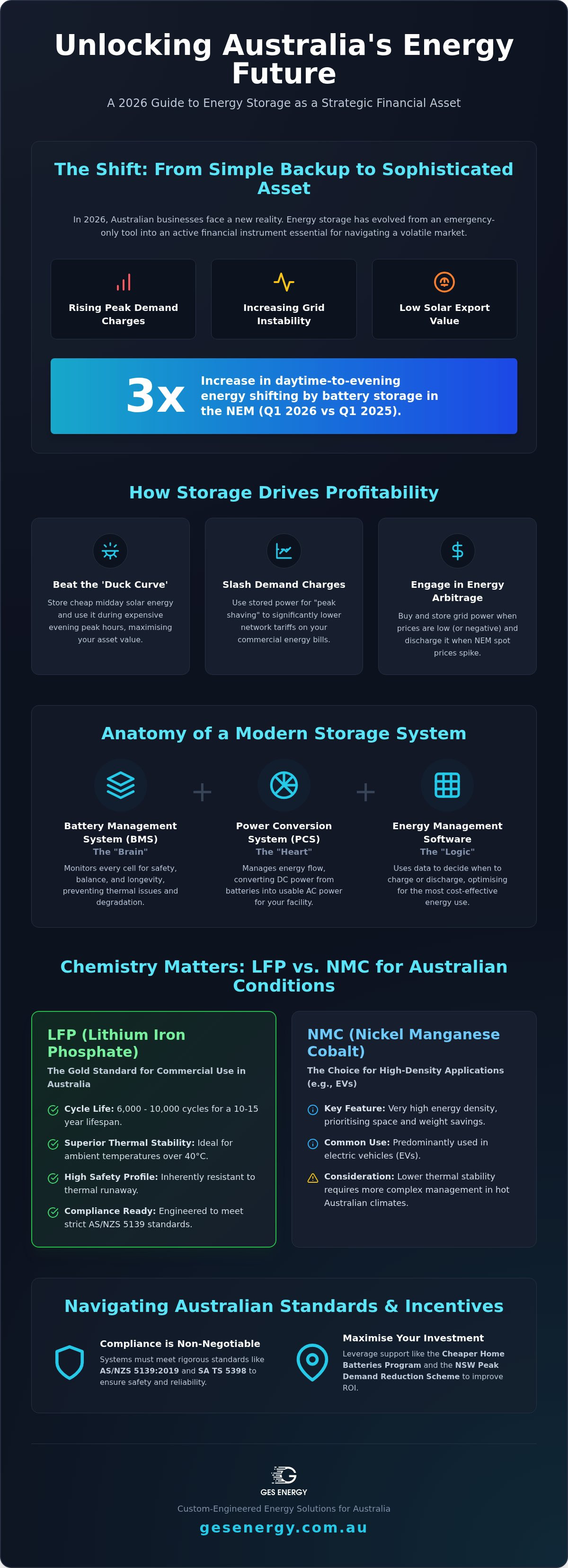
Energy storage systems act as the vital link between when electricity is generated and when it's actually used. In the past, batteries were often viewed as a simple insurance policy against blackouts. However, by 2026, the Australian market has shifted significantly. These systems are now active financial assets that allow businesses to take control of their power supply. For a comprehensive overview of energy storage technologies, it's clear that these systems have evolved from basic chemical cells into integrated infrastructure designed for high-stakes commercial environments.
The grid is changing rapidly. As coal-fired plants retire and solar penetration reaches record levels, the volatility of the National Electricity Market (NEM) creates both risks and opportunities for large-scale energy users. In the first quarter of 2026, battery storage systems in the NEM tripled their daytime-to-evening energy shifting compared to the same period in 2025. This isn't just about keeping the lights on; it's about stabilising a grid that's increasingly reliant on intermittent renewables. For Australian businesses, prioritising energy storage systems is now a matter of operational predictability and protecting the bottom line against fluctuating spot prices.
The Core Components of a Modern Storage System
A reliable system is more than just a collection of battery cells. It requires a sophisticated Battery Management System (BMS), which acts as the "brain" of the operation. The BMS monitors every cell to ensure safety, balance, and longevity. Without it, the risk of thermal issues or premature degradation increases. Next is the Power Conversion System (PCS). This hardware manages the flow of energy, converting DC power from the batteries into usable AC power for your facility. Finally, advanced energy management software provides the logic. It uses data to decide exactly when to charge or discharge, ensuring you're always using the most cost-effective kilowatt-hour available.
The Economic Case for Storage in Australia
The "duck curve" remains a primary driver for investment. With solar generation peaking at midday, export values have plummeted. Storing that excess energy for use during the expensive evening peak is the most direct way to lower costs. Beyond simple self-consumption, demand charge management offers substantial savings. By "shaving" your peak loads with battery power, you can lower the network tariff costs that often make up a huge portion of commercial bills. Some businesses also engage in energy arbitrage. This involves buying energy when prices are low, or even negative, and discharging it when the NEM spot price spikes, turning your storage into a revenue-generating tool.
Comparing Battery Chemistries: Lithium, Flow, and Beyond
Selecting the right chemistry for energy storage systems is a decision that dictates the next decade of your facility's performance. It isn't just about storing power. It's about how the system handles the harsh Australian sun and daily heavy cycling. In 2026, the market has matured, moving away from experimental setups toward proven chemistries that balance safety with long-term financial returns. While lithium remains the dominant force, new alternatives are carving out specific niches for industrial and remote applications.
Lithium-Ion: LFP vs. NMC Chemistries
Lithium Iron Phosphate (LFP) has firmly established itself as the gold standard for Australian commercial installations. Unlike Nickel Manganese Cobalt (NMC), which is common in electric vehicles due to its high energy density, LFP offers superior thermal stability. This is a critical factor for systems located in regions where ambient temperatures regularly exceed 40 degrees. LFP chemistries provide peace of mind because they're inherently more resistant to thermal runaway, making them easier to manage under the strict AS/NZS 5139 safety standards.
Your investment's longevity depends on cycle life. Modern LFP systems typically offer 6,000 to 10,000 cycles at a high depth of discharge. For most businesses, this translates to 10 to 15 years of reliable service if the system is correctly engineered. If you're unsure which chemistry fits your load profile, our team can help you design a custom energy strategy tailored to your specific site. We focus on matching the tech to your environment rather than pushing a one-size-fits-all product.
Flow Batteries for Industrial Applications
Vanadium Redox Flow batteries are becoming the preferred choice for long-duration storage, specifically for projects requiring 8 hours or more of continuous discharge. These systems don't store energy in solid cells. Instead, they use large tanks of liquid electrolyte. The primary advantage is an almost unlimited cycle life. The electrolyte doesn't degrade like lithium, meaning the battery's capacity remains constant for 20 years or more. This makes them ideal for heavy industrial sites or remote micro-grids where daily deep cycling is mandatory.
Facility managers should be aware that flow batteries have different maintenance needs. While the chemistry is stable, the system relies on pumps and sensors to circulate the electrolyte. This mechanical aspect requires a methodical maintenance schedule. However, for large-scale energy shifting, the ability to scale duration simply by increasing tank size offers a level of flexibility that lithium cannot match.
The 2026 market is also seeing the rise of sodium-ion and solid-state alternatives. Sodium-ion is gaining traction for cost-sensitive projects because it uses abundant materials and performs well across a wide temperature range. Solid-state batteries promise even higher safety and density, though they remain positioned at the premium end of the market for specialized applications. Choosing between these options requires a deep understanding of your operational goals and local environmental constraints.
Behind the Meter vs. Utility-Scale Storage
Distinguishing between utility-scale and behind-the-meter (BTM) systems is essential for any facility manager. While utility-scale arrays support the national transmission network, BTM systems are located on your side of the electricity meter. These onsite energy storage systems provide direct control over your facility's power consumption and costs. While grid-scale projects help stabilise the NEM, they don't address the specific peak demand charges that often inflate commercial invoices.
Community batteries have also emerged as a significant trend in 2026. These local arrays bridge the gap between individual business storage and the wider grid, often serving as the foundation for local micro-grids. By sharing storage capacity, businesses within an industrial park can collectively manage their energy needs, reducing the burden on ageing infrastructure. This collaborative approach allows for greater resilience without the need for each individual tenant to invest in massive standalone arrays.
Commercial and Industrial (C&I) BTM Solutions
Sizing a Battery Energy Storage System (BESS) for a factory or warehouse requires a methodical analysis of your load profile. It's not just about total capacity; it's about the discharge rate required to cover heavy machinery startups. Many Australian businesses are now integrating EV charging stations with their onsite energy storage systems. This prevents electric vehicle fleets from creating massive new peaks in demand that would otherwise trigger higher network tariffs.
Achieving energy security for critical infrastructure used to mean relying on diesel generators. In 2026, high-capacity batteries provide a cleaner, quieter alternative with faster response times. These systems ensure that sensitive equipment remains operational during grid outages without the maintenance headaches of internal combustion engines. It's a shift that prioritises long-term reliability over temporary fixes.
Virtual Power Plants (VPPs) and Micro-grids
Your business can now transform from a passive consumer into an active participant in the energy market through a Virtual Power Plant (VPP). By allowing a third-party provider to orchestrate your battery's discharge during grid stress events, you can earn significant revenue or credits. This turns your resilience planning into a profit centre while helping to keep the broader Australian grid stable.
For remote sites, micro-grid development offers a path to total independence. By combining solar arrays with robust storage, regional industrial operations are successfully disconnecting from unreliable grid spurs. A recent summary of industrial sites across Australia shows that those implementing micro-grids have effectively insulated themselves from the price shocks and outages that plague traditional network connections.
Planning and Implementing Your Energy Storage Strategy
A successful rollout of energy storage systems starts long before the first battery arrives on site. It requires a methodical EPC (Engineering, Procurement, and Construction) lifecycle that prioritises custom engineering over generic solutions. In 2026, navigating the regulatory landscape is more critical than ever. Compliance with AS/NZS 5139:2019 and the newer SA TS 5398 technical specifications ensures your installation meets strict Australian fire safety and quality standards. These regulations aren't just hurdles; they're essential safeguards for your long-term infrastructure investment.
Feasibility and System Design
The design phase begins with a thorough analysis of your facility's interval data. We look for specific patterns in your load profile to identify peak demand shaving opportunities that offer the highest financial return. Selecting the right inverter technology is the next step. High-quality inverters ensure seamless grid integration and allow the system to respond instantly to voltage fluctuations. For those looking to pair storage with new generation assets, our Commercial Solar Installation Guide provides a deeper look at integrated system design.
Future-proofing is a core tenet of our engineering philosophy. We design systems to be modular, ensuring they can scale as your business grows or as you expand your EV charging infrastructure. This foresight prevents your initial storage capacity from becoming a bottleneck as your operational needs evolve over the next decade.
Installation, Commissioning, and Maintenance
Safety and reliability during installation are paramount. We utilise SAA-accredited labour for all commissioning tasks. This ensures the system is balanced and safe from day one, while also protecting your manufacturer warranties. Once the system is operational, remote monitoring becomes your primary tool for tracking performance ROI. By analysing real-time data, we can monitor degradation rates and ensure the software is discharging the battery at the most profitable moments.
Ongoing maintenance is the final building block of a resilient energy ecosystem. Scheduled inspections of cooling systems and electrical connections are vital, particularly in harsh Australian environments where heat can impact battery efficiency. A well-maintained system doesn't just last longer; it performs more predictably. If you're ready to transition to a more reliable power model, you can request a comprehensive site feasibility study from our specialist team to start your journey toward energy independence.
Why GES Energy is Australia’s Partner for Industrial Storage
GES Energy operates as a national specialist in the design and delivery of complex energy infrastructure. We provide a complete end-to-end EPC (Engineering, Procurement, and Construction) service, which means we manage every phase of your project from initial feasibility through to final commissioning. While some providers focus solely on hardware sales, our approach is rooted in long-term partnership. We understand that transitioning to advanced energy storage systems is a significant capital investment. Our goal is to instill confidence by ensuring your system is engineered for stability, reliability, and measurable financial returns.
Custom Engineering for Complex Loads
Industrial facilities often have load profiles that generic, off-the-shelf battery cabinets simply cannot handle. We prioritise custom engineering because a one-size-fits-all solution rarely achieves the efficiency required for high-demand environments. Whether you're integrating storage with existing commercial solar arrays or building a new micro-grid from the ground up, we tailor the system to your specific operational needs. Our team specialises in systems up to 5 MW, providing the technical depth required for large-scale energy shifting and demand management.
- Bespoke system design that matches battery discharge rates to your heaviest machinery loads.
- Seamless integration with existing on-site generation to maximise solar self-consumption.
- Proven track record in delivering micro-grid solutions for remote Australian sites where grid reliability is a constant challenge.
Securing Your Energy Future
Long-term performance is the result of meticulous planning and high-quality procurement. We secure only Tier-1 components, ensuring that every part of your energy storage system meets or exceeds current safety standards. Our commitment doesn't end when the installation is complete. We maintain a national maintenance network to provide ongoing support, ensuring your infrastructure performs predictably for 15 years or more. This proactive stewardship is designed to provide total peace of mind, allowing you to focus on your core business while we manage your energy resilience.
If you're ready to take control of your power costs and secure your facility's energy independence, the next step is a professional assessment. You can organise a consultation for your industrial storage project with our specialist engineering team today. We'll help you navigate the transition with the expertise and precision your business requires.
Securing Your Energy Independence through Custom Engineering
The transition to modern energy storage systems represents a fundamental shift in how Australian facilities manage their operational costs. By selecting the right chemistry and ensuring strict adherence to the latest safety standards, you can transform your power supply into a resilient, predictable asset. Whether you're integrating behind-the-meter solutions or developing a remote micro-grid, the focus must remain on precision and safety to achieve true independence from grid volatility.
GES Energy stands as your dedicated partner in this transition. Our SAA-accredited engineering team specialises in complex projects up to 5 MW, providing the technical depth needed for high-stakes industrial applications. We don't just install hardware; we provide ongoing national maintenance and repair support to ensure your infrastructure delivers long-term value. Request a custom design and feasibility study for your energy storage system to begin your journey. It's time to take full control of your energy future.
Frequently Asked Questions
How long do commercial energy storage systems typically last?
Commercial energy storage systems generally have an operational lifespan of 10 to 15 years for Lithium Iron Phosphate (LFP) chemistries. This timeline is based on a standard cycle life of approximately 6,000 to 10,000 cycles. For industrial applications requiring longer durations, Vanadium Redox Flow batteries can last 20 years or more because the liquid electrolyte doesn't degrade. Regular maintenance of cooling systems and electrical connections is essential to reach these performance milestones.
What is the difference between a BESS and a standard solar battery?
A Battery Energy Storage System (BESS) is a high-capacity, engineered solution designed for commercial and industrial loads rather than simple residential use. While a standard solar battery often focuses on basic self-consumption, a BESS integrates sophisticated power conversion hardware and energy management software. These systems are custom-built to handle heavy machinery startups and complex demand management strategies that a residential-scale unit isn't equipped to manage.
Can an energy storage system help my business avoid peak demand charges?
Yes, energy storage systems are specifically designed to reduce peak demand charges through a process called peak shaving. By discharging stored energy during periods of high facility demand, the system prevents your property from drawing excessive power from the grid. This lower peak usage directly reduces the network tariff costs on your commercial electricity bill. It allows you to maintain full operational capacity without triggering expensive demand-based penalties.
Is it possible for a large industrial site to go completely off-grid?
Achieving total energy independence is possible through the development of a robust micro-grid. This requires a methodical combination of large-scale solar arrays, high-capacity energy storage, and sophisticated control systems. For remote Australian sites, this approach is often more reliable than maintaining a connection to a weak grid spur. The system must be engineered to provide enough redundancy to handle multiple days of low generation without interrupting critical operations.
What are the safety requirements for installing large-scale batteries in Australia?
Installation must comply with AS/NZS 5139:2019, which is the primary safety standard for battery energy storage systems in Australia. From January 1, 2027, products must also meet the new SA TS 5398 technical specifications to remain on the Clean Energy Council approved list. These regulations cover everything from fire suppression and ventilation to specific setbacks from property boundaries. All commissioning should be handled by SAA-accredited labour to ensure full compliance.
How does a Virtual Power Plant (VPP) benefit a commercial property owner?
Participating in a Virtual Power Plant allows you to earn revenue or billing credits by providing grid stability services. When the Australian grid experiences high stress, the VPP orchestrator can discharge a small portion of your stored energy to support the network. This turns your resilience infrastructure into a passive income stream. Property owners gain financial rewards while helping to prevent regional blackouts and supporting the broader transition to renewable energy.
Are there government incentives available for energy storage in 2026?
Several incentives are active in 2026, including the federal "Cheaper Home Batteries Program" which offers rebates via Small-scale Technology Certificates (STCs). In New South Wales, the Peak Demand Reduction Scheme (PDRS) provides incentives for VPP-capable systems. Western Australia also offers rebates of up to $3,800 in Horizon Power areas. These programs are designed to lower the upfront cost of energy storage systems and accelerate the transition to sustainable infrastructure.
What is the typical ROI period for an industrial battery system?
The return on investment for an industrial system typically ranges between five and eight years, though this varies based on your specific load profile. Savings are primarily generated through the reduction of peak demand charges and increased solar self-consumption. When integrated with a VPP or used for energy arbitrage, the payback period can be shortened. A detailed feasibility study is required to determine the exact financial performance based on your local network tariffs.


