

A low quote isn’t automatically one of the best solar deals. In Victoria, most households won’t need a rooftop solar system larger than 13 kW, and the right system size affects both the upfront cost and the value of any Small-scale Renewable Energy Scheme (SRES) certificates included in the quote.
It makes sense to focus on price, but equipment, system design, rebates and warranty terms also shape value. The best solar deals from GES ENERGY are easier to assess when you can see exactly what the quoted price covers and how incentives are applied.
This guide explains what affects solar costs in Victoria and how STCs, rebates, warranties and installation support can shape your decision. You’ll learn what to look for in a quote so you can compare the full value of different options, not just their headline prices.
Key Takeaways
- Assess a NSW solar quote by looking beyond the upfront price: system size, equipment and installation scope all affect its value.
- State and local solar or battery incentives can change the cost of a system, and eligibility conditions differ between schemes.
- STC value depends on system size and climate zone; eligibility also involves installer accreditation and approved panels and inverters.
- Compare panel, inverter and workmanship warranty terms separately to understand what each one covers.
- According to the Australian Government Department of Climate Change, Energy, the Environment and, the Cheaper Home Batteries Program provides a discount of around 30% on the upfront cost of installing eligible small-scale batteries.
State, territory and local solar and battery rebates
In NSW, incentives can reduce the upfront cost of solar panels or batteries. The benefit available depends on the scheme, system and applicant.
Local solar and battery rebates
State, territory and local government programs may support solar or battery upgrades. Some combine a rebate with an interest-free loan, while eligible systems can also receive STCs through the Small-scale Renewable Energy Scheme. Check how each scheme applies to your project and whether the quote itemises every incentive.
For shared systems, the Solar for apartment residents rebate offers eligible owners’ corporations or strata managers up to 50% off, capped at A$150,000. This applies to a shared solar system, rather than an individual apartment package. The building’s decision-makers can use the cap and rebate rate to assess the potential contribution towards project costs.
Combined solar and battery discounts
Solar panels and a battery may qualify for separate incentives, but each program has its own eligibility conditions. Compare the solar discount, battery discount and any loan separately. This shows which incentives lower the upfront cost and whether the quoted package includes both systems.
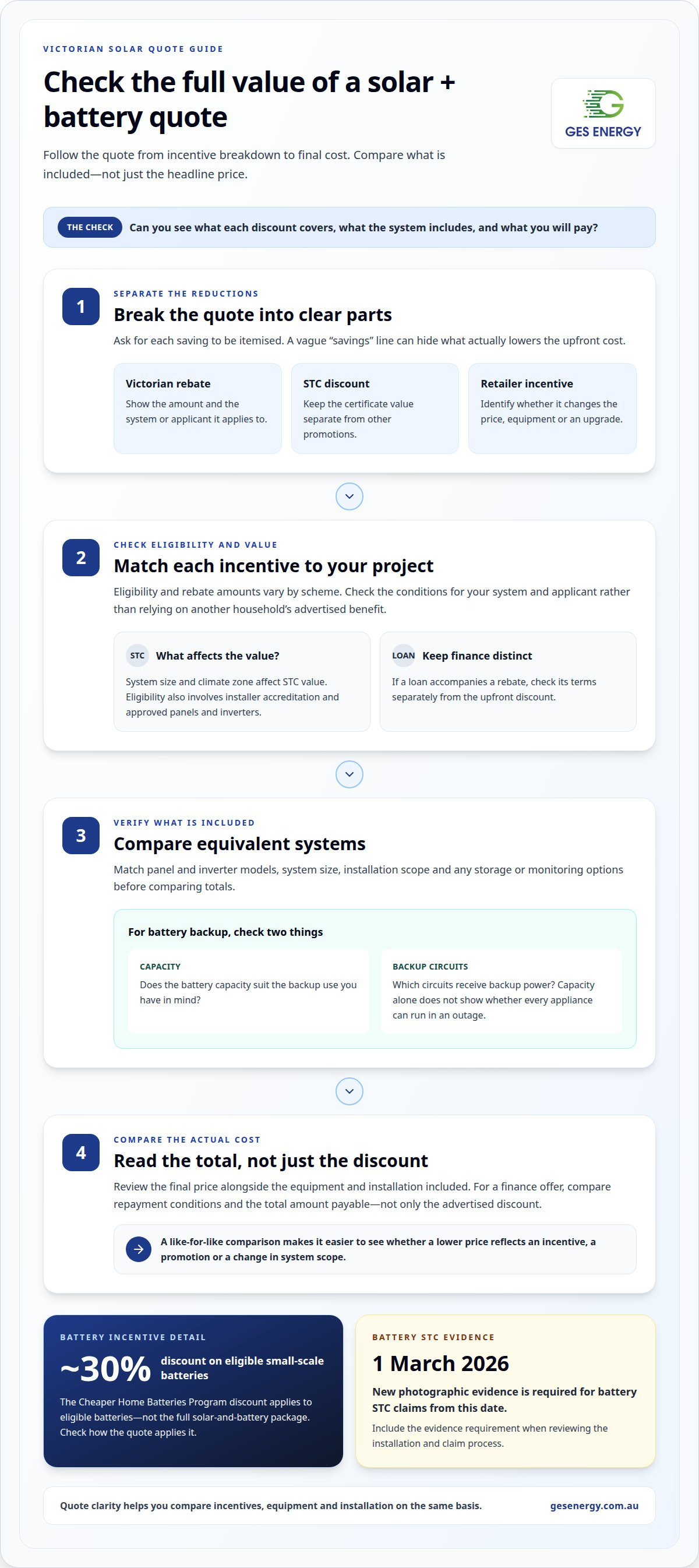
The Australian Government’s Cheaper Home Batteries Program provides a discount of around 30% on the upfront cost of installing eligible small-scale batteries, according to the Australian Government Department of Climate Change, Energy, the Environment and Water. This discount relates to eligible batteries, not the full solar-and-battery package. Check how the quote applies it before comparing package totals.
Battery capacity indicates how much electricity is available to use after solar generation falls. For blackout protection, the design must also specify which circuits receive backup power. Capacity alone doesn’t show whether a battery can support every appliance during an outage. Compare systems against your intended backup use, not capacity in isolation.
Battery STC claims also have an evidence requirement. New photographic evidence is required for battery STC claims in Australia beginning on March 1, 2026. Include this requirement when reviewing the installation and claim process, because photographs form part of the evidence needed for the claim.
Use these steps to assess a combined solar and battery offer:
- Separate solar incentives from battery incentives in the quote.
- Identify whether a state or local loan sits alongside a rebate.
- Confirm the package’s battery capacity matches the intended backup use.
- Check that the battery STC claim process includes the required photographic evidence.
These checks help you distinguish a genuine combined discount from a headline reduction. They also show whether the package accounts for the solar system, battery and relevant incentive conditions.
Victorian solar rebates and incentives
Unusually cheap solar deals may leave out equipment, installation work or incentives. Review finance offers carefully, too: compare repayment conditions and the total amount payable, not just the advertised discount.
For a Victorian quote, separate any state rebate, STC discount and retailer incentive. Each affects the upfront cost differently. A rebate should identify the system or applicant it applies to, and an STC discount should appear as a separate quote item. Clear itemisation makes the final price easier to understand.
Victorian rebate amounts depend on the scheme and eligibility. Compare the benefit available for your project, rather than a headline maximum from another household’s offer. The quote should state the amount and its effect on the total, not combine several reductions under a vague “savings” line.
STCs are separate from a Victorian rebate. Solar retailers or installers normally apply for STCs and sell them on your behalf, showing their value as a discount in the system quote. The value depends on system size and climate zone. Keep the STC discount separate from retailer promotions and equipment upgrades.
Retailer incentives can change a package’s equipment or price. Check whether a promotion applies to panels, storage, monitoring or an upgrade, and whether the advertised total already includes the STC discount. Itemised quotes make it easier to compare equivalent systems, including the installation scope.
Queensland offers a separate example, not a Victorian rebate. Its rental scheme may offer tenants savings, but those benefits should not be assumed to apply to Victorian households. Those figures relate to that scheme; they should not be treated as the savings available to Victorian households.
Some Australian state and territory schemes allow a solar or battery rebate to be combined with an interest-free loan. Eligible systems can also receive STCs through the Small-scale Renewable Energy Scheme. Loan terms and eligibility affect repayments, so assess the loan separately from the upfront discount.
Before accepting a low-price or finance offer, use these checks:
- Separate the Victorian rebate, STC discount and retailer promotion.
- Match each incentive to its eligible system, applicant and conditions.
- Compare the quoted equipment and installation scope, not only the discount.
- Review the financing terms and total repayments alongside the upfront cost.
This breakdown shows whether a premium package’s apparent savings come from an incentive, retailer promotion or change in system scope. It also helps you compare storage and monitoring options without mistaking a finance offer for a rebate.
Panel warranties and manufacturer credentials
Compare solar quotes by matching panel and inverter models, system size, warranties and estimated output. Then check each system’s specifications against your electricity use instead of relying on the quoted total alone.
For Australian SRES eligibility, the installer must be accredited by Solar Accreditation Australia. The panels and inverter must also appear on the Clean Energy Council’s approved modules and inverters lists.
Efficiency indicates how effectively a panel converts sunlight into electricity for its surface area. A listed Risen N-Type TOPCon module has a rated power of 475 watts and an efficiency of 22.5%. Quality residential modules commonly reach about 22-23% efficiency, depending on model and design.
These figures help compare specifications, but don’t predict a household’s total generation by themselves. Roof orientation, shading, system design and local conditions also affect output. Ask how the panel layout and inverter capacity work together, and compare estimated generation on the same basis across quotes.
Separate the panel’s product warranty from its performance warranty and the inverter warranty. Product terms cover the equipment itself; performance terms describe panel output over time. Read each document for coverage, exclusions, the claims process and conditions that could affect a claim. Don’t assume one warranty covers every part of the system.
Package examples show why the exact model and component terms matter. A 6.6 kW solar starter package includes a 10-year inverter warranty and a 25-year panel warranty. A 13.3 kW solar package also includes a 10-year inverter warranty and a 25-year panel warranty. These examples describe those packages, not a standard for every system.
To compare performance, put the panel rating, inverter model and estimated system output alongside the warranty terms. Check that each quote specifies the same system capacity and equipment. Lower electricity bills depend on using generated power effectively, so consider estimated output alongside your household’s energy needs.
Use this checklist when reviewing the documents:
- Match panel and inverter model names across the quote and warranty documents.
- Compare rated power and efficiency, including the Risen module’s 475-watt rating.
- Read panel, performance and inverter warranty terms separately.
- Confirm SAA installer accreditation and approved panel and inverter listings for SRES eligibility.
Incentives can reduce an upfront quote, but they don’t replace equipment checks. Assess specifications, expected performance and warranty coverage together. This gives you a clearer basis for comparing solar offers and understanding what support applies if equipment needs attention.
Australian Government Small-scale Renewable Energy Scheme and STCs
In Australia, the Small-scale Renewable Energy Scheme (SRES) can lower a solar system’s upfront cost through small-scale technology certificates (STCs). The discount depends on the system and its location, so the STC amount may differ between quotes.
The SRES calculates STC value using the estimated electricity a solar system will generate until 2030. System size and climate zone both affect the value. The size used in the calculation is capped at a maximum solar system size of 100 kW. This is the calculation cap, not a recommendation about the system size your property needs.
For an eligible system, solar retailers or installers normally apply for the STCs and sell them on your behalf. Their value usually appears as a discount in the system quote. Look for the STC amount as a separate line, then compare the remaining upfront price and included equipment. This helps distinguish certificate value from a retailer promotion.
Eligibility depends on installation and equipment requirements. The system must be installed by an installer accredited by Solar Accreditation Australia. Its panels and inverter must also appear on the Clean Energy Council’s approved modules and inverters lists. These requirements link the certificate claim to the installer and the equipment supplying solar energy.
From 1 October 2026, the Australian Government intends SRES changes supporting mid-scale solar to apply to systems installed from that date, subject to regulations being in place. This proposed change concerns mid-scale solar. It does not alter the quoted STC value for a household system by itself; the existing calculation factors remain relevant to comparing residential offers.
Use these steps to read the STC component of a quote:
- Identify the system size and the climate zone used for its STC calculation.
- Find the certificate discount separately from equipment and retailer discounts.
- Check that installer accreditation and approved panel and inverter requirements are addressed.
- For mid-scale projects installed from 1 October 2026, note the stated regulatory condition.
A clear quote explains how STCs affect the upfront amount instead of showing one unexplained discount. For example, two packages with different system sizes or installation locations can have different certificate values. Compare their equipment, system design and remaining price alongside the STC line.
STCs are one part of a solar deal, not a measure of overall system performance. A larger certificate discount doesn’t show how much electricity a system will supply or how well it suits your usage. Assess the SRES calculation, equipment details and estimated generation as separate factors.
Home solar battery costs in Australia incl. installation
The installed cost of a home battery depends on its capacity, equipment and installation scope. Adding storage to an existing solar system may involve different work from installing panels and a battery together. The quote should clearly separate the battery, installation and any system upgrades.
Battery capacity affects how much solar electricity you can store for later use. A larger battery may suit a household with higher evening use, while a smaller one may better match lower demand. Start by comparing your usage pattern and backup needs, not capacity alone.
Installation details also affect the quoted cost. The existing inverter, battery location and connection to the solar system all influence the work involved. A combined solar-and-battery package may include equipment and installation together, so review the scope to see what’s included and whether an upgrade is part of the offer.
The Australian Government’s Cheaper Home Batteries Program provides a discount of around 30% on the upfront cost of installing eligible small-scale batteries, according to the Australian Government Department of Climate Change, Energy, the Environment and Water. The discount applies to eligible batteries, so compare the quoted battery cost before and after the incentive.
For a useful comparison, consider the complete installed price rather than a battery-only figure. Check whether the quote includes system integration, installation and any required equipment changes. The installed price depends on battery capacity, selected equipment, solar integration and installation requirements, and is provided after a quote request.
Review these details in each battery quote:
- Battery capacity and the household’s intended use, including blackout backup.
- Whether the system is being added to existing solar or installed as one package.
- Any inverter or other equipment upgrade included in the installation scope.
- The eligible battery discount and how it changes the upfront amount.
- The installation and warranty terms for the battery and related equipment.
These details help distinguish a low headline price from a complete installed system. Two quotes, for example, may specify different battery capacities or include different upgrade work. Compare the final scope and how discounts are applied to understand what each upfront price covers.
If you’re planning home storage, request a solar and battery quote that sets out the system, installation and eligible discount clearly.
GES ENERGY
GES ENERGY helps you compare solar options by matching system design, equipment and installation scope to your energy needs. Its residential, commercial and off-grid services include Solar + Batteries for Homes, Commercial and Industrial Solar, Off Grid Solar Systems and EV Charging Stations. This gives you one place to discuss a solar quote, battery storage or a broader energy project.
Turn to GES ENERGY when you need help matching quote details to your intended use, whether you’re considering household solar, an off-grid setup or a commercial project. Clear system planning helps you understand what the proposal includes and how its components work together.
Contact GES ENERGY to discuss your solar requirements and next steps.
Plan for the energy needs ahead
The best solar deals should suit how you expect to use energy, not just your current setup. Consider whether your plans include battery storage, off-grid power or EV charging. A discussion about your project can connect these priorities with a system design that fits your home or site.
GES ENERGY works across Commercial and Industrial Solar, Off Grid Solar Systems and EV Charging Stations. Whether you’re planning for a household, a business site or a location beyond the grid, focus the next conversation on your energy use, site requirements and future needs. That gives the project a clear starting point without relying on a headline offer alone.
Take the next step when you’re ready to discuss the right direction for your solar project. Contact GES ENERGY about solar and move forward with a clearer plan.
Frequently Asked Questions
How much do solar panels cost in NSW?
NSW has no single statewide price for a solar installation. Your quote reflects the system specified for your property, not just the number of panels. Compare the complete installed total and the included work, such as electrical and connection work where applicable. A clearly itemised scope is more useful for budgeting than a panel-only price.
What are the best solar panel and battery deals in Australia right now?
The best solar deals fit your usage pattern rather than relying on a standard package. A household with steady daytime demand may prioritise panel output, while one that uses more power after sunset may value storage. Compare how each package fits your daily load profile and intended backup use. This helps you judge practical value without assuming one offer suits every Australian household.
How much does a typical 6.6 kW solar system cost in Australia after rebates?
There is no single after-rebate amount for every 6.6 kW system in Australia. The 6.6 kW figure describes solar array capacity, not battery storage capacity or the complete system scope. For a useful budget, distinguish a solar-only proposal from a solar-and-battery bundle. That prevents you from comparing an array-only figure with a package that includes additional equipment or installation work.
What rebates and incentives are available for solar panels and batteries in each Australian state?
Incentives vary across Australia, and some support shared rather than individual rooftop systems. The Australian Government’s Community Solar Banks Program is intended to help lower electricity costs for up to 25,000 households. In Victoria, the Solar Homes Program rebate and interest-free loan are available for applications received before 30 June 2027. These examples show why location and program eligibility matter when assessing options.
How long does solar take to pay for itself in Australia, and what affects savings?
Australian homes generally have a solar payback period of 3 to 5 years. Your savings depend partly on when you use solar electricity and how much you export. In NSW, the feed-in tariff benchmark range was set to drop to 3.4 to 6.5 cents per kilowatt-hour on 1 July 2026. Using more generated power at home can make export rates less central to your savings.


