

Yes, a portable power station can supply selected devices indoors during an outage when used as a standalone unit according to its instructions. A portable power station for emergency backup can be practical for essential devices, but the right choice depends on what you need to run and for how long. For Victorian households, start by listing your outage priorities.
It’s understandable to want dependable power for essential devices without running a fuel generator inside your home. Battery chemistry, capacity and inverter output all affect performance, while the available charging options determine how you can replenish the station during an outage.
This guide explains how to compare battery types, estimate the capacity your devices need and plan solar recharging. It also covers standalone and expandable systems, and how portable backup differs from a larger off-grid setup. Use these practical criteria to assess what suits your home or site.
Key Takeaways
- Match battery chemistry and capacity to how often you expect to use backup power and how long essential devices need to run.
- Estimate runtime from the combined load of your devices, then account for the inverter output needed to handle appliances’ start-up surges.
- Solar panels can recharge a station during an outage; the available charging conditions affect how much energy you can restore.
- Choose a portable unit for selected devices and a larger off-grid system when your needs call for a broader backup setup.
- Plan how you’ll recharge and which loads matter most before an outage, so your backup choice fits both emergency use and off-grid needs.
Battery chemistry and cycle life
Battery chemistry affects how a portable station stores energy and how its cells age through repeated charging and use. Lithium iron phosphate (LFP) and nickel manganese cobalt (NMC) are two lithium battery chemistries used in portable power products. Cycle life describes how many charge-and-use cycles a battery can complete under the manufacturer’s stated conditions. Compare cycle-life claims under equivalent test conditions, rather than treating chemistry alone as a guarantee of service life.
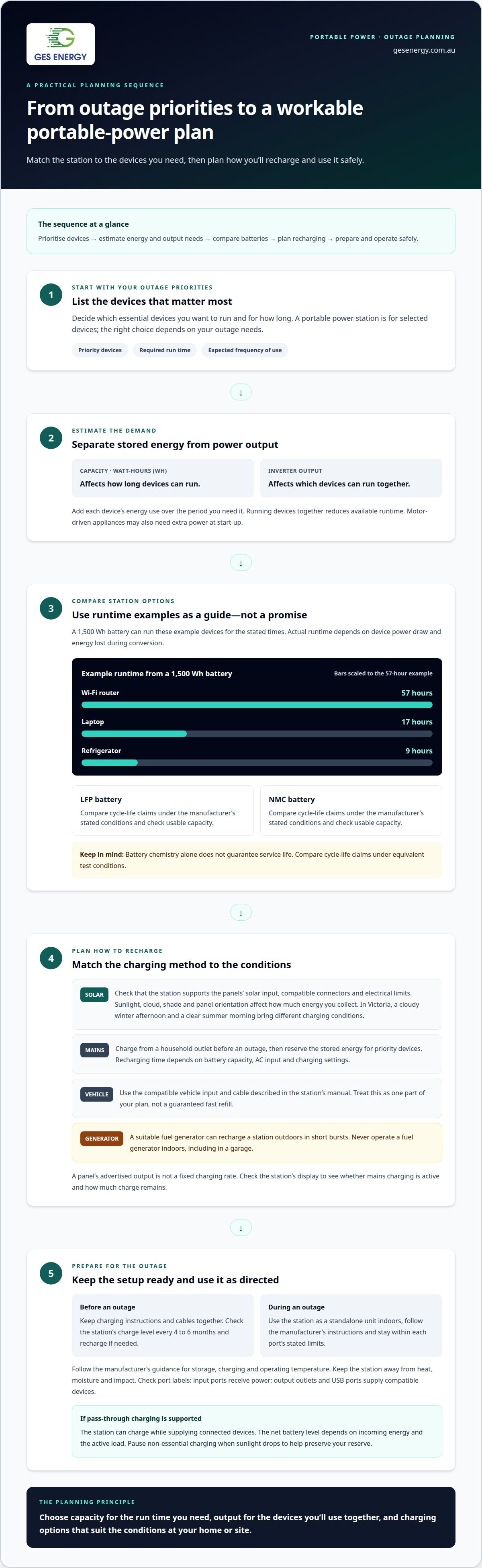
Capacity, measured in watt-hours (Wh), indicates how much energy a battery stores. Runtime depends on that capacity, the power drawn by connected devices and energy lost during conversion. A 1,500 Wh battery can run a Wi-Fi router for 57 hours, a laptop for 17 hours or a refrigerator for 9 hours. These examples show why the appliance mix matters as much as the battery rating.
Running devices together reduces available runtime. Estimate each device’s energy use over the period you need it, then add the amounts. A laptop and router running together use more energy than either device alone. Motor-driven appliances may also need extra power at startup. Capacity and inverter output answer different questions: stored energy affects runtime, while output affects which devices can run simultaneously.
- Router: 57 hours from a 1,500 Wh battery.
- Laptop: 17 hours from a 1,500 Wh battery.
- Refrigerator: 9 hours from a 1,500 Wh battery.
The comparison below distinguishes battery storage from a fuel generator. Neither battery chemistry nor capacity alone determines whether a setup suits your outage plan.
| Option | What it provides | Key comparison |
|---|---|---|
| LFP battery | Stored electrical energy | Compare cycle-life conditions and usable capacity. |
| NMC battery | Stored electrical energy | Compare cycle-life conditions and usable capacity. |
| Fuel generator | Power while fuel is available | Operates outdoors; it is not an indoor power source. |
Prepare a battery station before an outage by keeping its charging instructions and cables together. Check its charge level every 4 to 6 months, then recharge it if needed. Follow the manufacturer’s guidance for storage, charging and operating temperature. Avoid leaving the station where it can be exposed to heat, moisture or impact, as storage conditions and charging habits affect battery ageing.
A battery station supplies stored power quietly indoors, while a fuel generator must operate outdoors because it produces exhaust. For a portable power station for emergency backup, choose capacity according to the devices and runtime you need, then compare battery chemistry and cycle-life information for your expected use.
Can I use solar panels to recharge it during an outage?
Yes. A portable power station can recharge from solar panels during an outage if its solar input supports the panels you connect. Solar provides another way to restore stored energy when mains power is unavailable. How much energy the panels collect depends on sunlight, cloud, shade and panel orientation. A panel in full sun, for example, can deliver a different input from the same panel under a tree or behind a window.
First, match the panels to the station’s stated solar input. Check the manual for compatible connectors and electrical limits before connecting them. A panel’s advertised output is not a fixed charging rate: sunlight changes throughout the day, and shade can reduce production. In Victoria, a cloudy winter afternoon and a clear summer morning bring different charging conditions, so don’t plan around peak panel output alone.
Mains charging is useful before an outage. Fully charge the station from a household outlet, then reserve its energy for your priority devices. Recharge time depends on battery capacity, AC input and charging settings. A larger battery may store more energy but can also take longer to refill through the same input. The station’s display can indicate whether mains charging is active and how much charge remains.
A fuel generator can recharge a power station outdoors in short bursts. Switch the generator off before relying on the station for quiet indoor power. Never operate a fuel generator indoors, including in a garage. This separates outdoor fuel-based charging from indoor battery use, but the generator must be suitable for the station’s charging input.
Some stations also accept charging from a car. Use the compatible vehicle input and cable described in the manual. This can help while travelling or away from mains power, but a car connection is separate from solar charging. Treat it as one part of your plan, not a guaranteed way to refill the battery quickly.
AC outlets supply compatible household plugs, while USB ports can charge smaller electronics. Depending on the station’s design, input ports receive power from mains, solar panels or a vehicle. Don’t confuse an output outlet with a charging input. Check the labels before connecting a fridge or another appliance, and stay within each port’s stated limits.
Pass-through charging means the station charges while supplying connected devices, if its design supports the feature. Solar input may replenish energy while a fridge or phone draws power, but the net battery level depends on incoming energy and the active load. For a more predictable reserve, pause non-essential charging when sunlight drops, and keep the station’s instructions and cables accessible.
Can I use a portable power station indoors during an outage?
Yes. A portable power station can supply selected indoor devices during an outage. Use it as a standalone unit and follow the manufacturer’s instructions. Don’t run a fuel generator indoors or connect a station to household wiring with an improvised lead. A switchboard connection needs a suitable backup design and appropriate electrical installation.
Australian electrical safety requirements can depend on the equipment and installation. For standalone use, connect devices to the station’s intended outlets and keep its ventilation openings clear. For a fixed-wiring or switchboard connection, use a properly designed arrangement installed by a licensed electrician. This helps prevent unsafe backfeeding and ensures the backup system suits the home’s wiring.
Choose capacity by listing the devices you need, their power draw and how long you need them to run. Add their energy requirements, then allow for conversion losses and changes in use. A smaller station may suit lights, a router and phone charging, while a fridge or other appliance may need more stored energy. The right capacity depends on your priority loads and the length of the outage.
Capacity and output describe different limits. Capacity, measured in watt-hours, relates to stored energy and runtime. Inverter output, measured in watts, determines which devices can run together. Mid-sized portable stations typically have a rated output around 1,500 W. Motors and compressors, including refrigerators and freezers, can draw a startup surge above their normal running demand. The inverter must handle that surge as well as the combined load.
Some homes have important 240 V loads, including HVAC equipment and selected appliances. A station’s outlet type and inverter must suit each device. Don’t assume that a standard AC outlet can operate every household appliance or supply the whole home. Check the station’s rated output, surge rating, ports and controls against the devices you plan to connect. Use its display to monitor battery level and active output during an outage.
Australian retail prices for portable power stations vary with battery capacity, inverter output, chemistry, ports and included charging options. There’s no single price for every model. Compare features with the loads you need to support, rather than choosing by capacity alone.
For a practical home setup, prioritise essential devices, then add comfort loads only if the station can handle their combined output and required runtime. A portable station suits selected appliances and electronics; broader backup needs call for a system designed around the home’s electrical loads.
Backup system options by outage need
In Australia, choose a portable station whose capacity and output match your priority devices and expected outage. Connecting one to a home switchboard requires a manufacturer-supported design. Don’t improvise a connection or combine units unless that design supports it.
Expandable power station systems
An expandable system combines a portable power station with compatible extra battery capacity. It may suit a longer blackout or more devices than one unit can support alone. Expansion helps only when the station and added batteries are designed to work together. Check the combined capacity and output ratings, then plan which loads will run at the same time.
Portable power stations
A standalone portable station stores energy for selected devices, such as lights, a router or phone chargers. It suits targeted backup and can be moved between rooms as needs change. Capacity limits runtime, while the output rating limits which devices it can run together. A portable unit is less suited to supplying multiple household circuits without a supported connection design.
For a brief power outage, prioritise communication and essential lighting. For a longer weather-related outage, include refrigeration and a way to recharge the station. A fuel generator produces power independently of the battery but must operate outdoors; the station can then supply quiet indoor power. The options differ in fuel needs, noise, portability and the loads they can support.
Buildings may use a central emergency battery supply for designated equipment rather than a portable unit for general household use. One system design described for a 208 VAC emergency supply uses lead-acid cells arranged as a 12 or 24 VDC system. That example is a specific building-system architecture, not a portable station specification. The right option depends on whether backup is needed for selected devices, designated building equipment or wider loads.
| Option | Best suited to | Key consideration |
|---|---|---|
| Portable station | Selected household devices | Capacity and inverter output |
| Expandable station | More stored energy for compatible loads | System compatibility and combined ratings |
| Building emergency battery | Designated building equipment | Purpose-designed system architecture |
| Fuel generator | Outdoor power production | Fuel, noise and outdoor operation |
Before a blackout, group the devices you want to run and separate essential loads from comfort loads. Compare their combined demand with the station’s output rating, including motor or compressor startup surges. Then match capacity to the required runtime and charging plan. A higher rating alone doesn’t guarantee suitability if the ports, connection design or stored energy don’t meet your needs.
For a single room and a few devices, a portable station may be sufficient. Consider an expandable setup for more stored energy, or a purpose-designed building system for designated circuits and equipment.
Portable power station emergency and off-grid use
A portable station can cover short interruptions at home or supply selected equipment away from the grid. A portable power station for emergency backup can also suit off-grid use when its capacity, output and recharging options match the site’s needs.
During a blackout, assign the station to essential devices rather than treating it as a whole-home supply. A router, phone and task light support communication and basic lighting; adding a fridge changes energy demand and runtime. Keep comfort loads separate so you can reduce consumption if the outage lasts longer than expected.
Off-grid use has a different rhythm. At a campsite, worksite or remote shed, you may need to run devices daily and recharge the battery between uses. Solar input can help replenish stored energy, while sunlight and panel position affect how much you collect. Mains charging may not be available, so plan around the energy sources at the site.
Estimate runtime from the devices’ combined energy use over the period you need them to run. A device with a high running load uses stored energy faster than a small light or phone charger. The station’s inverter output must also handle connected devices together, including startup demand from equipment with a motor. Check both capacity and output ratings before planning your loads.
Ports determine what a station can power directly. AC outlets suit compatible household plugs, while USB outlets supply smaller electronics. Group devices by connector and priority, then reserve an outlet for each essential load. An available outlet doesn’t necessarily mean the station can support every connected device at full demand.
Use this operating plan for a remote stay or an extended outage:
- List essential devices, such as a phone, light, router or fridge, and note when each needs power.
- Set aside non-essential appliances so you can switch them off if the battery level falls.
- Place solar panels where they receive clear sunlight, then monitor the station’s input and remaining energy.
- Recharge devices in planned periods instead of leaving every outlet in use continuously.
A portable setup is suitable when its loads match the station’s capacity and output, and its recharge plan matches the location. If daily demand exceeds what the station can store or collect through solar input, a larger off-grid system may suit the site better than adding more devices to a small unit.
For a portable power station for emergency backup or an off-grid setup planned around your site’s energy needs, explore off-grid system options.
GES ENERGY: EV Charging Stations
GES ENERGY can help when your backup needs extend beyond selected devices and call for a planned energy system. Its Portable Off Grid Solution and Off Grid Solar Systems suit sites where ongoing power supply is a priority, while Commercial and Industrial Solar supports larger energy projects. GES ENERGY also provides EV Charging Stations for homes and businesses planning vehicle charging as part of their energy infrastructure.
A portable power station can be practical for a small set of essential loads, but remote sites and broader energy requirements call for a system designed around how and where you use power. The right option depends on your site, energy needs and intended use.
Contact GES ENERGY to discuss an off-grid system or EV charging solution suited to your requirements.
Plan backup around what comes next
Your next step is to decide whether backup means keeping a few essential devices running or supporting a broader energy plan. That distinction helps you avoid choosing a portable power station for emergency backup that doesn’t meet your longer-term needs. Consider how your requirements may change as you add equipment, work remotely or plan for electric vehicle charging.
For selected devices, a portable unit may suit the task. If you need ongoing off-grid power or support for a larger site, GES ENERGY offers Off Grid Solar Systems and Commercial and Industrial Solar. Its EV Charging Stations can also form part of an energy plan that includes vehicle charging. The right solution depends on your site and intended use.
Take the next step by discussing your requirements with GES ENERGY. Contact GES ENERGY to discuss backup options and identify a practical path towards more dependable power.
Frequently Asked Questions
How long can a portable battery run during a blackout?
Runtime depends on usable battery capacity and the total power draw of connected devices. For example, a 1,500 Wh battery could run a table lamp for 40 hours, while several devices running together use energy faster. Treat listed runtimes as estimates: inverter losses, battery condition and actual device demand affect how long power lasts. Switch off non-essential loads to extend the time available for priority equipment.
How do I calculate the watt-hours needed to power essential appliances during an outage?
Multiply each device’s wattage by the hours you plan to run it, then add the results. For example, calculate separate energy needs for a fridge, modem and lights instead of sizing the battery around one appliance. Check device labels or manuals for power information. Allow for conversion losses and consider startup demand from motor-driven appliances, whose initial draw can exceed normal running demand.
How long can a portable power station run a fridge, phone, CPAP machine, or modem?
There’s no single runtime for each type of device because models draw different amounts of power. A modem’s input rating and usage pattern affect its energy demand; a fridge also cycles its compressor. For a CPAP machine, include the prescribed settings and any humidifier or heated tube. Check each device’s power information, then estimate runtime from the station’s usable capacity and combined load.
What is the difference between lithium-ion and LiFePO4 portable power stations?
LiFePO4, or lithium iron phosphate, is one type of lithium-ion battery chemistry. The labels describe chemistry, not the station’s complete performance. Compare each model’s stated cycle-life conditions, usable capacity, output rating, weight and warranty terms. Cycle-life figures depend on the test conditions, so compare like with like. Also consider how often you expect to recharge the station and whether portability or repeated use matters more.
How can I recharge a portable power station from mains power, a car, or solar panels?
Use the station’s designated input and a compatible cable for each source. Mains power is useful before an outage; a vehicle input can provide supplementary charging, while compatible solar panels can collect energy in sunlight. Charging speed depends on the station’s input limits and the source. During a blackout, manage connected loads while recharging, since devices drawing power reduce the net energy added.
What are the risks of using a portable power station indoors, including fire and carbon monoxide hazards?
A battery power station doesn’t burn fuel while supplying power, so it doesn’t produce carbon monoxide during normal battery operation. Fire risk remains if a battery is damaged, faulty or used contrary to its instructions. Keep it away from heat and follow the manual’s ventilation and charging guidance. Fuel generators produce carbon monoxide, so operate them outdoors, away from doors, windows and other openings.
How should I maintain and store a portable power station for emergencies in Australia?
Follow the manufacturer’s storage and charging instructions, and keep the station in a dry, sheltered place within its stated temperature range. Before storing it, inspect the casing, cables and connectors for damage. Keep charging leads together so they’re easy to find during an outage. Australian conditions vary, so avoid leaving the unit in direct sun or a hot vehicle, and protect it from moisture and impact.
Which portable power stations suit emergency backup in Australia?
Choose a station based on the devices you need to run and how long they must run. Compare battery capacity, inverter output and startup-surge capability, battery chemistry and cycle-life information, and compatible charging options. Use a portable station as a standalone unit indoors according to its instructions.


