

The biggest backup-power decision isn’t which generator to buy. It’s which parts of your business must keep running when the grid goes down. A solar backup generator for business can mean different things, from a fuel generator supporting selected equipment to an integrated solar and battery system designed around priority loads.
It’s reasonable to want dependable backup without relying on a generator alone. The right setup depends on what your site needs to operate, how long those loads must run, and whether solar generation and battery storage can support them. For regional and remote businesses, these decisions are especially important when grid access is limited.
This guide explains how to identify essential loads, compare generator-only and solar-storage options, and plan a site-specific system. You’ll also learn how solar, batteries and microgrids can fit into a wider backup strategy. GES Energy designs and installs commercial and industrial solar systems, and provides a solar system design service and EPC services for projects across Victoria and Australia.
Key Takeaways
- Start by listing the equipment your business needs during an outage, then rank loads by operational priority and required backup duration.
- A solar backup generator for business can use a generator, solar PV and battery storage in different combinations. Site needs determine the suitable arrangement.
- Compare generator-only, solar-and-battery, and integrated systems by fuel dependence, solar contribution, storage role and site requirements.
- Record equipment needs and operating patterns to create a clear design brief for a site assessment.
- GES Energy’s solar system design service and EPC services can help plan and deliver a project around your site requirements.
What a solar backup generator for business actually does
A solar backup generator for business is a backup power arrangement designed to support selected operations using solar generation, battery storage, a generator, or a combination of these. The term describes the system’s purpose, not one standard piece of equipment. Its design depends on your site, the operations you need to protect and how long you need them supported during an outage.
Keeping a few essential loads running is different from backing up an entire facility. A business may prioritise communications, refrigeration, security or control systems while pausing non-essential lighting or equipment. A full-facility backup plan has a broader scope: it must account for the loads expected to operate across the site, their combined demand and how those needs may change through a working day.
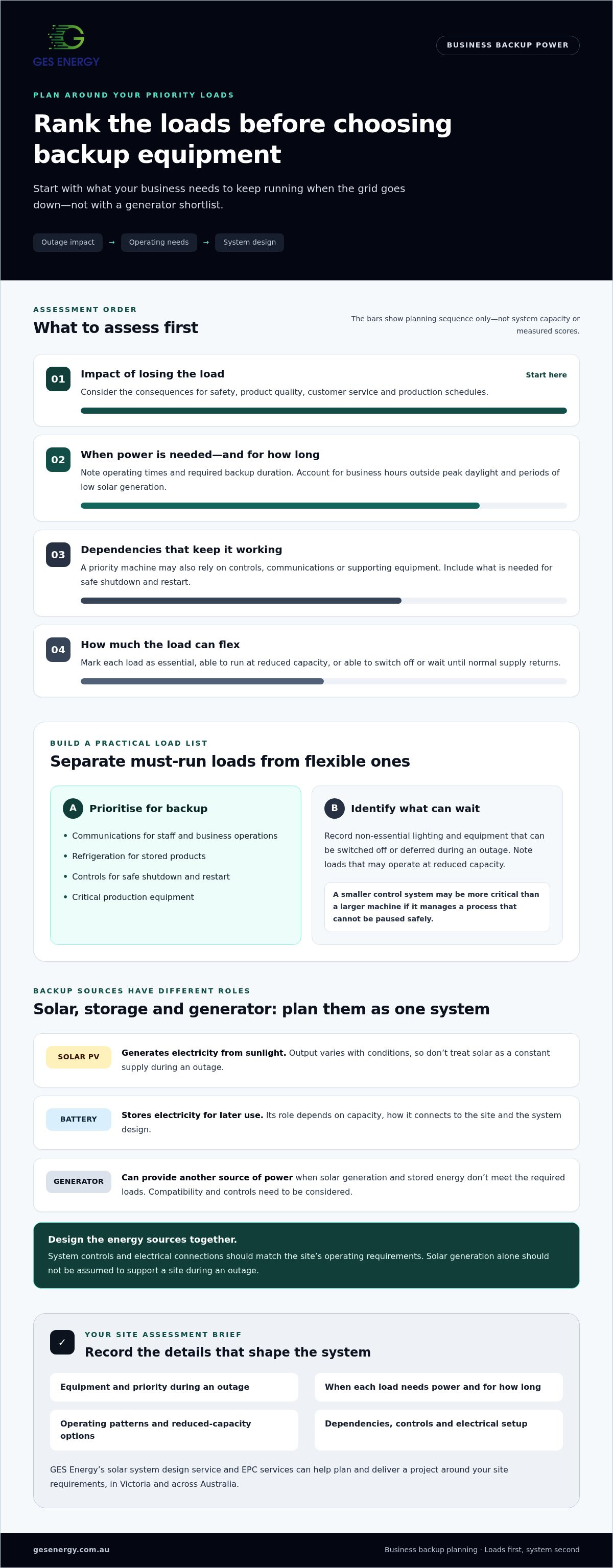
Start with the consequences of an outage, not just equipment nameplate ratings. Consider what a stoppage means for safety, product quality, customer service and production schedules. A small control system could be more critical than a larger machine if it manages a process that cannot be paused safely. List the loads that must remain available, those that can run at reduced capacity, and those that can wait until normal supply returns.
- Communications needed to coordinate staff or maintain business operations.
- Refrigeration where a loss of cooling could affect stored products.
- Controls that support safe or orderly shutdown and restart procedures.
- Critical production equipment where interruption has a material operational impact.
- Loads that can be switched off or deferred during an outage.
Which business operations need backup power first?
Rank each load by the impact of losing it, then note when it needs power and whether it can operate at reduced capacity. Include dependencies: a priority machine may rely on controls, communications or supporting equipment to function. This gives a clearer picture than a list of equipment ratings alone and helps define what the backup system needs to support.
What does solar backup mean for a business?
Solar PV generates electricity from sunlight, battery storage holds electricity for later use, and a generator can provide another source of power. The Photovoltaic System Overview explains the basic components and operation of PV systems. System controls and electrical design determine how these components interact. Solar generation alone should not be assumed to support a site during an outage.
A Portable off-grid solar generator is a mobile unit that provides electricity in remote locations without grid access. A fixed business backup system is engineered around a site’s electrical setup, priority loads and operating requirements. Neither format should be assumed to provide a set runtime or uninterrupted supply without a project-specific assessment. Defining the loads and outage priorities first gives that assessment a practical starting point.
How solar, batteries and generators work together at Victorian business sites
An integrated backup system brings together energy sources that serve different purposes. Solar PV generates electricity when sunlight is available. Battery energy storage holds electricity for later use, depending on the system design. A generator can provide another source of power when solar generation and stored energy don’t meet the site’s needs. The right balance depends on your operating priorities, electrical setup and backup plan.
What solar PV and battery storage contribute
Solar panels convert sunlight into electricity for the site. Generation varies with conditions, so a backup plan shouldn’t treat solar as a constant supply. Battery storage can hold energy for use at another time, but its role depends on capacity, how it connects to the site and the way the system is designed. For more detail on storage applications, see the industrial battery storage guide.
For a Victorian business, planning should account for periods of low solar generation. Consider how the site would operate through several overcast days, particularly if energy use remains high or the business operates outside peak daylight hours. This is a planning scenario, not a prediction of system performance. The design needs to account for how energy is generated, stored and used in relation to the site’s requirements.
When a generator forms part of an integrated system
A generator may support operations when solar output and stored energy aren’t enough for the required loads. Its contribution depends on factors such as fuel type, the site’s electrical configuration and how system controls coordinate energy sources. Compatibility and control logic need to be considered alongside energy capacity. Don’t treat the generator as a separate purchase that will automatically work with existing equipment.
Solar, batteries and a generator need to be designed as one system so their roles, controls and electrical connections match the business’s operating requirements.
The design should establish how the energy sources work together and which loads the system is intended to support. It should also account for different operating conditions, including times when solar contributes less than expected. Without project-specific details, a fixed runtime or uninterrupted supply can’t be promised. A tailored design gives your business a clearer basis for assessing the system’s intended operation.
GES Energy’s solar system design service translates site requirements into project-specific engineering for commercial and industrial solar, storage and microgrid solutions. Explore GES Energy’s commercial solar and storage projects to see how an integrated design could fit your site.
Compare business solar backup generator options before you commit
The right solar backup generator for business depends on what you need to keep operating, where the site is located and whether the need is temporary or ongoing. A generator-only setup, solar with battery storage, and an integrated arrangement each have different trade-offs. Compare them against the same criteria before choosing an approach.
Generator-only, solar-and-battery, or an integrated arrangement?
Use this comparison to identify which arrangement may fit your site’s operating priorities. It outlines general differences, not guaranteed performance. Actual operation depends on system design, equipment and site conditions.
| Approach | Fuel dependence | Solar contribution | Storage role | Site and operational considerations |
|---|---|---|---|---|
| Generator-only | Depends on fuel supply. | Not part of the arrangement. | No battery storage unless added separately. | Consider fuel access, generator placement and which loads need support. |
| Solar-and-battery | No generator fuel in the arrangement. | Solar PV generates electricity when conditions allow. | Stores energy for later use, subject to system design. | Assess site suitability, load needs and how the system is intended to operate during an outage. |
| Integrated backup | May depend on fuel if a generator is included. | Solar contributes when available. | Battery storage can form part of the energy mix. | Requires coordinated electrical design and controls for the selected components and loads. |
A generator-only arrangement may suit a business that prioritises a generator as its backup source, while solar-and-battery can combine on-site generation with stored energy. An integrated setup brings these elements together, but adds design considerations around electrical connections and controls. No option is automatically best. Weigh the fuel-supply plan, available site space, operating schedule and the consequences of losing each priority load.
Also distinguish a temporary power requirement from ongoing site resilience. A short-term task at a remote work location has different needs from a facility seeking backup for regular operations. Standalone systems operate without relying on the grid in the same way as grid-connected arrangements. The off-grid solar systems guide explains this context.
When does a portable off-grid solar generator suit a business?
A Portable off-grid solar generator may suit a remote work location or temporary application where a mobile source of electricity is practical. A Portable off-grid solar package is a pre-designed off-grid system that can be quickly deployed for remote applications. Suitability still depends on the equipment and operating needs at the location.
Portability can simplify power planning for a defined remote task, but it isn’t the same as a site-engineered solution for larger commercial operations. A facility with interconnected equipment or ongoing backup requirements needs its electrical setup, loads and operating priorities considered together. GES Energy’s commercial solar and storage solutions can help businesses assess a site-specific approach.
Plan backup capacity for your Victorian business step by step
A useful backup plan starts with the work your business needs to sustain, not a generator or battery size chosen in isolation. Follow these steps to prepare a clear brief for a site assessment. This connects a solar backup generator for business with real operating needs, site conditions and outage priorities.
Build a useful critical-load and backup brief
Keep the brief focused on business continuity. Record equipment requirements and operating patterns so the system design reflects how your site runs, rather than relying on equipment names alone.
- Map the loads. List the equipment that may need backup, including its rated electrical requirements where available. Note connected controls or supporting equipment that must operate alongside each priority load.
- Define outage priorities. Mark each load as essential, reduced-operation or able to pause. Describe the consequence of interruption, such as a halted process, loss of communications or disruption to stored products.
- Record operating patterns. Note when each load runs, whether it operates continuously or in cycles, and any periods of higher demand. Include how long the business aims to maintain priority operations, without assuming that duration can be met before system assessment.
- Review the site. Gather information on existing energy infrastructure, available installation areas and practical access constraints. Record where equipment is located and any site conditions that could affect installation planning.
- Prepare the design brief. Bring the load list, priorities, schedules and site notes together. The brief gives the system design a clear starting point for considering suitable solar generation, storage and backup arrangements.
Separate what the business needs to keep running from what would simply be convenient. For example, a process may be reduced or paused if supporting services remain available, while another load may need to operate with its controls. This detail helps the design focus on continuity requirements instead of assuming the whole facility needs identical backup.
Account for site conditions across Victoria
Location is part of the project brief. Note whether your business operates in Melbourne, Geelong, Ballarat, Bendigo, Shepperton, Melton, Mildura, Wodonga, Traralgon, Wangaratta, Horsham, Sale, Colac, Echuca, Ararat, Portland, Swan Hill, Benalla or Maryborough. Record available roof or ground areas for potential equipment, existing electrical infrastructure and access constraints that could affect installation planning. These details support a site-specific assessment, as the same solution won’t suit every Victorian location.
Solar generation is also part of the wider energy picture, not just the outage plan. The commercial solar guide provides further context on planning solar for Australian businesses.
With your load and site brief prepared, plan a site-specific solar and backup design around those requirements.
How GES ENERGY can deliver a business solar backup project
A business backup project needs to connect operational priorities with electrical design and practical delivery. GES Energy’s solar system design service takes your site requirements into an engineered project, whether the assessment considers commercial solar, battery storage, a microgrid or a combination. This turns priority loads and site information into a design shaped around how your business operates.
From business requirements to system design
The design process starts with the information that shapes the project: which operations need support, how those loads run, the site’s existing energy infrastructure and the available installation areas. These details guide the assessment of suitable solar generation and storage options, and whether a microgrid forms part of the wider solution. GES Energy designs and installs commercial and industrial solar systems across Victoria and Australia.
For a solar backup generator for business, the design needs to consider the relationship between priority loads and the proposed energy system. The aim is to define how the system is intended to support site operations, rather than assume a particular generator model or standard configuration. A project-specific approach suits businesses with different operating requirements, site layouts and energy infrastructure.
Solar, battery and electrical components also need to be considered in the context of the wider project. If your business is planning EV charging alongside solar and storage, coordinating these requirements during design can help establish how the project elements fit together. GES Energy’s solar EPC services guide explains how engineering, procurement and construction can support solar projects.
Project delivery, workmanship and ongoing support
Once project requirements and design have been established, EPC services can coordinate engineering, procurement and construction for solar, battery and EV charging projects. This delivery pathway connects the technical design with equipment procurement and construction. GES Energy delivers utility-scale projects up to 5 MW, supporting projects from commercial installations to larger energy developments.
Project planning also includes what happens after installation. GES Energy provides ongoing maintenance to support the care of commercial and industrial energy systems. Maintenance can include solar system health checks, inverter repairs and warranty assistance, including support for systems regardless of the original installer.
With your site requirements and operational priorities prepared, take the next step towards an engineered project. Plan your business solar backup project with GES Energy.
Build backup planning into your next business decision
Business needs change. New equipment, longer operating hours or added EV charging can alter which operations matter most during an outage. Treat backup planning as part of your wider energy strategy so future changes can be considered alongside the system’s original purpose.
Before a project moves ahead, make sure decision-makers agree on what the business needs to protect and what level of disruption it can manage. That shared direction gives the design process a clear basis and helps keep investment focused on operational priorities. GES Energy also provides EPC services, microgrid development and ongoing maintenance for solar installations.
A solar backup generator for business should be planned around your site, not chosen as a stand-alone product. A clear project brief is a practical starting point for turning resilience goals into an engineered solution. Start planning your business solar backup project with GES Energy and take the next step towards a power strategy shaped around your operations.
Frequently Asked Questions
Can a business solar backup system operate when the grid is down?
Yes, if the system is designed to supply power independently of the grid during an outage. Having solar panels alone doesn’t mean they’ll power your premises when grid supply fails. The system’s electrical design, controls and connection to priority loads all matter. For a solar backup generator for business, define which operations need support and have the arrangement assessed for the site, whether it’s in Melbourne or regional Victoria.
How do I work out which business equipment needs backup power?
Start by recording what each item supports, when it operates and what happens if it stops. For example, a cool room may need backup to protect stock, while non-essential office equipment could be switched off. Include connected equipment such as control panels or communications devices, not just the main machine. This inventory helps distinguish essential loads from equipment that can pause while the business manages an outage.
Can existing solar panels be included in a business backup system?
Existing solar can be considered as part of a backup project, but its suitability depends on the system already installed and the proposed design. An assessment can review the inverter, electrical configuration, solar generation and the loads you want to support. Gather available system documentation and details of previous upgrades. This helps establish how existing equipment may fit with battery storage or other backup components.
What happens to a solar backup system during several cloudy days?
Several low-solar days can reduce the energy available from PV generation. The outcome depends on system design, stored energy, demand and whether another energy source is included. Consider which loads could be reduced or paused if generation is low for an extended period. Include seasonal operating patterns and critical processes in the assessment, rather than assuming solar output will meet the same needs every day.
Is a portable off-grid solar generator suitable for a commercial site?
It can suit a defined temporary task or remote work location where a mobile power source meets the equipment’s requirements. For example, a business operating away from established infrastructure may assess one for selected tools or site needs. Suitability depends on the connected equipment and the unit’s specifications. For a fixed operation in Geelong, Ballarat, Bendigo or elsewhere in Victoria, assess site-wide requirements separately from portable power needs.
Can a business combine a generator with solar and battery storage?
Yes. A project can bring these sources together, provided the electrical design and controls account for how the selected components interact. The assessment should consider the generator’s fuel type, the existing electrical infrastructure and which loads the arrangement is intended to support. A business with operations across multiple areas, such as a facility in Melbourne and a remote regional site, may need a different design brief for each location.
Does a business solar backup system need ongoing maintenance?
Ongoing maintenance helps businesses monitor the condition of their solar and storage equipment and identify issues that may affect operation. Maintenance needs depend on the system components, site conditions and applicable equipment guidance. Keep system records, note changes in performance and document inverter alerts or faults for assessment. GES Energy provides ongoing maintenance and solar inverter repair services for business systems, including across Victoria.


