

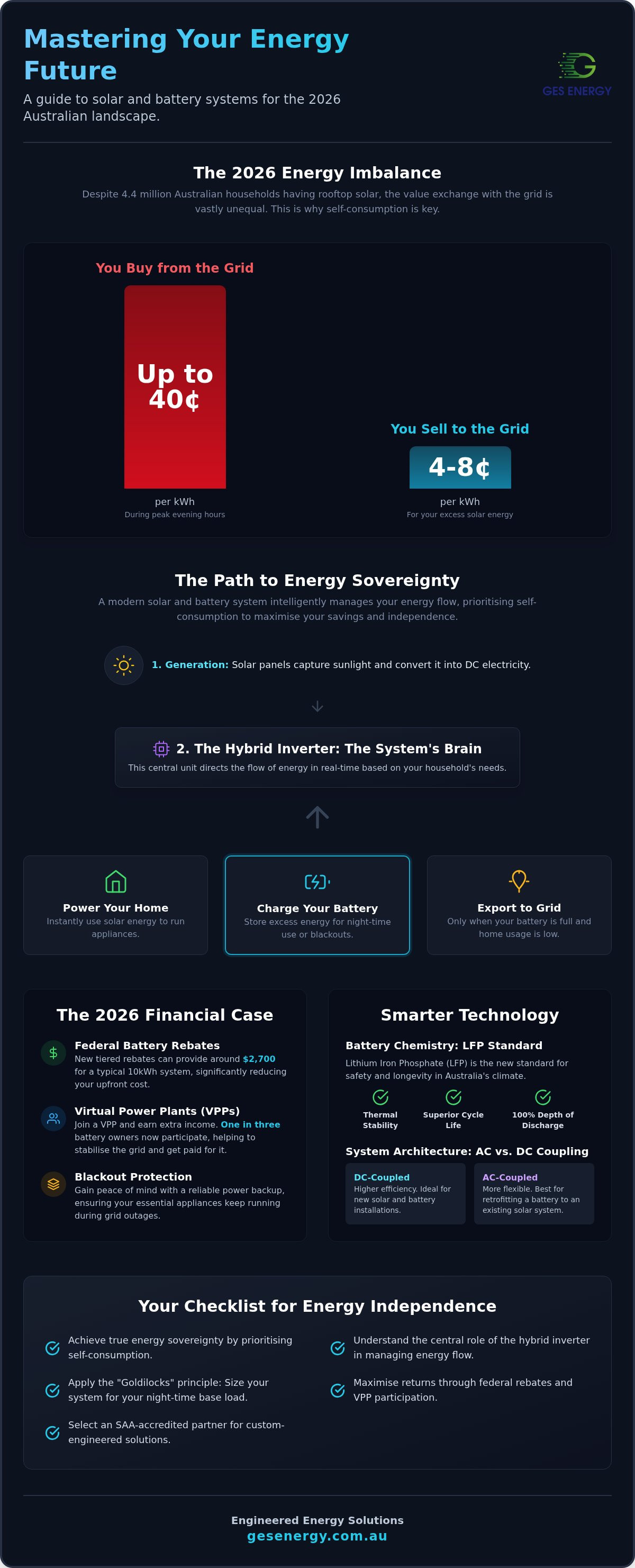
Did you know that by mid-2026, more than 4.4 million Australian households have installed rooftop panels, yet many still struggle with electricity rates reaching as high as 40c per kWh in some states? It's frustrating to watch your hard-earned solar energy disappear into a grid that pays you as little as 4c to 8c per kWh in return. You've likely noticed that the $300 Energy Bill Relief Fund has ended, leaving a gap in your budget just as grid reliability concerns grow. Integrating a solar and battery system is no longer just a green choice; it's a strategic move to regain control over your household or business infrastructure.
This guide will help you master the essentials of modern energy storage to slash your power bills and secure your future in the 2026 market. We'll examine the new tiered federal battery rebates, which can provide around $2,700 for a 10kWh system, and explain how Virtual Power Plants (VPPs) now allow one in three battery owners to earn extra income. From blackout protection to navigating shifting feed-in tariffs, you'll learn how to build a resilient energy ecosystem that provides genuine independence.
Key Takeaways
- Understand why the 2026 energy landscape marks a critical turning point for Australian households and how to achieve true energy sovereignty.
- Learn the technical synergy behind hybrid inverters and how they manage the journey of energy from the sun directly into your storage cells.
- Master the "Goldilocks" principle for sizing your solar and battery system to perfectly match your night-time base load and avoid costly errors.
- Navigate the updated 2026 federal rebate schemes and Virtual Power Plant (VPP) models to significantly reduce your upfront costs and ongoing bills.
- Identify the essential benchmarks for selecting an SAA-accredited partner who provides custom-engineered solutions rather than standard bundles.
Understanding Solar and Battery Systems in the 2026 Australian Landscape
A modern solar and battery ecosystem is a sophisticated arrangement of hardware designed to capture, convert, and store renewable energy. It consists of three primary pillars: high-efficiency photovoltaic (PV) panels, a hybrid inverter, and advanced storage cells. While traditional systems simply sent excess power back to the grid for a small credit, the 2026 standard focuses on keeping that energy within your own walls. This shift represents the move toward energy sovereignty, a state where homes and businesses exert direct control over their utility costs and power security.
Traditional grid-tied setups acted as passive generators. They relied heavily on the grid to buy excess energy during the day and sell it back at night. In 2026, this model is financially inefficient. Modern hybrid systems use the inverter as a central brain to manage flows in real-time, deciding whether to power your appliances, charge your battery, or export to the grid. Understanding how energy storage works is fundamental to appreciating this transition from being a consumer to becoming a prosumer.
The Shift from Feed-in Tariffs to Self-Consumption
Selling power back to the grid is no longer the lucrative strategy it once was. With feed-in tariffs often hovering between 4c and 8c per kWh, and retail electricity prices reaching 30c or 40c per kWh in some regions, the gap is too wide to ignore. This has led to the solar sponge effect. Instead of wasting midday generation, households use their batteries to soak up the excess. Self-consumption is defined as the ratio of generated energy used on-site versus what is exported or wasted. By prioritising this metric, you ensure every photon captured by your panels provides maximum financial value.
Why a Battery is No Longer "Optional" for New Solar
For many Australians, a battery has transitioned from a luxury add-on to a core requirement. Peak demand pricing often hits hardest in the early evening, exactly when solar panels stop producing. Without storage, you're forced to buy expensive grid power during these windows. Grid instability is also a growing concern. A solar and battery system provides a critical safety net during local outages. Beyond personal savings, there is a broader community benefit. By using stored energy during peak times, you help reduce the load on the grid. This lessens the need for fossil-fuel peaking plants to start up, making the entire network more sustainable.
How Solar and Battery Technology Works: The Technical Synergy
The technical synergy within a solar and battery system is what defines its overall performance and longevity. When a photon strikes a solar panel, it knocks electrons loose to create direct current (DC) electricity. This energy travels immediately to the hybrid inverter, which serves as the central brain of your property. It makes split-second decisions on where to route that power. It might direct it to your running appliances, send it to charge your storage cells, or export it to the grid if your local reservoir is full. This constant orchestration ensures that no generated watt is wasted.
In 2026, the industry has largely moved toward Lithium Iron Phosphate (LFP) chemistry for both residential and commercial applications. Unlike earlier lithium-ion variants, LFP offers exceptional thermal stability, which is vital for the harsh Australian climate. These units also boast a superior cycle life, meaning they can be charged and discharged thousands of times with minimal degradation. Most modern systems now support a Depth of Discharge (DoD) of up to 100%. This allows you to use the full capacity of your stored energy without compromising the unit's lifespan. If you're concerned about how your current hardware might integrate with these advancements, a professional review of your solar inverter repairs and warranties can help identify the best path forward.
AC vs. DC Coupling: Which Architecture Wins?
Selecting the right architecture is a critical design step. DC-coupled systems are generally preferred for new installations because the power from the panels flows directly into the battery without multiple conversion steps. This leads to higher round-trip efficiency, meaning you get more of the energy back out than you put in. AC-coupled systems are the practical choice for retrofitting a battery to an existing solar array. While they have slightly more conversion loss, they provide a flexible way to upgrade older systems without replacing your original inverter. For most new builds, a DC-coupled hybrid setup is the most efficient long-term investment.
Smart Inverters and Grid-Forming Capabilities
The most significant technical leap in 2026 is the widespread adoption of grid-forming inverters. Traditionally, solar systems were designed to shut down during a blackout to prevent back-feeding the grid. Grid-forming technology allows the inverter to create its own stable internal frequency, effectively turning your home or business into an independent micro-grid when the main network fails. These smart units now use advanced analytics to monitor weather patterns and household habits, automatically reserving extra power if a storm is predicted. They also integrate seamlessly with EV charging stations, allowing your vehicle to act as an additional storage reservoir when needed.
Sizing Your System: Matching Storage to Your Energy Load
Sizing a solar and battery system requires a methodical approach to ensure long-term value. We often refer to this as the "Goldilocks" principle. If you oversize, you've invested capital in capacity that sits idle. If you undersize, you'll still find yourself purchasing expensive grid power during peak evening windows. To find the right balance, we start with your smart meter data. This information reveals your night-time base load, which is the amount of energy your property consumes while the panels are dormant.
Residential Sizing: From 5kWh to 15kWh+
Residential needs typically fall into two categories. The "Daytime Worker" property usually requires a larger battery because the occupants aren't home to use energy as it is generated. In contrast, the "Home Office" user consumes power throughout the day, reducing the amount of excess energy available to charge the battery. A helpful framework is the 1:1.5 rule. For every 1kW of solar capacity, consider roughly 1.5kWh of storage. This ratio ensures you have enough capacity to capture midday peaks without over-investing. Many modern storage units are modular, meaning you can start with a 5kWh base and add modules as your energy requirements evolve.
Commercial and Industrial Load Analysis
For commercial and industrial clients, the primary goal is often Peak Shaving. Many businesses are hit with high demand charges based on their highest point of usage during a billing cycle. By discharging a solar and battery system during these peak windows, you can artificially lower your metered demand and significantly reduce your utility costs. This requires a high-capacity Battery Energy Storage System (BESS) designed for high-cycle industrial use. If you are exploring utility-scale solutions, our guide on Commercial Solar Installation: A Strategic Guide for Business offers a comprehensive look at the engineering required for high-load environments.
The Financial Case: Rebates, VPPs, and ROI in 2026
Financial planning for a solar and battery investment in 2026 requires looking beyond simple bill savings. The landscape has shifted toward targeted incentives that reward high-capacity storage. The federal Cheaper Home Batteries Program now operates on a tiered structure to encourage larger reservoirs. For the first 14kWh of capacity, you can access a rebate of approximately $271 per kWh. This means a standard 10kWh battery can receive around $2,700 in upfront support, significantly lowering the barrier to entry for most households.
Business owners must look at these systems through the lens of Internal Rate of Return (IRR) rather than just a simple payback period. A system that reduces peak demand charges provides a predictable hedge against the volatile energy markets we see in 2026. However, you must account for hidden costs that often go unmentioned in generic quotes. These include necessary switchboard upgrades for older Australian properties and specific fire safety compliance measures required for indoor battery enclosures. For a transparent assessment of your site's requirements, you can explore our solar and batteries for homes and business solutions.
Navigating Virtual Power Plants (VPPs)
Virtual Power Plants have become a cornerstone of the Australian grid, with total VPP capacity reaching 900 MW in the National Electricity Market as of early 2026. By joining a VPP, you allow an energy retailer to occasionally draw from your battery to stabilise the grid during peak demand events. In exchange, you receive financial incentives that can range from $200 to over $1,000 annually. While the upfront discounts are attractive, you are giving up a degree of control over your stored energy. Always check VPP contract exit fees and data privacy terms to ensure the arrangement suits your long-term goals.
Calculating True ROI: Beyond the Power Bill
The true return on investment includes "soft" benefits that are difficult to quantify on a standard utility statement. For home-based businesses or households with critical medical equipment, the value of uninterrupted power during a grid failure is immense. Furthermore, a high-performance energy system has become a significant factor in property valuation. Buyers in the 2026 market increasingly prioritise homes with established energy sovereignty. It's also vital to remember the scheduled phase-out of Small-scale Technology Certificates (STCs). In 2026, the deeming period has reduced to 5 years, meaning the available subsidy for panels will be lower in 2027 than it is today.
Selecting an Installer and Future-Proofing Your Investment
Selecting the right partner for a solar and battery installation is the most critical decision in your journey toward energy independence. In 2026, the complexity of integrated systems means you can't rely on "cookie-cutter" bundles designed for a generic property. A reputable installer must possess SAA-accredited labour for all system commissioning. This accreditation ensures that the technician handling your high-voltage storage cells has the specific training required for modern safety standards. Beyond certifications, you should prioritise a national specialist with a proven track record in both residential and industrial applications.
Maintenance is another often-overlooked factor that directly impacts your system's lifespan. While lithium-ion batteries are durable, their long-term warranties frequently depend on documented professional health checks. These inspections ensure that thermal management systems are functioning correctly and that the cells are balancing as intended. GES Energy operates as a diligent steward of your infrastructure, providing end-to-end design and ongoing performance oversight. This commitment to maintenance ensures that your system remains a high-performing asset for decades rather than just a few years.
The Importance of Custom Engineering
A professional site visit is non-negotiable for any complex installation. This allows engineers to assess your switchboard capacity and physical mounting constraints that a satellite image might miss. For larger commercial sites, we utilise comprehensive EPC (Engineering, Procurement, and Construction) services to manage the full lifecycle of the project. This rigorous approach is even more vital for remote reliability, as detailed in our guide to Off Grid Solar System Design. Custom engineering ensures that every component is matched to your specific load profile.
Future-Proofing for EV Integration and Micro-grids
Securing your energy future requires a partner who understands the intricacies of the 2026 Australian market. Contact GES Energy today to discuss a custom-engineered solution that delivers genuine independence and long-term peace of mind.
Securing Your Energy Sovereignty in 2026
The Australian energy landscape has fundamentally changed, moving away from passive grid reliance toward active, intelligent self-consumption. Achieving true independence requires a precise balance of high-efficiency hardware and custom engineering. By mastering the technical synergy of a solar and battery system, you protect your property from rising tariffs and ensure reliability during periods of grid instability. Whether you're managing a family home or a utility-scale industrial facility, the right infrastructure provides both immediate financial relief and long-term predictability.
GES Energy stands as your national partner in this transition. Our SAA-accredited engineering team specialises in everything from residential storage to complex 5 MW micro-grid solutions. We provide comprehensive national maintenance and warranty support to ensure your investment performs at its peak for years to come. Organise a custom solar and battery design with GES Energy to take full control of your power today. Building a resilient, future-ready energy ecosystem is a significant step toward peace of mind, and the right expertise makes that journey seamless.
Frequently Asked Questions
Is a solar battery worth it in Australia in 2026?
A solar and battery system is highly effective in 2026 because retail electricity rates have climbed as high as 40c per kWh while feed-in tariffs remain low at 4c to 8c per kWh. By storing your own energy instead of exporting it, you avoid buying expensive grid power during peak evening windows. This shift toward self-consumption provides the most reliable path to reducing your quarterly utility bills and achieving a faster return on your investment.
How long do solar batteries actually last before needing replacement?
Most modern Lithium Iron Phosphate (LFP) batteries are designed to last between 10 and 15 years. Their lifespan is measured in cycles, with high-quality units often rated for 6,000 to 10,000 cycles at a high Depth of Discharge. While the capacity will naturally degrade slightly over time, these units generally retain about 70% to 80% of their original storage potential at the end of their warranty period.
Can I go completely off-grid with a solar and battery system?
You can achieve total grid independence, but it requires a custom-engineered solution rather than a standard residential setup. Off-grid living necessitates a much larger solar array and significantly more storage capacity to manage consecutive days of low sunlight. GES Energy specialises in these high-reliability configurations, often integrating secondary backup sources to ensure your property remains powered regardless of external conditions.
What happens to my battery during a power outage?
Your system will continue to provide power if you have a grid-forming inverter with a dedicated backup circuit. Traditionally, solar systems shut down during outages to protect workers on the lines, but 2026-era smart inverters can create an independent micro-grid for your property. This allows you to run critical appliances like fridges and lights even when the main network is down.
Are there still government rebates available for batteries in 2026?
The federal Cheaper Home Batteries Program remains active in 2026, offering a tiered rebate structure based on capacity. For a standard 10kWh installation, you can receive approximately $2,700 in upfront support. While many state-based schemes have closed, Victoria's Solar Homes program still provides assistance for eligible households, making this a strategic year to invest before these incentives are further reduced.
How much solar capacity do I need to fully charge a 10kWh battery?
You generally need between 3kW and 5kW of dedicated solar generation to charge a 10kWh battery on a typical day. Since your home also consumes power during the daytime, a total solar array of 6.6kW to 10kW is usually required to ensure there is enough excess energy to fill the storage cells. Proper sizing ensures your battery reaches 100% charge before the sun goes down.
Do solar batteries require regular maintenance or servicing?
While batteries have no moving parts, they do require periodic professional health checks to maintain their warranty and performance. These inspections focus on thermal management systems, cell balancing, and firmware updates. Regular servicing ensures that your solar and battery integration remains safe and efficient, preventing minor technical issues from becoming costly repairs over the unit's decade-long lifespan.
Can I add a battery to my existing solar panel system?
It is entirely possible to retrofit a battery to an existing solar and battery setup through a process called AC-coupling. This method allows the battery to work alongside your current inverter without needing to rewire the entire system. Alternatively, you can replace your old unit with a modern hybrid inverter, which provides better efficiency and a more streamlined management of your property's energy flows.


