

Why are your quarterly electricity bills still rising even though your roof is covered in high-quality solar panels? It's a common frustration for many Australians who find that generating power isn't enough if they can't store it for use after the sun sets. Finding a valid solar battery rebate to offset the initial investment often feels like navigating a maze of conflicting state and federal regulations.
We understand that you're looking for predictability and control over your energy future rather than more complex paperwork. This guide provides a comprehensive roundup of the major Australian battery incentives and rebates available in 2026, specifically designed to help you reduce upfront installation costs. You'll learn how to distinguish between a one-off government rebate and ongoing Virtual Power Plant (VPP) incentives, giving you a clear path toward total energy independence. We'll also explain how professional engineering and design can ensure your system meets the strict eligibility criteria required for these financial supports.
Key Takeaways
- Understand how the federal Cheaper Home Batteries Program and state-specific schemes work together to reduce initial investment costs.
- Learn why Virtual Power Plants (VPPs) are becoming a vital alternative to the traditional solar battery rebate for ongoing household savings.
- Discover the financial benefits available for commercial and industrial energy storage, including tax-based incentives like the Instant Asset Write-Off.
- Identify common eligibility pitfalls and see how a professional installation partner manages the end-to-end application process for you.
- Explore how bespoke engineering ensures your battery system is future-proofed and compliant with the latest 2026 grid stability requirements.
The Current Landscape of Solar Battery Rebates in 2026
The energy environment in Australia has reached a critical turning point in 2026. While previous years focused heavily on the rollout of rooftop solar panels, the priority has shifted toward storage. The Australian Government now prioritises grid stability. This means incentives are designed to encourage households and businesses to store their own energy rather than overflowing the grid during the middle of the day. By decentralising energy storage, the national grid becomes more resilient against fluctuations and peak demand pressures.
Applying for a solar battery rebate often looks different today than it did a few years ago. Most modern schemes are structured as point-of-sale discounts. This means the financial benefit is applied directly to your invoice from an accredited installer. It reduces your out-of-pocket costs immediately. Residential schemes generally focus on smaller capacity systems for individual homes. In contrast, commercial eligibility often requires larger storage capacities and more complex engineering to support industrial loads. This distinction ensures that the right technology is deployed for the specific energy needs of the site.
Why 2026 is the Strategic Year for Battery Adoption
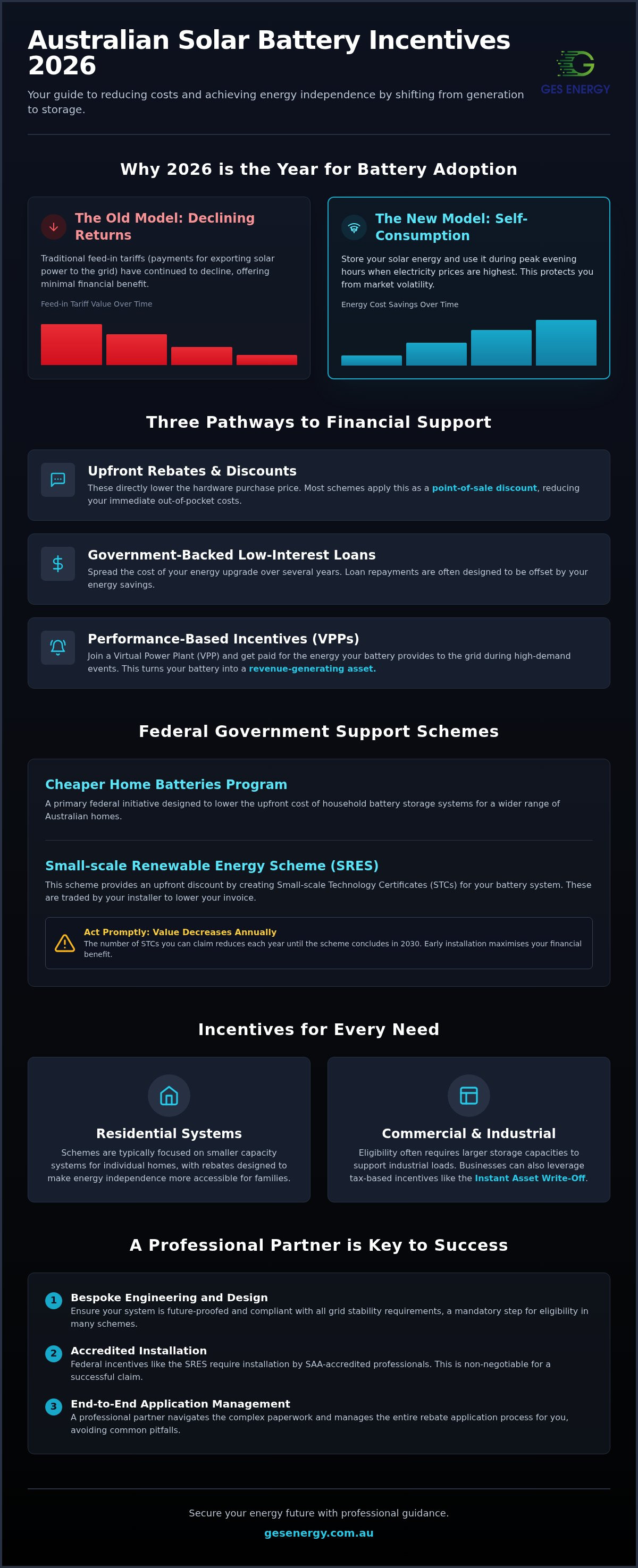
Following the 2025 energy policy updates, the financial case for storage has never been stronger. Traditional feed-in tariffs, where you get paid for sending power back to the grid, have continued to decline. Most retailers now offer very low rates for exported energy. By adopting a self-consumption model, you use your own stored power during peak periods. This is when electricity prices are at their highest. This transition ensures your energy costs remain predictable. A battery system protects you from the volatility of the wholesale energy market, providing long-term security for your household budget or business overheads.
Understanding the Types of Financial Support
Financial assistance for battery systems generally falls into three categories. Upfront rebates remain popular as they directly lower the hardware purchase price. Some states also offer government-backed, low-interest loans. These allow you to spread the cost of energy upgrades over several years, often with repayments that are offset by your energy savings. Finally, performance-based incentives are gaining traction. These involve participating in programmes where you are paid for the energy your battery provides to the grid during times of high demand. This effectively turns your storage unit into a revenue stream while supporting the wider community's energy needs.
Federal Incentives: The Cheaper Home Batteries Program and SRES
Federal support for energy storage has matured significantly. In 2026, the primary mechanism for lowering the cost of household storage is the Cheaper Home Batteries Program. This initiative works alongside the existing Small-scale Renewable Energy Scheme (SRES) to provide a multi-layered financial incentive. While the SRES was originally synonymous with solar panels, its application to battery storage has become a cornerstone of the national strategy to stabilise the grid. This federal backing ensures that a solar battery rebate is accessible to a wider range of Australian households than ever before.
The government focuses on these schemes to reduce the peak demand on our national infrastructure. By incentivising private storage, the federal government effectively builds a distributed power plant across the country. This reduces the need for expensive grid upgrades, which ultimately benefits all taxpayers. For the individual homeowner or business, it means the transition to a self-sufficient energy ecosystem is more financially viable than in previous decades.
How STCs Work for Battery Storage
Small-scale Technology Certificates (STCs) are tradable certificates that represent renewable energy generation. These certificates act as a form of currency that installers can trade to provide you with an upfront discount on your system. The value of these certificates is influenced by the "deeming period," which refers to the remaining years of the scheme until its conclusion in 2030. As we move closer to that date, the number of certificates you can claim decreases annually. This makes the timing of your installation a critical factor in the total value of your incentive. For a successful claim, the federal government requires that systems are installed by SAA-accredited professionals. Ensuring your system is designed and installed by accredited battery specialists is the most reliable way to secure these financial benefits.
Eligibility Criteria for Federal Support
Accessing federal support requires strict adherence to technical standards. Your storage hardware must appear on the Clean Energy Council (CEC) approved list to qualify for any federal solar battery rebate. This list is updated frequently to ensure only safe, high-performance equipment enters Australian homes. Eligibility also depends on the scale of the project. Residential systems typically have different capacity limits compared to commercial and industrial energy storage systems. While most households are eligible regardless of income, some specific federal grants within the Cheaper Home Batteries Program may be prioritised for low-income earners or communities in regional areas. Proper engineering and design are essential to navigate these criteria and ensure your property qualifies for the maximum available support.
State-Based Incentives and the Rise of Virtual Power Plants (VPPs)
While federal support provides a foundational discount, state-based initiatives often determine the final feasibility of a storage project. In 2026, the landscape has shifted. The traditional solar battery rebate is increasingly being replaced or supplemented by Virtual Power Plant (VPP) programmes. This transition reflects a move away from simple one-off payments toward a model that rewards homeowners for their ongoing contribution to grid stability. State governments now favour solutions that allow for active energy management rather than passive hardware ownership.
Choosing between an upfront discount and an ongoing incentive model requires a clear understanding of your long-term energy goals. An upfront rebate reduces the immediate debt or capital outlay required for installation. Conversely, a VPP or performance-based credit model can lower your electricity bills consistently over the life of the system. Many Australians now find that a combination of these two approaches provides the best balance of immediate affordability and long-term return on investment.
VPP Incentives: Trading Energy for Savings
A Virtual Power Plant is a network of decentralised home batteries that work together to support the national grid. When demand for electricity spikes, the VPP provider can briefly draw power from your battery to prevent blackouts. In exchange for this access, participants typically receive a significant sign-on bonus, which functions much like a traditional solar battery rebate, followed by recurring credits on their energy bills. While this requires giving the provider a degree of control over your stored energy, modern software ensures you always retain enough power for your own household needs. This model turns your storage system into a functional asset for the community while providing you with a steady revenue stream.
State Roundup: NSW, VIC, WA, and SA
State governments continue to refine their local offerings to address specific regional grid pressures. In New South Wales, the battery incentive that launched in late 2024 remains a primary driver for household adoption in 2026, specifically targeting homes with existing solar panels. Victoria continues to lead with its Solar Homes Program, which provides a mix of interest-free loans and storage-specific discounts to eligible households. In Western Australia and South Australia, the focus has narrowed toward grid-stressed regional areas. These states often prioritise incentives for properties in "fringe-of-grid" locations where local storage can prevent expensive infrastructure upgrades. Each state has unique eligibility rules regarding property type and system capacity, making it vital to work with a partner who understands the local regulatory environment.
Commercial Battery Storage: Incentives for Australian Businesses
Commercial and industrial (C&I) operations face distinct energy challenges compared to residential households. High operational costs are often driven by peak demand charges. These are specific fees based on the highest level of electricity used at any single point during a billing period. A commercial energy storage system allows a business to store power when rates are low and discharge it when demand peaks. This process, known as load shifting, provides a level of financial predictability that traditional energy procurement simply cannot match. It gives business owners direct control over their overheads and reduces reliance on the volatile wholesale market.
While a standard solar battery rebate might target smaller residential units, businesses in 2026 can access sophisticated tax-based incentives. Securing a commercial solar battery rebate or tax deduction requires meticulous documentation of the system's intended use and efficiency ratings. These programmes are designed to encourage the adoption of modern infrastructure that reduces the overall strain on the Australian grid. By integrating storage, companies don't just save on monthly bills; they future-proof their operations against energy market volatility. The transition to a smarter energy ecosystem is a strategic move for any business looking to maintain a competitive edge.
Tax Incentives and Depreciation for Businesses
The Small Business Energy Incentive remains a primary vehicle for commercial energy upgrades in 2026. This scheme allows eligible businesses to claim additional deductions on assets that support electrification and more efficient energy use. When this is combined with the Instant Asset Write-Off, the net cost of a battery installation is significantly reduced. This financial synergy between commercial solar and battery storage accelerates the return on investment. By effectively reducing peak demand charges, businesses often see a more rapid payback period than they would with a solar-only installation. It's a practical remedy for the challenge of rising industrial energy prices.
Large-scale Incentives (LGCs) for Industrial Sites
Larger industrial projects move beyond the scope of the Small-scale Renewable Energy Scheme. These systems typically qualify for Large-scale Generation Certificates (LGCs). Unlike Small-scale Technology Certificates (STCs), which are usually provided as an upfront discount, LGCs are generated based on the ongoing renewable energy output of the system. Addressing the legal and technical compliance for these certificates requires specialised Engineering, Procurement, and Construction (EPC) services. Professional oversight ensures that every component of the system meets the rigorous standards required for high-value certificate generation. You can learn more about how we integrate these complex systems by reading about our commercial solar installation services.
At GES Energy, we've designed bespoke systems for various industrial applications that focus specifically on the mechanics of load shifting. By custom-engineering the storage capacity to match a site's unique load profile, we maximise the available financial incentives while ensuring technical reliability. If you want to understand how these tax benefits and rebates apply to your specific facility, you can consult with our commercial engineering team for a detailed feasibility study and ROI analysis.
Maximising Your Rebate with a Professional Installation Partner
Attempting a DIY application for a solar battery rebate often leads to administrative bottlenecks or total rejection. Small errors in serial numbers, incorrect hardware listings, or missing accreditation dates can stall a claim for months. These complexities are why a professional partnership is essential. At GES Energy, we manage the end-to-end rebate process for our clients. This ensures that the technical design of your system aligns perfectly with the specific regulations active in 2026. We act as a diligent steward of your transition, handling the intricate paperwork so you can focus on the long-term performance of your new infrastructure.
Moving from the research phase to a commissioned battery system requires a methodical approach. A professional partner doesn't just install hardware; they design a total energy ecosystem. This involves verifying that every component is compliant with both federal and state standards. By securing an expert team, you gain peace of mind that your investment is protected by stable, reliable engineering. This structured process mirrors the meticulous planning we apply to every project, ensuring you capture every available financial incentive without the stress of navigating the bureaucracy alone.
Why Engineering Design Matters for Rebates
System sizing directly dictates the number of Small-scale Technology Certificates (STCs) your project generates. An oversized or poorly configured system might fail to meet the specific efficiency thresholds required by certain state-based programmes. We ensure your inverter and battery configuration are future-proofed for the latest grid requirements. This technical foresight is vital for maintaining eligibility as regulations evolve. Before adding storage, we also perform a professional health check on your existing solar panels. This identifies any underlying issues that could compromise your solar battery rebate eligibility or the overall longevity of the system.
The GES Energy Approach to Energy Independence
Our commitment is rooted in transparency and technical proficiency. We provide national support for residential, commercial, and off-grid clients, ensuring every Australian has access to high-level engineering and design. Capturing the maximum incentive requires a partner who understands the intricacies of both federal grants and local VPP credits. We offer a steady, composed path toward total energy control and predictable utility costs. If you are ready to secure your energy future, contact GES Energy for a custom solar and battery quote to begin your transition with an expert team.
Securing Your Energy Independence in 2026
The transition toward decentralised energy storage has made 2026 a landmark year for Australian households and businesses. As traditional feed-in tariffs continue to decline, the financial case for storage relies on capturing every available solar battery rebate and participating in grid-stabilising VPP programmes. You now have the opportunity to move beyond passive energy consumption and become an active participant in a resilient national grid. This shift doesn't just lower your bills; it provides long-term predictability and protection against fluctuating wholesale electricity prices.
Success in this new energy environment requires more than just hardware. It demands precise engineering and a partner who understands the intricate eligibility rules of federal and state schemes. As a national energy specialist, GES Energy provides the end-to-end design and rebate management required to ensure your system performs at its peak from day one. Our SAA-accredited installers are ready to help you navigate these technical requirements with confidence. You can get a professional quote on solar and battery storage today to start your journey toward total energy control. We look forward to helping you future-proof your property with a system built for the next decade of Australian energy.
Frequently Asked Questions
Is there still a federal solar battery rebate available in 2026?
Yes, federal support remains available through the Cheaper Home Batteries Program and the Small-scale Renewable Energy Scheme (SRES). These initiatives allow you to generate Small-scale Technology Certificates (STCs) which act as a direct discount on your installation. While the value of these certificates decreases annually as we approach 2030, they still provide a significant financial incentive for households looking to reduce their reliance on the grid.
Can I claim a battery rebate if I already have solar panels installed?
Yes, you can claim a solar battery rebate for retrofitting a storage system to an existing solar array. Many state-specific programmes, such as the New South Wales Battery Incentive, are designed specifically for homeowners who already have solar panels but want to add storage. Eligibility usually depends on your existing system meeting current technical standards and being installed by an accredited professional who can certify the new battery integration.
What is the difference between a rebate and a Virtual Power Plant (VPP) incentive?
A rebate is typically a one-off financial benefit provided at the point of sale to reduce the upfront purchase price. In contrast, a Virtual Power Plant (VPP) incentive is an ongoing arrangement where you receive credits or payments in exchange for allowing a provider to manage your battery during peak demand. While a rebate helps with the initial cost, a VPP provides a recurring revenue stream that improves the long-term return on your investment.
How much can a battery rebate actually save me on the total cost?
The total savings depend on the specific federal and state schemes you are eligible to stack together. By combining the federal STC discount with state-based incentives or VPP sign-on bonuses, many Australians reduce their out-of-pocket costs by several thousand dollars. The exact amount is determined by the battery capacity and your location, as regional areas often have access to higher incentive tiers to support local grid stability.
Do I need a specific type of inverter to qualify for battery rebates?
Yes, your inverter must be on the Clean Energy Council (CEC) approved list to qualify for any government financial support. Most rebates require a smart or hybrid inverter that is capable of communicating with the grid and managing bidirectional energy flow. If you have an older inverter, you might need to upgrade to a battery-compatible model to ensure your entire system meets the strict technical criteria required for a successful claim.
Are commercial businesses eligible for the same battery rebates as households?
Commercial businesses are eligible for financial support, but the schemes differ from residential offerings. Instead of standard household rebates, businesses often utilise the Small Business Energy Incentive or Large-scale Generation Certificates (LGCs) for bigger installations. Tax-based benefits like the Instant Asset Write-Off also play a major role in making commercial energy storage viable. These incentives focus on load shifting to reduce peak demand charges on industrial electricity bills.
What paperwork is required to claim the solar battery rebate in Australia?
Claiming a solar battery rebate requires several key documents, including a certificate of electrical safety and proof of SAA-accredited installation. You will also need to provide the specific model numbers of your CEC-approved hardware and your grid connection approval from the local network service provider. Professional installers usually manage the majority of this paperwork on your behalf, ensuring all technical data is submitted correctly to avoid delays in approval.
How long does it take for a battery rebate to be approved and paid?
The timeline for approval depends on whether the incentive is applied as an upfront discount or a post-installation payment. Point-of-sale discounts are applied immediately to your invoice, meaning you see the benefit on day one. For schemes that involve direct government applications or VPP sign-on bonuses, processing times typically range from four to twelve weeks. Working with an experienced partner helps streamline this process by ensuring all documentation is accurate from the start.


