

What if the biggest threat to your facility's energy transition isn't the cost of hardware, but the fragmented management of the project itself? You're likely feeling the pressure of unpredictable energy price hikes and the tightening of Australian grid-connection regulations. It's a common concern that the complexity of modern compliance, such as the 2026 CSIP-AUS inverter standards, might lead to costly delays or operational downtime during installation. By utilising professional industrial solar epc services, you can eliminate these risks and secure full energy independence through a single point of accountability.
We're here to help you master the intricacies of the Engineering, Procurement, and Construction model to ensure your investment delivers a reliable ROI with minimal administrative burden. This guide provides a methodical look at the 2026 industrial landscape, covering everything from Large-scale Generation Certificates to the latest engineering safety standards required for a future-proof energy ecosystem. You'll learn how a structured approach to design and oversight can transform your energy profile from a volatile liability into a stable, high-performing asset.
Key Takeaways
- Master the Engineering, Procurement, and Construction framework to transition from fragmented installations to a unified, turnkey energy solution.
- Discover how professional industrial solar epc services utilise digital twins and site-specific yield forecasting to guarantee performance in local climates.
- Learn how to navigate the 2026 procurement landscape to secure Tier-1 hardware that meets the latest AS/NZS electrical safety standards.
- Identify the essential markers of a quality EPC partner, ranging from SAA-accredited commissioning to comprehensive long-term maintenance programs.
- Understand the strategic role of BESS and EV charging in future-proofing your facility against volatile energy markets and evolving grid requirements.
What are Industrial Solar EPC Services? Defining the Standard
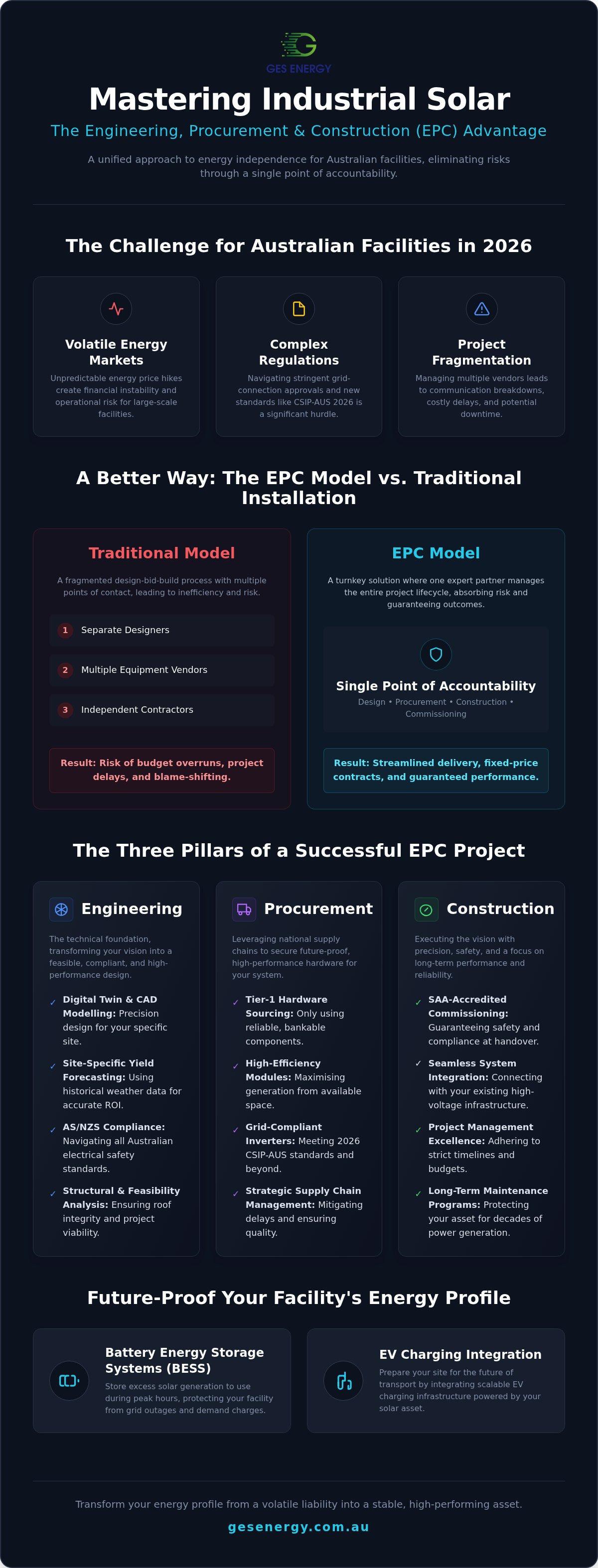
Industrial energy projects have evolved far beyond simple rooftop additions; they're now sophisticated infrastructure investments that require meticulous oversight. At its core, the Engineering, procurement, and construction (EPC) model provides a turnkey solution where one entity manages the entire lifecycle of a solar plant. This transition from a basic 'solar installer' to a comprehensive EPC partner is vital for Australian businesses aiming to secure energy independence without the headache of managing multiple contractors.
For large-scale facilities, industrial solar epc services act as a safeguard against the technical and regulatory risks inherent in the Australian market. Unlike residential setups, industrial systems must navigate stringent grid-connection approvals and complex AS/NZS electrical safety standards. An EPC specialist doesn't just bolt panels to a roof; they engineer a system that integrates seamlessly with your existing high-voltage infrastructure while ensuring the hardware is procured through reliable, Tier-1 supply chains.
The Single Point of Accountability Model
Project friction often occurs when communication breaks down between separate designers, equipment vendors, and electrical contractors. The EPC framework eliminates this by providing a single point of accountability. This model streamlines every interaction, ensuring that the engineering team is in constant dialogue with the construction crew. It's a strategy that protects your operational margins through fixed-price contracts, as the EPC provider absorbs the responsibility for project timelines and coordination. By removing the need for multi-vendor management, you can focus on your core business while your energy transition is handled by a dedicated steward.
EPC vs. Traditional Solar Installation
The difference between traditional installation and industrial solar epc services often comes down to the depth of the design-build approach. Traditional models frequently rely on a design-bid-build process, which can lead to finger-pointing if the final system doesn't meet the initial yield forecasts. In contrast, the EPC model is built for the 100kW to 5MW scale, where precision is non-negotiable. Key advantages of this end-to-end oversight include:
- Customised Engineering: Every site has unique load profiles and structural constraints that require bespoke electrical design.
- Strategic Procurement: Leveraging national supply chains to secure high-efficiency bifacial modules and grid-compliant inverters.
- Commissioning Excellence: Using SAA-accredited labour to ensure the system is safe, compliant, and ready for long-term performance.
Choosing an EPC framework means you're investing in a long-term asset rather than a short-term product. It ensures that the design you approve is exactly what's built, commissioned, and maintained for decades of reliable power generation.
The Engineering Phase: Design, Compliance, and Feasibility
Engineering is the technical foundation of any successful energy transition. It's where the conceptual vision meets the reality of Australian site constraints and electrical grid requirements. Professional industrial solar epc services begin with a deep dive into data, moving beyond simple estimates to create a digital twin of your facility using advanced CAD modelling. This process ensures that the proposed system isn't just feasible on paper but is optimised for the specific irradiance levels and thermal conditions of your local region, whether you're operating a distribution centre in an urban centre or a remote mine in a regional area.
Feasibility and Yield Analysis
We use decades of historical weather data to forecast annual generation with high precision. This analysis accounts for complex shading from adjacent structures and evaluates the structural integrity of industrial roofs to support multi-megawatt arrays. By identifying these variables early, we can accurately calculate the commercial solar roi australia, ensuring your capital expenditure is backed by reliable performance metrics. It's about turning environmental data into financial predictability and ensuring every square metre of your roof space is working toward your energy independence.
Compliance in 2026 requires a sophisticated understanding of evolving Australian solar installation standards. This includes adhering to AS/NZS 5033 for PV arrays and the latest iterations of AS/NZS 4777 for grid-connected inverters. With new mandates like CSIP-AUS compliant inverters now mandatory across various regions and progressively being implemented nationwide, the engineering phase must account for dynamic export limits and remote grid communication. We also integrate C&I energy storage systems (BESS) at this stage, ensuring the primary solar design and battery capacity are perfectly balanced to handle peak demand periods and provide essential backup power during grid instability.
Regulatory Approvals and Grid Connection
Navigating the paperwork is often the most significant hurdle for industrial projects. Our engineers manage the entire Network Service Provider (NSP) application process, conducting the technical studies required for grid-connection approval. Whether your site requires a zero-export configuration or a complex grid-feed agreement, having SAA-accredited engineers oversee the certification ensures the system meets all local utility requirements. This diligent oversight reduces the risk of project delays and ensures your facility is ready for commissioning the moment construction concludes. If you're ready to see how these standards apply to your site, you can request a technical site assessment from our engineering team.
Procurement and Construction: Executing the Industrial Vision
Translating a digital twin into a physical asset requires more than just labour; it demands a robust procurement strategy. Using industrial solar epc services ensures that every component, from high-efficiency inverters to bifacial solar modules, is sourced through a vetted national supply chain. We focus on Tier-1 hardware that offers high bankability, which is essential for businesses looking to secure financing or long-term insurance for their energy assets. By managing these international lead times directly, we prevent the delays that often plague smaller, fragmented installation teams.
Strategic Hardware Procurement
Selecting hardware for the Australian climate involves choosing components that can withstand extreme thermal cycling and high UV exposure. We prioritise bifacial modules for their ability to capture reflected light, which helps maximise output for systems generating Large-scale Generation Certificates (LGCs). The choice of inverter is equally critical. With the October 1, 2026 deadline for v1.2 CSIP-AUS re-certification approaching, our procurement team ensures all hardware meets the latest national requirements for grid interaction. This strategic selection ensures your system remains compliant and operational for its 25-year lifespan.
Construction Excellence and Site Safety
Industrial worksites are high-risk environments where safety is the primary priority. Our construction management team implements rigorous OH&S protocols that align with your facility's existing safety standards and the AS/NZS 3000 wiring rules. We coordinate closely with your operations manager to schedule heavy lifting and electrical shutdowns during low-production windows. This meticulous planning prevents production downtime, ensuring your business continues to function while we execute the mechanical and electrical fit-out.
Every project concludes with rigorous commissioning and performance testing. Our SAA-accredited labour performs comprehensive checks to ensure the installation meets AS/NZS 5033 standards for PV arrays and AS/NZS 4777 for grid connection. This isn't just a formality; it's a critical verification step that guarantees the system performs exactly as the engineering phase predicted. By maintaining a single point of accountability during construction, we ensure that the quality of the build matches the precision of the design.
How to Evaluate an Industrial Solar Installer in 2026
Choosing the right provider for industrial solar epc services is a strategic decision that impacts your facility's operational efficiency for decades. In 2026, the Australian market is crowded with residential installers attempting to scale up, but industrial projects require a vastly different technical skill set. You need a partner with a proven track record in the 100kW to 5MW range who understands the specific load profiles of heavy industry. Vetting an installer involves looking beyond the initial quote to examine their technical depth and long-term commitment to your asset's health.
Vetting Technical Expertise
Case studies are your most valuable tool during the evaluation process. Request detailed reports on previous projects with similar load profiles and structural challenges to your own. It's essential to confirm that the provider maintains in-house engineering and electrical teams rather than relying solely on third-party subcontractors. This internal cohesion ensures that the design intent is maintained from the first CAD model to the final commissioning. Additionally, evaluate their financial stability. You need a partner who will still be operational in a decade to honour warranties and provide technical support as your system ages.
O&M and Performance Monitoring
The value of a commercial solar installation that includes a health-check program cannot be overstated. Industrial ROI is directly tied to system uptime, making real-time performance monitoring a non-negotiable requirement. A high-quality EPC provider will offer sophisticated O&M (Operations and Maintenance) programs that balance scheduled maintenance with predictive analytics. This proactive approach identifies potential inverter faults or panel degradation before they lead to significant generation losses, ensuring your investment continues to perform at its peak.
Beyond basic solar, your partner should demonstrate proficiency in integrating advanced infrastructure like EV charging stations and micro-grid solutions. As Australian businesses shift toward fleet electrification, your solar system must be capable of supporting these additional loads without compromising grid stability. Transparency regarding performance guarantees is the final piece of the puzzle. Ensure your contract clearly outlines the expected yield and the specific terms of hardware warranties, protecting your investment against unforeseen technical failures. If you're ready to partner with a specialist that manages the entire risk profile of your project, you can contact our expert team today for a comprehensive evaluation of your site's potential.
The Strategic Advantage: Why EPC is the Future of Industrial Power
Adopting a long-term energy strategy is no longer optional for Australian industrial operators facing double-digit price fluctuations. By centralising your infrastructure management through industrial solar epc services, you transition from being a passive consumer to an active energy producer. This model provides the predictability required for multi-year financial planning, effectively hedging your operational costs against a volatile national market. Beyond immediate savings, a comprehensive EPC approach ensures that your facility is prepared for the inevitable shift toward full electrification and carbon reporting requirements.
The true value of an EPC partnership lies in its ability to view your facility as a total energy ecosystem. While a standard installer might focus on the immediate count of panels, an EPC specialist designs for the next twenty years. This involves integrating scalable technologies that can grow alongside your business. It's a method that prioritises long-term health and maintenance, ensuring that the engineering excellence established in the early phases continues to deliver a guaranteed ROI through every season of operation.
Future-Proofing with Micro-Grids and Storage
The road to 2030 decarbonisation targets requires more than just solar arrays; it demands an integrated infrastructure. Professional industrial solar epc services facilitate this by designing systems ready for standalone micro-grids and large-scale C&I energy storage systems. For remote mining and construction sites, we deploy portable off-grid solutions that provide reliable power where traditional grid access is limited. This scalability ensures that as your energy needs grow, whether through fleet electrification or expanded production lines, your infrastructure can adapt without requiring a complete system overhaul. Integrating a BESS (Battery Energy Storage System) now allows you to take advantage of tiered federal battery rebates, currently valued at approximately A$311 per usable kWh, further securing your energy independence.
Next Steps for Your Industrial Project
Transitioning to a high-capacity solar plant is a complex undertaking that requires a steady, expert hand. GES Energy acts as your national partner, providing a turnkey experience that manages every technical and administrative detail. We specialise in projects up to 5MW, ensuring that your facility maximises available federal and state-based incentives. For systems over 100kW, we help you navigate the Large-scale Generation Certificate (LGC) market, where certificates are valued at approximately A$46.25 each, providing a consistent revenue stream for your business.
To initiate your transition, our team offers a complimentary industrial energy analysis. This assessment provides a clear roadmap for customising a solar strategy that aligns with your specific corporate sustainability goals and operational requirements. You can contact the GES Energy team to discuss your multi-megawatt requirements and secure a single point of accountability for your facility's future. It's time to take control of your energy destiny with a partner committed to your long-term success.
Securing Your Facility’s Energy Independence in 2026
Navigating the shift toward a decarbonised grid requires more than just hardware; it demands a strategic alignment of engineering, procurement, and construction. By choosing a model that offers a single point of accountability, you eliminate the friction of multi-vendor management and ensure your system meets the rigorous 2026 AS/NZS standards. Whether you're integrating battery storage or preparing for fleet electrification, professional industrial solar epc services provide the technical foundation needed for multi-decade reliability.
Our SAA-accredited engineering team focuses on the specific needs of 100kW to 5MW industrial plants, offering national coverage for both remote mining sites and urban distribution centres. It's time to move beyond the uncertainty of energy market hikes and invest in a future-proof energy ecosystem that puts you in total control of your operational costs. Secure your industrial energy future with GES Energy's turnkey EPC services.
The transition to renewable infrastructure is a significant milestone for any business. With the right partner, you can turn complex regulatory requirements into a competitive advantage that secures your bottom line for years to come.
Frequently Asked Questions
What is the difference between a solar installer and an EPC contractor?
An EPC contractor provides a comprehensive turnkey solution that manages the entire project lifecycle; whereas a standard installer typically focuses on the physical mounting of hardware. Professional industrial solar epc services include sophisticated site-specific engineering, technical grid-connection studies, and long-term asset management. This single point of accountability ensures that the design intent is maintained during construction, reducing the risk of technical failures or yield shortfalls that often occur with fragmented vendor models.
How long does a typical industrial solar EPC project take from design to commissioning?
A typical industrial project generally takes between four to nine months from initial design to final commissioning. The engineering and grid-connection approval phase often requires several months to navigate utility requirements and technical studies. Construction is usually faster, depending on the system size, but meticulous planning is required to ensure minimal disruption to your facility's daily operations and production schedules.
Can an EPC provider help with grid-connection approvals in Australia?
Yes, managing grid-connection approvals is a fundamental component of the EPC model. Your provider handles the entire application process with the Network Service Provider (NSP), including the complex technical studies required for compliance. This is essential for navigating modern regulations like the 2026 CSIP-AUS inverter mandates, ensuring your system is certified and ready to operate legally within the Australian energy market.
What are the maintenance requirements for a multi-megawatt industrial solar system?
Multi-megawatt systems require a structured Operations and Maintenance (O&M) program to protect your investment. This includes real-time performance monitoring, annual thermal imaging of panels, and regular inverter health checks to ensure continued safety and efficiency. Proactive maintenance identifies potential faults before they lead to generation losses, ensuring your system continues to meet its predicted yield and ROI targets over its 25-year lifespan.
How does an EPC contract protect my business from cost overruns?
An EPC contract protects your business by providing a fixed-price structure where the contractor assumes the risk for project delivery. Because the EPC provider manages both procurement and construction, they're responsible for any price fluctuations in hardware or labour delays. This model ensures your capital expenditure remains predictable, protecting your operational margins from the unforeseen costs that often arise when managing multiple independent contractors.
Is it possible to integrate battery storage into an existing industrial solar array?
It is entirely possible to integrate C&I energy storage systems into existing arrays, though the technical approach depends on your current inverter setup. An EPC specialist can engineer an AC-coupled or DC-coupled solution that allows your facility to store excess solar energy for use during peak demand periods. This integration is a key strategy for achieving full energy independence and future-proofing your site against rising network charges.
What certifications should I look for in an Australian industrial solar installer?
You should prioritise providers with SAA-accredited engineers and labour for all design and commissioning work. It's also vital to verify that the installer has specific experience with large-scale 100kW to 5MW projects. Ensure they strictly adhere to current Australian standards, including AS/NZS 5033 for PV arrays and AS/NZS 4777 for grid-connected inverters, to guarantee the safety and compliance of your high-voltage infrastructure.
How do EPC services handle system performance guarantees?
EPC providers handle performance guarantees by using advanced yield forecasting based on decades of historical Australian weather data. These guarantees are backed by sophisticated industrial solar epc services that include real-time monitoring and automated reporting. If the actual generation deviates from the predicted metrics, the monitoring system allows for rapid troubleshooting to identify and remedy the cause, ensuring your energy asset performs as promised.


