

A shaded roof doesn’t automatically make microinverters the better choice. The key difference in the comparison of microinverters vs power optimisers is where electricity is converted: microinverters convert each panel’s direct current (DC) to alternating current (AC), while power optimisers condition DC at each panel and rely on a central inverter for conversion. That central inverter is a potential single point of failure in an optimiser system.
Shade and reliability matter when roof sections receive different amounts of sunlight or face different directions. Both technologies can help panels operate more independently than a standard string inverter, but neither can restore sunlight blocked by trees, chimneys or nearby buildings.
This guide explains how each system connects to your panels, what happens to the electricity they produce, and how shade and a complex roof can affect performance. You’ll also see how the options compare on system design, maintenance and cost factors, helping you judge which approach better suits your roof and energy priorities.
Key Takeaways
- Match the system to where shade falls and how your roof is divided across different orientations.
- Understand the key design difference: microinverters convert power at each panel, while power optimisers depend on a central inverter.
- Consider how each setup responds when a panel is shaded and what a central inverter’s role means for system operation.
- Compare system architecture, monitoring and maintenance needs alongside the equipment options available in Australia.
- Use the decision guide to identify which approach better fits your roof layout and energy priorities.
Efficiency improvements in partially shaded conditions
Partial shade reduces the sunlight reaching affected panels, but system design determines how that loss affects other panels. Microinverters and power optimisers manage panel-level output differently from a standard string inverter.
Shading and system efficiency
System efficiency describes how well a solar system turns available sunlight into usable electricity across its panels. With a standard string inverter, panels share an electrical pathway, so shade on one panel can affect the string’s output. Microinverters and power optimisers reduce this shared effect by managing each panel’s output separately.
For example, if a chimney shades one panel for part of the day, the remaining panels can continue producing electricity more independently with either technology. Neither option removes the shade or restores the sunlight blocked from that panel.
Conversion efficiency
Conversion efficiency measures how effectively an inverter changes a panel’s direct current into alternating current for household use. It differs from panel efficiency, which describes how effectively a panel converts sunlight into electrical energy. Shade reduces the energy available before conversion, so a high conversion figure cannot recover sunlight blocked by a roof obstruction.
Compare conversion specifications separately from shade response. For a roof with a chimney shadow, the panel-level operation of microinverters or optimisers can matter more to system output than conversion efficiency alone.
Solar panel efficiency also depends on how much sunlight reaches each panel. A panel in full sun and an otherwise similar panel beneath tree shade receive different amounts of solar energy, even when their equipment matches. Panel-level electronics manage how that difference affects the wider system; they don’t make shaded panels as productive as sunlit ones.
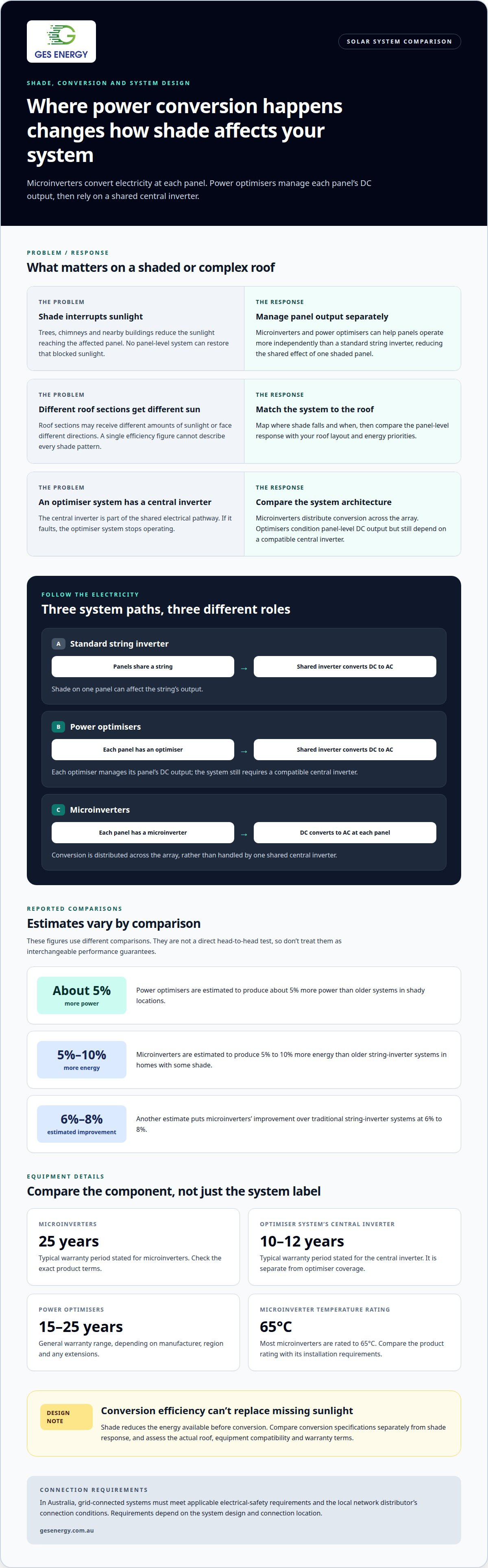
Reported comparisons estimate power optimisers can produce about 5% more power than older systems in shady locations. Microinverters are estimated to produce 5% to 10% more energy than older string-inverter systems in homes with some shade. Another estimate puts microinverters’ improvement over traditional string-inverter systems at 6-8%. These figures use different comparisons, so they are not a direct head-to-head test.
| System option | Panel-level response | Shade consideration |
|---|---|---|
| String inverter | Panels share a string | Shade can affect string output |
| Power optimisers | Manage each panel’s DC output | Reduce the effect of one shaded panel |
| Microinverters | Convert output at each panel | Other panels operate independently |
When assessing a roof, map where shade falls and when, then compare how each system handles the affected panel. A tree shadow moving across one section differs from persistent shade covering several panels.
Choose based on the roof’s shade pattern and the system’s panel-level response, not a single efficiency percentage.
How string inverters, power optimisers and microinverters connect to solar panels
Connection design determines how panel wiring, inverter equipment and the grid fit together. In Australia, grid-connected systems must meet applicable electrical-safety requirements and the local network distributor’s connection conditions. These depend on the system design and connection location.
Power optimisers with string inverters
In an optimiser setup, each panel connects to its own optimiser, and the optimisers feed a shared string inverter. The inverter is therefore a central component in the system’s electrical pathway. Its compatibility with the panels and optimisers matters during design, as does the route connecting the array to the inverter. A fault in that inverter stops the optimiser system from operating.
Optimisers can be built into panels or fitted separately. This affects the equipment arrangement, but the system still needs a compatible central inverter. Design the system around the selected components as a matched set, rather than treating each panel device as an independent inverter.
DC-to-AC conversion
Conversion equipment provides the interface between the solar array’s output and the home’s AC electrical supply. In a string-based arrangement, conversion takes place at the shared inverter; microinverter systems distribute that function across the array. This distinction affects which equipment belongs in the grid-connection design and which component plays the central role.
For microinverter installations, operating temperature is one specification to consider. Most microinverters are rated to 65°C. This gives you a concrete equipment rating to compare with the product’s installation requirements and the site design.
Warranty periods differ by component and manufacturer. Microinverters typically have a 25-year warranty, while the central inverter in a power optimiser system typically has a 10 to 12-year warranty. Power optimisers and DC optimisers are generally covered by warranties lasting 15-25 years, depending on the manufacturer, region and any extensions.
Read the warranty terms for the exact equipment in your system. In an optimiser arrangement, distinguish the optimiser coverage from the central inverter coverage, as they are separate components. For microinverters, check the terms for the panel-level units. The stated warranty period alone does not describe every condition of coverage.
Keep the equipment schedule, product documentation and grid-connection records with your system information. These identify the installed inverter and optimiser models, making warranty enquiries and technical servicing more precise. The system’s installer also needs to design the connection around the local distributor’s requirements, rather than assume conditions are identical across Australia.
Solar system performance on complicated roofs
A roof with several orientations, hips, valleys or obstructions needs a layout suited to each panel group. For example, east- and west-facing panels receive sunlight at different times, while a chimney may shade just one roof section. Microinverters and power optimisers can support panels across multiple orientations and handle shade better than a standard string inverter. The final choice depends on how those roof conditions interact with the system design.
Panel-level equipment can help limit the effect of differences between roof sections. With microinverters, each panel converts its own output. With power optimisers, each panel’s DC output is regulated before a central inverter converts it. A standard string inverter connects panels in a shared string. On a roof where one section gets morning sun and another afternoon sun, panel-level options allow a more flexible design than a basic string arrangement.
Reliability also depends on which components the system needs to keep operating. A power optimiser system relies on its central inverter, so an inverter failure can stop the whole system. Microinverters avoid that single central conversion point, although each unit remains a component that could fail. Reported estimates put optimiser failures at about 1 in 1,300 and microinverter failures at about 1 in 1,500. These figures describe reported equipment failures, not a prediction for a particular installation.
Installation time varies with the site and installation team. Microinverter systems are generally faster to install than string-inverter systems with power optimisers, but roof access, layout and electrical design affect the work. Scalability also depends on inverter architecture and the planned array. Adding panels on a different roof face requires consideration of the new orientation, shading and system compatibility, rather than assuming spare roof space is automatically usable.
Upfront costs include more than the panel-level devices. Power optimisers generally cost less than microinverters, but an optimiser system also needs a central inverter. Equipment selection, installation complexity, roof access and electrical design all influence overall cost. A roof with several small sections may need a different design from a broad, uninterrupted roof, so equipment prices alone don’t show which solution offers better value.
For a practical choice, compare the roof’s orientations and shade pattern, then assess central equipment, installation requirements and future expansion. On a Victorian home with east- and west-facing roof sections, the design should account for when each section receives sunlight. On a roof with one dominant face and few obstructions, a simpler string-based design may suit the layout. The best fit addresses the actual roof constraints without adding complexity that offers little benefit.
How microinverters and power optimisers work
To understand either design, view the solar system as a chain of connected components rather than a choice of panel accessory. Start with the modules, then identify the panel-level devices, inverter equipment, switchboard connection and any battery storage. A system diagram shows which equipment belongs to the generation array and which serves the wider property.
The panel-level device affects the system layout and the components that must work together. In an optimiser design, the optimiser and central inverter form a coordinated set. A microinverter design uses inverter units associated with each panel. This difference matters when checking whether the selected equipment matches the solar modules and intended array configuration.
Storage adds another design interface. A battery is not the same component as a microinverter or power optimiser: it stores electricity for later use. The project design needs to account for how generation equipment, storage and the property’s electrical system fit together. For example, a homeowner planning to add storage later should include that requirement in the initial system design.
Read specifications as a set, not in isolation. Check the named panel and device models against the inverter arrangement shown in the system design. An individual component’s specification cannot establish that the full system is compatible. The equipment schedule should identify the proposed design’s parts clearly, distinguishing panel equipment, inverter equipment and storage.
Viewing the system as a whole also makes future changes easier to assess. If the property later adds battery storage or changes its solar array, the original configuration helps show which interfaces may be affected. Consider a planned change as a system-design question, not just a matter of adding another device. Compatibility depends on the components and layout already in place.
For a practical review, follow the diagram from the solar modules to the property connection. Identify each component by its role, then compare that role with the manufacturer’s documentation for the selected model. This helps prevent confusion between an optimiser, an inverter and a battery, especially when product descriptions use similar electrical terms.
The key takeaway is to assess each option as part of a complete energy system. The device name alone doesn’t explain how the array, inverter equipment, storage and property connection fit together. A clear component schedule and system diagram provide a more reliable basis for understanding the design and planning future changes.
Which microinverter and power optimiser brands and models are available in Australia?
Enphase is a confirmed microinverter brand relevant to Australian solar systems. The model needs to suit the panel and installation design. For power optimisers, assess the selected optimiser together with its compatible central inverter. This is more useful than relying on a brand name without checking the equipment pairing.
Model choice depends on the specifications for the full system. Compare the panel’s electrical requirements with the device’s input limits, then consider the inverter arrangement, monitoring features and warranty terms. These details help distinguish products that serve similar roles but may suit different system designs.
- Panel compatibility: Match the model’s electrical requirements to the selected solar panel.
- System arrangement: Confirm whether the design uses panel-level inverters or a central inverter with optimisers.
- Roof layout: Check the model’s suitability for the planned panel arrangement across roof faces.
- Monitoring: Compare the performance information available for the system’s panels and inverter equipment.
- Warranty: Review coverage for each selected device and the central inverter, where applicable.
For an Enphase microinverter system, match the specific unit to the panel and electrical design. For an optimiser system, assess the optimiser and central inverter as a pair. A product name alone doesn’t establish compatibility or expected performance on a particular roof.
Australian product ranges and model availability can change. Use the manufacturer’s current model documentation when comparing equipment for a proposed installation. This gives you a basis for reviewing electrical specifications, system compatibility and warranty conditions without treating all products from one brand as interchangeable.
Focus your final comparison on the exact models in the proposed design, their compatibility with the panels, and how they fit the roof layout. This grounds the decision in equipment specifications and system requirements rather than brand recognition alone.
GES ENERGY: Micro Grid Solutions
GES ENERGY provides Microgrid Solutions for projects where solar generation, storage and energy demand need coordinated design. This can suit a site whose needs extend beyond choosing panel-level equipment, such as a commercial facility planning solar generation alongside its broader energy infrastructure.
For a business assessing a complex roof, Commercial and Industrial Solar can address the solar system design, while Microgrid Solutions can support a broader site energy strategy. Off-Grid Solar is relevant where a project needs an off-grid approach, and EV Charging Solutions can form part of a site’s electricity requirements.
Contact GES ENERGY to discuss how your project’s roof, generation and energy needs fit together.
Make your next solar decision with confidence
Turn the technical comparison into a project brief. Note which roof areas receive shade, how the roof faces are arranged, and when your household or site uses the most electricity. Include planned changes, such as adding battery storage or electric vehicle charging. These details help frame the design around how you use energy, not just the equipment installed on the roof.
The choice between microinverters and power optimizers is one part of that planning. Weigh the system architecture against your roof, energy priorities and future plans. A considered design helps you understand the trade-offs before committing to equipment and installation.
Contact GES ENERGY about your solar options to discuss the needs your project should address. With a clear brief, you can move forward with a better understanding of what your solar system needs to do.
Frequently Asked Questions
A single point of failure?
A central inverter is a shared failure point in a power optimiser system: if it fails, the system stops working. A fault in that inverter can interrupt generation from every connected panel, even if the panels and optimisers remain operational. Microinverters avoid one central conversion unit, so a fault in one unit affects its associated panel rather than creating the same system-wide dependency.
Efficiency numbers: what do they really mean?
Efficiency figures only make sense alongside their comparison baseline and test conditions. A reported improvement over an older string-inverter system doesn’t establish that one panel or technology will deliver the same gain on your roof. Shade duration, panel orientation and the equipment included in the comparison all matter. Check whether a figure describes inverter conversion, panel performance or the whole system’s energy output.
Microinverters versus optimisers: which solar power solution is right for you?
The right solution depends on your roof layout, shade pattern and preferred system architecture. A roof with panels split across different orientations may benefit from panel-level control. Your choice also affects which major components the system depends on and how faults can affect generation. Compare the complete design, including the inverter, monitoring approach and any planned battery storage, rather than choosing by device type alone.
So, which technology is right for your home?
Start with the roof conditions, then weigh system design and future plans. A homeowner with several roof faces and changing shade may prioritise panel-level operation. A simpler roof may not need the same design complexity. If you plan to add battery storage, include that requirement in the system design from the outset. The best fit meets your household’s energy needs and roof constraints.
What happens when something goes wrong?
The effect depends on which component fails. A central inverter fault can stop a power optimiser system, while a microinverter fault is local to the panel connected to that unit. Note the inverter or device model, the fault indication and any change in system output. Warranty coverage depends on the manufacturer’s terms and specific equipment, so keep product and installation records accessible.
What is a DC optimiser?
A DC optimiser is an electronic device paired with an individual solar panel. It regulates the panel’s direct-current output and sends that DC electricity to a central inverter for conversion. It does not convert the power into household AC at the panel. For example, an optimiser system needs both panel-level optimisers and a compatible central inverter to complete the energy conversion pathway.
How do solar microinverters and power optimisers work?
Both technologies manage output at panel level, but conversion happens at different points. A microinverter changes a panel’s DC electricity into AC at the panel. A power optimiser regulates panel-level DC and sends it to a central inverter, which converts it into AC. This distinction affects system architecture, monitoring and how faults in shared equipment could affect generation.
What are the main differences between microinverters and power optimisers?
The main difference is where DC becomes AC. A microinverter converts power at each panel, while a power optimiser conditions DC and relies on a central inverter. An optimiser system therefore has a shared conversion unit; a microinverter system distributes conversion across the array. Compare the equipment layout, warranty terms, monitoring options and roof design to understand the practical trade-offs for your installation.


