

A portable solar generator is often marketed as a simple retail gadget, but for those operating in the Australian outback, it must be treated as a critical engineered asset. If your operations rely on consistent power, a generic unit designed for mild climates will likely fail when the mercury hits 45 degrees. Selecting the right portable off grid solar solutions requires more than just looking at a price tag. It demands a professional understanding of thermal limits, actual battery depth of discharge, and the latest 2026 safety compliance standards.
We recognise the frustration of investing in technology only to find that runtime claims don't hold up under heavy tool loads or that a unit lacks the necessary RCM mark for Australian worksite safety. You deserve energy independence that is quiet, fume-free, and entirely predictable. This guide provides the technical clarity needed to select a reliable power source that thrives in local conditions. We will examine the mandatory AS/NZS 4417.2:2026 certifications, explain how to accurately calculate your power needs for heavy appliances, and help you navigate the updated federal battery rebate tiers to ensure your system is both secure and future-proof.
Key Takeaways
- Understand why standard retail units often fail in extreme Australian heat and how to identify components engineered for local thermal conditions.
- Learn how to conduct a professional load audit to size your portable off grid solar solutions correctly, ensuring your heavy tools and appliances have reliable power.
- Discover the essential selection criteria for 2026, including the importance of IP ratings for dust protection and the benefits of modular system designs.
- Navigate the latest safety compliance requirements, including the mandatory AS/NZS 4417.2:2026 certifications and updated federal battery rebate eligibility.
- Transition from noisy, fuel-reliant generators to a silent energy ecosystem that provides total independence without the ongoing logistics of petrol or diesel.
Understanding the Power Solar Generator: More Than Just a Battery
A modern Solar generator is far more than a simple battery in a box. In 2026, these units have evolved into sophisticated energy ecosystems capable of replacing traditional petrol generators on remote Australian sites. For years, industries relied on noisy, fuel-hungry combustion engines that required constant logistics and maintenance. Today, the shift toward portable off grid solar solutions provides a silent, emission-free alternative that meets the rigorous demands of commercial and industrial operations without the environmental or acoustic footprint.
Portable power no longer implies a compromise on performance. Modern units are designed as an integrated suite of PV panels, high-density lithium storage, and advanced power electronics. This integration ensures that energy is captured, stored, and converted with minimal loss, providing a level of reliability that matches or exceeds traditional grid-tied infrastructure in remote settings.
The Anatomy of Professional Portable Power
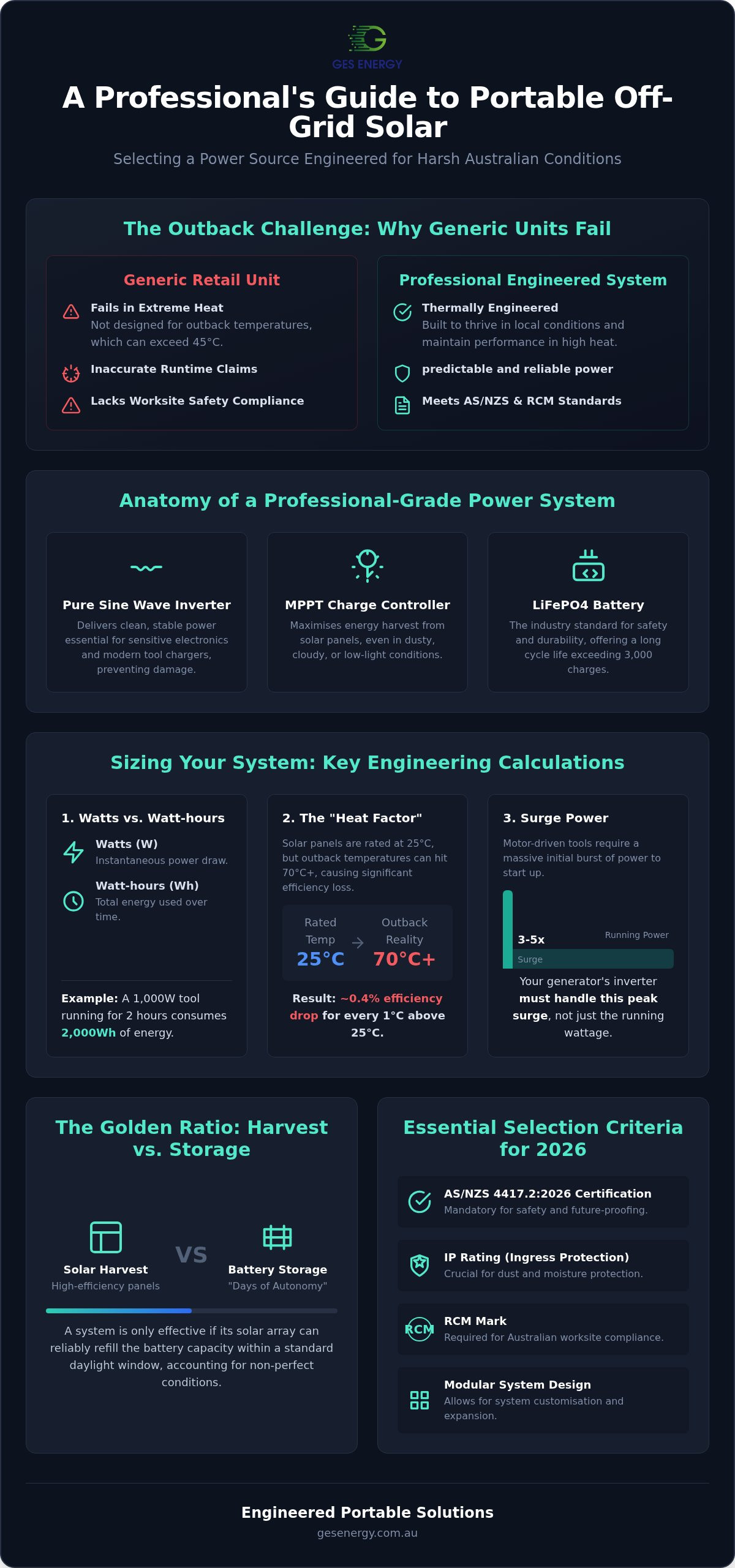
Precision engineering defines a professional-grade unit. Unlike entry-level retail models, industrial-strength systems utilise Pure Sine Wave Inverters. These are essential because they deliver clean, stable power that won't damage sensitive diagnostic equipment or modern power tool chargers. To manage the input, high-performance Maximum Power Point Tracking (MPPT) charge controllers are used to maximise energy harvest, even when the Australian sun is partially obscured by dust or cloud. For storage, Lithium Iron Phosphate (LiFePO4) has become the industry standard. This chemistry offers significantly higher safety margins and a cycle life that often exceeds 3,000 charges, far outperforming standard lithium-ion alternatives found in consumer goods.
Harvest vs. Storage: The Golden Ratio
A common mistake is focusing solely on battery capacity while neglecting the recharge rate. A massive storage reservoir is ineffective if your solar array cannot refill it within a standard daylight window. We call this the "Golden Ratio" of system design. For remote Australian operations, calculating "Days of Autonomy" is critical. This involves determining how long the system can run your essential loads if smoke, dust, or heavy cloud cover reduces solar input for several days. The adoption of high-efficiency N-type solar cells in 2026 portable off grid solar solutions has changed the game. These cells offer superior performance in low-light conditions and better temperature coefficients, ensuring you stay powered even when the mercury rises and the sun is less than perfect.
Sizing Your Portable Off-Grid Solar Solution for Australian Conditions
Sizing a system for the Australian outback is a precise engineering task rather than a simple retail choice. A common point of confusion for many operators is the difference between Watts and Watt-hours. Watts represent the instantaneous power draw, essentially how fast you are using energy. Watt-hours measure the total capacity used over time. If you run a 1,000W tool for two hours, you've consumed 2,000Wh. Selecting portable off grid solar solutions that match your daily consumption requires a clear understanding of this distinction to avoid mid-day shutdowns.
Environmental variables in Australia significantly alter system performance. The "Heat Factor" is a primary concern. Most solar panels are rated at 25 degrees Celsius, but in the Red Centre or the Top End, panel temperatures can easily exceed 70 degrees. For every degree above the rating, efficiency typically drops by about 0.3% to 0.5%. Similarly, batteries discharge differently in extreme heat. Engaging in a professional load audit ensures your investment isn't just a guess, but a calculated energy strategy that accounts for these local thermal realities.
Surge power is another critical metric often overlooked. Motor-driven tools like drills, compressors, or water pumps require a massive burst of energy to start up, often three to five times their running wattage. If your power solar generator cannot handle this peak surge, the inverter will trip, even if the tool's continuous rating is well within the unit's limits.
Common Load Profiles for Remote Sites
The Impact of Dust and Shade in the Bush
In the Australian bush, partial shading is a silent power killer. If a single branch or a layer of bulldust covers just a small portion of a portable panel, the output of the entire string can tank. Modern portable off grid solar solutions mitigate this by using bypass diodes, which allow current to flow around shaded cells. However, regular maintenance remains vital. A simple wipe-down to remove fine red dust can improve your daily energy harvest by up to 20% in arid environments, ensuring your storage stays topped up throughout the day.
Key Selection Criteria: What to Look for in 2026
Selecting portable off grid solar solutions in 2026 requires a shift in mindset from consumer electronics to industrial infrastructure. Durability is the first line of defence for any remote asset. You must verify the IP (Ingress Protection) rating before committing to a system. An IP54 rating or higher is essential for units facing the fine bulldust of the interior or the sudden downpours of the tropical north. This rating ensures the internal electronics are shielded from particulates and moisture that cause premature failure in cheaper, retail-grade units.
The choice between modular and integrated designs often determines the long-term viability of your energy setup. Integrated "all-in-one" boxes offer simplicity and rapid deployment. However, they can be difficult to repair if a single component fails. Modular systems allow you to customise the harvest-to-storage ratio by adding extra panels or batteries independently. This flexibility is vital for professional operators who need to scale their power as project demands change. Weight also plays a practical role. If a unit requires two people and a set of ramps to move, it may not be truly "portable" for your specific application. Look for ergonomic handle placement and high-strength casing that can withstand being secured in the back of a ute.
Smart monitoring has become a standard requirement for remote operations. High-end systems now include 4G or satellite-linked applications. These allow you to track your state-of-charge, solar input, and discharge rates from your phone, even if you're kilometres away from the unit. This data provides the predictability needed to manage your work schedule without the risk of a sudden blackout.
Inverter Capacity and Peak Loads
Continuous output is the amount of power the unit can provide indefinitely for items like lighting or Starlink terminals. Peak surge capacity is the split-second burst required to start heavy motors. If your peak load exceeds the inverter's surge rating, the system will shut down to protect its circuitry. Undersized inverters are the primary cause of system failure on worksites. Professional units often feature "Power Assist" technology, which allows the battery to supplement an external power source when demand momentarily spikes, preventing nuisance tripping.
Charging Versatility: Beyond the Sun
While the sun is your primary fuel, portable off grid solar solutions must offer multiple charging pathways for reliability. AC wall charging is useful for topping up your storage before leaving a town centre. DC-to-DC charging is even more critical for mobile teams. This allows you to harness your ute's alternator to charge the system while driving between remote sites. For extended periods of heavy cloud, a dedicated generator input serves as a necessary fail-safe, ensuring your operations never grind to a halt due to the weather.
Installation and Safety: Meeting Australian Standards
"Plug and play" is a convenient marketing term, but it shouldn't lead to a "set and forget" mentality. When deploying portable off grid solar solutions on a professional site, you are essentially operating a mobile power station. This carries specific legal and safety obligations. In Australia, even portable systems must align with the intent of AS/NZS 3000 (the Wiring Rules) and AS/NZS 5033 for PV arrays to ensure operator safety and equipment longevity. As of February 2026, all portable energy storage supplies must also carry the RCM mark and comply with AS/NZS 4417.2:2026 to be legally sold and used on local worksites.
Proper grounding and the use of Residual Current Devices (RCDs) are non-negotiable on remote sites. Without these, a minor internal fault in a tool or the generator itself could lead to a fatal electric shock. Thermal management is equally critical. In ambient temperatures exceeding 40 degrees Celsius, lithium batteries require adequate airflow to prevent thermal throttling or fire risks. While Lithium Iron Phosphate (LiFePO4) is inherently safer than older chemistries, your placement of the unit remains vital. Keeping the core unit in a shaded, ventilated area while the panels harvest the sun is a basic but essential safety practice.
Securing Your System for Transport
The corrugated roads of the outback are a graveyard for poorly mounted electronics. Your system must be secured using vibration-resistant mounting solutions, whether it's housed in a site pod, a trailer, or the back of a ute. Constant rattling can loosen internal terminal connections, leading to arcing and potential failure. Beyond physical damage, theft prevention is a reality for remote gear. We recommend units with integrated GPS tracking and reinforced physical locking points to secure your asset when the site is unattended.
When to Call a Professional Installer
There is a clear line between a consumer-grade gadget and a commissioned energy system designed for industrial use. If your project involves integrating portable units into a larger site network or requires permanent mounting, SAA-accredited labour is essential. This accreditation ensures the work meets Australian safety standards, which is a prerequisite for most commercial insurance policies. For businesses moving toward larger, fixed infrastructure, you can learn more about commercial solar installation to understand the differences in scale and compliance requirements.
Ensuring your site meets these rigorous safety benchmarks protects both your personnel and your investment. If you are unsure about the compliance of your current setup, you can consult with our engineering team for a professional site assessment.
The GES Energy Advantage: Engineered Portable Solutions
GES Energy operates differently from standard retail outlets. We view portable off grid solar solutions as critical infrastructure rather than simple consumer gadgets. Most retailers focus on "box-moving," leaving you to navigate the technicalities of integration and performance alone. Our approach is rooted in professional engineering. We move beyond off-the-shelf limitations to provide fit-for-purpose energy design that aligns with the specific operational demands of Australian industry. This ensures that your power source isn't just portable, but also predictable and resilient in the face of local environmental extremes.
Our expertise extends to how these units function within a larger energy ecosystem. A portable generator is often a single component of a broader off grid solar system strategy. Whether you're using a portable unit for temporary site offices or as a modular addition to an existing micro-grid, we ensure the electronics are compatible and the harvest ratios are optimised. We don't just provide a product; we provide a commissioned energy asset backed by SAA-accredited labour for professional oversight.
Custom Site Audits and System Design
Precision begins with an accurate load audit. Our engineers calculate your exact energy requirements to prevent the common mistake of over-spending on capacity you don't need or undersizing a system that will fail under pressure. We specialise in customising portable off grid solar solutions for high-stakes industries including mining, rail, and heavy construction. By assessing your specific duty cycles and surge requirements, we design a system that is future-ready for 2026 standards, ensuring long-term compliance and operational stability.
National Maintenance and Technical Support
Reliability is maintained through ongoing support, not just at the point of sale. We provide technical assistance for our systems regardless of your location in Australia. If you're operating in a remote corner of the Pilbara or a site in regional Queensland, you have access to expert guidance and warranty assistance. We conduct regular health checks and offer repair services to ensure your system continues to deliver a high return on investment. This commitment to the ongoing health of your energy infrastructure is what defines a true partnership.
If you're ready to move away from generic retail products and toward a professional energy strategy, Contact the GES Energy team today for a customised portable power quote tailored to your specific site requirements.
Securing Your Remote Energy Independence in 2026
Transitioning to a professional power setup requires more than just buying a battery. It involves a precise load audit to ensure your energy harvest matches your consumption, particularly during the extreme heat of an Australian summer where system efficiency can drop. You also need to ensure your equipment meets the latest 2026 safety standards to stay compliant on commercial worksites and maintain insurance coverage. Investing in engineered portable off grid solar solutions ensures your operations remain silent, fuel-free, and entirely predictable.
Our SAA-accredited engineering team specialises in remote Australian energy security, offering end-to-end design and maintenance support to keep your site running. We don't just provide a product; we deliver a commissioned energy asset that is fit for purpose in the harshest environments. Request a Professional Off-Grid Power Audit from GES Energy and take control of your remote power needs today. Reliable power is the backbone of any remote operation. With a system designed for your specific loads, you can focus on the work at hand with total peace of mind.
Frequently Asked Questions
Can a power solar generator run an air conditioner in the Australian summer?
Yes, provided the unit’s inverter can handle the high startup surge required by the compressor. Most high-capacity portable off grid solar solutions can run efficient 24V or inverter-based air conditioners, but you must ensure the continuous wattage rating exceeds the cooling load. In 40-degree heat, the unit will draw more power as the compressor works harder, so a professional load audit is recommended to avoid mid-day shutdowns.
How long do the lithium batteries in a portable off-grid system last?
Modern Lithium Iron Phosphate (LiFePO4) batteries typically last for 3,000 to 5,000 charge cycles before their capacity drops to 80%. For most professional operators, this translates to over 10 years of daily use. Unlike older lead-acid batteries, these lithium systems can be discharged more deeply without damage, providing a more reliable energy reservoir for remote Australian operations where replacement logistics are difficult and expensive.
Do I need a special licence to install a portable solar generator on a work site?
You don't usually need an electrical licence for standalone "plug and play" units, but commercial worksites have strict compliance rules. As of February 2026, all units must display the RCM mark and meet AS/NZS 4417.2:2026 standards. If the system is being integrated into fixed site wiring or sheds, an SAA-accredited electrician must perform the installation to ensure the site remains compliant with Australian safety regulations and insurance requirements.
What happens to my portable solar power if it is cloudy for three days?
Solar production will significantly decrease during extended cloud cover, forcing the system to rely on its stored battery capacity. This is why we calculate "days of autonomy" during the design phase. To maintain operations, you can supplement the storage using a backup petrol generator or by charging the unit from a vehicle's alternator. High-efficiency N-type cells help capture more ambient light during overcast periods compared to older panel technologies.
Can I charge my portable solar generator from my ute while I am driving?
Yes, most professional portable off grid solar solutions can be charged via a DC-to-DC connection while your vehicle is running. This allows you to harness the ute's alternator to top up the batteries while moving between remote jobs. It's a vital feature for mobile teams who may not have enough stationary time for a full solar recharge, providing an extra layer of energy security during busy project schedules.
Are portable off-grid solar solutions eligible for government rebates in 2026?
Eligibility for rebates depends on the system's design and installation method. While standalone consumer gadgets rarely qualify, larger portable systems installed by CEC-accredited professionals as part of a site's energy infrastructure may be eligible for Small-scale Technology Certificates (STCs). You should check the updated May 2026 tiered battery rebate levels, as these incentives are increasingly focused on systems that provide verified usable capacity for commercial use.
What is the difference between a solar generator and a portable power station?
The terms are often used interchangeably, but a "solar generator" typically refers to the complete ecosystem including panels, while a "portable power station" refers only to the battery and inverter unit. In 2026, the market has shifted toward integrated solar generators that combine MPPT controllers and pure sine wave inverters into a single, ruggedised housing. This integration simplifies the setup process for operators who need reliable power without complex component matching.
How do I protect my portable solar panels from high winds in the outback?
You should secure panels using heavy-duty ground anchors, sandbags, or integrated mounting brackets fixed to your vehicle or trailer. In the outback, sudden wind gusts can easily flip unsecured folding blankets or rigid panels, leading to shattered cells or glass. Ensuring your panels are angled correctly not only maximises solar harvest but also reduces the surface area exposed to direct wind resistance, protecting your investment from physical damage during storms.


