

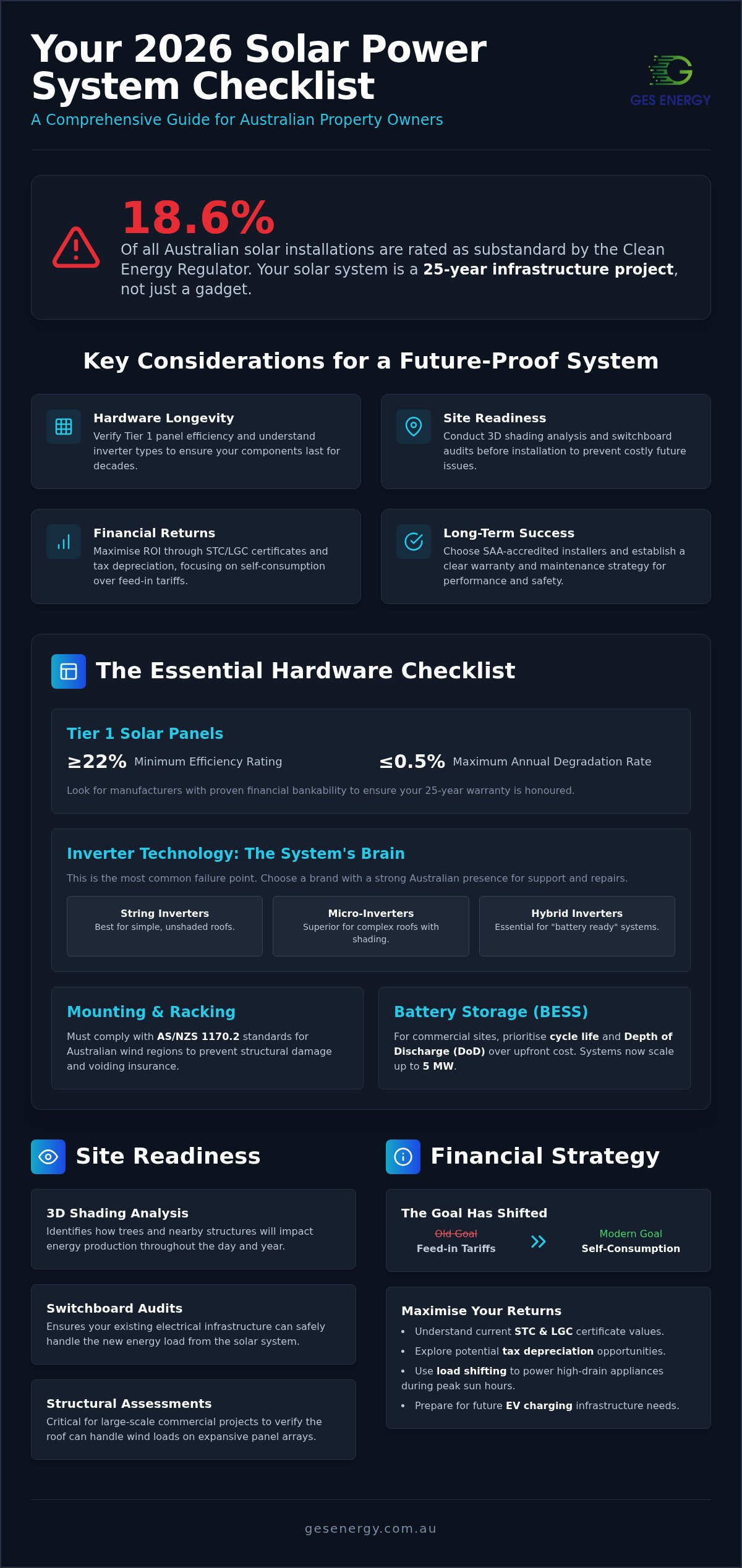
The Clean Energy Regulator recently revealed that 18.6% of all Australian solar installations are substandard, a figure that should give any property owner pause. When you invest in a solar power system, you aren't just buying a gadget for the roof; you're commissioning a 25-year infrastructure project. It's perfectly normal to feel overwhelmed by technical jargon or the fear of choosing a provider that might not be around to honour a warranty in three years.
You deserve a transition to renewable energy that feels stable, predictable, and financially sound. This comprehensive 2026 checklist provides a methodical framework to help you distinguish between residential-grade components and industrial-strength gear. We'll guide you through the latest SAA compliance standards, the reality of current feed-in tariffs, and the engineering requirements for battery integration. By the end of this guide, you'll have the confidence to evaluate any quote with the precision of a seasoned professional and ensure your investment is future-proofed.
Key Takeaways
- Identify the technical differences between inverter types and learn how to verify Tier 1 panel efficiency ratings to ensure hardware longevity.
- Evaluate your property's site readiness through 3D shading analysis and switchboard audits before installing a new solar power system.
- Maximise your financial returns by understanding current STC and LGC certificate values alongside potential tax depreciation opportunities.
- Ensure long-term performance and safety by choosing SAA-accredited installers and establishing a clear strategy for warranty and maintenance management.
Understanding Your Solar Power System: The 2026 Landscape
By 2026, the definition of a photovoltaic system has fundamentally changed. It's no longer just a passive set of panels on a roof; it's a dynamic energy ecosystem. We've seen a decisive shift from simple rooftop arrays toward smart micro-grids that integrate generation, storage, and intelligent management. This evolution means your solar power system acts as a private utility, giving you granular control over how energy is harvested and deployed across your property.
A generic, "one-size-fits-all" solution often fails to meet the rigorous demands of Australian industrial or large-scale residential sites. Success in the current market requires selecting the right architecture from three primary categories. Grid-tie systems remain the standard for those with reliable utility access, while hybrid systems add battery storage to bridge the gap between day and night. For remote sites, standalone off-grid solutions provide total independence, though they require meticulous engineering to ensure reliability during periods of low irradiance.
Residential vs Commercial vs Industrial Systems
Scaling a project involves more than just adding more panels. A standard 6.6kW home system is worlds apart from a 5MW industrial plant. Large-scale commercial projects require specialised structural assessments to handle wind loads on expansive roof spaces, often necessitating reinforced mounting systems. Industrial designs also involve high-voltage engineering to manage massive energy throughput. Choosing a partner with experience in complex EPC (Engineering, Procurement, and Construction) services is essential to ensure these larger assets perform safely over their 25-year lifespan.
The Goal: Energy Independence and Load Shifting
The financial priority for property owners has moved away from chasing feed-in tariffs. The modern focus is self-consumption. By utilising load shifting, you can direct solar energy to high-drain machinery or appliances during peak production hours. Integrating battery storage allows you to capture excess power for use when grid prices spike, effectively insulating your budget from market volatility. This forward-thinking approach also prepares your site for the inevitable demand of EV charging infrastructure. A well-designed solar power system today is the foundation for a fully electrified, carbon-neutral operation tomorrow.
The Essential Hardware Checklist: Evaluating Components
Selecting hardware for a solar power system requires a move away from consumer-grade thinking toward an infrastructure-first mindset. The physical components you choose today will dictate your energy security for the next two decades. Reliable systems start with Tier 1 solar panels, which are defined by the manufacturer's financial bankability and their ability to honour 25-year warranties. In 2026, you should look for panels with an efficiency rating of at least 22% and a guaranteed degradation rate of no more than 0.5% per year. This ensures your asset continues to produce significant power as it ages.
Mounting and racking hardware is often overlooked, yet it is the only thing keeping your investment attached to your property during extreme weather. All racking must comply with AS/NZS 1170.2 standards for Australian wind regions. For detailed guidance on component standards, the Australian Government’s Solar Consumer Guide provides a baseline for what to expect from quality hardware. Using inferior mounting kits can lead to structural roof damage or system failure during a storm, which often voids insurance policies.
Inverter Technology: The Brain of Your System
The inverter is the most complex part of your installation and remains the most common failure point. Reliability is paramount, so choosing a brand with a strong Australian presence and established repair pathways is essential. String inverters are effective for clear, simple roofs, while micro-inverters offer superior performance on sites with complex shading. If you plan to add storage later, ensure you select a hybrid inverter that is "battery ready" to avoid costly equipment swaps. Modern units now feature smart monitoring with remote diagnostics, allowing technicians to identify and resolve issues before they impact your production.
Industrial Battery Storage and BESS Integration
For commercial and industrial sites, the focus has shifted toward high-capacity energy storage to manage peak demand charges. Industrial Battery Energy Storage Systems (BESS) function as high-capacity reservoirs that stabilise the grid and manage peak demand, with 2026 trends seeing common installations scaling up to 5 MW for large-scale industrial applications. When evaluating batteries, prioritise cycle life and depth of discharge (DoD) over upfront cost. Lithium-ion remains the standard for compact power, though emerging flow battery technologies are becoming viable for long-duration storage needs. Safety is a non-negotiable factor; ensure your enclosures meet the latest Australian standards for thermal management and fire suppression. If you are unsure which storage technology suits your site, you can explore specialised C&I energy storage systems designed for high-demand environments.
Site Readiness Checklist: Engineering for Australian Conditions
A successful solar power system begins with a precise engineering assessment of your physical site. While many providers rely on basic satellite imagery, true accuracy requires 3D modelling to perform a comprehensive shading analysis. This process accounts for seasonal sun paths and nearby obstructions, ensuring your projected energy yields match real-world performance. Beyond the roof, your electrical infrastructure must be capable of supporting the new load. Older switchboards often require upgrades to handle solar export and meet modern safety standards set by your local Distributed Network Service Provider (DNSP). Each DNSP has specific grid connection agreements that dictate how much power you can export, making early consultation a vital step in the design phase.
Environmental resilience is another critical factor in the Australian context. Sites near the coast must account for salt mist corrosion, while inland installations face challenges from heavy dust and extreme heat. High temperatures can cause voltage drop and component fatigue, so selecting gear with superior thermal coefficients is non-negotiable. For a broader look at how these factors influence residential setups, the government’s Rooftop solar guide offers foundational advice on site selection and system orientation. Ensuring your site is ready for these stressors protects the longevity of your investment.
Structural Integrity and Roof Lifespan
Before any panels are installed, you must verify that your roof can support the static and dynamic weight of a commercial array for its entire 25-year lifespan. It's often more cost-effective to perform "solar-ready" roof repairs or reinforcements before the racking is fixed. If the underlying structure is compromised, the cost of removing and reinstalling the system for mid-cycle repairs will significantly erode your financial gains. Property owners should ensure that mounting points don't compromise the waterproofing of the building. For more details on managing these large-scale projects, see our Commercial Solar: 2026 Guide for Australian Businesses.
Micro-grid and Off-grid Feasibility
Remote sites require a different engineering approach to ensure total reliability. A robust off-grid checklist must include the integration of backup generators to provide security during consecutive "no-sun" days. Modern micro-grid controllers are essential for managing multiple energy sources, such as solar and diesel, without interrupting the power supply. Sizing these systems correctly involves calculating your peak load and ensuring your battery capacity can sustain operations through the longest expected periods of low production. This methodical planning transforms a remote property into a self-sufficient energy hub that remains independent of grid instability and rising utility costs.
Financial and Regulatory Checklist: Maximising Your ROI
Understanding the financial mechanics of a solar power system is as vital as the engineering itself. In 2026, the landscape of incentives has matured, requiring property owners to distinguish between immediate rebates and ongoing performance-based certificates. Small-scale Technology Certificates (STCs) still provide an upfront discount for systems under 100kW, effectively acting as a point-of-sale subsidy. For larger industrial installations exceeding 100kW, Large-scale Generation Certificates (LGCs) offer a recurring revenue stream based on the actual clean energy your system produces. Managing these certificates involves complex trading markets, so it's standard practice to ensure your provider handles this process as part of their service.
Tax treatment remains a significant lever for improving your internal rate of return. Commercial entities should consult with their financial advisors regarding current depreciation schedules and any active instant asset write-off provisions. The choice between a Power Purchase Agreement (PPA) and a direct capital outlay will depend on your specific cash flow requirements. While a capital purchase offers the highest long-term savings, a PPA allows for zero-upfront costs by paying a fixed rate for the generated power. Once the system is operational, updating your property insurance is a non-negotiable step to protect the asset against fire, hail, or storm damage.
Navigating Rebates and Incentives in 2026
The Small-scale Renewable Energy Scheme (SRES) is currently in its phase-out period toward 2030, meaning the rebate value decreases every year on 1 January. For a typical 6.6kW system in Sydney, the STC value in 2026 sits at approximately $1,700 to $1,800. Battery incentives have become more robust, with the federal Cheaper Home Batteries Program providing $272 per kWh for eligible systems. State-specific programs also offer targeted support, such as the $1,400 rebate in Victoria for eligible households or Western Australia’s Horizon Power battery rebate of $380 per kWh. Eligibility for these programs strictly requires the use of SAA-accredited labour for the installation.
Calculating the Real Payback Period
A precise payback calculation must account for more than just the initial price tag. While the national average payback period in 2026 ranges from 3.5 to 6 years, your specific results will depend on local network tariffs and your self-consumption ratio. Commercial property owners must pay close attention to "Demand Charges" on their electricity bills, as solar can significantly reduce these peak-use penalties. It's a common mistake to choose the lowest quote without considering long-term efficiency; cheaper components often have higher degradation rates that extend the payback period by several years. To get a clear picture of your potential savings, you can explore commercial and industrial solar solutions designed for maximum financial performance.
The Selection and Maintenance Checklist: Ensuring Long-Term Success
The final stage of securing your solar power system involves moving from technical specifications to long-term operational security. A solar asset is only as reliable as the team that installs and maintains it. Vetting your provider requires a deep dive into their track record, particularly their experience with Engineering, Procurement, and Construction (EPC) projects of a similar scale to yours. You must also establish a clear protocol for warranty management. If a component manufacturer ceases operations, you need to know exactly who will facilitate a replacement or manage the technical integration of new hardware to keep your site operational.
Ongoing performance monitoring is the only way to protect your ROI from "silent" failures. Modern systems should be equipped with intelligent analytics that send real-time alerts if production drops below expected thresholds. Without these automated checks, a faulty string or a failing inverter might go unnoticed for months, costing you thousands in lost generation. A proactive approach to maintenance ensures your infrastructure remains a high-performing asset rather than a liability on your roof.
Evaluating EPC and SAA-Accredited Partners
When reviewing potential partners, always ask for references from completed systems that match your project's complexity. There is a significant difference between residential rooftop work and high-voltage industrial engineering. Prioritise companies that utilise in-house labour rather than outsourcing to third-party contractors, as this ensures tighter quality control and direct accountability. SAA-accredited labour is a mandatory requirement for ensuring that all electrical work meets the rigorous safety and compliance standards mandated by Australian law. Choosing an accredited specialist guarantees that your installation is performed by technicians who are up to date with the latest AS/NZS standards.
Post-Installation: Maintenance and Repair
Scheduled maintenance is essential for preserving industrial uptime and preventing component fatigue. Your checklist should include annual electrical health checks, professional panel cleaning, and thermal imaging to identify "hot spots" before they lead to fire risks or equipment failure. Inverter health checks are particularly vital, as these components work under constant thermal stress. For those operating in remote areas, a specialised maintenance plan is even more critical to prevent prolonged outages. You can learn more about managing these complexities in our guide on Off Grid Solar System Design for Remote Reliability. Consistent oversight ensures that your solar power system continues to deliver peak efficiency for its intended 25-year lifespan.
Securing Your Energy Future with Confidence
Investing in a solar power system is a significant commitment to your property's long-term operational efficiency. We've detailed the necessity of high-grade hardware, the importance of site-specific engineering, and the shifting landscape of Australian rebates. Success requires moving beyond simple installation toward a model of ongoing stewardship. By prioritising SAA-accredited components and a robust maintenance schedule, you protect your asset against physical and financial volatility. Reliability is built on expertise.
Our SAA-accredited engineering team specialises in complex energy transitions. We focus on industrial micro-grids and remote off-grid solutions that deliver reliability across the country. We provide national maintenance and repair support to ensure your infrastructure remains a high-performing asset for years to come. If you're ready to move forward with a partner who understands the 2026 market, we can help. Get a Custom Solar Design and ROI Analysis from GES Energy and take control of your energy independence today.
Frequently Asked Questions
How much does a commercial solar power system cost in Australia in 2026?
Commercial costs depend on the engineering complexity, roof structural integrity, and the required energy storage capacity. Unlike residential kits, industrial solutions require custom EPC services to manage high-voltage integration and micro-grid controls. We recommend a site-specific ROI analysis to determine the total capital outlay based on your current load profile and network demand charges.
Can I add a battery to my existing solar power system later?
You can add a battery to your existing solar power system later, though the ease of integration depends on your inverter type. If you have a hybrid or "battery-ready" inverter, the process is straightforward; otherwise, an AC-coupled battery system can be installed alongside your current setup. It's often more cost-effective to plan for storage during the initial design phase to avoid redundant equipment costs.
What is the difference between a grid-tie and an off-grid solar power system?
A grid-tie system remains connected to the utility network, allowing you to export excess energy, while an off-grid system is a completely independent power source. Off-grid setups require significantly larger battery storage and often a backup generator to ensure reliability during consecutive low-sun days. Grid-tie systems are simpler and less expensive, but they don't provide independence from utility price hikes or blackouts.
How long do solar panels and inverters actually last in the Australian sun?
Tier 1 solar panels are generally warranted for 25 years, though high-quality modules can continue producing power well beyond that timeframe. Inverters are the hardest-working component and typically have a lifespan of 10 to 15 years in the harsh Australian climate. Regular maintenance and choosing gear with high thermal resilience are essential for ensuring your hardware reaches its maximum operational life.
Do I need council approval to install a large-scale solar power system?
Most standard residential installations don't require council approval, but large-scale commercial or industrial systems often do. Requirements vary between local government areas, especially if the installation involves ground-mounted arrays or significant structural changes to a building. Your EPC partner should manage these planning permits and ensure the design complies with all local building codes and wind-load standards.
What happens to my solar power system during a grid blackout?
A standard solar power system will automatically shut down during a blackout to prevent "islanding," which keeps utility workers safe while they repair the grid. If you require power during an outage, you must install a battery system with a dedicated backup circuit or a micro-grid controller. These specialised components allow your property to disconnect from the grid and run independently using stored energy.
Are there still government rebates available for solar in 2026?
Federal and state incentives remain available in 2026, though the value of some rebates is gradually decreasing. The Small-scale Renewable Energy Scheme (SRES) still provides upfront discounts through STCs, and the federal Cheaper Home Batteries Program offers $272 per kWh for eligible storage. It's important to verify that your installer is SAA-accredited, as this is a mandatory requirement for claiming any government incentives.
How often should I have my solar power system professionally serviced?
We recommend having your system professionally serviced at least once every 12 months to maintain peak efficiency and safety. A comprehensive service should include thermal imaging of panels to detect hot spots, inverter health checks, and a thorough inspection of all electrical connections. Proactive maintenance identifies minor issues before they lead to costly system downtime or void your manufacturer warranties.


