

What if the most valuable asset on your property isn't the land it sits on, but the roof above your head? In 2026, rooftop solar for homes is no longer just about sticking a few panels on tiles. It's the foundation of a sophisticated energy ecosystem designed to shield you from the rising cost of living. You've probably noticed that while technology has advanced, the market has become crowded with confusing jargon and questionable installers making big promises. It's understandable to feel uncertain about whether a battery setup is worth the investment or how to navigate the latest government incentives.
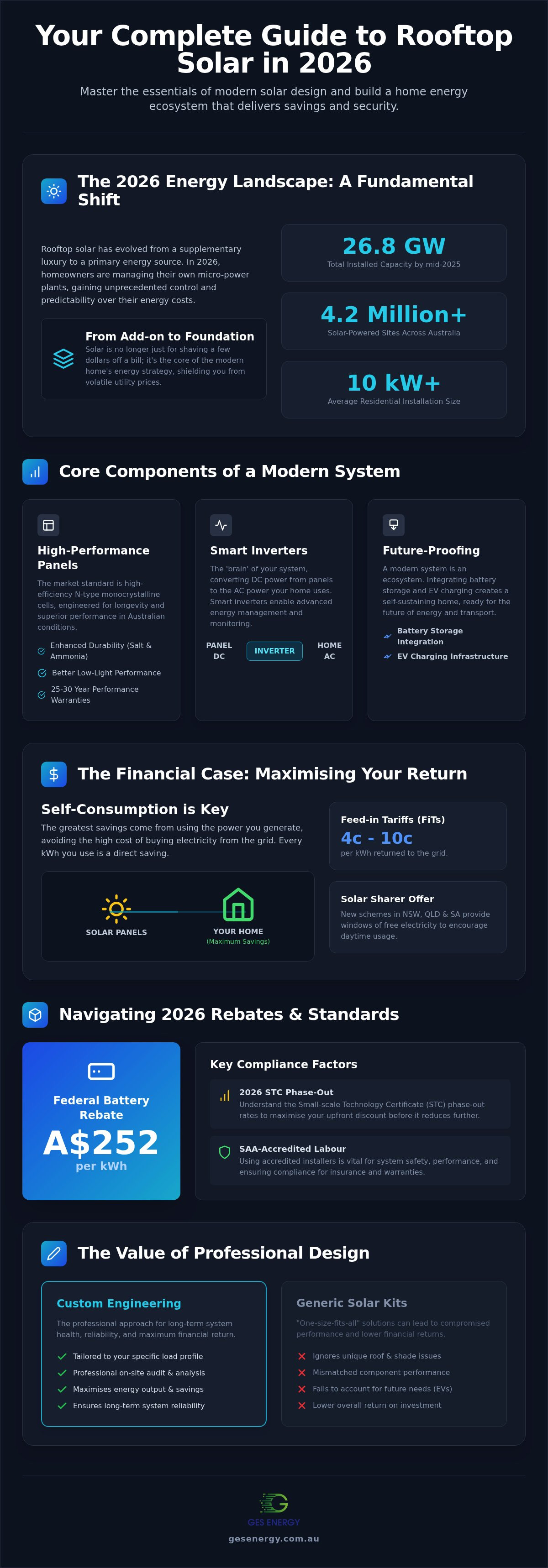
We believe that energy independence should be straightforward and reliable. This complete guide provides the technical clarity you need to master the essentials of modern solar design. You'll learn how to leverage the current A$252 per kWh federal battery rebate, understand the 2026 STC phase-out rates, and take advantage of new schemes like the Solar Sharer offer. We're here to help you move past the confusion and build a system that delivers significant savings and long-term security for your energy future.
Key Takeaways
- Understand why rooftop solar for homes has evolved into a primary energy source in 2026, providing a robust shield against fluctuating utility prices.
- Identify the technical advantages of high-efficiency N-type cells and smart inverters to ensure your system design delivers maximum energy output.
- Learn how to integrate battery storage and EV charging infrastructure to create a self-sustaining, future-proofed energy ecosystem.
- Navigate the 2026 federal rebate landscape and understand why SAA-accredited labour is vital for safety and insurance compliance.
- Discover why custom engineering and professional site audits are superior to generic solar kits for long-term system health and reliability.
Understanding Rooftop Solar for Homes in the 2026 Energy Landscape
Photovoltaic (PV) cells serve as the quiet, high-efficiency engines of the modern Australian household. These cells capture sunlight and convert it into direct current (DC) electricity; an inverter then transforms this into the alternating current (AC) required to power your appliances. While the history of solar power in Australia began with small-scale experimental setups, the technology has reached a point of industrial-grade maturity. By mid-2025, Australia had already surpassed 26.8 GW of installed capacity across more than 4.2 million sites. This growth reflects a fundamental change in how we view our rooftops.
The Financial Case: Beating Bill Shock
Rising utility rates have made "bill shock" a persistent concern for many Australians. A professionally engineered solar array provides a direct remedy by offsetting expensive peak-time electricity rates. As of August 2026, specific initiatives like the Solar Sharer offer in NSW, Queensland, and South Australia provide windows of free electricity during the day to encourage usage during peak generation times. While feed-in tariffs (FiTs) currently range between 4c and 10c per kWh in most regions, the most significant financial return comes from self-consumption. Every kilowatt-hour you generate and use internally is a unit you don't have to purchase from a retailer at a significantly higher price. A high-quality system, designed for your specific load profile, ensures a reliable return on investment over decades rather than years.
Environmental Impact and Sustainability
Core Components of a Modern Home Solar Power System
A high-quality installation relies on the synergy between four primary elements. While the panels are the most visible part of rooftop solar for homes, the inverter, mounting hardware, and monitoring software are equally critical for long-term reliability. Choosing components that are specifically engineered to withstand the unique Australian climate ensures your system remains a productive asset for decades. A failure in any one of these areas can compromise the safety and financial return of your entire energy ecosystem.
Selecting High-Performance Solar Panels
Tier 1 manufacturers remain the industry benchmark because they demonstrate financial stability and rigorous quality control. In 2026, the market has largely shifted toward high-efficiency N-type monocrystalline cells. These panels offer superior longevity and a lower temperature coefficient compared to older technologies. This coefficient is vital for Australian homeowners. It measures how much power a panel loses as the surface temperature rises during a scorching summer afternoon. An efficiency rating represents the percentage of sunlight a panel can convert into usable electricity within a specific surface area of your roof.
Quality panels should provide:
- Enhanced Durability: Resistance to salt mist and ammonia for coastal or rural properties.
- Better Low-Light Performance: The ability to generate power during early morning or late afternoon hours.
- Long-Term Warranties: Performance guarantees that protect your output for up to 25 or 30 years.
Inverters and Smart Energy Management
The inverter acts as the brain of your system. Standard string inverters are often the most cost-effective choice for simple, unshaded roof layouts. However, micro-inverters provide individual panel optimisation. This is ideal for properties with complex rooflines or potential shading from trees and chimneys. If you intend to integrate storage now or in the future, a hybrid inverter is essential. It manages the bidirectional flow of electricity between your panels, your battery, and the grid.
Modern smart monitoring software allows you to track generation and consumption in real-time through a mobile app. This visibility is crucial for identifying system faults early, which prevents prolonged periods of underperformance. You can also integrate these systems with home automation to run heavy appliances, such as dishwashers or pool pumps, when your rooftop solar for homes is producing peak power. If you ever encounter technical disruptions, utilising professional solar inverter repairs and warranties ensures your system is restored to peak efficiency by experts who understand the hardware's intricacies.
Finally, do not overlook the mounting system. It must be structurally sound and corrosion-resistant. Given Australia's history of extreme weather events, ensuring your racking is cyclone-rated and compliant with AS/NZS 1170.2 provides necessary peace of mind during storm seasons.
Future-Proofing: Integrating Batteries and EV Charging
The Role of Solar Battery Storage
A battery acts as a reservoir for the energy produced during the middle of the day. Instead of exporting excess power to the grid for a minimal feed-in tariff, you store it to offset expensive evening peaks. As of August 2026, the federal Cheaper Home Batteries Program provides an upfront discount of approximately A$252 per usable kWh for the first 14kWh of capacity. This incentive makes the path to Solar and Battery Storage: Achieving Home Independence more financially viable for the average Australian household. Beyond the savings, modern batteries provide critical blackout protection. This ensures your essential circuits, such as refrigeration and home security, remain operational during grid disruptions. Homeowners in NSW can also access incentives of up to A$1,100 by connecting their battery to a Virtual Power Plant (VPP), which helps stabilise the broader grid while providing additional financial returns.
EV Charging Infrastructure at Home
Preparing your property for an electric vehicle (EV) requires more than just a standard power point. A dedicated Level 2 smart charger is now the standard for residential installations. These systems are designed to prioritise solar energy, ensuring your car is charged using clean, free power rather than drawing from the grid during peak times. Most Level 2 chargers require a dedicated 32-amp circuit to deliver the necessary 7kW of power efficiently. When designing a new array, it's vital to account for this increased load. The average residential system size has grown to exceed 10kW to support both household needs and vehicle charging simultaneously. This integrated approach ensures your rooftop solar for homes remains a high-performance asset as your energy needs evolve. By coordinating your generation, storage, and transport, you create a self-sustaining ecosystem that offers long-term protection against energy price hikes.
Navigating Australian Standards, Rebates, and Incentives
The regulatory framework for rooftop solar for homes ensures that systems are safe, efficient, and compatible with a rapidly evolving grid. Compliance is not just a legal hurdle; it is your primary protection against poor-quality installations. As of mid-2026, new requirements have emerged to manage high solar penetration. In New South Wales and the ACT, all new or upgraded systems must now utilise CSIP-AUS compliant inverters. These "smart" inverters allow for better communication with the grid, helping to manage export limits and maintain voltage stability in your local area. Understanding these technical standards before you sign a contract ensures your investment remains compliant with insurance requirements and local distribution network rules.
Small-scale Technology Certificates (STCs)
The primary federal incentive for residential solar is the Small-scale Renewable Energy Scheme (SRES). This program generates Small-scale Technology Certificates (STCs) based on the expected clean energy your system will produce until the scheme ends in 2030. In practice, these certificates act as an upfront discount on the total cost of your system. Most installers will handle the creation and sale of these certificates on your behalf, applying the value directly to your quote. The value of this incentive decreases every year on January 1st as the program phases out. Securing your installation sooner rather than later maximises the number of certificates you can claim, significantly improving your initial return on investment.
Choosing an Accredited Solar Installer
Selecting the right partner is the most critical decision in your solar journey. Using SAA-accredited labour is non-negotiable. This accreditation confirms that your installers have undergone rigorous training to meet Australian standards, specifically AS/NZS 5033:2021. Since March 1, 2026, all solar battery installations also require geotagged and timestamped photo documentation of critical labelling to ensure compliance. If an installer cannot guarantee these standards, they are likely "solar cowboys" who prioritise speed over safety. These low-quality operations often disappear when warranty issues arise, leaving homeowners with orphaned systems and no technical support.
A professional quote should provide a detailed breakdown of the components, mounting hardware, and labour warranties. You should look for a partner that offers national support networks combined with localized engineering expertise. This ensures that your system is designed for your specific roof orientation and shading profile rather than being a generic kit. To ensure your transition is handled by qualified professionals who prioritise long-term system health, consider partnering with a specialist for expert solar design and installation. This level of oversight provides the peace of mind that your energy future is built on a stable, high-performance foundation.
The GES Energy Approach: Custom Design and Installation
While many retailers offer "one-size-fits-all" bundles, these generic kits often fail to account for the unique variables of your property. A high-performance system requires more than just high-quality hardware; it requires precision engineering. Our approach to rooftop solar for homes focuses on creating a bespoke energy ecosystem that is specifically designed for your roof's architecture and your family's consumption patterns. By prioritising custom design over cookie-cutter solutions, we ensure that your investment delivers the maximum possible financial and environmental return.
The process begins with a comprehensive site audit. Our technicians don't just look at the available roof space; we analyse your historical energy bills, shading from nearby structures, and your long-term goals, such as adding an EV charger or a home battery. This data-driven foundation allows us to design a system that balances component selection with your specific budget. Once the design is finalised, our SAA-accredited labour teams manage the installation and commissioning, ensuring every connection meets the rigorous Australian safety standards updated for 2026.
Tailored Solar Design and Engineering
Long-term Support and Maintenance
We view our role as a diligent steward of your energy future. A solar array is a 25-year asset, and regular health checks are vital for maintaining peak performance and ensuring warranty compliance. Dust accumulation, electrical wear, and minor hardware shifts can impact output over time if left unaddressed. Our maintenance services provide peace of mind by identifying and resolving minor issues before they lead to system downtime. If you are exploring similar efficiencies for your workplace, our Commercial Solar: 2026 Guide for Australian Businesses provides a detailed roadmap for industrial applications.
Our commitment to rooftop solar for homes extends far beyond the day of installation. We remain a localized partner, providing the technical mastery and ongoing support needed to help every Australian household achieve true energy independence. By building reliable, low-maintenance systems, we empower you to take control of your energy costs and contribute to a sustainable national grid.
Secure Your Energy Independence Today
Mastering the 2026 energy landscape requires a fundamental shift in perspective. You now have the technical tools to transform your property into a high-performance power plant that shields your family from rising utility costs. By integrating high-efficiency components with smart battery storage and EV infrastructure, you ensure your home remains resilient and cost-effective for decades. The key is moving beyond generic solutions and embracing a system that is specifically engineered for your unique roof and energy profile.
Investing in rooftop solar for homes is one of the most practical steps you can take toward total energy independence. Our team provides the technical mastery required to navigate complex rebates and local grid regulations with confidence. With SAA-accredited installers, custom engineering for every roof, and a national support and maintenance network, we ensure your transition is seamless and secure. Transitioning to a sustainable future is a significant milestone, and we are here to guide you through every stage of the design and installation process.
Request a Custom Solar Design for Your Home today and take the first step toward a predictable, green energy future. You have the opportunity to define how you generate and use electricity for years to come.
Frequently Asked Questions
Is rooftop solar still worth it in Australia in 2026?
Rooftop solar for homes remains a highly effective investment because it serves as a primary defence against rising grid electricity costs. While feed-in tariffs have shifted, new initiatives like the Solar Sharer offer and the Midday Power Saver provide households with specific windows of free or low-cost energy. These programs reward you for using your own generation during peak daylight hours, which significantly improves your long-term return on investment.
How many solar panels do I need for a 4-bedroom home?
What is the average payback period for a residential solar system?
Most Australian households see a full return on their investment within four to seven years. This timeframe is influenced by your state's specific electricity rates and how effectively you shift your energy usage to match peak generation times. Systems that include battery storage may have a slightly longer payback period but offer greater protection against future price hikes and grid instability.
Can I add a battery to my existing solar system later?
Do solar panels work on cloudy or rainy days in Australia?
Solar panels continue to produce electricity during overcast weather by capturing diffuse sunlight that penetrates through the clouds. While a heavy storm might reduce your system's output to 10% or 20% of its maximum capacity, modern high-efficiency cells are designed to perform better in low-light conditions than older technology. Your system will still contribute to your household needs even when the sun isn't shining directly.
What happens to my solar power during a grid blackout?
Standard solar systems are designed to shut down during a blackout to prevent electricity from flowing back into the grid while technicians are performing repairs. If you require power during an outage, your system must include a battery and an inverter with "islanding" or backup capabilities. This setup allows your home to operate as a self-contained micro-grid until the main utility service is restored.
How much maintenance does a rooftop solar system actually require?
Will solar panels damage my roof or affect my home insurance?
Solar panels do not damage your roof when they are installed by SAA-accredited professionals using compliant mounting hardware. The racking is designed to distribute weight evenly and maintain the structural integrity of your tiles or metal sheeting. You should contact your insurance provider after installation to add the system to your building policy, as most insurers view rooftop solar for homes as a permanent fixture that increases the value of the property.


