

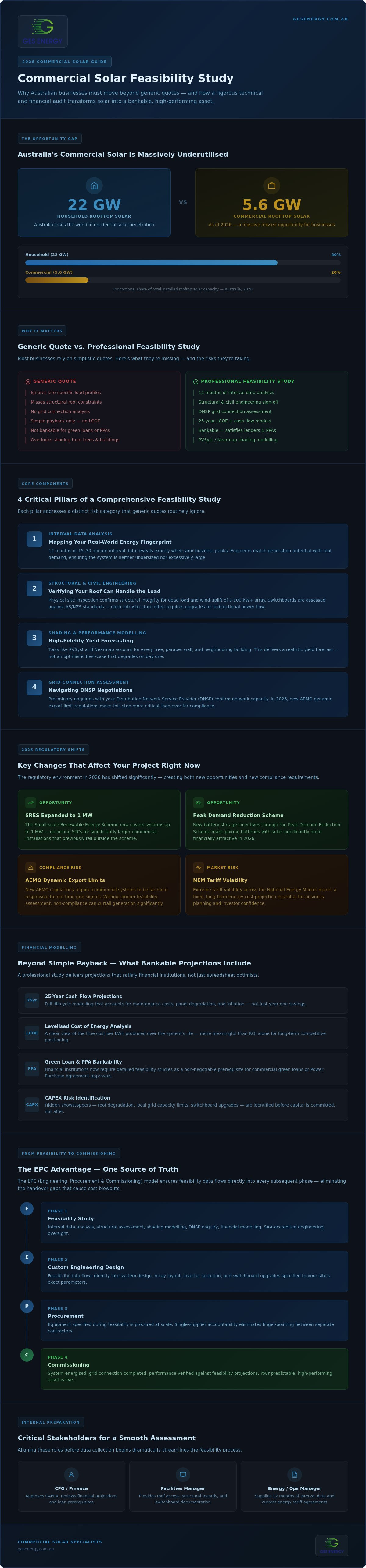
While Australian households have led the world with 22 GW of rooftop solar, our commercial sector has only realised about 5.6 GW as of 2026. This gap represents a massive missed opportunity for businesses facing volatile energy costs across the National Energy Market. You likely recognise that transitioning to renewables is a strategic necessity, yet the technical complexity of grid connection approvals and integrating battery storage can feel like a moving target. Investing in a professional commercial solar feasibility study australia ensures your project isn't based on guesswork; it's built on engineering certainty and bankable financial projections.
We understand the pressure of rising tariffs and the need for long-term stability. This guide explains how a detailed study de-risks your investment by verifying roof structural integrity and providing accurate 10-year cash flow models. You'll discover how the 2026 expansion of the Small-scale Renewable Energy Scheme to 1 MW, alongside new battery incentives like the Peak Demand Reduction Scheme, can secure your business's energy future. We will look at the technical requirements, regulatory shifts, and financial frameworks that turn a complex infrastructure project into a predictable, high-performing asset.
Key Takeaways
- Understand why a rigorous technical and financial audit is essential to avoid the hidden costs and structural risks often overlooked by generic solar quotes.
- Learn how to utilise 12 months of interval data to map your site's unique energy fingerprint and verify if your roof can support a 100kW+ array safely.
- Discover how a professional commercial solar feasibility study australia provides bankable 25-year cash flow projections that account for maintenance and the latest 2026 incentive changes.
- Identify the critical internal stakeholders, from CFOs to facilities managers, required to streamline data collection and ensure project alignment from the outset.
- Explore how the EPC model ensures project accountability by flowing feasibility data directly into the custom engineering, procurement, and commissioning phases.
Why a Commercial Solar Feasibility Study is Non-Negotiable in 2026
A commercial solar feasibility study australia is much more than a preliminary check; it's a rigorous technical and financial audit designed to determine project viability before any significant capital is committed. In a mature market where Solar power in Australia has achieved record-breaking penetration, businesses can't afford to rely on back-of-the-envelope calculations. Generic quotes often fail to account for site-specific load profiles or structural constraints, leading to underperforming assets and unexpected costs. By prioritising SAA-accredited engineering oversight during this initial phase, you move away from the era of "solar cowboys" and toward a model of absolute technical certainty.
Future-proofing your energy strategy means accounting for the extreme market volatility and shifting tariff structures seen across the National Energy Market (NEM) in 2026. A professional study evaluates how your specific operation consumes power, matching your generation potential with real-world demand to avoid wasted energy. This methodical approach ensures that every dollar of your investment is geared toward long-term value rather than short-term hype. It transforms a complex infrastructure decision into a transparent, data-driven business case.
De-risking Your Capital Expenditure (CAPEX)
Investing in large-scale solar requires substantial CAPEX, and a feasibility study identifies potential "showstoppers" before they become expensive mistakes. These bottlenecks might include hidden roof degradation or local grid capacity issues that strictly limit your system's size. Most financial institutions now require these detailed studies as a non-negotiable prerequisite for commercial green loans or Power Purchase Agreement (PPA) approvals. Bankability is defined as the document's capacity to satisfy a lender's risk assessment through verified technical data and conservative financial projections.
The NEM Landscape: Why 2026 is Different
The National Energy Market is evolving at a relentless pace. As of 2026, new AEMO regulations regarding dynamic export limits mean that commercial systems must be far more responsive to grid signals than in previous years. A feasibility study helps you navigate these complex Distribution Network Service Provider (DNSP) negotiations, ensuring your system remains compliant while maximising your self-consumption. We look beyond simple ROI, focusing instead on Levelised Cost of Energy (LCOE) analysis. This provides a clear, 25-year view of the true cost of each kilowatt-hour produced by your system, ensuring your business remains competitive in a decarbonising economy.
Core Components of a Comprehensive Australian Feasibility Study
A robust commercial solar feasibility study australia moves beyond simple bill analysis to uncover the actual energy "fingerprint" of your facility. This process begins with harvesting 12 months of interval data, typically measured in 15-to-30-minute increments. This granularity allows engineers to see exactly when your business peaks and how solar generation will offset that specific load. It's about precision. We combine this data with high-fidelity performance modelling to provide a realistic yield forecast. The study typically focuses on four critical pillars:
- Interval Data Analysis: Mapping your real-world usage to ensure the system is neither undersized nor excessively large.
- Structural and Civil Engineering: Verifying that your roof can handle the dead load and wind-uplift of a 100kW+ array.
- Shading and Performance Modelling: Using tools like PVSyst or Nearmap to account for every tree, parapet wall, or nearby building.
- Grid Connection Assessment: Managing preliminary enquiries with your Distribution Network Service Provider (DNSP) to confirm network capacity.
Technical Integrity and Site Constraints
While satellite imagery is helpful, it can't replace a physical site inspection. Engineers must verify the structural integrity of your roof to ensure it can support the dead load of a large-scale array. We also assess your existing switchboards against modern AS/NZS standards. Often, older infrastructure requires specific upgrades to accommodate the bidirectional power flow of a commercial system. Evaluating cable runs and inverter placement is equally critical. Efficient design reduces voltage drop and ensures long-term maintenance access remains straightforward.
Energy Storage and EV Integration
Integrating C&I Energy Storage Systems is now a standard requirement for businesses looking to mitigate peak demand charges. A feasibility study determines the optimal battery size for effective load shifting, ensuring you store excess solar for use during high-tariff periods. We also analyse the projected impact of future EV charging infrastructure on your site's total load. For businesses requiring high resilience, we evaluate micro-grid viability to determine if your site can operate independently during grid outages. This forward-looking approach ensures your system meets the regulatory demands of the 2026 energy landscape.
Financial Modelling: Beyond the Simple Payback Period
Many providers focus on a three to five year payback period, but a professional commercial solar feasibility study australia looks at the full 25 year lifecycle of the asset. We provide detailed cash flow projections that move beyond surface level savings. This modelling includes anticipated operations and maintenance (O&M) costs, ensuring your board has a realistic view of the internal rate of return (IRR). We don't just look at the initial reduction in your power bill; we calculate the net present value (NPV) of the system over decades.
Navigating incentives is a critical part of this financial audit. From October 2026, the Small-scale Renewable Energy Scheme (SRES) expanded its eligibility from 100 kW to 1 MW. This allows much larger commercial systems to access upfront support through Small-scale Technology Certificates (STCs). For an eligible 850 kW system, the government estimates an upfront saving of over $230,000. Our study determines whether these STCs or Large-scale Generation Certificates (LGCs) provide the most effective financial outcome for your specific project scale.
Sensitivity analysis is the final pillar of a bankable financial model. Energy markets remain volatile, and your ROI shouldn't rely on a single set of assumptions. We test your business case against various scenarios. For example, we model what happens to your savings if grid electricity prices fall by 12% as seen in some 2026-27 Default Market Offer (DMO) segments, or if they rise by 5% unexpectedly. This creates a range of outcomes that allows for confident, risk adjusted capital allocation.
Operational vs Capital Expenditure Analysis
Determining whether to pursue direct system ownership or a Power Purchase Agreement (PPA) is a strategic choice. Ownership allows your business to claim depreciation benefits and provides total energy independence. However, it requires a dedicated budget for ongoing inverter repairs and warranties to protect the asset's performance. We also quantify the 'cost of inaction'. This shows exactly how much capital is leaking from your business every month you remain fully exposed to fluctuating commercial tariffs.
ESG and Brand Value Quantification
Solar assets are now a central component of corporate ESG (Environmental, Social, and Governance) reporting. A feasibility study provides the verified data needed to calculate carbon offset tonnage for marketing and compliance purposes. For commercial landlords, these systems do more than lower operating costs. They significantly enhance property valuation and increase tenant appeal. High quality renewable infrastructure is often the deciding factor for premium tenants who are looking to meet their own sustainability targets.
How to Organise Your Business for a Solar Assessment
Preparing for a commercial solar feasibility study australia requires more than just handing over a few recent invoices. While a single bill shows the total cost, it doesn't reveal the timing of your energy consumption. To build a truly accurate model, we require 12 months of interval data. This granular information is the gold standard for engineering because it allows us to map generation against your real-time demand. Proper preparation ensures that the engineering phase moves quickly and delivers the technical certainty your business needs.
Success also depends on involving the right internal stakeholders from the outset. Facilities managers provide essential site knowledge, while the CFO will focus on the bankability of the financial projections. Sustainability leads often have specific carbon reduction targets that must be integrated into the final design. You must also define your primary objectives. Is your business prioritising the highest possible ROI, or is the goal to achieve carbon neutrality? Perhaps you are seeking energy security via an off-grid configuration. Clear goals allow engineers to tailor the study to your specific operational needs. Additionally, ensure that site access is arranged for the physical audit. This includes preparing keys for switchrooms and ensuring safe access to all roof areas for structural inspections.
The Data Collection Checklist
Organising your documentation early prevents delays during the site audit. You'll need to coordinate with your energy retailer to secure raw interval data in a CSV format. This data should cover at least one full year to account for seasonal variations in load. You should also locate original building plans and any existing structural certifications for your facility. If you have plans for future expansion, such as a new production line or a fleet of electric vehicles, document these now. Anticipating future load changes is vital for sizing a system that remains relevant for the next decade.
Selecting the Right Partner for the Study
The quality of your assessment depends entirely on the expertise of the people performing it. We recommend looking for SAA-accredited engineers rather than sales-focused consultants who may lack technical depth. It's important to evaluate the provider's track record with Commercial Solar Installation projects of a similar scale and complexity. A professional study must be vendor-neutral. It should focus on recommending the best technical and financial solution for your site, not just a specific brand of hardware. If you're ready to secure your energy future, you can book a professional feasibility assessment to get started.
From Feasibility to Commissioning: The EPC Advantage
A commercial solar feasibility study australia shouldn't be a static document that sits in a drawer; it's the architectural blueprint for your entire energy ecosystem. By adopting the EPC (Engineering, Procurement, and Construction) model, you ensure that the data captured during the feasibility phase flows directly into the custom engineering and design stages. This single-source accountability is the most effective way to reduce project risk, as it eliminates the technical friction that often occurs between separate consultants, designers, and installers. When one partner manages the lifecycle from the first audit to the final commissioning, the transition from paper to power is seamless.
Hardware procurement is another area where feasibility insights prove invaluable. We use the specific load profiles and environmental data from your study to select Tier 1 panels and industrial inverters tailored to your site's unique conditions. This level of precision ensures that the hardware isn't just high quality, but also correctly matched to your facility's existing electrical infrastructure. It's the difference between a generic installation and a high-performance asset designed for a 25-year lifespan. This methodical approach transforms your energy transition into a predictable, manageable business evolution.
Seamless Project Delivery
GES Energy utilises the results of your initial assessment to streamline the entire EPC Services lifecycle. This integrated approach is particularly vital when managing the grid connection phase with your Distribution Network Service Provider (DNSP). Because the engineering data is already verified, the application process for systems up to 5 MW becomes significantly more predictable. We insist on SAA-accredited labour for every stage of the physical build, ensuring that the commissioning process meets the highest Australian standards for safety and technical performance.
Long-Term Performance Monitoring
The relationship doesn't end once the panels are on the roof. We integrate Solar Analytics and advanced monitoring software to provide real-time visibility into your generation. This allows us to verify that your real-world performance matches the initial feasibility projections exactly. Scheduled maintenance and regular health checks are essential for preserving your warranty status and maintaining peak system efficiency as the asset ages. This ongoing stewardship ensures that your energy transition remains a stable, long-term success. Secure your business's energy future with a professional Commercial Solar Feasibility Study today.
Securing Your Energy Independence Through Engineering Certainty
Transitioning to large-scale renewables in 2026 requires a shift from speculative estimates to data-driven engineering. A professional commercial solar feasibility study australia provides the technical foundation your board needs to approve significant capital expenditure with confidence. By verifying structural integrity and mapping precise energy fingerprints, you eliminate the risks of system underperformance or grid connection delays. We've explored how integrating battery storage and EV infrastructure into your initial design ensures your facility remains competitive as the National Energy Market continues to evolve.
GES Energy specialises in comprehensive EPC project management for commercial and industrial systems up to 5 MW. Our commitment to SAA-accredited engineering and labour means your project is managed by experts who understand the intricacies of modern infrastructure. Moving from a feasibility audit to a commissioned system is a complex journey, but it's one that delivers long-term stability and significant operational savings. You can book a professional commercial solar feasibility study with GES Energy to begin your transition. We look forward to helping you future-proof your business's energy strategy.
Frequently Asked Questions
What is the difference between a solar quote and a commercial solar feasibility study?
A quote is a sales document focused on hardware costs and estimated installation, whereas a commercial solar feasibility study australia is a comprehensive engineering audit. The study uses interval data to model real-world performance and financial viability. It identifies technical constraints like grid capacity or structural limits that a generic quote might ignore. This rigorous approach ensures your investment is based on site-specific facts rather than optimistic sales projections.
How long does a typical commercial solar feasibility study take in Australia?
A comprehensive commercial solar feasibility study australia typically takes between two to four weeks to complete. This timeline includes the collection of 12 months of interval data, a physical site inspection by SAA-accredited engineers, and the development of 25-year financial models. Complex projects involving DNSP negotiations for dynamic export limits or large-scale battery integration may require additional time to ensure all regulatory and technical variables are accurately addressed.
Will a feasibility study help my business get grid connection approval?
Yes, the study is a critical tool for navigating the Distribution Network Service Provider (DNSP) application process. It provides the technical data and system design specifications required for preliminary and formal connection enquiries. By identifying potential grid constraints early, the study allows for design adjustments that satisfy AEMO's 2026 dynamic export limit regulations. This proactive approach significantly reduces the risk of your application being rejected or delayed by the network operator.
Do I need a feasibility study if I am only installing a 30kW system?
While smaller systems are less complex, a feasibility study is still recommended to verify your consumption profile and roof integrity. For systems under 100kW, the audit might be less intensive, but it remains essential for calculating accurate payback periods and ensuring switchboard compliance. Even at 30kW, understanding how your load matches solar generation helps prevent wasted energy and ensures you maximise the value of available Small-scale Technology Certificates.
Can a feasibility study determine if my roof is strong enough for solar panels?
A professional study includes a structural engineering assessment to verify if your roof can support the dead load of the panels and mounting hardware. Engineers evaluate the existing roof structure against Australian Standards for wind-uplift and weight capacity. This is vital for older industrial buildings where degradation may have occurred. Identifying these issues early allows you to factor in any necessary reinforcement costs before the project commences.
Is a solar feasibility study bankable for securing green finance?
Yes, a detailed feasibility report is considered a bankable document by Australian financial institutions and green loan providers. Lenders require verified technical data and conservative 10-to-25-year cash flow projections to assess the risk of a renewable energy project. Because the study accounts for maintenance costs and degradation rates, it provides the transparency needed to secure Power Purchase Agreements (PPAs) or low-interest commercial finance with absolute confidence.
What data do I need to provide for an accurate industrial solar assessment?
The gold standard for an accurate industrial assessment is 12 months of raw interval data in CSV format from your energy retailer. You should also provide original building plans, structural certifications, and details of any planned machinery upgrades or EV fleet charging requirements. This information allows engineers to create a precise model that accounts for your current energy fingerprint while future-proofing the system for your business's long-term growth.
What happens if the feasibility study concludes that solar isn't viable for my site?
If the study concludes that solar isn't viable, it has saved your business from a poor capital investment. Reasons might include extreme shading, insufficient grid capacity, or structural issues that are too costly to remedy. In these cases, the report provides a clear no-go signal, allowing you to redirect your capital toward other efficiency measures. It's better to discover these limitations through a technical audit than after a system has been installed.


