

There’s no Australian regulation setting one battery-autonomy figure for every telecommunications site. For hardened regional base stations, the Commonwealth Mobile Network Hardening Program set a target of at least 12 hours of autonomy, while off-grid communication tower power needs to be designed around the site’s load and conditions.
Reliable off grid communication tower power depends on more than battery choice. Solar generation, battery capacity, equipment demand, weather and travel time to a remote site all affect how long a tower or repeater can operate without grid power.
This guide explains how to assess autonomy needs for permanent towers, repeater sites and temporary communications, then match generation and battery backup to the application. It also covers planning for low solar output, when portable off-grid solar may suit a temporary site, and the key considerations when moving from an initial assessment to system design.
Key Takeaways
- Set autonomy around the site’s power demand, outage exposure and access conditions; the 12-hour target for hardened regional base stations is a planning reference, not a universal requirement.
- Size battery backup for the equipment load and the period when solar generation may be limited, while allowing for battery ageing and site temperatures.
- Assess tower consumption across all connected equipment, including cooling, so generation and storage match the real operating load.
- For temporary sites, weigh a portable solar-and-battery setup against generator backup and the communications coverage the task requires.
- Use a site-specific design to coordinate power generation, battery storage and backup arrangements for reliable remote operation.
Off-grid and poor-grid power for remote communications sites
Remote communications sites need power designed around their equipment, local conditions and maintenance access. Heat, bushfire exposure and dust can affect batteries, panels and electronics, so include these risks in the site plan.
Remote-site reliability and maintenance planning
Plan maintenance around site access, weather, spare parts and the consequences of equipment failure. Remote repairs can require longer journeys than urban ones, so record battery condition, ventilation, panel cleanliness and cable wear during scheduled visits. For sites across Victoria, factor local seasonal conditions and travel access into the maintenance schedule. Keep operating and fault records together so technicians can spot changes and plan work before a minor issue interrupts communications.
Off-grid power for remote radio towers
For an off-grid radio tower, size solar generation and battery storage to meet continuous equipment demand and site conditions. In Australia, panels generally face north, towards the equator, and a starting tilt can follow the site’s latitude. At Victorian sites, account for seasonal sunlight and shading when estimating generation. The design also needs to cover overnight use and provide enough energy to recharge the batteries. A generator can provide backup when solar and stored energy are insufficient.
Heat, fire and dust controls
Heat increases operating stress on batteries and power electronics, particularly inside enclosures exposed to direct sun. Choose enclosure placement and ventilation to manage temperature while limiting dust entry. Bushfire exposure matters at outdoor sites in Victoria and elsewhere in Australia. Consider the surroundings, cable routes and protection of electrical equipment. After fire-weather events or heavy dust exposure, inspect panels, vents and connections during planned maintenance.
Remote monitoring and unit synchronisation
Remote monitoring can show whether the system is charging, discharging or reporting a fault, helping teams prioritise site visits. Useful readings include battery state of charge, solar output, load and equipment alarms. If multiple power units operate together, synchronisation must keep their output coordinated with the communications load. Record normal readings during commissioning and compare later data with that baseline to identify unusual changes.
Remote-area and outdoor communications
Outdoor communications sites face changing sunlight, wind, dust and access conditions. Place panels where buildings or vegetation will not shade them, and route cables to reduce the risk of damage. For a repeater in a remote Victorian area, confirm that the power supply supports the radio equipment and that the battery can carry the load when generation falls. Include enclosure access and safe maintenance routes in the site plan.
Battery backup for radio base stations and repeater sites
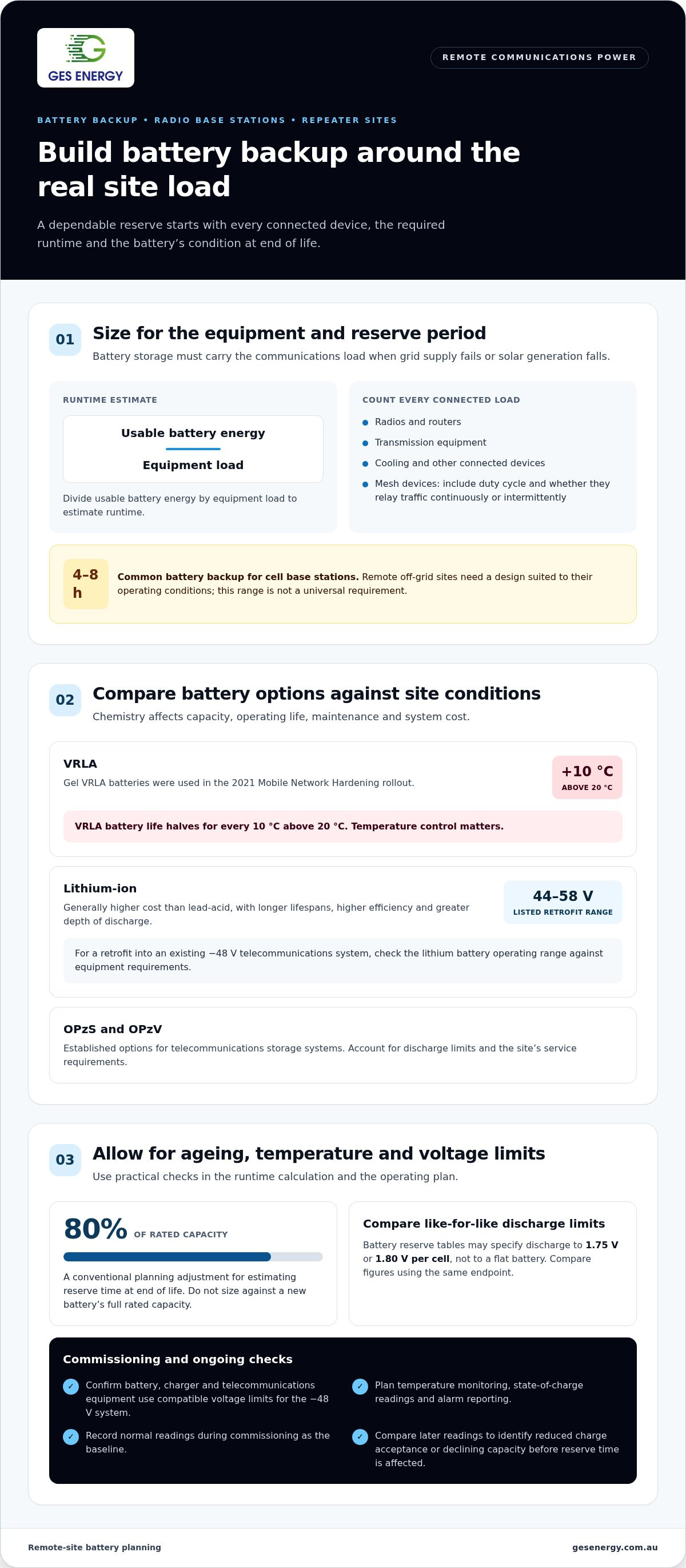
Battery storage keeps radio base stations and repeaters operating when grid supply fails or solar generation falls. Size the system around the connected equipment’s continuous energy demand, required reserve time and battery condition at end of life. Cell base stations commonly have battery backup for four to eight hours, but remote off-grid sites need a design suited to their operating conditions.
Estimate runtime by dividing usable battery energy by the equipment load. Include every connected device, such as radios, routers, transmission equipment and cooling. For a mesh device, account for its duty cycle and whether it relays traffic continuously or transmits intermittently. A low-power node may use less energy than a base station, but several nodes can increase the total storage requirement.
Battery chemistry affects capacity, operating life, maintenance and system cost. Lithium-ion batteries generally cost more than lead-acid batteries, but offer longer lifespans, higher efficiency and greater depth of discharge. OPzS and OPzV battery systems are also used in off-grid telecommunications. The right choice depends on the load profile, charging conditions, enclosure temperature and maintenance approach for the site.
- VRLA: Gel VRLA batteries were used in the 2021 Mobile Network Hardening rollout. VRLA battery life halves for every 10 °C above 20 °C, so temperature control matters.
- Lithium: For a retrofit into an existing −48 V telecommunications system, the listed lithium battery range is roughly 44-58 V. Check the operating range against equipment requirements.
- OPzS and OPzV: These established battery types are options for telecommunications storage systems. Account for their chosen discharge limits and the site’s service requirements.
Battery capacity also changes with age and temperature. A conventional planning adjustment uses 80% of rated capacity when estimating reserve time at end of life. Use this allowance in the runtime calculation rather than sizing against a new battery’s full rated capacity. Battery reserve tables may specify discharge to 1.75 V or 1.80 V per cell, not to a flat battery, so compare figures using the same endpoint.
For a −48 V system, confirm that the battery, charger and telecommunications equipment operate within compatible voltage limits. Plan temperature monitoring, state-of-charge readings and alarm reporting alongside scheduled inspections. These readings help identify reduced charge acceptance or declining capacity before reserve time is affected. A site-specific off-grid solar system can coordinate generation, battery storage and the communications load.
Understanding the Basics - What Powers a Cell Tower?
Australian rules do not set one universal battery-autonomy period for telecommunications sites. Solar, wind, diesel or hybrid power can supply a tower, with seasonal solar output, site load and backup fuel shaping the design.
Backup autonomy and site load sizing
Autonomy means how long stored energy can support the site without generation or grid supply. Start by listing each load, including radios, transmission equipment and cooling, then calculate their combined energy use. For example, a tower drawing 5 kW continuously uses 120 kWh per day; three days of autonomy requires 360 kWh of battery capacity in the stated example. Add the loads that must remain active during an outage, not just the core radio equipment. The result guides both battery storage and generator sizing.
Australian sites don’t have a mandated number of backup hours. The 2014 backup power determination sunset on 1 October 2024; it was an information-disclosure instrument, not an engineering mandate. ACMA outage rules address reporting and consumer protection, rather than backup-power design. Separately, the Commonwealth Mobile Network Hardening Program set a 12-hour autonomy target for hardened regional base stations. Treat site load, outage exposure and operating needs as the basis for an individual design.
Solar, wind, diesel and hybrid power
Solar panels generate energy during daylight, while batteries carry the load outside generating hours. Australian seasonal conditions matter: assess the site’s lower-output periods, not only its sunnier months, when sizing generation and storage. Wind can complement solar where local wind is strong; turbines are more effective at locations with wind speeds above 10 mph. Diesel or propane generators can provide backup when renewable generation and stored energy fall short. A hybrid system combines sources, reducing reliance on any single input.
Backup generators and battery chemistries
Diesel and propane are generator-fuel options for off-grid towers. Choose a generator based on the loads it must support and its role, such as emergency backup or battery charging. Battery options include lithium-ion, gel VRLA, OPzS and OPzV. Lithium-ion generally costs more than lead-acid, while offering higher efficiency, longer lifespans and greater depth of discharge. Match battery chemistry to charging conditions, maintenance access, operating environment and equipment compatibility.
Backup during outages and tower uptime
During an outage, batteries can maintain power to mobile-network equipment while another source is unavailable. Generator starting and battery discharge need coordinated control, so the tower’s critical loads receive supply in the intended order. Check whether transmission equipment and cooling remain powered alongside radios. A site-specific off-grid solar system can bring generation and storage together, with seasonal output and the required backup period informing the design.
Cell tower electricity consumption
A typical cell tower consumes between 1 and 8 kW, depending on location, users, technology and cooling requirements. If that load runs continuously, it equates to a daily energy range of 24 to 192 kWh. This gives you a starting point for assessing generation and storage, not a substitute for measuring the actual site load.
The total load includes more than radio equipment. Add transmission hardware, network switches, control systems and cooling to the assessment. Each device draws power differently, so record its demand during normal operation and peak activity. Cooling can add substantially to the infrastructure load at sites exposed to high temperatures, and equipment upgrades can change demand over time.
Use this process to estimate energy needs:
- List each connected device, including radios, transmission equipment and cooling.
- Record the operating load and whether it runs continuously or intermittently.
- Add the loads to establish total demand in kilowatts.
- Multiply continuous load by operating hours to estimate energy use in kilowatt-hours.
- Allow for the loads that must remain powered during an outage.
Keep power and energy units distinct. Kilowatts describe the rate of power use; kilowatt-hours measure energy consumed over time. If a load changes during the day, estimate energy use for each operating period rather than applying one peak reading to every hour. This distinction informs both solar-panel output planning and battery capacity.
At off-grid or poor-grid sites, compare demand with expected solar generation throughout the year. Panels produce energy during daylight, while mobile networks may need continuous power overnight. Seasonal sunlight and site shading affect array output. A hybrid design can combine solar, battery storage and generator backup to cover periods when generation falls below demand.
Consumption data also informs operating and maintenance plans. Compare monitoring data with the original load estimate to identify changes caused by added equipment, cooling demand or faults. A rise in overnight consumption, for example, may indicate a new load or a system issue that needs inspection. Reassess the energy balance after equipment changes, since an array or battery sized for an earlier configuration may no longer meet current demand.
Accurate load records provide a clearer basis for planning tower power. For Australian sites, use measured equipment demand, seasonal solar conditions and required outage operation to set generation and storage capacity. This helps avoid sizing the system around a single peak reading or overlooking the continuous energy needs of communications infrastructure.
Temporary power and communications for off-grid sites
Temporary communications in remote areas need power matched to the task, deployment period and equipment. A construction camp, emergency worksite or temporary repeater may need a different setup from a permanent tower. Start by listing radios, routers, lighting and other essential loads, then identify which must remain powered overnight.
Outage timing can affect communications before a site loses all power. The first hour may remain business as usual; problems can begin during hours one to four, with widespread communication gaps during hours four to eight. Use this sequence as a prompt to plan backup before deployment, not as a runtime promise for every Australian site.
For temporary power, compare a portable off-grid solar generator, panels with battery storage, and a fuel generator. Solar can recharge batteries during daylight, while stored energy supplies equipment after sunset. A fuel generator can support loads when solar generation is insufficient. A hybrid arrangement combines these sources, but adds equipment and operating steps.
- Define the task: Identify whether the site needs voice, data, radio coverage or a temporary link between crews.
- List the loads: Include communications equipment and supporting devices, then separate essential from optional demand.
- Choose the power mix: Match panels, battery storage and generator backup to expected use and access.
- Plan deployment: Decide where equipment will sit, how cables will run and how staff will monitor charging.
Communications coverage is separate from electricity supply. A charged radio or router cannot provide a useful link if the selected network or relay does not reach the work area. Map intended operating locations and test communications equipment before crews rely on it. For example, a repeater may extend a radio link locally, while a satellite communicator uses a different connection path.
Portable panels need clear, stable placement. Shade from vehicles, temporary buildings or nearby trees reduces solar generation. Dust can also obstruct sunlight, so include panel cleaning in the deployment plan. Secure cables against vehicle movement and foot traffic, and keep batteries and generator equipment accessible for inspection.
Before leaving the site, record the system’s operating state and assign responsibility for checks. Monitor battery charge, solar input and generator fuel where applicable. If the task changes, recalculate demand before adding radios or other loads. Plan how to pack down the temporary system, including safe isolation and removal of panels, batteries and cabling.
GES ENERGY: Commercial and Industrial Solar
GES ENERGY designs and installs off-grid solar systems for remote communications sites that need power beyond the grid. If your tower, repeater or temporary setup requires coordinated generation and battery storage, GES ENERGY’s Commercial and Industrial Solar service can support a system designed around site demand and operating conditions.
Bring together equipment loads, required autonomy, seasonal solar conditions and maintenance access to define the project priorities. This provides a practical starting point for discussing an off-grid power system suited to your communications site.
Contact GES ENERGY to discuss your remote-site power requirements.
Plan the next stage of your remote site
Use your load profile and operating priorities to shape a power design that can adapt as communications equipment changes. Planning off grid communication tower power also means considering how future upgrades could affect generation, storage and backup, rather than designing only for today’s demand.
For Victorian organisations planning a permanent remote site or temporary communications setup, GES ENERGY offers Off Grid Solar Systems and Commercial and Industrial Solar. Its EV Charging Stations address a separate infrastructure need for sites adding electric vehicle charging.
A useful next step is to bring together equipment loads, site conditions, maintenance access and the role of backup generation. These details help frame a practical project discussion and clarify the design priorities for your location and operations.
Discuss your remote site power requirements with GES ENERGY, and take the next step towards a power system shaped around your communications needs.
Frequently Asked Questions
How many hours of autonomy does a telecommunications site need?
Australia has no regulation mandating one specific number of backup hours for every telecommunications site. The Commonwealth Mobile Network Hardening Program set a target of at least 12 hours for hardened regional base stations. Treat that as a program target, not a universal design rule. Set site autonomy by considering critical equipment demand, likely outage conditions, access for repairs and whether another power source can start during an interruption.
Is 100% Off-Grid Cell Tower Feasible?
Yes. A tower can operate without grid electricity if its power system meets the site’s full energy demand. The design must account for continuous loads, seasonal solar availability, battery storage and periods of low generation. Solar panels and batteries can supply energy, while wind or a generator can add another source where site conditions suit. Define which equipment must stay online and how the system will handle extended low-generation periods.
Should I use lithium or VRLA at a telecommunications site?
Choose lithium-ion when higher efficiency, longer lifespan and greater depth of discharge support the operating plan; choose VRLA where its characteristics suit the site and maintenance approach. Lithium-ion generally costs more than lead-acid. Temperature also matters: VRLA battery life halves for every 10 °C above 20 °C. For an existing −48 V system, check battery voltage compatibility and charger settings before selecting a replacement chemistry.
What reserve time will I actually get at my site?
Actual reserve time depends on usable battery energy, current equipment demand, battery age, temperature and the discharge endpoint used in the calculation. For a practical estimate, divide usable stored energy by the measured load, then account for battery capacity at end of life. Compare reserve tables using the same end voltage, because the discharge limit affects the runtime result. Include cooling and transmission loads in site measurements.
How much power does an off-grid communications tower use in Australia?
A typical cell tower consumes between 1 and 8 kW, with demand affected by location, users, technology and cooling. A continuous 5 kW load uses 120 kWh per day. For a useful site estimate, measure demand across normal operation and include radios, transmission equipment, routers and cooling. Remote monitoring can help reveal load changes after equipment upgrades or faults, informing future generation and storage adjustments.
What solar panel and battery capacity does an off-grid telecom tower need?
Capacity depends on daily energy use, local solar conditions and the autonomy required. One example uses a 24 kW solar array for a tower consuming 120 kWh daily at a site receiving five peak sunlight hours each day. Three days of autonomy in that example requires 360 kWh of battery capacity. These figures illustrate a specific scenario, not a standard specification for every Australian tower.
How do you size an off-grid power system for a communications tower?
Start with a load schedule recording each device’s power draw and operating pattern. Convert continuous demand into daily energy use, then identify essential loads during outages. Next, assess solar availability by season, battery reserve needs, generator role and equipment voltage compatibility. Designing off-grid communication tower power around measured demand helps avoid relying on a peak reading that does not represent the site’s full operating profile.
How can an off-grid tower power system be monitored and maintained?
Track battery state of charge, solar production, load and system alarms so changes are visible before a site visit. Log readings and compare current performance with the system’s normal operating pattern. During planned inspections, check battery temperature, ventilation, panel condition, cable connections and generator readiness. Remote monitoring can help prioritise maintenance when travel takes time, while fault records support more focused troubleshooting.


