

A microgrid brings local energy sources, storage and controls together to supply a site, either alongside the electricity grid or independently from it. Commercial microgrid solutions can combine solar, batteries and other generation to help businesses manage energy use and maintain supply when grid power is unavailable. For remote sites, battery storage can balance generation with demand when connection to the grid is limited or unavailable.
Reliable power is essential to business operations, but the right commercial microgrid solutions depend on the site, its energy use and its backup needs. This guide explains how commercial and remote microgrids work, how batteries support them, when a business might choose off-grid operation, and how ownership and financing can fit into a project. It also covers site loads, generation, storage and future expansion, helping you understand the decisions behind a practical microgrid design.
Key Takeaways
- Choose between a grid-connected microgrid and an off-grid system based on your site’s connection, energy use and need for independent power.
- Battery capacity should reflect site loads, generation patterns and the energy required when solar or other sources aren’t producing.
- For remote sites, combine generation, storage and controls to manage changing demand and support a reliable local supply.
- Compare ownership and financing approaches alongside potential Australian incentives, including Small-scale Technology Certificates and Large-scale Generation Certificates.
- Plan for future demand as well as current needs, so the system design can account for expansion, storage and the site’s operating requirements.
Battery energy storage for commercial and industrial microgrids
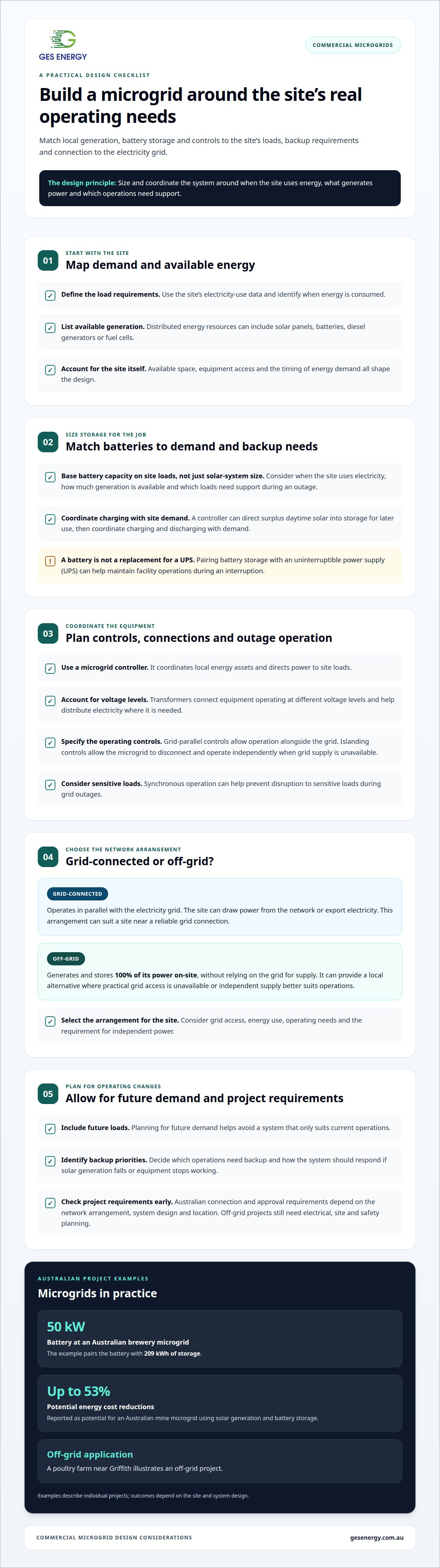
A commercial microgrid combines local generation, storage and controls to manage a site’s power supply. Australian projects include an off-grid poultry farm near Griffith and a brewery microgrid with a 50 kW battery and 209 kWh of storage.
Australian providers design and integrate commercial microgrid systems for industrial sites, businesses and remote facilities. Case studies also include an Australian mine microgrid using solar generation and battery storage, with potential energy cost reductions of up to 53%.
Technology selection and control
Technology selection starts with the site’s load requirements, available generation and the role of storage. Distributed energy resources can include solar panels, batteries, diesel generators or fuel cells. A microgrid controller coordinates these assets and directs power to site loads. Transformers connect equipment operating at different voltage levels, helping distribute electricity where it is needed.
Battery capacity depends on site loads and electricity-use data, not just the solar system’s size. Designers consider when the site consumes energy, how much generation is available and which loads need support during an outage. A battery energy storage system can provide backup, but it does not replace an uninterruptible power supply (UPS). Pairing a battery with a UPS can help maintain facility operations during an interruption.
Grid-parallel controls allow a microgrid to operate alongside the electricity grid. Synchronous operation can help prevent disruption to sensitive loads during grid outages. In normal conditions, the system can manage energy use, store available generation and draw power from the grid when needed. Islanding controls allow the microgrid to disconnect and operate independently when grid supply is unavailable.
Emergency power systems can also serve as distributed energy resources. A diesel generator, for example, can support a site alongside solar and battery storage. Hybrid microgrids combine multiple resources to strengthen supply reliability. The right mix depends on the site’s loads, fuel access, renewable generation and required operating mode.
Solar generation and battery storage can increase self-consumption by storing surplus daytime output for later use. Controllers coordinate charging and discharging with site demand. This can help businesses use more locally generated electricity and manage their power supply without relying on a single energy source.
Australian solutions and providers
Australian commercial microgrid providers develop grid-connected and off-grid energy solutions, including solar, batteries, generators and controls. When reviewing a project, focus on how the design addresses load requirements, storage capacity, outage operation and future expansion. The Griffith poultry farm illustrates an off-grid application, while the Australian brewery example pairs a 50 kW battery with 209 kWh of storage.
Why Do Businesses Choose To Go Off-Grid?
Businesses may choose off-grid operation when grid access is unavailable or an independent power supply better suits their needs. In Australia, connection and approval requirements depend on the site and system design. Project planning must account for the network arrangement and applicable electrical and safety requirements.
Grid-connected and off-grid options
A grid-connected microgrid operates in parallel with the electricity grid, allowing it to draw power or export electricity. An off-grid system generates and stores 100% of its power on-site. For a site near a reliable grid connection, a grid-connected design can retain access to network supply. For a remote operation, off-grid generation and storage can provide a local alternative.
Solar can support either arrangement. A grid-connected business can use solar generation alongside the network, while a standalone battery system can store electricity for later use. A battery can also operate without on-site solar, supporting energy management and resilience through microgrid controls. System planning should match storage and generation to the site’s loads, operating hours and backup needs.
Off-grid drivers and system definitions
A microgrid is a local energy system that combines distributed energy resources with controls. It may operate alongside the grid or independently. An off-grid system generates and stores all its electricity on-site, without relying on the grid for supply. The terms describe different things: a microgrid is a coordinated set of local energy assets, while off-grid describes the system’s relationship with the utility network.
Businesses may choose an off-grid design when a remote location lacks practical grid access or an independent supply better suits operations. Solar panels, batteries and generators can form a renewable energy system, with each resource serving a different role. Site infrastructure matters too: available space, equipment access and the timing of energy demand all shape the design. Planning for future loads helps avoid a system that only suits current operations.
Rules, approvals and operational risks
For Australian projects, connection and approval requirements depend on whether the system connects to the local network, its design and its location. Grid-connected projects must account for the network connection arrangement. Off-grid projects still need planning for electrical, site and safety requirements. These factors affect equipment selection and project delivery.
Reliability planning should identify which operations need backup and how the system responds when solar generation falls or equipment stops working. Cybersecurity planning should control access to microgrid controllers and communications systems. Safety planning should address battery and electrical equipment, while maintenance schedules should include inspections of batteries, inverters, generators and controls. Clear operating procedures help staff respond to faults and carry out maintenance consistently.
Battery storage for remote microgrids
Remote facilities need local generation and storage when a grid connection is unavailable or unsuitable. A battery can store surplus electricity for later use, helping balance supply and demand as solar output changes. For a site in regional Victoria, the design should reflect operating loads, available infrastructure and access for maintenance. These factors shape how the system supports daily operations.
Battery capacity should match the facility’s energy use and backup priorities. Start by identifying essential equipment, its operating schedule and periods of peak demand. Then assess how generation can recharge the battery under expected operating conditions. This helps distinguish the energy needed for routine use from the reserve required to support priority loads.
System ratings describe different functions. Kilowatt-hours indicate stored energy, while kilowatts describe the rate at which equipment can supply or consume power. GES ENERGY’s project portfolio includes an 80 kW solar installation with 184 kWh of battery storage in Wheelers Hill, Victoria. This example shows how generation and storage capacity are specified separately, rather than treated as interchangeable measures.
Controls coordinate batteries with solar and other on-site generation. A microgrid controller can direct available power according to operating priorities, such as maintaining refrigeration or communications equipment. Planning should define which facilities receive power first when generation falls and how the system responds if a component becomes unavailable. Clear operating procedures help staff act consistently.
Location also affects equipment layout and service planning. For a remote Victorian site, project design can consider access routes, installation space, equipment protection and the practical process for maintenance visits. A 40 kW off-grid installation in Victoria provides another local example of a system designed without relying on a grid connection. Its relevance depends on the site’s loads and generation profile.
Solar generation paired with battery storage can increase the use of electricity produced on-site. If a generator is part of the system, the operating plan can define when it supports supply and how stored energy is managed. The emissions effect depends on which energy sources the system replaces. Recording the existing energy mix gives the business a basis for assessing changes.
For a sound design, model site demand alongside seasonal generation, battery charging opportunities and backup requirements. Include planned changes to equipment and operating hours, since future demand can alter storage needs. Reviewing these factors together helps align system capacity with the facility’s actual requirements and supports dependable operation as conditions change.
Financing and ownership of microgrid assets
Australian businesses may use Small-scale Technology Certificates (STCs) and Large-scale Generation Certificates (LGCs) to offset solar and battery installation costs. These incentives can form part of a project’s funding plan. They are distinct from tax treatment, which depends on the business and how it owns or finances the assets.
Ownership affects who funds the equipment, operates it and carries ongoing asset responsibilities. A business that buys its microgrid assets funds the project directly and owns the solar generation, battery energy storage and controls. This gives the business direct oversight of system operation, while making it responsible for maintenance and future equipment replacement.
Third-party ownership is another structure to consider. An external asset owner may supply electricity or energy services under an agreed commercial arrangement. Compare the payment structure, operating responsibilities, contract length and end-of-term arrangements with direct ownership. The right model depends on cash flow, control requirements and how the site expects to use electricity.
For an industrial site, financing decisions should account for more than the initial equipment purchase. Include solar generation, battery energy storage, grid connection work, control systems, commissioning and planned maintenance in the project model. Then compare these costs with the expected value of on-site electricity, reduced grid imports and backup capability. Savings depend on the site’s demand profile, energy sources and system operation, so use actual load and electricity data.
Certificate eligibility and project design affect how incentives fit the funding case. STCs and LGCs are separate mechanisms, and their relevance depends on eligible generation and project configuration. Avoid treating an incentive as guaranteed project revenue. Model the business case with and without certificate value, then assess how each scenario affects cash flow and the preferred ownership arrangement.
Emissions can also form part of the assessment. A microgrid using renewable generation and battery storage may reduce reliance on electricity from other sources or on-site fuel generation. The emissions effect depends on what generation the system replaces and when the battery charges. Record baseline energy sources, projected operation and the reporting method before comparing outcomes.
A practical financing review can follow these steps:
- Set out the site’s electricity demand, critical loads and planned expansion.
- Separate equipment costs, operating costs, maintenance and replacement planning.
- Compare direct ownership with third-party asset arrangements and their payment terms.
- Assess STCs and LGCs within the project’s funding model.
- Review projected savings, emissions effects and operational responsibilities together.
This process gives decision-makers a clearer view of the trade-offs between ownership, control and cash flow. For commercial microgrid solutions, the financing model should match the system’s technical design and the business’s operating priorities.
What commercial microgrid solutions are available in Australia?
Australian businesses can consider grid-connected microgrids, off-grid systems and portable power solutions. Each can be designed around the site’s location, operating requirements and access to electricity infrastructure. In Victoria, requirements may differ between a Melbourne industrial facility and a regional operation in Geelong, Ballarat or Bendigo, where site conditions and network access shape the project scope.
A grid-connected microgrid combines on-site generation and storage with an existing network connection. Solar panels can generate electricity for a facility, while batteries store energy for later use. This arrangement suits businesses seeking greater control over on-site energy while retaining the network as part of their supply plan. The design needs to account for existing electrical infrastructure and operating needs.
An islandable design can separate from the network when required. Its equipment and operating plan are tailored to the loads the business wants to support independently. A food manufacturer in Melbourne, for example, may prioritise refrigeration and process controls, while a Geelong warehouse may focus on communications, security and essential handling equipment. Identifying these priorities gives designers a clear basis for the project brief.
Off-grid systems suit facilities where a network connection is unavailable or does not fit the site’s operating model. A regional business near Mildura or Horsham may need a locally generated supply designed around its facilities and work patterns. Solar can form part of that system, alongside storage and other generation options selected for the site. Transport access and available installation space also influence project delivery.
Portable power systems address a different need. They can suit temporary worksites or remote operations where fixed infrastructure is impractical. The design must reflect the connected equipment, expected use and practical constraints of moving and positioning the system. A permanent industrial site in Bendigo, by contrast, can be planned around fixed equipment, long-term operations and future changes in demand.
To narrow the options, first define the site boundary, operating priorities and network access. Then establish which facilities need support, where equipment can be located and how the system may need to expand. A commercial site in Ballarat may face different constraints from a Melbourne facility, even when both seek solar generation and storage. These details shape the technical design and project delivery plan.
Commercial microgrid solutions are selected by matching the system arrangement to the location and operating purpose. Businesses in Melbourne, Geelong, Ballarat, Bendigo and other Victorian centres can start with their site requirements, then assess which generation, storage and control arrangement fits.
Discuss a commercial microgrid design suited to your site’s location, energy needs and operating priorities.
GES ENERGY: Commercial and Industrial Solar
GES ENERGY designs commercial and industrial solar systems for projects ranging from 10 kW to 5 MW, helping Victorian businesses plan generation around site demand. Its Micro Grid Solutions can integrate local energy assets, while Off Grid Solar Systems suit sites needing an independent power supply. For temporary or remote applications, a Portable Off Grid Solution provides another option to consider.
Turn to GES ENERGY when you need a system designed around commercial loads, remote operations or a planned move towards greater energy independence. The design can account for the site’s energy use and the role of solar, storage and other generation. Commercial and industrial projects include a 10-year warranty.
Contact GES ENERGY to discuss your site’s energy requirements and project goals.
Plan your next energy step
The next decision is how your energy system should support the business as operations change. Set out the site’s priorities, planned loads and preferred level of grid independence. This gives the design process a practical starting point and connects technical choices with day-to-day requirements.
GES ENERGY offers Commercial and Industrial Solar, Off Grid Solar Systems and EV Charging Stations. These services can inform an energy plan that considers generation, storage and vehicle charging together. The right mix depends on your site’s needs and the role each system must play. Discussing your priorities with GES Energy can help define a clear path for assessing commercial microgrid solutions.
Contact GES ENERGY about microgrids to discuss your business’s energy needs. A considered plan can help you move towards an energy system that fits your operations and future direction.
Frequently Asked Questions
What is a Microgrid?
A microgrid is a coordinated energy system for a defined site, such as a factory, warehouse or regional facility. For a business, the key distinction is its operating boundary: which buildings, equipment and energy assets the system manages together. Defining that boundary clarifies what the project should serve and which operations belong in its energy plan.
Will a BESS system act as a UPS for my facility?
No. A BESS is not a complete substitute for a UPS. For a facility with sensitive equipment, map which devices need uninterrupted operation and which can tolerate a brief interruption. Then coordinate the UPS and battery system with the site’s electrical design and operating procedures. This clarifies continuity requirements for equipment such as control systems, communications and process equipment.
How do commercial microgrids work and what components do they include?
Components vary with the site’s requirements and connection design. A project may involve solar generation, battery storage, generators, inverters, transformers, switchboards, metering and control equipment. The practical task is to define how these elements connect to existing electrical infrastructure and how operators will monitor performance. A site plan and electrical drawings help establish equipment locations, interfaces and maintenance access.
What are the costs and payback periods for commercial microgrids in Australia?
There is no single cost or payback period for every Australian project. The quote depends on system design, equipment selection, site works, grid connection requirements and commissioning scope. A project assessment should compare these costs with expected electricity savings and operating benefits over time. GES Energy prepares project quotes based on the specific requirements of the site.
How do solar, battery storage, generators and energy management systems compare for commercial microgrids?
Each technology serves a different role. Solar produces electricity, batteries shift stored energy to another time, and generators provide dispatchable supply. An energy management system coordinates operation with business priorities. For example, a site may set charging schedules around production hours and reserve generator operation for planned contingencies. Compare options by assessing how each supports the facility’s operating plan, rather than selecting one technology in isolation.
How can a business assess whether a commercial microgrid is financially viable?
Prepare a business case comparing the proposed system with the site’s current energy arrangement. Include projected capital and operating costs, expected savings, maintenance, replacement planning and the value of improved operating continuity. Test the model against changes in production schedules or electricity use. In Australia, eligible projects may also consider Small-scale Technology Certificates and Large-scale Generation Certificates when assessing the funding case.
What are the steps to design, install and commission a commercial microgrid in Australia?
Start by setting the project brief, site boundaries, operating priorities and electrical design requirements. The delivery team then develops the design, sources equipment, completes construction and prepares commissioning records. Commissioning checks should document system operation, protection settings, control responses and handover information for site operators. GES Energy provides EPC services for solar, battery and microgrid projects, including delivery through commissioning.


