A solar farm EPC proposal can look complete while leaving critical responsibilities unclear. For a large scale solar farm epc project, the division of work across engineering, procurement, construction and commissioning can shape how smoothly delivery proceeds, especially at grid and handover interfaces.
A single delivery structure can simplify coordination, but a broad capability statement won’t show whether the proposed scope fits your project or how responsibilities will be managed. GES ENERGY delivers EPC projects from 100 kW to 5 MW, with engineering, CAD modelling, procurement, construction and commissioning available under one contract.
This guide explains how to define a practical EPC scope, set clear project-owner requirements and compare proposals against consistent criteria. It also covers delivery questions to address from early engineering through construction and commissioning, including responsibilities and handover expectations. Whether your project is in Victoria or elsewhere in Australia, you’ll have a clearer basis for assessing project fit and planning the next steps.
Key Takeaways
- A clear large scale solar farm epc scope distinguishes end-to-end delivery from equipment supply or construction-only work.
- Map each delivery stage and identify owner decisions and approvals early, so handovers remain clear.
- Compare proposals against the same criteria, including exclusions, assumptions, interfaces, change control and commissioning records.
- Prepare site information, project objectives and decision-makers early, then account for the planning, environmental and grid-connection requirements relevant to the location.
- Assess project fit through the specific engineering, CAD modelling, procurement, construction and commissioning scope, rather than broad capability claims alone.
What does large-scale solar farm EPC mean for an Australian project?
A solar farm EPC contract brings engineering, procurement and construction together as connected workstreams, with responsibilities and interfaces defined in one project scope. In practical terms, an EPC partner develops the design, arranges the agreed equipment and delivers the site works through to the contract’s stated completion point. For a large scale solar farm epc project, define that endpoint clearly. Commissioning may be included, but ongoing operations and maintenance are separate unless the contract says otherwise.
This delivery model differs from buying equipment alone or engaging a construction-only contractor. An equipment supplier provides specified components, while the project owner may need to coordinate design, installation and commissioning separately. A construction-only arrangement generally covers site works based on a design provided by others. Contract boundaries vary, so compare the actual scope rather than relying on the EPC label.
Australian solar projects span a range of scales and settings, as outlined in Solar Power in Australia. The EPC scope for an individual project still needs to reflect its site, delivery model and owner requirements.
What work can a solar farm EPC contract cover?
The project brief determines which activities sit inside the contract and which the owner retains. A defined scope can include engineering, CAD modelling, procurement, construction and commissioning. For each stage, identify its outputs, who reviews design information and how changes are handled. Spell out exclusions and interfaces so that equipment supply, site works and testing do not fall between parties.
For example, a contract may include engineering and procurement while leaving specific owner-supplied equipment outside the EPC contractor’s scope. The contract should then identify who provides the equipment information, coordinates delivery and resolves related interface issues. Describe commissioning deliverables just as clearly. A completed installation does not automatically include every record or activity the owner may expect.
When does an integrated EPC approach suit a project?
A single delivery scope can make coordination more direct by managing engineering decisions, equipment selection and site works within an agreed structure. This can help when several technical interfaces need to align. The value comes from defined ownership and communication pathways. It does not guarantee a particular cost, completion date or operating result.
Site conditions and owner priorities determine what that structure needs to cover. Access, terrain, existing infrastructure and intended connection arrangements can influence design inputs, procurement choices and construction planning. Set out the project scope, approval points and commissioning information you expect. Clear decisions at these interfaces help the delivery team work from a shared brief, whether the project is in Victoria or elsewhere in Australia.
Before agreeing the scope, establish who is responsible for each design input, approval, supplied item and handover document. An integrated contract can bring these responsibilities together, but only a specific scope makes the boundaries visible. That gives the project owner a practical basis for resolving interfaces before work moves from engineering into procurement and construction.
How Australian solar farm EPC delivery moves from engineering to commissioning
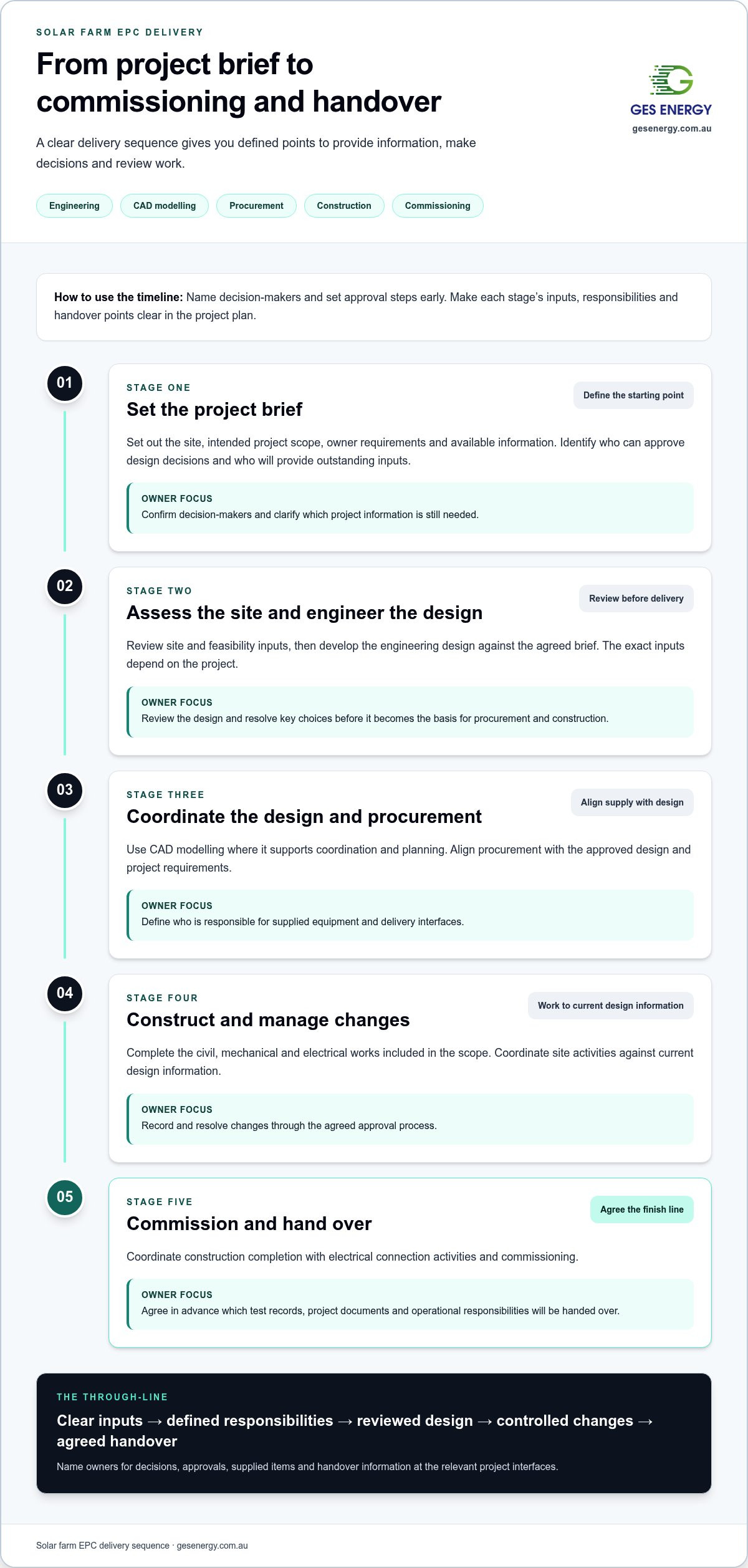
A defined delivery sequence gives the owner clear points to provide information, make decisions and review work. In a large scale solar farm EPC project, handovers can become difficult when inputs or responsibilities remain unresolved. Name decision-makers and set approval steps early, then include them in the project plan.
- Project brief: Set out the site, intended project scope, owner requirements and available information. Identify who can approve design decisions and who will provide outstanding inputs.
- Assessment and engineering: Review the site and feasibility inputs, then develop the engineering design against the agreed brief. Review the design and resolve key choices before it becomes the basis for procurement and construction.
- Design coordination and procurement: Use CAD modelling where it supports coordination and planning. Align procurement with the approved design and project requirements, and define responsibilities for supplied equipment and delivery interfaces.
- Construction: Complete the civil, mechanical and electrical works included in the scope. Coordinate site activities against current design information, and record and resolve changes through the agreed approval process.
- Commissioning and handover: Coordinate construction completion with electrical connection activities and commissioning. Agree in advance which test records, project documents and operational responsibilities will be handed over to the owner.
What happens during solar farm engineering and procurement?
Engineering translates the project brief and site information into a design that can guide delivery. Site assessment and feasibility inputs inform that work, with the exact inputs depending on the project. CAD modelling can support coordination by making design information easier to review alongside construction planning. Owner feedback is important: late decisions or changes to approved requirements can affect procurement planning and site work.
Procurement should follow the agreed design, not run ahead of unresolved requirements. Define the equipment and materials covered, who orders and receives them, and how owner-supplied items connect with the construction scope. These details help the delivery team plan around interfaces without assuming a supplier, technology or lead time that may not suit the project.
How should construction and commissioning connect?
Construction may include civil, mechanical and electrical work, depending on the project scope. Coordinate the sequence so completed works, connection activities and commissioning can progress against agreed design information. Define how completion is recorded, who coordinates outstanding items and what must be ready before commissioning begins. This makes the transition from site delivery to verification clear to the owner.
Commissioning verifies the completed project against its agreed scope and records the results for handover. Set out the commissioning deliverables in the contract, including the records and documents the owner expects. State whether ongoing operations and maintenance form part of the arrangement or sit outside it. Clear handover requirements help the owner understand what has been delivered and who takes responsibility next.
For an EPC scope that brings engineering, CAD modelling, procurement, construction and commissioning together, GES Energy’s solar EPC services provide a single delivery structure for coordinating those workstreams.
How to compare solar farm EPC proposals and contract responsibilities
Compare proposals against the same scope, not just the headline price or a broad list of capabilities. For a large scale solar farm epc project, a side-by-side review can reveal differences in exclusions, owner responsibilities and handover requirements before they become contract issues. Ask each proposal to describe what it includes, what it relies on and where responsibility passes between parties.
Which scope boundaries should an owner compare?
Use a consistent comparison framework. Record whether each proposal covers engineering, procurement, construction and commissioning, then examine the boundaries within each workstream. An item described generally as “included” may still depend on owner-provided information, approvals or equipment. Note those dependencies and identify how the contract handles changes to the agreed scope.
| Scope area | What to compare |
|---|---|
| Scope | Engineering, procurement, construction and commissioning tasks, with their stated outputs. |
| Exclusions | Work, equipment or activities the owner must arrange separately. |
| Assumptions | Site information, design inputs and owner decisions the proposal relies on. |
| Interfaces | Who coordinates owner-supplied items, connection activities and work by other parties. |
| Change control | How proposed changes are assessed, approved and recorded. |
| Commissioning and handover | Testing scope, records, documents and agreed operational responsibilities. |
Pay particular attention to connection and handover boundaries. A proposal should state which party coordinates relevant connection activities and what the owner receives at handover. Do not assume these responsibilities are covered simply because the document uses the term EPC. The contract should also explain how the owner provides information, reviews design submissions and approves changes. Clear owner decision pathways remain necessary, even under one EPC contract.
Fixed-price and cost-plus are different contract structures. Their meaning and allocation of cost or change risks depend on the agreed terms and project details; neither is automatically right for every project. Compare the assumptions and mechanisms behind each proposal, not only its commercial label. Review the contract terms and risk allocation carefully before signing.
How can project experience demonstrate relevant EPC fit?
Look for experience that relates to your project’s scale and scope, supported by evidence of coordinated engineering, construction and commissioning. A capability statement alone does not explain how responsibilities were managed across those stages. GES Energy’s stated project experience ranges from 100 kW to 5 MW; that range does not mean every project in it is a solar farm. Assess how the proposed scope aligns with your specific project.
For each proposal, check that the named workstreams connect clearly, owner inputs are visible and commissioning deliverables are defined. This gives you a consistent basis for comparing delivery approaches and understanding what each contract asks the project owner to decide, provide and oversee. Make sure the final terms match the proposal, including its exclusions, assumptions and change process.
What Australian and Victorian solar farm project planning needs to address
Early project information gives the EPC team a sound basis for defining design work, assumptions and delivery responsibilities. For a large scale solar farm epc project, a useful readiness check brings together land, energy objectives, connection context and owner decision-making, not just a site address. This matters in Victoria as much as elsewhere in Australia, because planning, environmental and grid-connection requirements depend on the project location and circumstances.
Which project inputs help establish a viable EPC scope?
Prepare a written owner brief before comparing proposals. It should identify the project’s priorities, constraints, available information and decision-makers. Use this checklist to organise the inputs:
- Site: Location, boundaries, available site information, access considerations and known constraints.
- Land use: The intended use of the land and any known planning or environmental considerations that may affect the project.
- Energy objectives: The project’s purpose and intended outcomes.
- Connection context: Available information about the intended connection arrangement and any relevant discussions or documents.
- Delivery objectives: The intended project scope, expected workstreams and any owner-supplied inputs.
- Decision responsibilities: Owner representatives, approval pathways and the person authorised to resolve scope changes.
Record what is known, what remains open and who will provide each outstanding input. If site details or owner requirements change during design, the EPC team may need to revisit coordination and proposal assumptions. A dated brief with a clear record of revisions helps all parties work from the same information and makes changes easier to track.
How do local approvals and grid interfaces affect delivery?
There is no single approvals pathway that applies to every Australian solar project. Planning and environmental considerations, along with grid-connection processes, depend on factors such as the site, project scope and relevant authorities. A Victorian project may involve different local considerations from a project elsewhere in Australia. Identify the authorities relevant to the location and verify project-specific requirements with them rather than treating one jurisdiction’s process as universal.
Build these interfaces into the project plan. The EPC scope should state who coordinates information and communication with relevant parties, who prepares or supplies project inputs, and which activities remain with the owner or another party. Distinguish coordination from responsibility for approvals or connection decisions. Clear boundaries help the owner understand dependencies without implying that an EPC contract alone secures an approval or connection.
Before seeking proposals, assemble the site information and owner brief, flag unresolved requirements and document who will make decisions. These steps give each proposal a clearer basis for pricing and scope definition. Discuss your solar project scope with GES Energy to establish how EPC workstreams can be organised around your project requirements.
GES ENERGY large-scale solar farm EPC: project fit and next steps
A suitable EPC partner should be able to connect the workstreams your project needs and define how they fit together. GES Energy provides EPC services covering engineering, CAD modelling, procurement, construction and commissioning. Bringing relevant workstreams under one contract can support coordination across design, equipment procurement and site delivery, with responsibilities set out for the project.
Which GES ENERGY EPC capabilities may fit a solar farm project?
GES Energy provides EPC services for solar, battery storage, micro-grids and off-grid solutions. Its EPC service areas also include solar car parks and EV charging stations. The right scope depends on your project brief, site conditions and owner requirements. Compare the proposed work against the functions your project needs, including commissioning and handover, rather than relying on general capability statements.
Project fit also depends on how clearly the proposal defines interfaces between workstreams and responsibilities across the delivery team. Set out what you expect the EPC arrangement to cover and which decisions remain with the owner. This gives both parties a practical basis for discussing how the project can be delivered.
What should a project brief include before requesting a quote?
A clear brief helps shape a useful proposal. Include the following information where available:
- Site location: The project location and available site details.
- Project objectives: The intended purpose and outcomes.
- Known constraints: Site, land-use, planning or environmental considerations already identified.
- Preferred delivery scope: The workstreams you want included.
- Existing information: Available design material, site assessments and connection information.
- Owner decision-makers: The people responsible for reviewing information and approving decisions.
Share what is known and identify any information still being developed. GES Energy supports solar projects across Victoria, including Melbourne, Geelong, Ballarat, Bendigo, Shepperton, Melton, Mildura, Wodonga, Traralgon, Wangaratta, Horsham, Sale, Colac, Echuca, Ararat, Portland, Swan Hill, Benalla and Maryborough. For broader EPC context, the Solar EPC Australia guide explains how the delivery workstreams relate. To discuss your project scope with GES Energy, request a quote.
Set your solar farm project up for its next stage
Decide how your organisation will make project decisions as work advances. Assign owners for technical reviews, commercial approvals and changes to project priorities, then make those pathways clear to the delivery team. This gives discussions a reliable point of reference as the project moves from development into delivery, even when some details are still being resolved.
An EPC relationship works best when both parties can see what is agreed, what remains open and who will act on each item. For a large scale solar farm epc project, preparation is not about removing every uncertainty. It is about making assumptions visible and managing them deliberately as the project progresses.
GES Energy can discuss a delivery scope that reflects your project requirements. Request a quote to start a focused conversation about your solar farm EPC project. With clear decision pathways and a well-framed scope, you can approach the next stage with confidence.