Yes, an end-to-end commercial solar EPC project can cover feasibility, engineering, procurement, construction and project management, with large-scale projects reaching up to 5 MW. A solar EPC capability statement should make clear how a team assesses site suitability, estimates project returns and manages delivery, quality and safety controls.
Choosing an EPC partner is about more than installing solar panels. You need to understand how a project could match your energy use, which funding structure may suit your business and what affects feasibility and return on investment.
This article explains commercial solar EPC delivery in Australia, from feasibility studies and ROI projections to capital expenditure (CAPEX), finance and power purchase agreement (PPA) options. It covers procurement, construction, project management, and quality and safety controls, with practical considerations for Victorian businesses.
Key Takeaways
- Compare CAPEX, finance and power purchase agreement options to understand how each can shape project ownership and cash flow.
- Assess how solar, battery storage and integrated energy networks could support your commercial site’s energy needs.
- Use site conditions, energy consumption and project design to build a practical feasibility and ROI assessment.
- Plan procurement, construction and project management as connected stages of an EPC project, with quality and safety controls built into delivery.
- GES ENERGY delivers commercial and industrial solar projects, including utility-scale projects up to 5 MW.
CAPEX, finance and power purchase agreement options
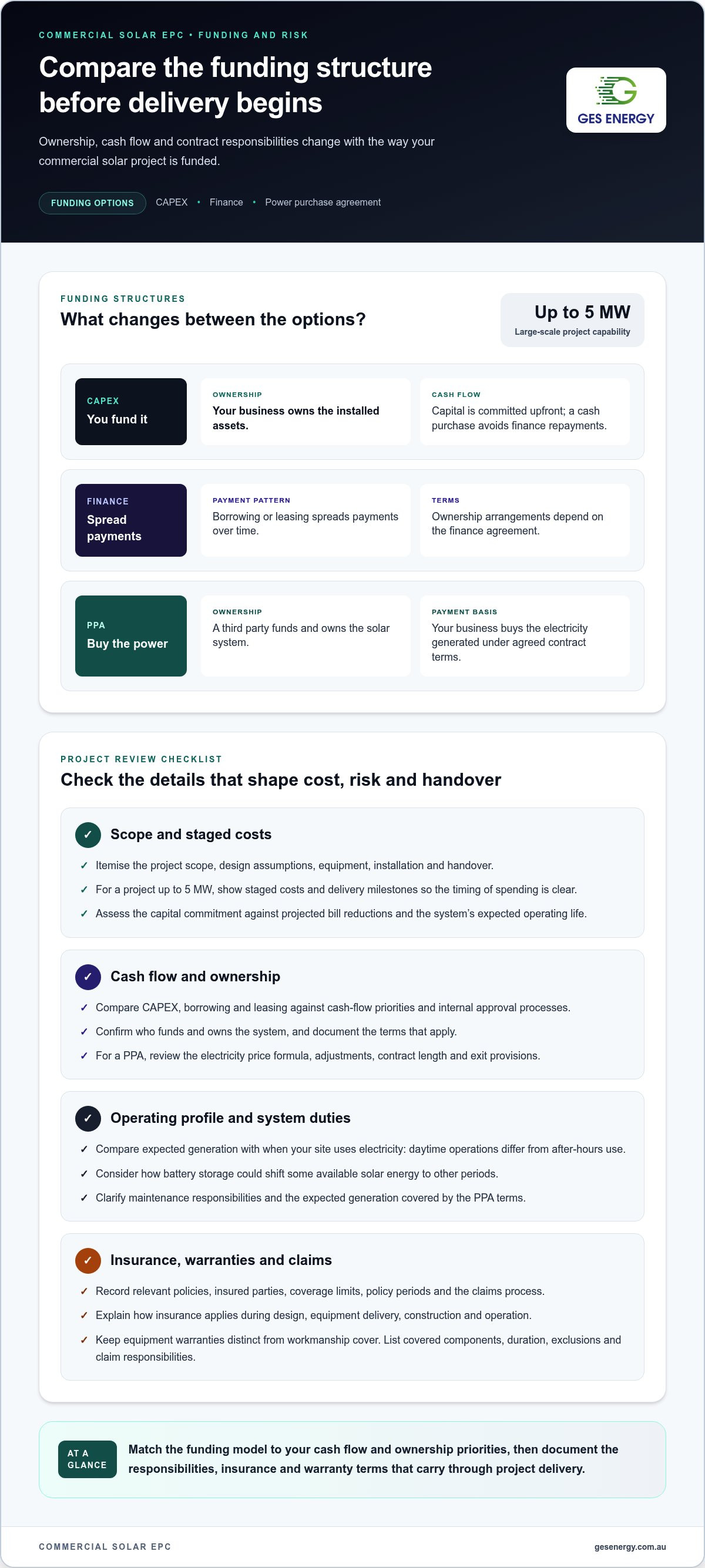
A solar EPC capability statement should explain project funding, system ownership, insurance and warranty terms. It should identify who funds and owns the system, what cover applies and how claims are managed. Keep equipment warranties distinct from workmanship cover.
Under a CAPEX model, your business funds the project and owns the installed assets. The proposal should itemise the project scope, design assumptions, equipment, installation and handover. This helps your finance team assess the capital commitment against projected bill reductions and the system’s expected operating life. For a project up to 5 MW, staged costs and delivery milestones can clarify when spending occurs.
Compare CAPEX with borrowing or equipment finance by mapping each option against cash flow, ownership and internal approval processes. A cash purchase avoids finance repayments but commits capital upfront. Borrowing or leasing spreads payments, while terms and ownership arrangements depend on the chosen finance agreement. The project quote depends on site conditions, system design, equipment, grid connection work and construction scope, and is provided after a quote request.
A power purchase agreement (PPA) offers a different structure. A third party funds and owns the solar system, and your business buys the electricity it generates under agreed contract terms. Review the electricity price formula, adjustments, contract length, expected generation, maintenance responsibilities and exit provisions. A site with daytime operations may value on-site generation differently from a business that uses most of its power after hours. Battery storage can shift some available energy to other periods.
Insurance information should identify relevant policies, insured parties, coverage limits, policy periods and the claims process. Include certificates and explain how cover applies during design, equipment delivery, construction and operation. Specific documents help procurement and risk teams assess the project more effectively than a general statement that it is insured.
Separate equipment warranties from installation workmanship cover. Set out covered components, the start date, duration, exclusions, claim process and responsibility for coordinating manufacturer claims. A clear schedule helps your asset manager understand who handles an inverter fault, panel issue or installation defect. It also makes handover records easier to use.
- For CAPEX: map the scope, payment milestones and ownership into the project case.
- For finance: compare repayments and ownership terms against cash-flow priorities.
- For a PPA: assess the electricity pricing method, contract conditions and operating profile.
- For risk review: organise insurance certificates and warranty schedules by project stage.
The Melbourne Water solar farms in Victoria are expected to power 22% of the electricity required to run the Eastern Treatment Plant, an example of project scale.
What is a Solar EPC and why is it important for commercial projects?
A solar EPC contractor coordinates engineering, procurement and construction throughout a project’s lifecycle. For commercial sites, its capability statement should connect relevant project evidence with the proposed technical scope and delivery model.
Commercial and Large-Scale Solar Projects
For commercial projects, present each case study with the site context, system type, delivery role and outcome. Distinguish measured results from forecasts, and explain how the project addressed the facility’s energy needs.
Victoria offers relevant examples of large solar and storage infrastructure. The Hardwicks Meat Works microgrid in Kyneton included 2 MW of battery storage. A useful case study would explain the project’s delivery scope, how storage fitted into the microgrid, and which responsibilities sat with the EPC team. That detail helps buyers compare experience with their own project requirements.
For government and commercial tenders, match case studies to the requested scope and evaluation criteria. Identify the contractor’s role, delivery model and supporting evidence. Do not present projected outcomes as completed results or make broad claims without evidence. Focused project records help reviewers assess how relevant the experience is to the proposed work.
Licences and Regulatory Requirements
Australian licensing and approval requirements vary by state or territory, work scope and grid connection. In a tender response, identify the relevant electrical contractor and worker credentials, then describe the approvals and safety processes that apply to the work.
Make supporting information easy to assess. Name responsible personnel, explain their project roles and provide relevant credential details. Clarify which activities and locations each credential covers. A jurisdiction-specific summary helps procurement teams understand responsibility for each part of the work.
Project Sizes, Technologies and Delivery Models
State the project scale supported by documented experience. Identify relevant technologies, such as solar PV, battery storage, microgrids or EV charging, and explain how they connect to the site’s electrical infrastructure.
Commercial storage can hold solar generation for use later. Describe its intended role, connection points and relationship to site loads. An industrial facility with evening operations, for example, may assess storage differently from a business whose main activity takes place during daylight hours.
Specify whether the proposed model covers engineering, procurement, construction or the full EPC lifecycle. Then clarify interfaces, owner responsibilities and handover needs. Tender reviewers can assess the proposed commercial solar EPC delivery approach more effectively when each stage connects to documented project work and the tender’s practical requirements.
A project’s technology mix and operating context can make its relevance clearer than scale alone. The Yadlamalka Energy Project in South Australia included a 6 MW solar PV system and 9 MWh of vanadium flow battery storage. This example can help buyers assess experience with solar generation paired with long-duration storage, while checking how the proposed delivery scope relates to their own site needs.
For a treatment facility, the Barwon Water Blackrock Treatment Plant solar project was associated with stated yearly energy usage of 3019 MWh and was stated to save 1500 tonnes of CO2 emissions per year. Present such figures with their stated or estimated status, alongside the project context, so procurement teams can evaluate their relevance without treating estimates as measured results.
Feasibility studies and ROI projections
A commercial feasibility study tests whether a proposed solar project suits the site, energy profile and investment objectives. Start with interval electricity data, site plans, operating hours and existing infrastructure. These inputs help engineers assess usable installation areas, likely generation patterns, connection requirements and potential constraints. A Melbourne business should also consider seasonal demand and planned changes to site operations.
Next, compare expected generation with the site’s electricity use. Map projected system output against the facility’s demand across its operating hours. This helps show how much electricity may be used on site and when surplus could be available. Review generation alongside operating schedules and electricity purchasing arrangements, rather than judging a project by system capacity alone.
ROI projections translate technical design into financial scenarios. Set out capital and operating assumptions, projected energy production, self-consumption, export arrangements and maintenance allowances. Compare expected bill savings with project expenditure over the assessment period. Show which assumptions have the greatest effect, such as solar yield, energy use during generation hours and future site loads. Keep base, higher-generation and lower-generation scenarios separate so decision-makers can see how changed assumptions affect the result.
Storage can change a solar project’s value by shifting when generated electricity is used. Model battery charging and discharging against the site’s demand profile rather than treating storage as an automatic addition. A Melbourne facility with evening demand, for example, may assess a different storage role from a site operating mainly during daylight. Include the battery’s operating strategy, system losses and replacement considerations in the financial model.
Base project comparisons on each site’s actual operating conditions. A Melbourne warehouse, for example, may have different roof space, daytime loads and operating schedules from a manufacturing facility in Ballarat. Use site-specific inputs rather than transferring another project’s projected savings. A defensible projection explains its assumptions, calculation method and boundaries, including exclusions. Distinguish estimated savings from measured outcomes in every report.
- Gather: interval usage data, site plans and operating schedules.
- Assess: usable areas, generation profile, grid connection and site constraints.
- Model: self-consumption, exports, storage operation and financial assumptions.
- Present: scenarios, exclusions and the assumptions that influence projected returns.
Clear feasibility findings help finance and operations teams compare options consistently. In Victoria, relate projected benefits to the specific site and its electricity profile, not another facility’s headline savings.
Procurement, construction and project management
An EPC should present engineering, procurement and construction as connected responsibilities, with clear scope, interfaces and handover records. Look for named project stages, responsible roles and evidence of how delivery is coordinated.
Procurement Capabilities
Procurement turns the approved design into equipment orders, supplier coordination and delivery planning. A capability statement should explain how technical specifications, equipment schedules and project requirements guide purchasing decisions.
It should also explain how the EPC tracks deliveries, checks supplied items against specifications and manages equipment interfaces. For a solar and battery project, show how panel, inverter and storage procurement aligns with the design and construction sequence. This helps you assess whether procurement supports the project scope rather than operating as a separate task.
Construction Capabilities
Construction capability describes how site works, installation and commissioning follow the approved design. Look for clear scope boundaries, site coordination, installation quality checks and a defined handover process.
A project example should explain the EPC’s role from mobilisation through testing and documentation. For instance, the Central Power House project in Umuwa included a 2.9 MW solar farm and 1 MWh of battery storage to power five remote communities. A useful case study would make the construction interfaces and delivery responsibilities clear, not simply list equipment.
Project Management
Project management connects design, procurement, site activities and stakeholder decisions through a controlled delivery plan. The capability statement should name key roles and explain how the EPC tracks schedule, scope changes, dependencies and progress reporting.
For a commercial site, explain how construction is coordinated with existing operations and access needs. Include the escalation process for design changes, delayed equipment or site constraints. A clear reporting sequence gives your project team visibility into decisions, responsibilities and outstanding actions throughout delivery.
Engineering, Procurement and Construction Delivery
Present the complete delivery model, from engineering inputs to final handover. Set out what falls within the EPC scope, which interfaces involve the owner or network stakeholders, and how design decisions inform purchasing and construction.
Use a project-stage summary to make the sequence easy to assess. Where relevant, include design reviews, procurement release, construction readiness, installation checks, commissioning records and handover documents. This shows how each stage informs the next and helps tender reviewers compare the proposed approach with their requirements.
- Scope: define EPC responsibilities, exclusions and project interfaces.
- Evidence: provide relevant project examples and explain the contractor’s role.
- Controls: show how design, equipment, site work and handover records connect.
- Reporting: describe progress updates, change handling and escalation pathways.
Quality and safety management
For Australian projects, list relevant technical capabilities, certifications and accreditations, and explain their scope. Show how quality checks and safety processes apply across design, procurement, construction and handover.
Quality Management
A quality management approach should link approved designs to inspection records, testing and project handover. Explain how document control, design reviews and equipment checks help identify issues before they affect later construction stages.
For example, describe how installation records are checked against project specifications and commissioning results. Explain how defects are recorded, corrective actions assigned and issues closed out. Clear evidence helps your project team trace decisions from engineering documents through completed site work.
Safety Management
Describe how safety planning is built into each project stage, from site preparation to commissioning. Explain how teams communicate hazards, coordinate work activities and record safety actions for the specific site.
A solar project may involve electrical equipment, elevated work areas and construction interfaces. Explain how site-specific risk assessments, worker briefings and supervision address those conditions. Include the process for reporting incidents and reviewing controls when work conditions change. This shows how safety management works in practice, not just as a policy statement.
Certifications and Accreditations
List certifications accurately, with the certified entity, scope and evidence available to tender reviewers. Relevant credentials in this context include ISO 9001 for quality management, ISO 14001 for environmental management and ISO 45001 for occupational health and safety management.
Identify Solar Accreditation Australia (SAA) accreditation where it applies, and state the accredited party and work scope clearly. Do not imply that an organisation-wide certification automatically covers every subcontractor, worker or project activity. Attach supporting documents when tender requirements request them.
Technical capability also needs evidence. Specify the engineering and construction work covered, such as solar PV design, equipment integration, installation, testing and commissioning. Link each capability to completed project examples or documented procedures. For battery or EV charging projects, describe how the equipment interfaces with site electrical systems and project controls. This gives evaluators a practical view of how technical planning supports quality and safe delivery.
- Quality: describe design reviews, inspections, testing and corrective-action records.
- Safety: explain site risk planning, briefings, supervision and incident reporting.
- Credentials: name each certification, accredited party and applicable scope.
- Evidence: connect technical claims to project records and tender documents.
For a commercial solar project, apply these quality and safety checks to the design, installation and commissioning scope of GES ENERGY Commercial and Industrial Solar.
GES ENERGY: Commercial and Industrial Solar
GES ENERGY provides Commercial and Industrial Solar for businesses assessing a new project or expanding existing energy infrastructure. Its commercial solar systems are designed for projects ranging from 10 kW to 5 MW, giving you a basis to discuss site requirements, system scale and project objectives.
Turn to GES ENERGY when your business needs commercial solar, an off-grid system or EV charging stations. For commercial and industrial projects, GES ENERGY provides a 10-year workmanship warranty, giving you clear installation cover to consider alongside equipment warranties and project documentation.
To discuss your commercial solar requirements, contact GES ENERGY.
Turn your project priorities into a clear next step
Turn the project’s energy needs into a focused decision brief. Set out the outcomes your organisation values, the site constraints that shape delivery and the commercial questions stakeholders need answered. Use these priorities to assess which delivery model suits the project and what evidence your procurement team needs before moving forward.
A solar EPC capability statement can frame the discussion, but your project brief should lead. Bring together relevant site information, energy-use data and internal approval requirements. This gives early conversations a practical focus and connects engineering choices with operational and financial priorities.
GES ENERGY offers Commercial and Industrial Solar, Off Grid Solar Systems and EV Charging Stations. If you’re ready to discuss how these may fit your project, talk with GES ENERGY about solar EPC.
A well-defined next step can make a complex energy decision easier to manage. Start with the priorities that matter most to your business.
Frequently Asked Questions
Can your team provide end-to-end solar EPC solutions for large commercial sites?
Yes. GES ENERGY provides EPC services for solar, battery storage, microgrids and EV charging projects. Its work can coordinate design, equipment supply, installation and commissioning for commercial sites. In Victoria, project discussions can cover Melbourne, Geelong, Ballarat, Bendigo, Shepparton, Melton, Mildura, Wodonga, Traralgon, Wangaratta, Horsham, Sale, Colac, Echuca, Ararat, Portland, Swanhill, Benalla and Maryborough. Planning can focus on site operations, energy needs and delivery scope.
What is a solar EPC capability statement?
A solar EPC capability statement is a concise document that helps a buyer assess whether an engineering, procurement and construction contractor suits a project. It should make the contractor’s role, relevant project experience and delivery strengths easy to understand. For example, a tender team reviewing a proposed microgrid can use it to identify experience with integrated generation and storage, then assess supporting evidence against the project brief.
What sections should a solar EPC capability statement include?
Include an organisation profile, relevant project examples, technical scope, delivery approach, key personnel, quality and safety information, and supporting credentials. Organise the document around the tender’s evaluation criteria. For example, place a microgrid case study near the section on integrated solar and storage experience. Label completed work and projected outcomes separately, and support every claim with evidence a procurement team can assess.
What safety, quality and environmental systems should a solar EPC demonstrate?
Show documented processes for design review, equipment verification, inspection, commissioning, hazard management, incident reporting and environmental controls. Identify how each process applies to the project and who is responsible for maintaining its records. If you present a certification, state its scope and the entity it covers. This helps tender evaluators distinguish documented management systems from general commitments, without implying that one credential covers every project partner.