

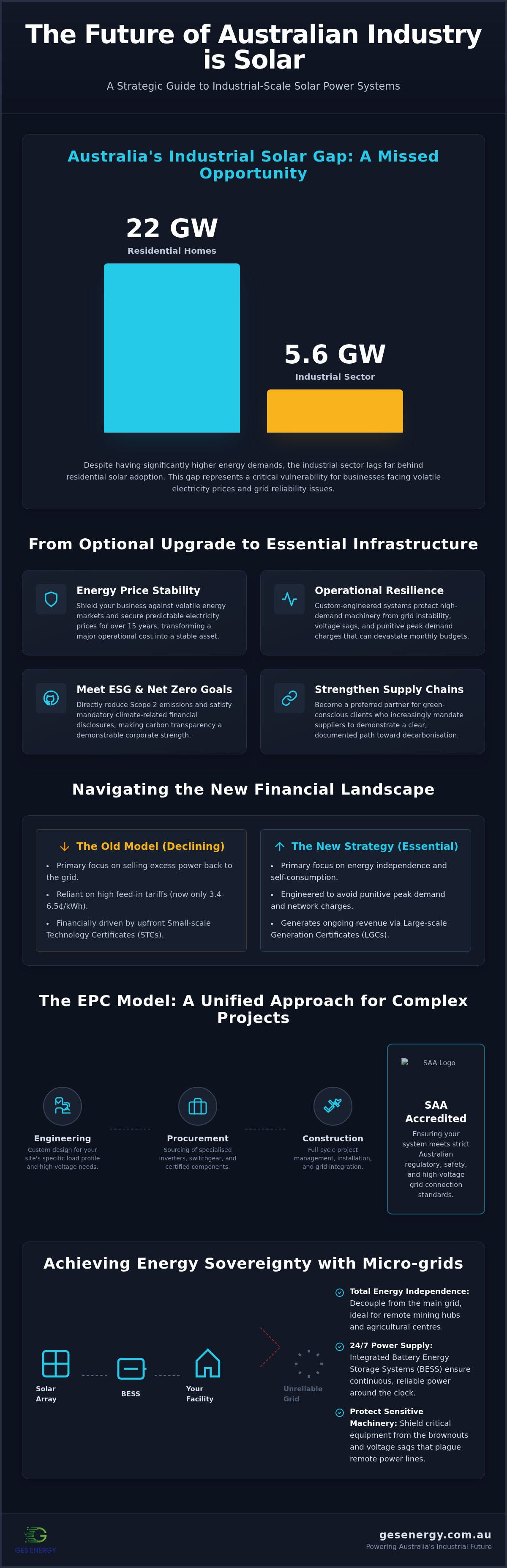
Did you know that while Australian homes have reached 22 GW of solar capacity, the industrial sector sits at just 5.6 GW despite having much higher energy demands? This gap represents a significant missed opportunity for Australian leaders who are currently grappling with volatile electricity prices and grid reliability issues. Implementing industrial solar power systems is no longer just a sustainability goal; it's a critical infrastructure shift required to secure your facility's operational future.
It's understandable if you feel overwhelmed by the technical complexity of large-scale engineering and the shifting regulatory landscape, including the 2026 Solar Accreditation Australia (SAA) requirements. This guide serves as a comprehensive roadmap to help you manage multi-megawatt energy strategies and EPC services with confidence. We'll examine how custom engineering, battery storage, and micro-grid solutions can deliver price predictability for over 15 years while simultaneously strengthening your carbon reduction efforts and ESG reporting.
Key Takeaways
- Learn why industrial solar power systems have transitioned from optional upgrades to essential infrastructure for shielding Australian businesses against volatile energy markets.
- Understand the EPC model and how SAA-accredited engineering ensures your high-voltage system meets strict Australian regulatory and safety standards.
- Navigate the financial architecture of large-scale solar, including the transition from upfront STCs to ongoing revenue streams from Large-scale Generation Certificates (LGCs).
- Discover why proactive inverter maintenance and system health monitoring are vital for protecting the operational longevity of multi-megawatt energy assets.
- Identify the strategic advantages of a national delivery model for companies looking to standardise energy independence across multiple interstate industrial facilities.
The Strategic Role of Industrial Solar Power Systems in 2026
Industrial solar power systems represent a fundamental shift in how Australian manufacturing and logistics hubs manage their operational overheads. While a standard commercial array might power a suburban office block, industrial-scale installations typically exceed 100kW and often reach multi-megawatt capacities. These systems are essentially a private photovoltaic power station designed to integrate with high-voltage infrastructure. In 2026, these assets have moved from being an optional sustainability "extra" to becoming critical infrastructure for any facility looking to survive in a high-cost energy market.
The Australian industrial landscape is currently facing a unique set of pressures. As of mid-2026, the gap between residential and industrial solar adoption remains stark; homes have installed 22GW of capacity, while businesses trail at only 5.6GW. This disparity exists despite the fact that industrial facilities consume the lion's share of daytime power. With feed-in tariff benchmarks across the nation generally declining to a range of 3.4 to 6.5 cents per kWh for the 2026-27 period, the financial logic has shifted entirely. It's no longer about selling power back to the grid. It's about engineering energy independence to avoid the high costs of peak demand.
Meeting Net Zero and ESG Mandates
For industrial leaders, industrial solar power systems are the most direct lever for reducing Scope 2 emissions. In 2026, large Australian entities are now required to provide mandatory climate-related financial disclosures under the Treasury Laws Amendment Act, making carbon transparency a legal necessity rather than a marketing choice. Beyond compliance, renewable energy assets are becoming a prerequisite for securing supply chain contracts. Green-conscious partners increasingly demand that their logistics and manufacturing providers demonstrate a clear, documented path toward decarbonisation.
Energy Security in High-Demand Environments
Generic, off-the-shelf solar packages frequently fail in industrial settings because they don't account for the complexity of high-demand machinery. A facility running sensitive CNC equipment or 24/7 cold storage requires a custom-engineered solution that manages voltage stability and harmonics. Off-the-shelf inverters often lack the sophisticated grid-interaction capabilities needed to handle the sudden load spikes common in heavy industry. By designing a system specifically for your site's load profile, you shield your operations from grid volatility and the punitive peak demand charges that can otherwise devastate a monthly budget.
Engineering Resilience: EPC Services and Micro-grid Development
Engineering a 2MW array is vastly different from a standard rooftop job. For high-voltage industrial sites, the EPC (Engineering, Procurement, and Construction) model provides a streamlined pathway to energy independence. It moves away from fragmented subcontracting. Instead, it offers a single point of responsibility. GES Energy manages this full lifecycle for projects ranging from 500kW to 5MW. This ensures that every component, from the structural racking to the high-voltage switchgear, is designed to work as a unified asset.
A critical part of this process involves SAA-accredited engineering. As of 2026, Solar Accreditation Australia (SAA) is the official body ensuring that designers and installers maintain the technical proficiency required for complex grid connections. This is especially vital when integrating industrial solar power systems with existing SCADA (Supervisory Control and Data Acquisition) or industrial control systems. Proper integration allows facility managers to monitor real-time performance alongside their production data, ensuring that solar output matches the facility's load profile perfectly.
If your facility operates in a region with poor grid reliability, you might consider exploring micro-grid solutions that offer true operational resilience.
Micro-grid Solutions for Remote Industrial Sites
Remote mining hubs and agricultural centres often face the highest energy costs and the least reliable supply. Decoupling from the main grid through a micro-grid is no longer a futuristic concept. By integrating industrial solar power systems with a Battery Energy Storage System (BESS), these sites achieve energy sovereignty. This setup provides 24/7 power, shielding sensitive machinery from the brownouts or voltage sags that often plague remote lines. It’s a shift from being a passive consumer to becoming an active energy producer.
Procurement and Quality Control
Longevity in the Australian outback or a coastal industrial zone requires more than just standard hardware. Sourcing Tier 1 components specifically rated for high-ambient temperatures and corrosive environments is essential. High-efficiency inverters play a pivotal role here. They don't just convert power; they maximise the energy harvest during the shoulder periods of the day. Rigorous factory testing and strict procurement standards ensure that your investment remains a high-performing asset for decades, not just years.
The Financial Architecture of Large-Scale Solar
The transition from a 99kW commercial system to a multi-megawatt industrial asset fundamentally changes the financial structure of the project. While smaller systems rely on upfront Small-scale Technology Certificates (STCs), industrial solar power systems exceeding the 100kW threshold enter the Large-scale Renewable Energy Target (LRET) framework. In 2026, the STC deeming period has reduced to just five years, making the upfront rebate less impactful for large projects. Instead, industrial leaders must pivot their focus toward Large-scale Generation Certificates (LGCs), which provide an ongoing revenue stream based on actual system performance.
LGCs are created for every megawatt-hour of renewable electricity produced and are traded through the Clean Energy Regulator. Unlike the "set and forget" nature of STCs, LGCs require ongoing compliance and reporting, but they offer a hedge against future energy price fluctuations. This ongoing yield can be sold to entities with liabilities under the renewable energy target or used to prove carbon neutrality for ESG reporting. Successfully managing these certificates transforms your energy infrastructure from a cost centre into a performing financial asset.
Choosing between a capital expenditure (CAPEX) model and a Power Purchase Agreement (PPA) is a strategic decision that impacts the balance sheet differently. CAPEX allows for full ownership and the ability to claim depreciation and any available instant asset write-offs on industrial energy equipment. Conversely, a PPA provides a "solar as a service" model, where a third party owns the system and you simply purchase the generated power at a lower rate than the grid. This preserves capital for core business operations while still securing energy price predictability for the next 15 years.
Calculating Real-World ROI and Payback Periods
Payback periods are no longer determined solely by feed-in tariffs, which have dropped as low as 3.4 cents per kWh in New South Wales for the 2026-27 period. Instead, ROI is driven by high self-consumption rates and peak demand shaving. By using solar power to run heavy machinery during the day, you avoid the most expensive tariff brackets. Reducing your peak demand footprint can lower the fixed network charges on your bill, which often account for a significant portion of industrial energy expenditure. Most industrial facilities find that the combination of reduced demand charges and avoided grid costs leads to a much faster payback than residential or small-business setups.
Government Incentives and Rebates in 2026
Navigating the 2026 landscape requires understanding both federal and state-based industrial energy grants. While some state-specific rebates have closed, federal incentives for energy-intensive industries often focus on decarbonisation and grid stability. GES Energy manages the administrative burden of these incentive claims, ensuring all SAA-accredited engineering requirements are met for compliance. This diligent oversight ensures your facility captures every available dollar while maintaining total transparency for your financial audits and annual reports.
Operational Longevity: Maintenance and Inverter Reliability
Industrial solar power systems are high-voltage infrastructure assets that require rigorous technical stewardship far beyond a simple annual wash. While residential systems might tolerate minor inefficiencies, a 1% drop in performance on a multi-megawatt array translates to thousands of dollars in lost revenue and increased grid dependency. Ensuring operational longevity requires a proactive approach centred on electrical integrity and inverter reliability. It's about protecting a multi-decade investment through precise engineering oversight.
The inverter is the heart of your energy ecosystem. It’s also the most common point of failure due to the heavy thermal loads and constant cycling inherent in industrial operations. GES Energy provides comprehensive oversight for these systems, including those originally installed by other providers who may no longer offer support. By utilising advanced solar analytics, we can identify performance deviations that signal a failing component before it leads to an unscheduled shutdown. This predictive capability allows you to maintain production continuity without the risk of sudden energy shortfalls.
If your current system is underperforming or requires a technical audit, you can book a comprehensive maintenance assessment to secure your facility's uptime.
Inverter Repairs and Warranty Management
Industrial-grade inverters face extreme environmental stress, particularly in regional Australia where heat and dust are constant factors. Common failure points often include capacitor degradation or cooling system malfunctions. Having an Australian-based technical team is vital for managing warranty claims and sourcing replacement parts quickly to avoid prolonged downtime. In many cases, upgrading a legacy system with modern, high-efficiency inverters can significantly improve energy harvest and provide better integration with modern grid requirements.
Scheduled Maintenance Protocols
Effective maintenance involves deep-dive diagnostics like thermal imaging and string testing. Thermal cameras detect "hotspots" in panels or loose electrical connections that aren't visible to the naked eye but pose a fire risk or efficiency drain. All work must be performed by SAA-accredited technicians to ensure compliance with AS/NZS 5033 and AS/NZS 3000 wiring rules. We organise these maintenance windows to align with your facility’s scheduled downtime, ensuring that critical energy infrastructure work never interferes with your production cycles or logistics operations.
Partnering with GES Energy for National Industrial Rollouts
For companies operating across multiple Australian states, managing energy transitions can quickly become a fragmented administrative burden. GES Energy provides a national delivery model that ensures consistency in engineering standards and maintenance protocols from Perth to Brisbane. This centralised approach allows multi-site organisations to standardise their energy infrastructure, making ESG reporting and financial auditing significantly more efficient. Unlike sales-led retail firms that prioritise volume, we are an engineering-led specialist. This means your industrial solar power systems are designed by technical experts who understand the nuances of high-voltage integration and long-term asset performance.
Our expertise extends beyond simple PV arrays to the creation of comprehensive energy ecosystems. We specialise in integrating C&I energy storage systems and EV charging stations into your existing facility infrastructure. This holistic design ensures that as your logistics fleet electrifies or your peak demand charges rise, your site is already equipped with the necessary capacity and control logic to adapt. We act as a diligent steward of your energy future, moving your project through a methodical progression from initial feasibility to final commissioning.
Tailored Solutions for Every Industry
Different sectors face unique energy profiles that require specific engineering responses. Cold storage facilities require maximum output during peak daylight heat to offset refrigeration loads, while manufacturing plants need stable voltage for precision machinery. We address site-specific constraints such as roof structural integrity for large-scale arrays or ground-mount options for facilities with limited roof space. A significant part of our role involves managing complex grid connection negotiations with Distributed Network Service Providers (DNSPs). We handle the technical dialogue required to secure approval for large-scale exports or zero-export limiters, ensuring your project moves forward without regulatory delays.
Start Your Energy Transition Today
The first step toward energy independence is a professional feasibility study and energy audit. This process identifies your actual load profile and determines the optimal system sizing to maximise self-consumption and ROI. Whether you require a full EPC contract for a new multi-megawatt site or technical maintenance services for an existing asset, our team provides the oversight needed for a successful rollout. Contact GES Energy to discuss your industrial solar strategy and secure a future-ready energy solution for your national operations.
Securing Your Facility's Energy Future
The transition to large-scale renewable infrastructure is a strategic move that protects your bottom line from the volatility of the Australian energy market. By moving beyond simple panel installations and embracing custom-engineered industrial solar power systems, your facility gains predictable energy costs for the next 15 years. We've examined how the EPC model ensures technical excellence and how Large-scale Generation Certificates (LGCs) transform your roof into a performing financial asset.
GES Energy provides the technical stewardship required for these complex projects. Our SAA-accredited engineering and labour ensure your system meets the highest safety standards, while our end-to-end EPC project management removes the complexity of national rollouts. With national maintenance and repair support, we ensure your energy ecosystem remains resilient against operational downtime. The most effective way to begin this transition is with data-driven insights tailored to your specific site.
Request an Industrial Energy Audit and Solar Feasibility Study to understand your facility's potential for true energy independence. Investing in robust solar infrastructure today ensures your business remains competitive and resilient in a decarbonising economy.
Frequently Asked Questions
What is the difference between commercial and industrial solar power systems?
The primary difference lies in scale and electrical complexity. While commercial systems typically range from 30kW to 100kW for standard business premises, industrial solar power systems often exceed 100kW and reach multi-megawatt capacities. These larger installations require sophisticated high-voltage engineering, custom structural designs, and integration with complex industrial control systems or SCADA to manage heavy machinery loads and grid interactions safely.
How do Large-scale Generation Certificates (LGCs) work for systems over 100kW?
LGCs are created for every megawatt-hour (MWh) of renewable electricity your system generates. Unlike the upfront rebate provided by Small-scale Technology Certificates (STCs), LGCs provide an ongoing revenue stream. These certificates are registered and traded through the Clean Energy Regulator. Businesses can sell them to electricity retailers or use them to meet mandatory carbon reporting requirements and ESG targets in the 2026 regulatory environment.
Can an industrial solar system work off-grid for remote operations?
Yes, remote industrial sites often achieve energy sovereignty through micro-grid solutions. By combining a large-scale solar array with a Battery Energy Storage System (BESS), operations can decouple from the main grid or replace expensive diesel generation. This setup provides 24/7 power and shields sensitive equipment from the voltage fluctuations often found at the end of long, unreliable rural power lines.
What are EPC services in the context of industrial solar?
EPC stands for Engineering, Procurement, and Construction. It is a comprehensive project delivery model where a single specialist manages the entire lifecycle of the installation. For a large-scale project, this includes the initial high-voltage design, sourcing Tier 1 components that suit Australian conditions, and managing the actual construction. This model provides industrial leaders with a single point of responsibility and ensures technical consistency across the project.
How long is the typical payback period for a 500kW industrial solar system?
Most industrial facilities see a payback period between three and seven years. The exact timing depends on your daytime self-consumption rates and how effectively the system shaves your peak demand charges. Because network charges often make up a large portion of industrial bills, the financial benefit comes more from avoiding expensive grid power than from export tariffs, which have dropped significantly in mid-2026.
Does GES Energy maintain solar systems installed by other companies?
Yes, we provide national maintenance and repair support for existing industrial solar power systems regardless of the original installer. Our services include technical audits, inverter repairs, and warranty management to restore underperforming assets. Many older systems require modernising with high-efficiency inverters or updated monitoring software to meet current SAA standards and improve the overall energy harvest for the facility.
What happens to industrial solar production during a grid outage?
Standard grid-tied systems automatically shut down during an outage to prevent "islanding," which protects workers repairing the lines. However, if your facility has a micro-grid or a BESS with islanding capabilities, the system can continue to operate. This allows critical machinery or cold storage to remain powered during a blackout, providing the operational resilience necessary for high-stakes industrial environments.
Are there specific Australian standards for industrial solar installations?
Installations must comply with several rigorous standards, including AS/NZS 5033 for PV arrays and AS/NZS 3000 for general wiring rules. Grid-connected systems also fall under AS/NZS 4777 requirements. In 2026, it's mandatory for designers and installers to hold Solar Accreditation Australia (SAA) credentials to ensure the system is eligible for federal incentives and meets the strict safety requirements for high-voltage industrial sites.


