

What if your most unpredictable operational expense became your most stable long-term asset? Most Australian business owners feel the weight of complex demand charges and the persistent confusion surrounding commercial solar roi australia and rebate thresholds. It's frustrating to watch utility bills fluctuate despite your best efforts to economise, especially when the transition to renewable infrastructure feels like a moving target. You deserve control over your overheads and a clear path toward energy independence without the technical jargon.
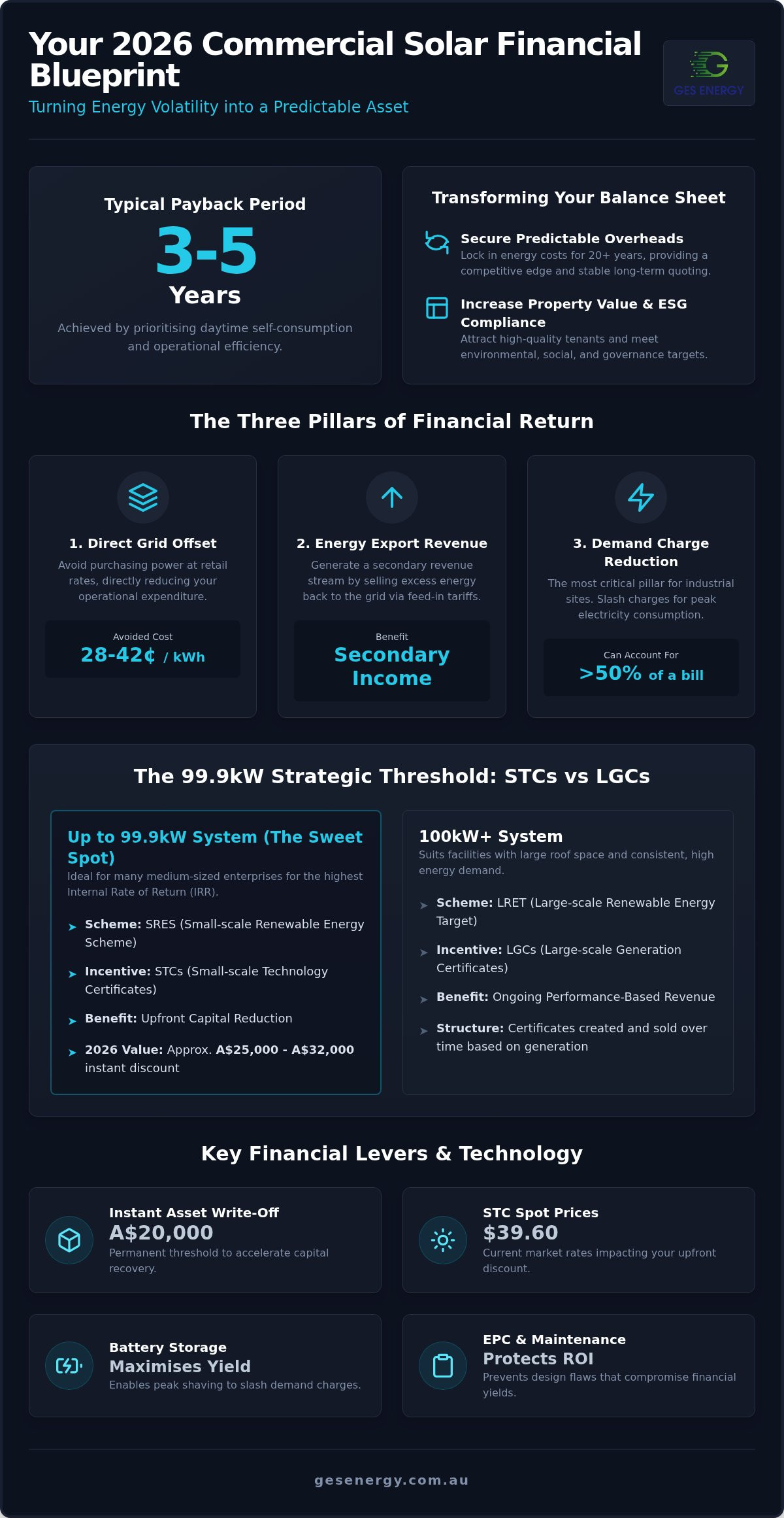
This guide provides the definitive financial blueprint for your 2026 energy strategy. We'll show you how to turn energy volatility into a predictable asset with a typical payback period of just 3 to 5 years. By aligning your installation with current market conditions, such as the permanent $20,000 instant asset write-off, you can significantly reduce operational expenditure while meeting ESG compliance targets. We will break down the 99.9kW strategic threshold, explain how STC spot prices of $39.60 impact your upfront costs, and demonstrate how integrated battery storage now dictates your total investment yield. This is about more than just panels; it's about engineering a future-ready energy ecosystem for your business.
Key Takeaways
- Understand why most Australian businesses achieve a full return on investment within 3 to 5 years by prioritising daytime self-consumption and operational efficiency.
- Navigate the 99.9kW strategic threshold to determine whether upfront STCs or long-term LGCs provide the most favourable commercial solar roi australia for your specific facility.
- Learn how to leverage the permanent A$20,000 instant asset write-off and strategic depreciation schedules to accelerate your capital recovery and improve cash flow.
- Discover how integrating energy storage and peak shaving can slash expensive demand charges, which often account for over half of an industrial utility bill.
- Identify the critical role of professional EPC services and ongoing maintenance in preventing the design flaws that frequently compromise long-term financial yields.
The Fundamentals of Commercial Solar ROI in Australia
Commercial Solar ROI is the net financial gain relative to the total cost of system design, installation, and financing. While residential systems are often viewed through the lens of simple bill reduction, commercial solar roi australia represents a sophisticated capital expenditure strategy. It's a calculation that must account for tax implications, asset depreciation, and the complex structure of industrial utility bills. We don't just look at the power produced; we look at how that power transforms your balance sheet.
Success in this space relies on three specific pillars of financial return. First is the direct offset of grid power, where you avoid purchasing electricity at retail rates that currently average between 28 and 42 cents per kWh across most states. Second is the export of excess energy back to the grid. Even with feed-in tariffs, which vary across the country, this provides a secondary revenue stream. The third and most critical pillar is demand charge reduction. For many industrial sites, these charges represent a significant portion of the total bill. By using solar to lower your peak consumption from the grid, you achieve a level of cost control that residential systems simply don't offer.
The 2026 energy market provides a unique window for investment. While default market offers have seen some moderation, price volatility remains a significant risk for unhedged businesses. With hardware costs reaching decade lows, the case for self-generation is stronger than ever. This transition is a core part of the broader growth of Renewable energy in Australia, as businesses seek to decouple their operating costs from global energy markets. It's about securing predictability in an unpredictable landscape.
The Shift from Savings to Strategic Asset
Commercial solar is no longer just a way to save money on power; it's a tool for increasing property value. Landlords find that solar-equipped buildings are more attractive to high-quality tenants who are increasingly focused on ESG compliance. For manufacturers, the predictability of energy costs provides a massive competitive advantage. You can quote long-term contracts with confidence because your power prices are essentially locked in for the next 20 years. This stability allows for better capital allocation elsewhere in the business.
Payback Period Benchmarks for 2026
Payback timelines vary based on system size and consumption patterns. A typical 30kW system often pays for itself in 3 to 4 years if the facility has high daytime usage. Larger 100kW systems generally follow a similar timeline, aided by the upfront STC rebate. For 500kW systems and beyond, the commercial solar roi australia calculation becomes more complex, involving LGCs and sophisticated demand management. However, the long-term yield remains exceptionally high for those with consistent industrial loads, often outperforming traditional market investments.
The 99.9kW Strategic Threshold and Government Incentives
The 100kW threshold represents a significant financial fork in the road for Australian businesses. Systems falling just below this limit qualify for the Small-scale Renewable Energy Scheme (SRES), which provides an immediate upfront discount through Small-scale Technology Certificates (STCs). Once a system reaches 100kW or larger, it transitions into the Large-scale Renewable Energy Target (LRET) and generates Large-scale Generation Certificates (LGCs). This distinction is critical because it fundamentally changes how you realise your commercial solar roi australia, shifting the benefit from an initial capital reduction to an ongoing, performance-based revenue stream.
For many medium-sized enterprises, a 99.9kW system often yields a higher Internal Rate of Return (IRR) than a slightly larger 110kW installation. This is primarily due to the "upfront" nature of STCs, which can reduce the initial cost of a 100kW system by approximately A$25,000 to A$32,000 in 2026. By contrast, LGCs are created over time based on actual generation. Unless your facility has the roof space and energy demand to support a significantly larger array, such as 150kW or more, the administrative complexity and lack of immediate CAPEX relief often make the 99.9kW "sweet spot" the more attractive financial choice.
STCs: The Upfront Capital Injection
STCs act as a point-of-sale discount, effectively lowering the barrier to entry for commercial solar. As of July 2026, the STC spot price remains stable at A$39.60, providing a predictable boost to project viability. However, there is a significant opportunity cost associated with delay. The STC multiplier reduces on 1 January every year as the scheme tapers toward its 2030 conclusion. Postponing an installation from late 2026 into 2027 results in a direct financial loss, as the number of certificates you can claim will decrease. Securing your installation before the next multiplier drop is a simple way to protect your projected payback period.
LRET and LGCs: The Long-Term Yield
Large-scale Generation Certificates offer a different value proposition for industrial sites with massive energy requirements. While LGC spot prices have moderated to around A$5.00 in mid-2026, they provide a continuous income stream for the first decade of the system's life. This ongoing revenue can be used to offset operational costs or be sold to entities with renewable energy obligations. The trade-off is the increased administrative burden; LGCs require precise metering and annual reporting to the Clean Energy Regulator. Consulting with an expert in commercial and industrial solar helps determine if your energy profile justifies the jump into this large-scale regulatory environment.
Strategic sizing requires a balance between your available roof area, your daytime load profile, and these government incentives. While a 99.9kW system is often the default choice for its simplicity and upfront savings, industrial facilities with heavy 24/7 loads may find that the long-term generation of a 500kW system far outweighs the loss of initial rebates. The goal is to design a system that matches your specific energy footprint rather than simply building to a rebate threshold.
Maximising ROI with Batteries, EV Charging, and Demand Management
Standalone solar systems provide a solid foundation for energy savings, but the most sophisticated Australian businesses are now moving toward integrated energy ecosystems. In 2026, the strategy has shifted from simple generation to comprehensive demand management. By combining solar arrays with battery storage and EV charging infrastructure, you create an ROI multiplier effect. This approach doesn't just lower your energy consumption; it fundamentally changes how and when you interact with the grid, turning a passive asset into a dynamic financial tool.
Peak shaving is perhaps the most immediate way to enhance your commercial solar roi australia. Industrial utility bills are often heavily weighted toward demand charges, which are based on the highest point of energy usage during a billing period. A well-designed battery system can discharge during these peak events, effectively "shaving" the top off your demand profile. This reduces the fixed costs on your bill that solar alone cannot reach. When paired with load shifting, where energy-intensive processes are moved to the middle of the day to coincide with peak solar production, the financial yield of the system increases significantly.
Industrial Battery Storage: Beyond Backup
Modern Battery Energy Storage Systems (BESS) are no longer just for emergency backup. In 2026, falling hardware costs have made BESS a viable component of the standard commercial solar business case. Beyond peak shaving, batteries allow for energy arbitrage. Your system can be programmed to charge from the grid during low-cost windows, such as overnight or during periods of negative pricing, and discharge when grid prices are at their highest. This flexibility protects your operations from price spikes and can even prevent the need for expensive transformer or infrastructure upgrades by managing high-load events locally.
EV Infrastructure as a Revenue Stream
Future-proofing your site with EV charging stations adds a new dimension to your investment. As fleet electrification accelerates across Australia, businesses that provide solar-powered charging can attract premium tenants and retain high-quality staff. You can monetise these points directly by charging for the service or use them to reduce the total cost of ownership for your own company vehicles. Integrating EV infrastructure into your initial solar design ensures that your electrical capacity is managed efficiently from day one, avoiding the higher costs of retrofitting later. This holistic view of energy management ensures your infrastructure remains an active contributor to your bottom line for decades.
Tax Benefits, Depreciation, and Financing Strategies
The final piece of the commercial solar roi australia puzzle involves your tax and financing strategy. In the 2026-27 financial year, small businesses with an aggregated turnover under A$10 million can benefit from the permanent A$20,000 instant asset write-off. This allows for an immediate deduction of the asset's cost in the year it's first used or installed, providing a significant cash flow boost. For larger systems that exceed this threshold, the Australian Taxation Office sets the effective life of solar panels at 20 years. This means you can claim depreciation annually, reducing your taxable income over the long term and improving the project's net present value.
Your choice of funding model fundamentally changes your Internal Rate of Return (IRR). A direct capital outlay usually offers the highest total lifetime savings because you avoid interest costs and own the asset outright from day one. However, many businesses prefer to preserve cash flow through financing. Balancing upfront costs against long-term operational savings is a delicate exercise that depends on your specific tax bracket and capital requirements.
Commercial Solar Financing Options
- Green Loans: These specialised products offer lower interest rates for renewable energy projects, making the monthly repayments more manageable while you wait for the system to pay for itself.
- Operational Leases: This model can keep the asset off your balance sheet, which might be preferred for certain corporate accounting structures or when trying to maintain specific debt-to-equity ratios.
- Solar PPAs: A Power Purchase Agreement allows you to achieve an immediate ROI with zero upfront cost. You simply pay for the generated power at a rate lower than the grid, though your total long-term savings are typically lower than a self-funded model.
Tax-Effective Solar Strategies
If your system is 100kW or larger, it's vital to remember that income from Large-scale Generation Certificates (LGCs) is generally considered taxable income. Balancing this against your depreciation claims is a key part of your annual tax planning. For businesses with a turnover under A$50 million, the 25% company tax rate makes these deductions a powerful tool for improving net cash flow. By structuring your investment to maximise year-one deductions, you can effectively use the tax system to subsidise your transition to clean energy. This ensures your capital works harder for you from the moment the first panel is installed.
If you're unsure which model fits your current tax position, our team can help you evaluate the commercial and industrial solar options that best align with your business goals.
The GES Energy Approach: Protecting ROI Through EPC Excellence
Poor design is the primary factor that compromises commercial solar roi australia. A system that looks good on paper but fails to account for site-specific shading, roof orientation, or local grid constraints will never meet its financial targets. This is where the Engineering, Procurement, and Construction (EPC) model becomes essential. It ensures that every phase of the project, from the initial structural assessment to the final commissioning, is managed by a single authoritative partner. At GES Energy, we provide national EPC services for projects up to 5MW, focusing on creating a total energy ecosystem that performs reliably for 25 years or more.
Custom Engineering for Industrial Loads
Off-the-shelf systems often fail because they don't address complex demand charges or variable load profiles. Our process begins with a granular load profile analysis to understand exactly when your business consumes power. This data allows us to size the array and any accompanying C&I energy storage systems to maximise self-consumption and peak shaving. For complex sites, we often integrate micro-grid solutions to provide even greater independence from the grid. Using SAA-accredited labour is a non-negotiable part of our delivery. It ensures that every connection meets Australian standards and protects your long-term warranty compliance.
Ongoing Maintenance: The ROI Guardian
A faulty inverter or a single "dead" string of panels can go unnoticed for months, quietly eroding your financial returns. The financial cost of lost generation often far exceeds the price of a scheduled health check. We recommend proactive maintenance over ad-hoc repairs to keep your infrastructure at peak performance and prevent performance degradation. Real-time monitoring and advanced solar analytics allow us to identify and remedy technical issues before they impact your balance sheet. This diligent stewardship is what differentiates a successful investment from a depreciating asset.
Protecting your investment requires more than just high-quality hardware; it requires a partner committed to the ongoing health of your system. Whether we are performing solar inverter repairs and warranties or managing a complete site overhaul, our goal is to maintain the integrity of your energy strategy. If you want to ensure your facility is operating at maximum efficiency, you can organise a professional energy audit with GES Energy today. We provide the technical oversight and engineering expertise needed to turn your energy transition into a long-term commercial success.
Securing Your Energy Independence Through Strategic Investment
Achieving a superior commercial solar roi australia requires a shift from viewing solar as a simple utility saving to treating it as a core financial asset. Success in 2026 depends on integrating solar with battery storage and EV charging to actively manage expensive demand charges. By leveraging the permanent A$20,000 instant asset write-off and making informed decisions about the 99.9kW threshold, you can ensure your capital works harder for your business from day one.
GES Energy serves as your end-to-end partner, providing Australia-wide EPC services for projects up to 5MW. Our SAA-accredited engineering teams specialise in complex industrial micro-grids, ensuring every installation is custom-designed for your specific load profile. This technical oversight is the most reliable way to protect your infrastructure from performance degradation over its 25-year lifespan. You don't have to navigate these complexities alone. We provide the stability and expertise required to make your transition to renewable energy both seamless and highly profitable.
Request a custom Commercial Solar ROI Business Case from GES Energy
Transitioning to a smarter energy ecosystem is a significant step toward future-proofing your operations, and we're here to guide you through every technical detail with confidence.
Frequently Asked Questions
What is the average payback period for commercial solar in Australia in 2026?
The average payback period typically ranges between 3 and 5 years for most Australian businesses. This timeline is heavily influenced by your facility's daytime energy consumption and current retail electricity rates, which generally sit between 28 and 42 cents per kWh. Companies that align their heaviest operational loads with peak sunlight hours usually see the fastest return on their capital investment.
How does the 99.9kW threshold affect my upfront solar costs?
Staying under the 99.9kW limit allows you to access the Small-scale Renewable Energy Scheme, which provides an upfront discount via Small-scale Technology Certificates. In 2026, this can reduce your initial costs by approximately A$25,000 to A$32,000. Systems 100kW or larger transition to a different scheme where incentives are paid out over time based on actual generation rather than as a point-of-sale deduction.
Can commercial solar help reduce my business demand charges?
Yes, solar can significantly lower demand charges by meeting your power needs internally during peak grid periods. This process, known as peak shaving, reduces the highest point of energy usage your retailer records during a billing cycle. Because demand charges can account for up to half of an industrial utility bill, this strategy is a vital component of modern energy cost control.
Are there still government rebates available for commercial solar in 2026?
Federal incentives remain a primary driver of commercial solar roi australia through the ongoing SRES and LRET certificate schemes. Additionally, the permanent A$20,000 instant asset write-off provides immediate tax relief for eligible small businesses. These programs work alongside state-based grants to lower the barrier to entry and accelerate the recovery of your initial capital expenditure.
What is a Solar PPA and is it better than buying the system outright?
A Power Purchase Agreement allows you to install a system with zero upfront cost by paying for the generated electricity at a rate lower than the grid. While this preserves your cash flow, buying the system outright typically yields the highest total lifetime savings. The best choice depends on whether your priority is immediate operational savings or the highest possible long-term return on investment.
How much does maintenance add to the lifecycle cost of a commercial system?
Maintenance is a necessary but manageable expense that protects your infrastructure from performance degradation. Budgeting for annual health checks and real-time monitoring ensures that faulty inverters or damaged strings are identified before they impact your bottom line. Proactive care is far more cost-effective than reactive repairs, as it prevents the significant loss of generation revenue over the system's 25-year life.
Will a commercial solar system increase the value of my business property?
Installing solar often increases property value by improving NABERS ratings and making the site more attractive to premium tenants. Modern lessees are increasingly focused on ESG compliance and lower occupancy costs, making solar-equipped warehouses and offices highly competitive in the lease market. This transition turns a standard roof into a high-performing asset that supports both capital growth and rental yield.
Do I need a battery storage system to get a good ROI on commercial solar?
You don't strictly need a battery to achieve a positive return, but storage acts as a powerful ROI multiplier for many industrial sites. Batteries allow you to capture excess solar energy for use during expensive peak demand windows or overnight. This flexibility is particularly valuable for businesses with 24/7 operations or those looking to avoid the most expensive grid tariffs.


