

An inverter fault doesn’t automatically mean your warranty has expired or that the manufacturer is your only source of support. When claiming a solar inverter warranty, record the fault, check the warranty terms and contact the original solar retailer to manage the claim.
It’s reasonable to expect the written warranty to explain what happens next. But your rights don’t necessarily end when the manufacturer’s warranty does: Australian Consumer Law provides consumer guarantees in addition to product warranties, as the ACCC explains for Australian consumers.
This guide explains how to recognise common inverter fault signs safely, understand what your warranty may cover and prepare the information needed for a claim. It also covers support if your installer has closed, consumer guarantees and extended warranties, with a practical sequence from documenting the issue to choosing your next step.
Key Takeaways
- Record inverter fault messages and changes in system output, but don’t touch the equipment if you notice burning smells, scorch marks or arcing.
- Check the warranty document for its coverage period, exclusions and whether labour, removal and recommissioning are included.
- If your installer has closed, manufacturer warranties may still apply. Gather proof of purchase, installation details, serial numbers and electrical safety paperwork for the claim.
- Contact the original retailer or installer about a fault and keep your installation certificate and commissioning documents accessible.
- Manufacturer warranties sit alongside Australian Consumer Law guarantees, which can continue to apply beyond a written warranty period.
What voids a solar inverter warranty in Australia?
A warranty claim may depend on how the inverter was installed, operated and maintained. Resolution time varies with the fault, the evidence provided and the manufacturer’s assessment process.
If your installer has closed, you can still make a claim under the manufacturer’s warranty. Send the manufacturer your purchase and installation records, inverter details and electrical safety paperwork.
- Read the warranty and installation requirements. Find the inverter’s warranty document and manual, then identify exclusions, registration steps and required operating conditions. Check the specified ventilation clearances and installation location against the manual. An inverter installed without the required airflow, or altered in a way the manufacturer does not approve, can create grounds to reject a product warranty claim. Keep the manual for the exact model, not just a general guide for the product range.
- Check who installed the system and what records remain. Warranty terms can depend on installation being completed by an appropriately accredited installer. An unaccredited installation may affect manufacturer cover. Gather the installation certificate, commissioning documentation, electrical safety paperwork, invoice and inverter serial number. These records help establish when the system was installed, what equipment was supplied and whether the installation followed the manufacturer’s requirements.
- Contact the manufacturer if the installer has closed. The installer’s closure does not automatically end manufacturer warranties for the panels, inverter or battery. Send proof of purchase, the installation date, serial numbers and electrical safety paperwork with your claim. Include the fault message, photographs of the display and a short description of when the issue began. Keep copies of every document and record the date you submitted them.
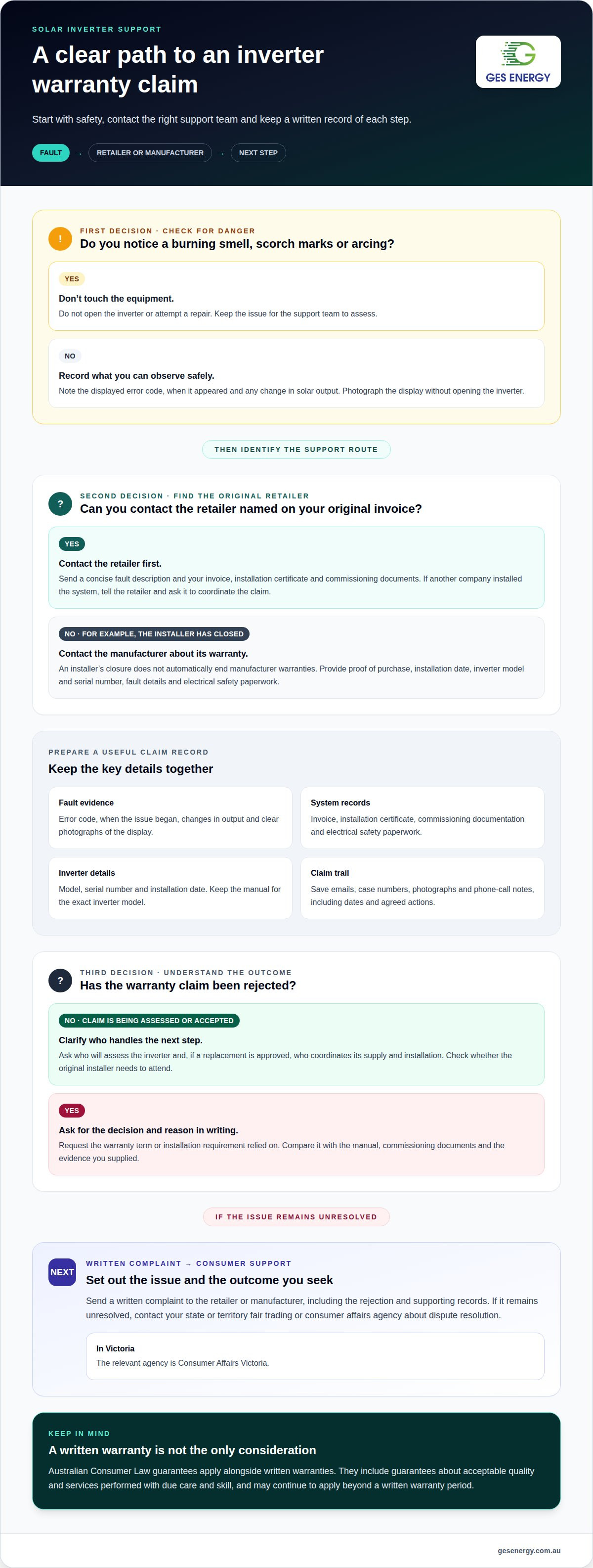
- Ask for the reason if the claim is rejected. Request the manufacturer’s decision in writing, with the warranty term or installation requirement it relies on. Compare that reason with the inverter manual, commissioning documents and the evidence you supplied. If the dispute concerns poor installation rather than a product defect, identify the installer’s business records and any workmanship terms that apply. Keep communication factual and retain each response.
- Escalate through the appropriate consumer channel. First send the retailer or manufacturer a written complaint that states the outcome you seek and includes the rejection and supporting records. If the issue remains unresolved, contact your state or territory fair trading or consumer affairs agency about dispute resolution. In Victoria, that agency is Consumer Affairs Victoria. The ACCC explains that Australian Consumer Law guarantees apply alongside written warranties, including guarantees about acceptable quality and services performed with due care and skill.
Is support available after installation?
Yes. Start with the original solar retailer, which can manage a warranty claim under Australian Consumer Law. Have your installation certificate and commissioning documents ready.
Follow these steps to report the fault to the right support team and keep a clear record of your claim.
-
Identify the company to contact
Find the retailer named on your original invoice and contact it first about the inverter fault. Check your contract and installation records to identify whether the retailer arranged the installation or engaged another installer. If another company did the work, tell the retailer and ask it to coordinate the claim. Avoid opening separate claims with several parties until you know who is managing the case.
-
Document faults and contact the retailer
Record the displayed error code, when you noticed it and any change in solar output. Photograph the display clearly, but don’t open the inverter or attempt a repair. Send the retailer your invoice, installation certificate and commissioning documents, along with a concise description of the fault. Ask it to confirm receipt, outline the next assessment step and clarify whether the claim concerns the inverter, battery or another system component.
-
Contact customer support
If the retailer directs you to the manufacturer, use the support details in the inverter manual or warranty paperwork. Provide the model and serial number, error code, installation date and retailer’s claim reference. Explain whether the system has stopped operating or the fault is intermittent. Ask customer support to confirm the case number, identify any further evidence it needs and say whether it will contact the retailer or installer directly.
- Keep one written claim record. Save emails, case numbers, photographs and phone-call notes together. After each conversation, note the date, the person or team you spoke with and any agreed action. If customer support requests more evidence, send the specific records requested and keep a copy. This timeline can help clarify what happened if the claim stalls or different parties give different instructions.
- Clarify assessment and replacement arrangements. Ask who will assess the inverter and how you’ll receive the findings. If a replacement is approved, request details about who coordinates its supply and installation, and whether the original installer needs to attend. A replacement unit may not resolve a fault caused elsewhere in the system, so ask how the assessment distinguishes an inverter defect from an installation or component issue. For help with the next technical step, request inverter fault support.
Product warranties versus performance warranties
Before assessing a solar claim, distinguish cover for equipment, output and installation. The warranty period and claim process depend on the document and product involved.
-
Distinguish warranty types
Check each warranty to see whether it covers the inverter, system output or installation workmanship. A product warranty covers defects in the inverter itself; a performance warranty sets an output or capacity measure over time. Workmanship cover relates to installation defects. These protections aren’t interchangeable: a wiring fault may need a different assessment from an inverter failure.
-
Confirm the product warranty period
Find the inverter model and the warranty start date in the purchase or commissioning records. In Australia, string, hybrid and battery inverters commonly carry product warranties of 5-10 years. Solar inverter manufacturer warranties are typically described as lasting 5 to 12 or more years. Microinverters attached to a rail commonly have a 10-year product warranty; those attached to a panel commonly have a 25-year warranty.
- Match the warranty to the affected equipment. A solar panel performance warranty measures output, not whether the inverter is free from defects. Battery warranties can use capacity retention or throughput conditions, while an inverter product warranty concerns the inverter unit. Check whether accessories have separate terms. Some complex inverter warranties provide only 1-2 years of cover for essential accessories, so include the relevant component in your claim.
- Separate installation cover from product cover. Solar installation workmanship warranties in Australia are usually 5 years. That cover concerns installation work, while a manufacturer’s product warranty concerns equipment. Read both documents before deciding which party to approach. Check whether the terms specify who pays expenses connected with a claim, including removal, return, replacement installation or recommissioning. A product replacement does not automatically mean associated labour is covered.
- Locate the serial number and check return terms. Read the label on the inverter’s exterior or check its monitoring records for the serial number. Don’t open the unit to find it. Give the manufacturer the model and serial number, then follow its assessment or return instructions. Warranty terms may specify return locations, approved service areas, packaging requirements and who pays for transport. Confirm these arrangements before shipping equipment or arranging a replacement.
Diagnosing inverter faults and determining warranty coverage
Record the inverter’s warning and system behaviour before deciding which warranty may apply. Keep clear of equipment that shows signs of electrical damage.
- Record the fault safely. Note the displayed error code, when it appeared and whether solar generation changed. For example, record whether the inverter stopped producing power or shows an intermittent warning. Save a screenshot from the monitoring app if available. Don’t open the inverter or attempt a repair. If you smell burning, see scorch marks or hear arcing, don’t touch the system. Give these details to an accredited technician or the warranty contact.
- Identify the component and likely coverage. Match the fault to the inverter, battery, panels, cabling or an accessory. A manufacturer’s product warranty usually covers the replacement inverter unit when a covered fault occurs during its warranty period. It may not cover an associated battery or system component. Essential accessories can have shorter cover, with some complex inverter warranties providing only 1-2 years. Check each component’s own warranty terms rather than assuming one document covers the whole system.
-
Check labour and freight coverage
Check the warranty terms for instructions on removal, installation, recommissioning, freight and returns. Standard inverter product warranties usually cover the replacement unit, not the labour to remove, install or recommission it. The document should explain who is responsible for claim expenses. Before sending equipment, confirm the manufacturer’s approved return process and whether you’re responsible for freight or assessment costs.
-
Identify costs outside warranty coverage
If the fault isn’t covered by warranty, ask for an itemised assessment. The final cost may depend on the cause, replacement parts, site access, labour and whether the system needs recommissioning. An installation or component fault may require different work from a failed inverter unit. Request the proposed work and charges in writing before authorising a repair or replacement.
- Compare the diagnosis with the warranty conditions. Check whether the failure occurred within the stated term and whether installation and operating requirements were followed. An unaccredited installation may affect manufacturer cover, depending on the warranty terms. An error code can help identify an issue, but it doesn’t establish the cause or prove the fault is covered. Refer to the written assessment, model details and fault record when discussing the decision.
Australian Consumer Law and extended warranties
Read Australian Consumer Law alongside the manufacturer’s terms to understand what protection may apply. A written warranty isn’t the only source of consumer guarantees.
- Separate consumer guarantees from the written warranty. According to the ACCC, Australian Consumer Law provides automatic guarantees that goods are of acceptable quality, durable and fit for purpose for a reasonable time. These rights apply in addition to solar system warranties. A manufacturer’s warranty sets out its own cover; it doesn’t replace those guarantees. Keep both documents to hand when discussing an inverter failure with the retailer.
- Match the fault to the relevant guarantee. Describe what the inverter does, when the problem began and how it affects the system. For example, note whether it has stopped operating or repeatedly displays a fault. Australian Consumer Law also requires services to be provided with due care and skill, according to the ACCC. This may be relevant if your concern is about installation work rather than a defect in the inverter.
- Assess an extended warranty by its actual terms. Compare the additional cover period with the manufacturer’s existing warranty, then check which components are included. See whether the extended terms cover the inverter, accessories, labour, freight or recommissioning. An extension can provide extra contractual cover, but it doesn’t remove your rights under Australian Consumer Law. Read the exclusions and claim steps before relying on an advertised extension.
- Keep evidence that supports the claim. Save the invoice, warranty documents, installation certificate, commissioning records and written fault assessment. Include the inverter model and serial number, as well as relevant monitoring records. If monitoring shows a change in output, keep dated screenshots with your notes. These details help distinguish an equipment failure from an installation issue and give the retailer or manufacturer a clear basis for assessing your claim.
- Raise the issue in writing and keep the response. Explain the fault, identify the guarantee or warranty term you’re relying on and state the resolution you want. Ask the retailer to provide its assessment and reasons if it rejects the claim. Keep emails and case references together. If the dispute remains unresolved, the ACCC provides information about Australian consumer rights, while state and territory consumer agencies can explain local dispute-resolution options.
If you need technical help assessing an inverter fault or warranty claim, request solar inverter repair support.
GES ENERGY: Solar Inverter Repairs & Warranties
GES ENERGY provides solar inverter repairs and warranty claim support when a fault affects your system. You can seek help regardless of where you purchased or installed your solar system. The team can assess the inverter issue, help identify the next repair step and assist with the claim process, using the fault details and system records you have gathered.
This support is relevant to home systems and larger energy installations, including off-grid and commercial setups. A technical assessment can help distinguish an inverter fault from an issue elsewhere in the system, making the repair or warranty pathway clearer. GES Energy also works with solar and battery systems connected to broader energy infrastructure.
Contact GES ENERGY to discuss your inverter fault or warranty claim.
Take the next step towards a reliable system
A warranty claim is also a useful opportunity to review your energy system’s performance. Once the inverter fault has been assessed, use the findings to understand whether the issue is isolated or affects other connected equipment. This context can help you make informed decisions about repairs and ongoing system support.
Keep the assessment outcome with your system records. It can provide a useful starting point if another fault arises or you expand your energy setup. GES Energy supports inverter repairs and warranty claims, as well as Commercial and Industrial Solar, Off Grid Solar Systems and EV Charging Stations.
For claiming a solar inverter warranty, a clear fault record and the right technical support can make the next steps easier to manage. If you need help with an inverter fault or claim, get support from GES ENERGY. Take the next step with a clearer understanding of your system.
Frequently Asked Questions
What Happens When Your Warranty Ends?
The manufacturer’s written cover may have ended, but that alone doesn’t determine whether you have a consumer guarantee claim. If the inverter fails afterwards, tell the retailer its age, operating history and symptoms. Keep service records and earlier fault reports together. This context can help the retailer assess whether the product lasted for a reasonable time, rather than relying only on the printed warranty end date.
What's the difference between a product warranty and a performance warranty?
A product warranty covers defects in the inverter unit; a performance warranty concerns an agreed output measure. Match your evidence to the issue: a recurring inverter error supports an assessment of a product fault, while monitoring data can help show an output concern. Keep inverter symptoms separate from panel-generation figures so the claim is directed to the relevant equipment and warranty terms.
How do I claim a solar inverter warranty in Australia?
Make your report specific: describe the symptoms, when they began, whether they’re constant or intermittent, and what outcome you’re seeking. Submit the claim in writing and keep the case reference with the response. When claiming a solar inverter warranty, don’t present a suspected cause as a confirmed diagnosis. Distinguishing observed behaviour from your interpretation helps the assessor focus on the fault itself.
What documents and information are needed to make a solar inverter warranty claim?
Organise your supporting records into a clear claim pack, grouping the invoice, technical documents, fault evidence and correspondence. Label photographs and monitoring screenshots with dates, and keep unedited copies of the originals. Add a short timeline showing when the system was installed, when the issue appeared and what changed afterwards. This helps the assessor follow events without searching through unrelated files.
Who should I contact first for a solar inverter warranty claim: installer, retailer, or manufacturer?
Start with the original retailer, even if another business installed the system. The retailer can coordinate the consumer claim and direct technical questions to the installer or manufacturer as needed. If the retailer has closed, contact the manufacturer with your claim information. Keep one case record, especially if the retailer, installer and manufacturer each provide separate reference numbers or instructions.
What are the warranty periods and coverage terms for popular solar inverter brands in Australia?
Terms vary by model and inverter type, so the brand name alone won’t identify your exact cover. Some brands offer a 5-year base warranty that can extend to 10 years when the product is registered online within a few weeks of installation. Check the specific model’s registration conditions and whether the extended term changes any exclusions or claim requirements.
Does an Australian solar inverter warranty cover labour, call-out fees, removal, and reinstallation?
Don’t assume approval for a replacement inverter also covers related service costs. Ask for a written breakdown separating the unit from site attendance, removal, installation, freight and recommissioning. This makes it easier to see which expenses the warranty decision covers and which may be billed separately. Before work begins, keep the breakdown with the manufacturer’s or retailer’s written decision.
What Australian Consumer Law rights apply if a solar inverter fails outside its manufacturer warranty?
A failure after the manufacturer’s stated warranty term may still be assessed under Australian Consumer Law. The key question is whether the inverter lasted a reasonable time in its circumstances, not simply whether the written warranty has expired. Raise the issue with the retailer and explain the system’s operating history and fault. If installation work is also in dispute, describe that separately from the product failure.


