

A solar inverter can need attention before your panels do. If your system is around 8-12 years old, or you’re seeing repeated error messages, unexplained shutdowns or irregular battery switching, upgrading your solar inverter may be worth considering. The right choice depends on the inverter’s condition, your existing panels and what you want your system to do next.
It’s reasonable to want more from a system you’ve already invested in. Upgrading your solar inverter may help accommodate extra panels or battery storage, but compatibility and available capacity matter. This guide explains the signs to look for, what affects costs and potential savings, and how Australian requirements apply to replacement work.
You’ll also see why an upgrade isn’t always the only option. The sections ahead cover when adding panels alongside an existing inverter may suit, how a battery-ready system changes the decision, and what professional assessment considers before work begins.
Key Takeaways
- Recurring faults, unexplained shutdowns or an ageing system can signal that an inverter assessment is worthwhile.
- Extra panels may need a larger inverter; compatibility, spare capacity and roof space all affect the design.
- Weigh upgrade costs against potential savings by considering your energy use, system condition and any applicable incentives.
- Inverter replacement must account for Australian standards, electrical safety and the requirements that apply to your system.
- A professional assessment can help determine whether repair, replacement or a broader system upgrade best suits your plans.
Signs an existing solar inverter or system may need upgrading
Inverters can become a concern as systems age, develop faults or no longer suit household energy needs. The right response may be a repair, inverter replacement or wider system upgrade.
Recognising upgrade signs
An upgrade sign is a fault or mismatch that limits how your solar system converts or manages energy. Homeowners commonly consider an upgrade when their system is 8-12 years old; a well-installed, correctly sized inverter can last 10-15 years, depending on conditions.
Frequent error messages, beeping, overheating, voltage fluctuations or unexplained shutdowns warrant a professional assessment. Internal component degradation and reactive power issues can also contribute to shutdowns. If a battery system switches irregularly between grid and battery power, the inverter or system configuration may need attention.
String, hybrid and microinverters manage solar energy differently. String inverters connect panel strings to a central unit, hybrids manage solar production and battery charging, and microinverters work with individual panels. If you want to add panels, the existing inverter’s spare capacity and compatibility matter. In some systems, microinverters can accommodate an additional panel.
Feed-in tariffs also affect whether adding capacity makes financial sense. Australian tariffs can be as low as 3c to 10c per kWh, so exporting surplus solar energy may return less than using it at home. The NSW Solar Bonus Scheme and South Australia’s Transitional Feed-in Tariff had concluded payments, allowing formerly size-constrained owners to add solar capacity.
Adding a second system is another option if the existing inverter remains suitable. It may operate alongside the original system or supply a battery, but separate meters, export limits and system communication can affect how energy is measured and used. A professional design should account for the existing meter arrangement and network export settings.
Battery plans can change the upgrade calculation. According to the Australian Government Department of Climate Change, Energy, the Environment and, the Cheaper Home Batteries Program can reduce the cost of a new battery by around 30%. That incentive relates to the battery, so assess it separately from inverter replacement costs.
Getting professional upgrade advice
Professional upgrade advice starts with assessing system condition, compatibility and costs. A technician can determine whether repairs, an inverter replacement or a new system better suits your panels, battery plans and energy use. This helps avoid paying for equipment that cannot work with the existing array.
When choosing an installer, look for Solar Accreditation Australia accreditation. Solar work should be carried out by a qualified professional, with the inverter installed in line with relevant safety requirements. It must also match the solar array and any proposed battery bank voltage.
Upgrade costs depend on the fault, inverter type, system age, switchboard requirements and whether panels or batteries are added. Payback depends on how much energy you use directly, how much solar energy you export and the value of avoided grid electricity. A system that exports surplus energy for low feed-in rates may deliver a different return from one that uses more generation at home.
Solar inverter upgrades for additional panels
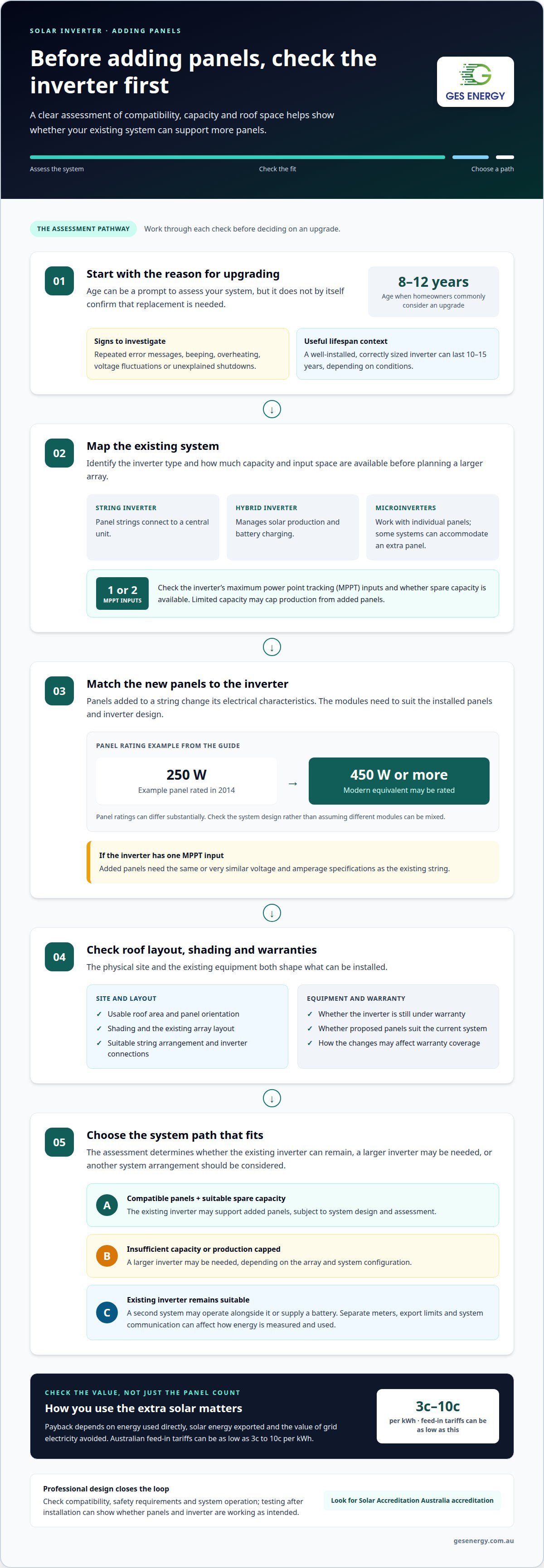
Adding panels can increase solar power generation, but the existing inverter must suit the larger array. A professional assessment considers inverter capacity, panel compatibility, roof space and the system’s design before recommending an upgrade.
Most solar panels connect in strings, with each string feeding an inverter input. Adding panels to an existing string can change its electrical characteristics, so the new modules need to work with the installed panels and inverter. For example, a 2014 panel rated at 250 W may differ substantially from a modern equivalent rated at 450 W or more. Mixing panel types without checking the system design can affect energy production.
Inverters may have one or two maximum power point tracking (MPPT) inputs. With one MPPT input, added panels need the same or very similar voltage and amperage specifications as the existing string. If the inverter lacks spare capacity, it may cap production and limit the benefit of extra panels. Depending on the array and system configuration, a larger inverter may be needed.
Roof space is another design factor. An experienced installer assesses usable roof areas, panel orientation, shading and the existing array layout. These details help determine whether panels can be arranged in a suitable string and connected to the inverter. Microinverters can accommodate an additional panel in some systems, while a central inverter’s inputs and capacity shape the options.
Compatibility checks should also consider panel and inverter warranty terms. Solar panel warranties can cover build quality and expected output over time; inverter warranties and performance guarantees vary by brand and model. An assessment should establish whether the existing inverter remains under warranty and whether the proposed panels suit the current system. This helps clarify how an upgrade may affect warranties and expected performance.
Adding panels involves more than mounting modules. The installer assesses the existing array, inverter inputs, electrical configuration and available roof area, then designs a compatible system. Testing after installation can show whether the panels and inverter are operating as intended. If the existing inverter cannot support the added array, replacement may be part of the upgrade.
The main risks are incompatibility, capped production and changes to warranty coverage. A professional assessment helps reduce these risks by matching the new panels to the inverter and reviewing applicable warranty conditions before installation.
Upgrade costs, savings and financial value
The total cost of a solar upgrade depends on its scope, not just the inverter. Replacing an inverter differs from adding panels, batteries or switchboard work. Existing solar equipment, electrical configuration and connection requirements all influence the work. A professional assessment separates necessary changes from optional additions, helping you judge the likely value.
Household savings depend on how much solar power is used on site rather than exported. Australian grid electricity prices are described as 30c to 50c per kWh, so using solar generation can reduce the amount households buy from the grid. The financial return also depends on when appliances operate, how much energy the system produces and the applicable export rate.
Network settings can limit the benefit of a larger system. Most Australian networks usually limit solar exports to 5 kW, so additional panels may increase generation without increasing the amount owners can send to the grid. The installer considers the connection arrangement and export limit when designing the upgrade. A battery may store surplus energy for later use, but its value depends on household consumption and system compatibility.
Switchboard work can add to project costs. Whether it is needed depends on the existing board and the electrical changes required. Identifying switchboard requirements during the initial assessment helps you budget for this work alongside inverter and panel costs, rather than treating the equipment price as the full project budget.
Victoria has a separate panel rebate of up to A$1,400 for systems more than 10 years old. Solar Victoria states that a system must be over 10 years old to qualify for the state’s panel rebate. This incentive concerns eligible panel upgrades, not the cost of an inverter by itself. Its relevance depends on the system’s age and the work included in the proposed upgrade.
Payback is the time it takes for savings to offset the project cost. Estimate it by comparing the installed upgrade cost with the likely reduction in grid electricity purchases and the value of exported energy. For example, a household that uses more solar energy during daylight may gain more from added capacity than one that exports most generation at a lower rate.
Connection limits, switchboard work and system size can change the financial result. Ask for a quote that separates the inverter, additional panels, required electrical work and applicable incentives. This makes it easier to compare the full cost with expected bill savings, rather than judging the upgrade by equipment alone.
Australian standards and inverter replacement
In Australia, inverter replacement involves electrical safety, grid connection and compliance with applicable standards. The work is more than swapping equipment: the installer must assess how the replacement interacts with the existing solar system, battery and network connection.
Replacing an existing inverter legally requires the installer to upgrade the entire system to current standards, which may add work and cost. This can affect older panels, wiring, protection equipment and the switchboard. The assessment should identify which parts need changes, rather than treating the inverter as an isolated component. It also helps explain why a replacement quote may include system-wide electrical work.
Solar work should be carried out by a suitably qualified installer. A qualified provider should install the inverter in accordance with Clean Energy Council guidelines and applicable Australian standards. This matters because incorrect wiring or system configuration can create safety risks and affect performance. The installer also needs to consider network connection requirements, which differ by location and distributor.
Inverter upgrades must meet applicable Australian standards and network requirements. Western Power applies in its network area; other Australian locations have their own network arrangements. The required design can depend on the inverter, export controls and existing connection. Your installer accounts for relevant requirements during planning and approval, rather than assuming one setting suits every property.
A standard grid-connected solar system must shut down during a grid outage. Replacing an inverter does not automatically provide backup power. If you want a battery to supply selected loads during an outage, the system needs compatible equipment and a suitable design. A hybrid inverter manages solar production and battery charging and discharging, but the battery installation must also meet its safety requirements.
AS/NZS 5139 governs battery safety requirements. This standard is relevant when adding battery storage, including its installation and placement. Battery compatibility also matters: an inverter must work with the proposed battery system and its voltage requirements. A system designed only for solar generation may need additional equipment or a different inverter before it can manage storage.
During replacement, the installer safely disconnects the system from the grid before removing the old inverter. After fitting the new unit, performance testing checks that the system operates correctly. These steps support safe work and help identify configuration issues before the system returns to normal operation.
For a renewable energy upgrade, ask for a clear scope covering the inverter, required system changes, battery compatibility and network requirements. This breakdown shows how compliance work affects the design and what the installation includes, without confusing an inverter-only replacement with a broader system upgrade.
Reasons to upgrade a solar inverter
An inverter upgrade can address more than faults. It can improve how your system converts electricity, accommodate new household loads or prepare solar generation for battery storage. The best reason depends on what your existing equipment can do and how your energy needs have changed. A replacement makes most sense when it solves a defined limitation, not simply because newer equipment exists.
Conversion efficiency is one possible consideration. An illustrative comparison puts older inverter efficiency at 92% and newer efficiency at 97%, with an estimated gain of hundreds of kilowatt-hours of usable energy per year. Actual solar output depends on system conditions, but the comparison shows why conversion losses matter. An assessment can identify whether the current inverter is limiting usable electricity. Ask yourself, “Is upgrading your solar inverter the right response to that limitation?”
Battery plans can also make an upgrade worthwhile. A standard solar inverter converts panel electricity from DC to AC for household use but cannot manage battery storage. A hybrid, or multi-mode, inverter can handle solar and battery inputs, including charging and discharging storage. Battery chemistry compatibility matters, and a design supporting both DC and AC coupling can offer more choice when planning storage. If storage is your goal, ask, “Will upgrading your solar inverter make a battery practical for your system?”
Changing energy use is another reason to review inverter capacity. Adding appliances or an electric vehicle can increase household demand, especially when solar production is low. A suitably matched inverter and battery system can manage energy flows around those needs. The assessment should consider expected loads, the solar array and proposed storage together, rather than selecting equipment by output alone.
Modern monitoring can make system performance easier to understand. App monitoring and real-time data access show when panels produce electricity and when the home draws power from the grid. Smart energy management can support time-of-use optimisation and remote monitoring. These functions are most useful when they match your tariff and daily usage patterns.
Older square-wave inverters can cause appliances to hum. Replacing one with a sine-wave inverter can address this compatibility issue. Newer units may also be physically smaller, which can help when installation space is restricted. These are practical reasons to consider an upgrade, even when the existing system still produces solar power.
Choose an upgrade around the limitation you want to solve: conversion losses, battery integration, changing loads, monitoring or appliance compatibility. A professional assessment can relate those needs to the system’s design and expected output. Arrange a professional inverter assessment to discuss the upgrade options for your solar system.
GES ENERGY: Solar Inverter Repairs & Warranties
GES ENERGY provides Solar Inverter Repairs & Warranties for faults, reduced performance and warranty questions. An assessment can help determine whether repair or replacement is the practical next step and support an inverter warranty claim where relevant. This service can help if your inverter displays recurring errors, stops producing solar energy or no longer suits plans for added panels or battery storage.
For larger energy projects, GES ENERGY also offers Commercial and Industrial Solar and Off Grid Solar Systems. The right service depends on your system and the change you’re planning. Clear information about the inverter fault, system setup and warranty can help shape the next discussion.
Contact GES ENERGY to discuss your inverter repair or warranty needs.
Plan your next step with confidence
Your inverter decision can shape how your property uses energy in the years ahead. Before choosing a direction, consider what you want the system to support next: changing household demand, adding storage or developing a broader energy project. That priority gives the assessment a clear purpose and helps keep proposed work aligned with your plans.
Deciding whether upgrading your solar inverter fits your plans is easier when the system’s future role is clear. GES ENERGY also offers Commercial and Industrial Solar, Off Grid Solar Systems and EV Charging Stations, supporting projects where generation, storage and charging need to work together.
A professional discussion can help turn your priorities into a practical scope for your property or project. Contact GES ENERGY about your upgrade to take the next step towards a solar system that suits your plans.
Frequently Asked Questions
What Other Upgrades Can I Make?
Alongside inverter work, you can consider a smart meter, additional panels, battery storage or an EV charging station. These options serve different needs: a smart meter can support energy monitoring and export control, while an EV charging station connects solar planning with vehicle charging. GES ENERGY offers EV Charging Stations. The right upgrade depends on how you use energy and what you want the system to support.
When should I upgrade a solar inverter in Australia?
Consider a wider system replacement rather than an inverter-only upgrade if the solar system is more than 20 years old. A professional assessment can also identify whether damage, degradation or incompatibility with newer technology makes replacement more suitable. The decision should account for the condition of the panels and other system components, not just the inverter, so the proposed work addresses the system’s overall performance.
How much does a solar inverter replacement or upgrade cost in Australia?
There isn’t one set cost for every Australian system. The price depends on the work involved and is provided after a quote request. A repair, an inverter-only replacement and a broader upgrade have different scopes. The quote should make clear what is included, such as equipment replacement and any required changes to the existing system, so you understand what you’re paying for.
Can I upgrade my inverter without replacing my solar panels?
Yes, the panels can remain if they suit the replacement inverter and system design. The installer can assess the existing array as a whole and determine whether the proposed inverter can operate with it. Panel replacement is a separate decision, not an automatic part of inverter replacement. Providing available system records can help identify the existing equipment and its configuration.
What size inverter do I need for my existing solar panel system?
The suitable size depends on the array and the inverter’s role in the system. A rating is not a promise of identical household output: a 2 kW inverter should not be expected to produce 2000 Watts because cabling and inverter losses affect output. An installer considers the system design and intended use before selecting capacity, rather than choosing from the panel rating alone.
Can I add a battery when upgrading my solar inverter?
Yes, if the proposed equipment and system design are compatible with the battery. The installer needs to account for the battery’s intended role, including whether it will store solar energy for later use or support selected loads. A solar-only inverter may need additional equipment or replacement to manage storage. The battery and inverter should be designed as a compatible system, rather than chosen separately.
What Australian standards and state rules apply to inverter upgrades?
Battery installations must account for AS/NZS 5139, the standard governing battery safety requirements. Solar work must be performed by a Solar Accreditation Australia-accredited installer, and inverter installation should follow Clean Energy Council guidelines and applicable Australian standards. State and network requirements can affect the project design. For example, Western Power requirements apply within its network area, while other locations have their own connection arrangements.
Do I need approval from my electricity distributor to upgrade my inverter?
Whether distributor approval is needed depends on the proposed change and the local network’s connection process. Changes to inverter details or export settings can affect the system’s approved grid connection. The installer can account for the relevant distributor process in the project design. This is especially relevant when the work changes how the system connects to the grid, rather than replacing equipment without altering the connection.


