

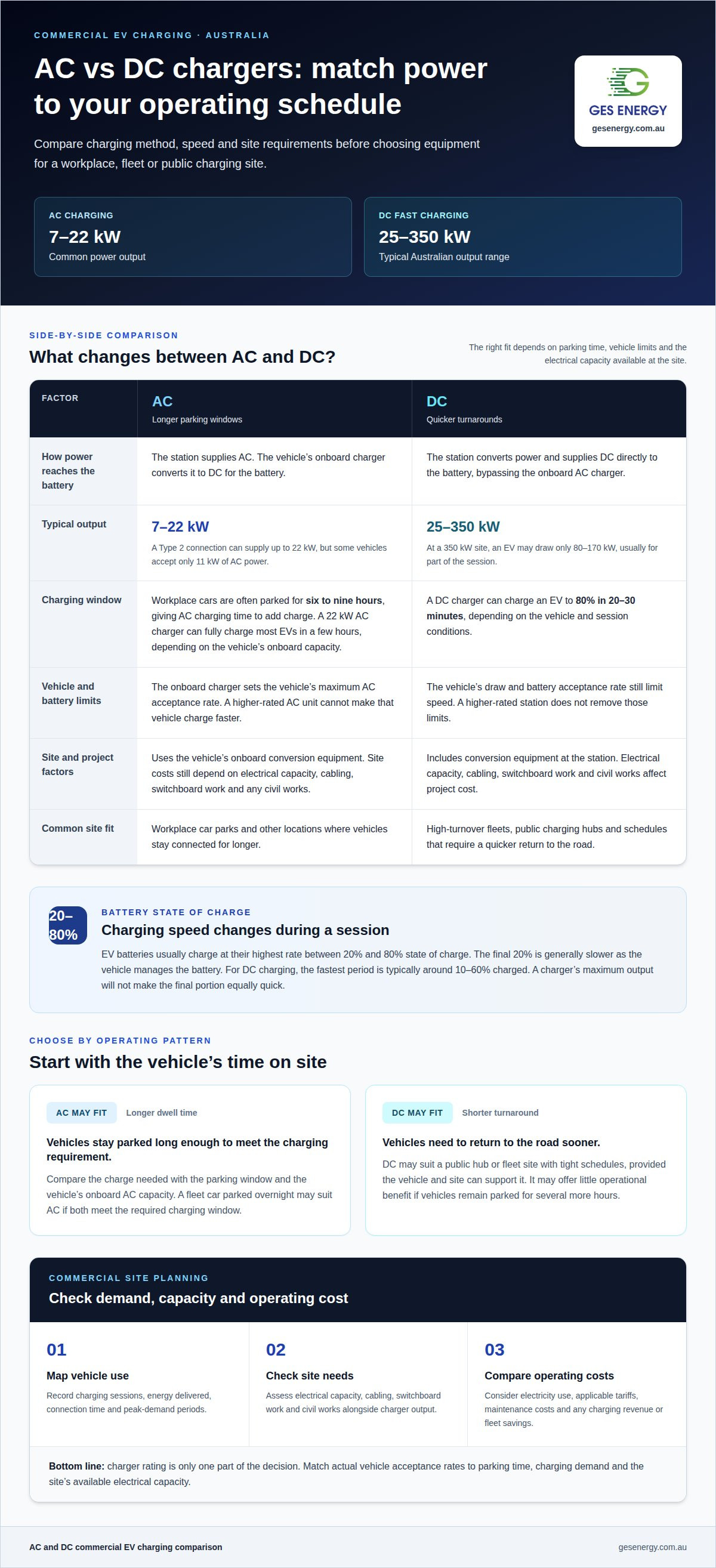
The fastest charger isn’t always the best fit for a business. Choosing an AC vs DC EV charger for commercial use depends on how long vehicles are parked and how quickly they need to return to the road: AC chargers commonly provide 7 to 22 kW, while Australian DC fast chargers typically provide 25 to 350 kW. AC charging uses the vehicle’s onboard charger to convert power for the battery; a DC charger performs that conversion externally and supplies power directly to the battery.
Charging speed matters when vehicles run to tight schedules, but charging patterns and site infrastructure matter just as much. A workplace car park may suit AC charging, while a high-turnover fleet or public charging hub may need DC fast charging. Across Victoria, from Melbourne and Geelong to Ballarat and Bendigo, vehicle schedules and site capacity shape the right setup.
This article explains how AC and DC charging work, compares their power outputs and charging speeds, and outlines the cost and infrastructure factors businesses should consider in Australia, including Victoria. You’ll see where each option fits, how the vehicle’s charging capacity affects real-world speed, and why the right solution depends on the site’s operating needs as well as the charger’s rated output.
Key Takeaways
- Understand why AC charging relies on the vehicle’s onboard charger, while DC charging converts power at the station.
- Match charging speed to how long vehicles are parked and when they need to be back on the road.
- Learn why a charger’s rated output does not always equal the speed an EV can accept.
- Assess how site electrical capacity and installation requirements shape the infrastructure decision.
- Compare the practical trade-offs of AC and DC before planning charging for a workplace, fleet or public site.
How AC and DC charging convert power for EV batteries
An electric vehicle battery stores energy as direct current (DC), so it must receive DC power. With AC charging, the vehicle’s onboard charger converts alternating current (AC) into DC. The charging station supplies AC, while the vehicle’s onboard equipment controls the conversion and limits the rate it can accept.
A DC fast charger converts power at the station and supplies DC directly to the battery. This bypasses the vehicle’s onboard AC charger, but not the vehicle’s own charging limits. The station’s rated output alone therefore does not determine how quickly an EV will charge.
Battery state of charge also affects charging rates. EV batteries usually charge at their highest rate between 20% and 80% state of charge. Charging the final 20% is generally slower, as the vehicle manages the battery during the later part of a session. A charger’s maximum output won’t make that final portion equally quick.
For commercial sites, there is no single purchase price for an AC or DC charger. Equipment output, electrical capacity, cabling, switchboard work and civil works all affect project cost. DC units include conversion equipment at the station, while AC units rely on the vehicle’s onboard charger. These differences shape equipment and infrastructure requirements.
Operating costs depend on electricity use, the applicable tariff and how often vehicles charge. Maintenance needs vary with charger design, operating conditions and usage. There is no universal lifespan for either type: component quality, exposure and charging demand all affect service life. A maintenance plan can help businesses track faults and keep equipment operating.
To estimate utilisation and return on investment, record charging sessions, energy delivered, connection time and peak-demand periods. Compare these figures with electricity charges, maintenance costs and any charging revenue or fleet savings. Pricing should reflect site costs and intended use. Utilisation data helps determine whether AC capacity or faster DC charging better fits demand.
Home battery settings matter when a business vehicle charges overnight at home. Set the EV charger or home battery app to prevent EV charging from drawing on the home battery before grid electricity. This can keep stored energy available for household use instead of directing it to the vehicle.
For example, a fleet car parked overnight may suit AC charging if its onboard charger and parking time meet the required charging window. A vehicle that needs a quick turnaround may benefit from DC charging, provided the site can support the equipment. Compare the vehicle’s charging limits, battery state and operating schedule before choosing.
AC and DC charging speeds
Charging speed depends on the vehicle, charger and available infrastructure. For commercial planning, compare vehicles’ actual acceptance rates with parking times, not just charger ratings.
Onboard Charger Limits
An onboard charger sets the maximum AC power an electric vehicle can accept. A Type 2 connection can supply up to 22 kW, but some vehicles accept only 11 kW of AC power. The vehicle may accept less still, depending on its onboard charger. This limit matters because a higher-rated AC unit cannot make that vehicle charge faster.
DC Charging and Vehicle Limits
DC charging speed is limited by what the vehicle can draw and how its battery accepts power. At a 350 kW charging site, an EV may draw only 80-170 kW, usually for part of the session. DC fast charging is typically fastest when the battery is roughly 10-60% charged. A higher-rated station won’t remove the vehicle’s limit.
Factors Affecting Charging Speed
Charging speed changes with the vehicle’s charging capacity, battery state of charge and the power available through the site infrastructure. Batteries usually charge fastest between 20% and 80%; the final 20% generally takes longer. For a business, those factors shape how much charge vehicles gain during each parking period.
Workplace parking can make AC a practical fit. Employees typically leave business cars parked for six to nine hours, giving an AC charger time to add charge while vehicles are unused. A 22 kW AC charger can fully charge most EVs in a few hours, although the vehicle’s onboard capacity affects the result. Match charger capacity to the vehicles using each bay.
DC can suit vehicles that need a quicker turnaround. A DC charger can charge an EV to 80% in 20-30 minutes, depending on the vehicle and session conditions. That speed may help at a public charging hub or a fleet site with tight schedules. It may offer little operational benefit where vehicles remain parked for several more hours.
Plan around actual arrival and departure patterns. Compare the charge vehicles need with their parking time, then check whether AC charging can meet that requirement. Where vehicles leave sooner, DC may better support the schedule. A charging station’s rated output is only one part of the decision.
For a commercial site, charging infrastructure planning can align charger selection with vehicle limits, parking windows and available electrical capacity.
AC vs DC: What are the differences for companies?
For workplaces, the key difference is how long vehicles can stay connected and how soon they need to leave. AC charging suits longer parking periods, while DC fast charging supports quicker turnarounds.
Commercial Charging Applications
Commercial charging includes workplace car parks, shopping centres, fleet depots and public charging locations. AC chargers suit sites where vehicles remain parked for hours, while DC charging can support high-turnover and time-sensitive fleet operations.
An office car park, for example, can provide AC charging during the workday. A logistics depot with vehicles returning between jobs may need faster charging. These use cases affect charger choice, parking arrangements and the electrical infrastructure required on site.
Choosing AC or DC for a Site
AC chargers generally suit offices, shopping centres and fleet parking areas where vehicles stay for extended periods. DC fast chargers can suit public hubs, highway locations and high-use fleets that need vehicles back on the road sooner.
Choose according to the site’s operating pattern, not charger speed alone. An office where cars are parked throughout the workday can make effective use of AC. A depot with short stops and high vehicle turnover may benefit from DC, if its electrical capacity can support it.
Installation Standards and Regulations
Commercial EV charger installations in Australia must account for applicable electrical standards, state or territory requirements and site network connection conditions. Requirements depend on the equipment and project design, so factor them into planning before installation.
Safety and access planning matter too. Route cables to avoid trip hazards, and arrange charging bays so people can move safely around vehicles and equipment. Consider vehicle impact exposure, maintenance access and how the site’s insurance arrangements cover installed charging equipment.
Treat grants, tax incentives and funding as project-specific inputs, not assumed savings. Program terms, eligibility and available support can differ by jurisdiction and business circumstances, so keep any funding estimate separate from core project costs.
AC charging can provide a practical fit where vehicles park overnight or through a workday. In Australia, workplace vehicles may remain parked for eight to ten hours overnight, which can give standard AC charging time to meet daily commute needs. A Type 2 connector is typical for AC, while CCS2 is typical for DC fast charging.
At mixed-use sites, allocate parking areas by dwell time and operational need. Staff bays may suit AC charging, while visitor or fleet bays with shorter stays may call for DC. The AC and DC decision is about more than speed: it affects charger allocation, site access and electrical infrastructure planning.
Assess safety, accessibility and insurance alongside charging needs. Include cable placement, bay layout, equipment protection and maintenance access in the site design. These details help reduce practical risks for drivers, pedestrians and site operators.
Typical AC and DC charger power outputs
Charger power ratings in Australia range from a standard power point to high-output public charging equipment. A rating helps compare supply capacity, but the vehicle’s own charging limit also affects how much power it receives.
EV Charging Levels and Power Ratings
Charging levels describe the power and equipment used to transfer electricity to an EV. In Australia, Level 1 charging from a standard 240 V power point supplies a maximum of 2.4 kW. It can suit long parking periods, but businesses with several vehicles need to consider whether that output matches their charging schedule.
AC chargers commonly provide 7 kW or 22 kW. A typical single-phase AC charger supplies 7 kW, while three-phase AC charging can range from 11 kW to 22 kW. A 22 kW rating does not mean every vehicle will draw 22 kW. Drivers’ vehicles may accept less through their onboard chargers.
Power Supply Requirements
The charger rating must fit the electricity supply available at the site. A standard 240 V power point supports Level 1 charging up to 2.4 kW, while higher-output AC equipment uses a compatible supply. Three-phase charging can support 11 kW to 22 kW, subject to the vehicle’s acceptance limit and site capacity.
For a business, the combined load matters as much as each charger’s rating. Several chargers drawing power simultaneously place different demands on site infrastructure than a single unit operating alone. The planned number of charging bays, session timing and available supply all inform system design.
DC chargers deliver power as DC directly to an EV battery, while AC units supply alternating current for conversion by the vehicle. Australian Level 3 DC chargers supply between 25 and 350 kW. This wider output range supports different commercial uses, from a lower-power site unit to higher-output public charging.
DC chargers over 100 kW are usually considered ultrafast in Australia. However, a charger’s rated output is not necessarily the power stored in a vehicle’s battery throughout a session. The vehicle may accept less than the station can provide, and charging rate can change as the battery fills.
When comparing AC and DC equipment, consider the rating alongside the power supply and vehicles using the site. For example, a 7 kW AC charger may fit a parking area where vehicles stay connected for longer, while higher-output DC equipment can serve public charging with faster turnover. The right rating depends on the site’s demand and available electrical capacity.
These figures describe charger output, not guaranteed vehicle charging speed. Compare each vehicle’s AC and DC acceptance limits with the planned equipment to avoid specifying power the fleet cannot use.
AC charging costs and infrastructure
Commercial AC charging can reduce infrastructure demands where vehicles stay parked for hours, but installation costs depend on the site. In Australia, a Level 1 charger uses a standard 240 V power point and supplies a maximum of 2.4 kW. Commercial AC equipment requires planning around its power rating, electrical supply and parking layout.
Installation and grid-upgrade costs depend on charger output, existing switchboard capacity, cable routes, trenching and the number of charging stations. If the site needs more electrical capacity, network connection work may also affect the project. Costs vary by Australian site, and pricing follows a site-specific quote.
Start by assessing available supply and expected charging demand. One AC charger operating during the workday places a different load on infrastructure than several units charging simultaneously. The number of bays, charger ratings and session schedule help determine whether existing electrical infrastructure can support the installation or needs changes.
AC charging stations supply alternating current, which the vehicle’s onboard charger converts to direct current for the battery. This means the vehicle’s onboard equipment affects the rate it accepts. A vehicle limited to 11 kW AC won’t draw the full output of a higher-rated charger. That limit matters when comparing equipment costs with the charging capacity a fleet can use.
DC fast charging converts power at the station and supplies direct current to the vehicle battery. Its higher output can support faster charging, but may require more substantial electrical infrastructure than AC. Assess available supply, equipment location, cable runs and any required switchboard or connection upgrades. These factors affect installation scope as well as charger choice.
Ongoing operating costs depend on electricity use, the site’s tariff and when charging takes place. Review charging sessions and energy consumption to understand demand. If the tariff varies by time, scheduling charging around applicable rates can affect costs, subject to fleet requirements and vehicle availability.
Solar generation can also inform the site’s energy plan. A commercial solar system may supply some charging demand when generation coincides with vehicle charging. The benefit depends on site load, solar output and charging schedules; it does not remove the need to assess grid capacity or each charger’s electrical requirements.
For a sound cost comparison, separate equipment, installation, electrical upgrades and ongoing electricity use. Compare those costs with expected utilisation and the value of charging access for staff, customers or fleet vehicles. This focuses the AC decision on usable charging capacity and site fit, not just purchase price.
There is no standard price for commercial AC or DC charging in Australia. Costs depend on charger output, site electrical capacity, installation requirements and necessary upgrades. Pricing is provided after a site-specific quote.
GES ENERGY: Commercial and Industrial Solar
GES ENERGY delivers Commercial and Industrial Solar and EV Charging Solutions for businesses planning workplace, fleet or public charging. If your site needs charging equipment and a clearer view of its energy supply, these services can help bring the project requirements together.
Choosing AC or DC is only one part of the design. Charger output, vehicle use, parking patterns and available electrical capacity all shape the required infrastructure. Commercial solar may also be relevant when daytime generation aligns with charging demand.
GES ENERGY helps businesses plan commercial solar and EV charging projects around their site and operational needs. Contact GES ENERGY to discuss your commercial charging requirements.
Plan for your next stage of fleet electrification
Charging needs may change as your fleet evolves. Treat charger selection as part of a wider site energy plan that accounts for vehicle operations, electrical capacity and how the premises uses energy. Choosing an AC vs DC EV charger for commercial use is one part of that plan, not a decision in isolation.
GES Energy offers EV Charging Solutions alongside Commercial and Industrial Solar and Off-Grid Solar. These services can suit businesses considering charging infrastructure alongside on-site generation or an off-grid energy system. The right project focus depends on your premises and operational requirements.
Start a conversation about the needs of your site and the charging direction you are considering. Contact GES ENERGY about EV charging to discuss a practical next step for your business.
Frequently Asked Questions
What Is AC Charging?
AC charging supplies an electric vehicle with alternating current from a charging station. The vehicle’s onboard equipment converts it into the direct current its battery stores. This matters in commercial planning because vehicles can have different onboard AC limits. Two fleet models connected to the same AC charger may accept different power, so the charger’s rating alone cannot predict each vehicle’s charging time.
Does AC vs DC affect battery health?
Both AC and DC charging can form part of normal EV use. Occasional DC fast charging is fine for most drivers, while frequent fast charging can increase heat and may contribute to faster battery degradation, depending on the vehicle and usage. For fleet planning, consider vehicle duty cycles and follow each manufacturer’s battery-care advice rather than assuming one charging method suits every battery.
Is DC always faster?
No. A 25 kW DC charger can be similar to, or only slightly faster than, an 11-22 kW AC charger, depending on the EV. The vehicle’s maximum charging rate is a key factor: a vehicle that accepts less power than the station supplies cannot use the station’s full output. Compare the vehicle’s charging capability with the charger rating before assessing likely turnaround.
Need Help Choosing the Right Setup?
GES Energy provides EV Charging Solutions for commercial projects. To develop a useful site plan, bring together your fleet’s vehicle models, typical arrival and departure patterns, parking arrangements and charging priorities. This information defines the project’s operating requirements. GES Energy can use it to shape a charging setup around your site, rather than treating charger output as the only selection factor.
What does AC and DC stand for?
AC stands for alternating current, where the direction of electrical flow changes repeatedly. DC means direct current, which flows in one direction. Australian electricity supplies AC, while an EV battery stores energy as DC. Charging equipment and the vehicle must therefore convert or deliver electricity in a form the battery can accept. These terms describe the electrical current, not connector type or charging speed.
What is the difference between AC and DC EV chargers for commercial use?
AC chargers send alternating current to the vehicle, where its onboard charger converts it for the battery. DC chargers convert power at the station and supply direct current to the vehicle. For commercial sites, AC can suit staff parking and longer stops; DC can suit locations that need quicker vehicle turnover. The best fit depends on how the site operates and which vehicles it serves.
How long does AC versus DC charging take for common EVs?
Charging time depends on the vehicle’s battery, charging limit and starting charge. A 7 kW single-phase AC charger adds about 40 km of driving range per hour; three-phase AC can add about 70-120 km per hour. DC charging can take an EV to 80% in 20-30 minutes, depending on the vehicle and station. These are guides, not fixed times for every model.
What electrical capacity, connectors and network requirements do commercial chargers need in Australia?
Requirements depend on charger output, the site’s available electrical supply and how many chargers may operate together. Type 2 is typical for AC charging in Australia, while CCS2 is typical for DC fast charging. A commercial design also considers switchboard capacity, cable routes and the site connection. If the chosen equipment uses networked management or reporting, its communications setup must suit the site.


