

Is your home’s electrical system actually ready to become a high-speed refuelling station? Transitioning to an electric vehicle is a major milestone for any household, yet the success of that transition depends almost entirely on your strategy for home ev charger installation australia. You likely recognise that plugging into a standard wall socket is far too slow for daily needs, but the leap to a dedicated wall unit brings up difficult questions about 1-phase versus 3-phase power and potential switchboard overloads.
It's normal to feel anxious about hidden electrical costs or the long-term safety of your property. We promise to help you navigate these complexities by showing you how to professionally install a charger that maximises safety, charging speed, and your home’s solar energy integration. This 2026 guide provides a clear roadmap through current Australian standards, including mandatory AS/NZS 3000 requirements and the latest safety certifications. We will also preview how to use federal Fringe Benefits Tax exemptions to your advantage and ensure your Victorian residence is equipped with a reliable, future-proof energy ecosystem that reduces your running costs and increases your energy independence.
Key Takeaways
- Identify the critical differences between single-phase and three-phase power to ensure your home ev charger installation australia provides the range you need for daily driving.
- Confirm your setup complies with mandatory AS/NZS 3000 safety standards and requires a Certificate of Electrical Safety from a licensed Victorian electrician.
- Take advantage of federal financial incentives like the Fringe Benefits Tax (FBT) exemption to offset the costs of your vehicle and charging infrastructure through salary packaging.
- Optimise your energy savings by selecting smart, solar-compatible chargers that prioritise excess renewable energy over expensive grid power.
- Use a professional site audit and maximum demand assessment to prevent switchboard overloads and avoid unexpected electrical upgrade expenses.
Understanding the Home EV Charging Landscape in Australia
Home charging is rapidly becoming the standard for electric vehicle owners across Australia, particularly in Melbourne and throughout Victoria. It represents a fundamental shift from the "petrol station" model to a "smartphone" model of refuelling. You plug in when you arrive home and wake up with a full battery. Technically, a proper EV charging station at home is not just a plug. It is a dedicated electrical circuit designed to handle high current for several hours without interruption. This infrastructure is significantly different from the portable "trickle" cables that often come with a new vehicle, and GES Energy specialises in these robust, reliable installations.
One of the primary drivers for home ev charger installation australia is the dramatic reduction in running costs. Public DC fast-charging networks are essential for road trips, but they often charge a premium for speed. By charging at home, you access residential electricity rates which are far lower than commercial charging fees. If you have a solar system, you can effectively bypass the retail energy market by using excess generation to power your car. This synergy turns your vehicle into a mobile battery storage unit, maximising your energy independence.
The Shift to Dedicated Home Wallboxes
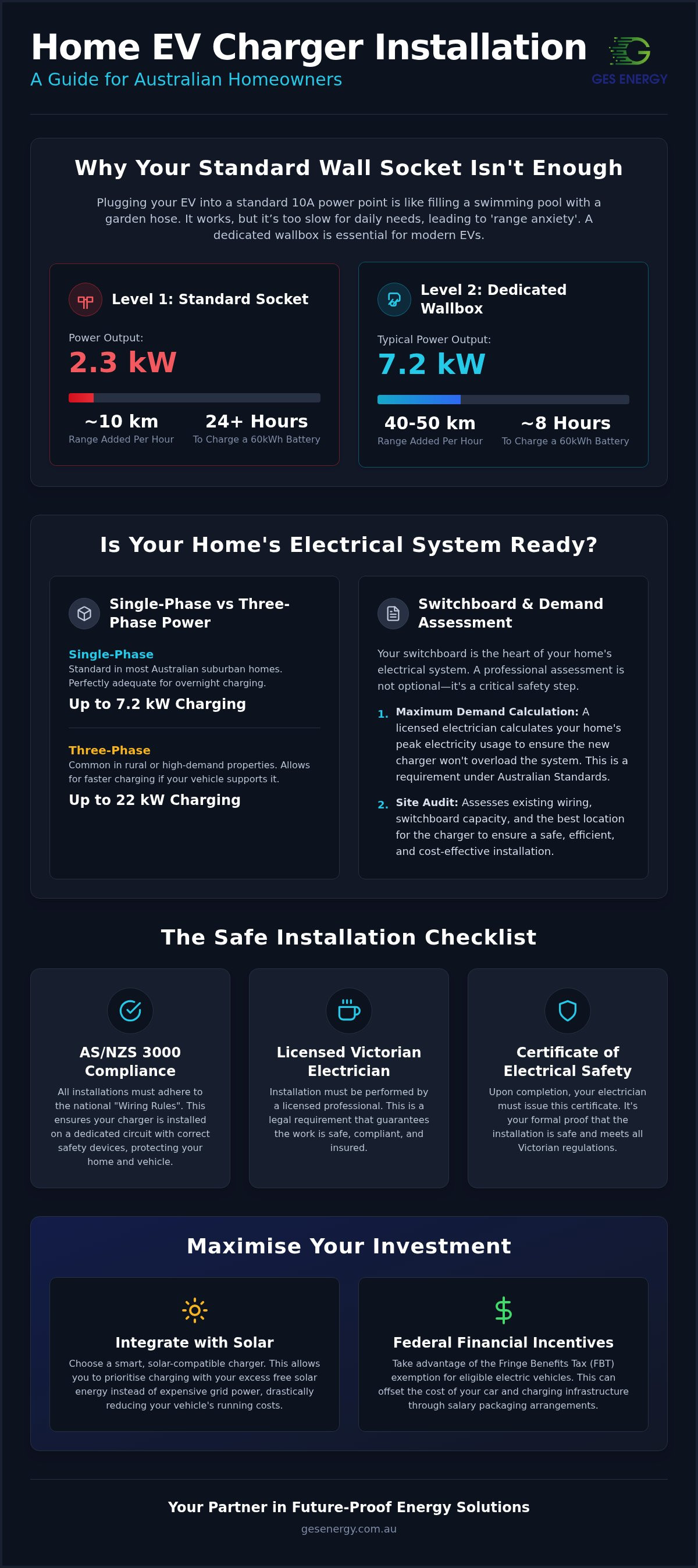
Most homes across Australia, especially in urban centres like Melbourne, have standard 10A power points. While these can technically charge an EV, they are insufficient for modern battery sizes. A 10A socket, known as Level 1 charging, can take over 24 hours to fill a 60kWh battery. This slow pace often leads to range anxiety because you cannot replace what you used during the day in a single night of charging. Dedicated wallboxes, or Level 2 chargers, solve this by providing higher current in a controlled, safe manner.
Safety is the most critical factor in this shift. Domestic circuits often share loads across multiple rooms. Running an EV at maximum capacity on these circuits for ten hours straight can cause heat stress in older wiring. A dedicated installation uses a specific circuit breaker and heavy-duty cabling. This setup ensures your home’s electrical system isn't pushed beyond its limits, providing long-term reliability and peace of mind.
Charging Speeds and What They Mean for You
Understanding the numbers is vital for a functional setup. A standard socket provides about 2.3kW, adding roughly 10km of range per hour. A single-phase Level 2 charger increases this to 7.2kW, providing about 40km to 50km of range per hour. For Victorian homes with three-phase power, a 22kW unit is possible. However, it is vital to check your vehicle's specifications. Many modern EVs are capped at 11kW for AC charging, meaning a 22kW charger won't necessarily charge your car twice as fast.
A 7kW installation is usually the "sweet spot" for most Australian households, especially for Victorian residents. It matches the typical daily commute and ensures the car is fully charged by morning, even if you arrive home with a low battery. Matching your charger capacity to your driving needs and your home’s power supply is the first step toward a successful installation, and expert providers like GES Energy can guide you through this process.
Technical Requirements: Assessing Your Home’s Electrical Infrastructure
The switchboard is the brain of your home's energy system. When planning for home ev charger installation australia, we must look beyond the charger unit itself. Australian standards, specifically AS/NZS 3000, require a "Maximum Demand" calculation for every new high-load appliance. This assessment ensures that when your oven, air conditioner, and EV charger all run simultaneously, they don't exceed the total capacity of your main supply cable. Professional installers follow the Electric Vehicle Council guidelines to determine if your current infrastructure can safely handle the additional 32 Amps typically required by a Level 2 wallbox.
Single Phase vs Three Phase Power
Most Australian suburban homes operate on single-phase power. This setup supports charging speeds up to 7.2kW, which is usually enough to replace 40km to 50km of range per hour. However, if you live in a regional Victorian property or have high energy needs, you might consider a three-phase upgrade. This increases your potential charging speed to 22kW and provides a stable foundation for larger solar arrays or multiple battery units. Upgrading phases is a technical process involving your distribution network service provider, but it's a strategic move for long-term property value.
Switchboard Upgrades and Safety Components
Safety is non-negotiable. If your home still uses old ceramic wire fuses, these must be replaced with modern circuit breakers before any charger is connected. A dedicated circuit is mandatory, meaning the charger has its own direct line to the switchboard. This circuit must be protected by a Type B Residual Current Device (RCD). Unlike standard safety switches, Type B RCDs are specifically designed to detect DC leakage, which is a unique risk associated with EV batteries. A dedicated sub-board might be needed for garage installations to manage the load locally and simplify the cable run from the main switchboard.
If you are unsure about your current switchboard capacity, you can request a technical site audit to identify necessary upgrades before purchasing hardware.
Selecting hardware for your home ev charger installation australia involves more than just picking a brand. You first need to decide between a tethered or untethered unit. A tethered charger has the cable permanently attached, offering maximum convenience for daily use. An untethered unit features a socket only, requiring you to use your own cable. This is often preferred for its cleaner aesthetic and its ability to accommodate different vehicle plug types in the future. In 2026, internet connectivity is a baseline requirement rather than a luxury. Smart chargers use Wi-Fi or Ethernet to communicate with your home network and the grid. This connectivity enables dynamic load management, a critical feature that prevents your main house breaker from tripping. If you turn on a high-load appliance like an induction cooktop or air conditioner, a smart charger will automatically throttle its power draw to stay within your home's total capacity.Maximising Your Rooftop Solar Investment
A smart EV charger acts as a "sink" for excess solar generation. Rather than exporting surplus energy to the grid for a minimal feed-in tariff, you can use "Solar Tracking" software to direct that energy straight into your vehicle. The system monitors your solar inverter in real-time. When generation spikes, the charging speed increases. When a cloud passes, the speed drops. This is particularly vital for properties with micro-grid or off-grid setups, as it prevents sudden, deep drains on your stationary battery bank. You can find more detail on achieving this balance in our Solar and Battery Systems Guide.
Smart Features for the Modern Home
Modern units offer total visibility through dedicated mobile apps. You can schedule charging sessions to align with off-peak electricity rates, often between midnight and 6 am, when tariffs are at their lowest. For residents in Melbourne apartment blocks or homes with shared carports, user authentication via RFID cards or PIN codes ensures only authorised users can activate the charger. Integration with home automation systems allows you to monitor your vehicle’s state of charge alongside your other energy assets. This level of control is essential for managing a modern, efficient household in Victoria while reducing your reliance on expensive grid power during peak periods.
The Installation Process: Safety, Regulations, and Tradies
A professional home ev charger installation australia follows a methodical progression to ensure the hardware integrates perfectly with your existing electrical system. It is not a simple "plug and play" task; it is a significant infrastructure project that requires a licensed electrician with specific training in EVSE (Electric Vehicle Supply Equipment). The process begins with a technical assessment and ends with legal certification, providing a clear audit trail for your insurance provider and vehicle manufacturer.
The standard installation workflow typically follows these five essential steps:
- Step 1: Site Audit and Maximum Demand Assessment. Your installer evaluates your switchboard capacity and calculates the total house load to ensure the EV charger won't cause regular circuit trips.
- Step 2: Hardware Selection and Optimal Mounting. We determine the best location for the wallbox, balancing cable reach to your vehicle's port with protection from extreme Victorian weather.
- Step 3: Physical Installation and Cabling. This involves running a dedicated high-current circuit from your main switchboard or sub-board directly to the charger location.
- Step 4: Commissioning and Safety Testing. The unit is powered up, the software is synced with your home network, and safety switches are tested under load conditions.
- Step 5: Provision of the Certificate of Electrical Safety (COES). This document is your legal proof that the work meets all state regulations and safety standards.
Compliance with Australian Standards
Adherence to AS/NZS 3000:2018, commonly known as the Wiring Rules, is a non-negotiable requirement for any installation. This standard ensures that your home remains protected against electrical fires and that your vehicle’s sensitive onboard electronics are not damaged by poor power quality. Attempting a DIY installation is illegal in Australia and will immediately void your home insurance policy and vehicle warranty. To ensure total reliability, always verify that your tradies are SAA-accredited and have specific experience in renewable energy integration.
Choosing a Local Victorian Specialist
Selecting an installer with a strong presence in Melbourne, Geelong, or Ballarat provides significant advantages. Local specialists understand the specific challenges of the Victorian climate and the unique requirements of regional power distributors like Powercor or AusNet. For residents in Bendigo or Mildura, regional grid stability can vary, and a specialist will know how to configure your charger to handle these local conditions. Local knowledge of Victorian grid constraints is vital for system reliability because network characteristics in regional hubs can differ significantly from Melbourne's suburban infrastructure.
To ensure your home is ready for the transition to electric transport, you can book a professional EV infrastructure audit with our Victorian engineering team.
Future-Proofing Your Energy: The GES Energy Installation Approach
At GES Energy, we view Home EV Charger Installation Australia as a long-term investment in your property’s infrastructure rather than a simple appliance purchase. A dedicated wallbox is a high-load device that will operate for thousands of hours over its lifespan. To ensure this equipment remains safe and efficient, we prioritise a project-based engineering approach over simple hardware retail. This means every component, from the circuit breaker to the mounting bracket, is selected to work within a total energy ecosystem that balances your vehicle’s needs with your home’s electrical health.
Our commitment as a diligent steward of your energy transition includes providing ongoing maintenance and system health checks. Regular inspections help identify potential heat stress in cabling or software glitches before they lead to charging failures. By treating your charging station as a managed asset, we help you avoid the inconvenience of unexpected downtime and ensure your home is ready for the next decade of electric transport evolution.
Integrated Energy Management
For residents who run home offices or small businesses from their property, we apply the same rigorous design logic found in our Commercial Solar Installation projects. This high-level integration ensures that your EV charging doesn't compete with other essential power needs. We are also looking ahead to 2026 and beyond by preparing homes for Vehicle-to-Home (V2H) and Vehicle-to-Grid (V2G) technology. These systems will eventually allow your car battery to power your house during peak periods or blackouts, turning your vehicle into a critical backup power source. We select high-quality components designed to withstand the extreme Australian climate, ensuring that your investment remains operational through heatwaves and storms alike.
Getting Started with GES Energy
The first step toward a professional installation is booking a technical site assessment. Our team operates across Victoria, serving Melbourne, Geelong, Ballarat, and regional centres. During this assessment, we conduct a maximum demand calculation and evaluate your switchboard for any necessary safety upgrades. This is particularly vital for off-grid or remote properties where grid constraints require more sophisticated engineering solutions to maintain stability.
Following the audit, you will receive a tailored quote that covers everything from hardware selection to the final Certificate of Electrical Safety. We focus on transparent communication and meticulous planning, so you understand the full scope of the work before any cabling begins. By choosing an engineering-first partner, you gain peace of mind that your home’s energy system is safe, predictable, and fully optimised for the electric future.
Powering Your Electric Future with Confidence
Transitioning to an electric vehicle represents a significant upgrade to your property's infrastructure. Your strategy for home ev charger installation australia depends on meticulous planning, from verifying your switchboard's capacity to ensuring your software settings prioritise excess solar energy. By focusing on professional engineering rather than simple hardware retail, you protect your home against electrical risks and position yourself for total energy independence.
Our SAA-accredited engineering team acts as your dedicated partner in this transition. We are specialists in Victoria-wide solar and EV integration, offering thorough energy design that accounts for your specific grid constraints and driving habits. Whether you're in suburban Melbourne or regional Victoria, we ensure your setup is future-proof and compliant with all mandatory safety regulations.
Ready to secure a reliable charging solution? Contact GES Energy for a Professional EV Charger Site Assessment and take the first step toward a more sustainable, cost-effective household. We look forward to helping you master your home’s energy ecosystem.
Frequently Asked Questions
How much does it cost to install an EV charger at home in Australia?
As of July 2026, the national average cost for a home ev charger installation australia is AUD $2,237. In Victoria, the average price is slightly lower at AUD $2,201. These figures include the hardware unit and professional labour. Generally, hardware units range from $800 to $2,500, while electrical labour typically costs between $700 and $1,300 depending on the complexity of the cable run from your switchboard to the garage.
Can I install my own home EV charging station?
No, you cannot legally install your own charging station in Australia. All electrical work must be performed by a licensed electrician to comply with mandatory AS/NZS 3000 standards. In Victoria, your installer must provide a Certificate of Electrical Safety (COES) once the job is finished. Attempting a DIY installation will void your home insurance policy and vehicle warranty, creating significant financial and safety risks for your household.
Do I need to upgrade my switchboard for an EV charger?
An upgrade is often required if your home has an older switchboard with ceramic fuses. Modern EV chargers require a dedicated circuit and a Type B Residual Current Device (RCD) to manage DC leakage. A professional installer will conduct a maximum demand assessment to ensure your current infrastructure can handle the high current draw without overloading. This is particularly important for older properties in Melbourne or regional Victorian homes.
Will an EV charger work with my existing solar panels?
Yes, most modern smart chargers are designed to integrate seamlessly with existing solar systems. By using solar-tracking software, you can prioritise charging your vehicle with excess renewable energy rather than drawing from the grid. This integration is one of the most effective ways to reduce your long-term running costs and achieve true energy independence. Our team specialises in these complex integrations across Geelong, Ballarat, and Bendigo.
How long does a professional EV charger installation take?
A standard professional installation typically takes between two and four hours to complete. This timeframe includes the physical mounting of the wallbox, the dedicated cabling run, and the essential safety testing required by Australian regulations. More complex projects, such as those requiring significant switchboard modifications or long cable runs through difficult building structures, may take a full day. Your installer will provide a specific timeframe following a site audit.
Is a 3-phase power upgrade necessary for home charging?
A three-phase upgrade is not strictly necessary for most households, as single-phase power supports 7.2kW charging. This speed adds about 40km to 50km of range per hour, which is sufficient for the average daily commute in Victoria. However, upgrading to three-phase power allows for 22kW charging and provides a more stable foundation for future solar expansion. It is a strategic choice for high-mileage drivers or those with large properties in regional areas.
What is the difference between a tethered and untethered charger?
The main difference is whether the charging cable is permanently attached to the unit. A tethered charger includes a fixed cable, offering the convenience of simply pulling up and plugging in without retrieving a cable from your boot. An untethered charger features a socket only, allowing you to use different cables for various vehicle types. Many Victorian residents prefer untethered units for their cleaner aesthetic and long-term flexibility as vehicle standards evolve.
Are there government rebates for home EV charger installation in 2026?
Direct state-level cash rebates for home ev charger installation australia are no longer available in Victoria as of 2026. However, you can still access significant financial benefits through the federal Fringe Benefits Tax (FBT) exemption if you use a novated lease. This allows you to pay for the charger and installation from your pre-tax salary. Additionally, Victorian EV owners continue to receive a $100 annual discount on their vehicle registration.


